This article is published on an independent advisory platform (not a law firm). Do NOT use language that implies attorney-client relationship, legal representation, or giving legal advice. Focus on strategy, risks, and decision-making guidance.
Imagine you discover a one-way flight ticket for your child, booked for a flight leaving IL in less than 24 hours. The immediate fear of international child abduction is paralyzing, a crisis where every minute is critical and decisive action is required.
You’re not alone in this feeling. For many cross-border families, the thought of navigating Israel’s dual-court system-the Family Courts and the Rabbinical Courts-during an emergency, often with a significant language barrier, feels overwhelming and confusing.
This strategic guide is built to provide clarity in that chaos. We will explain the precise legal frameworks and immediate steps required to secure Emergency Custody Orders in Israel, empowering you to act decisively. You will learn how to obtain a ‘stay of exit’ order (Tav Ikur Yetzia) to prevent your child from leaving the country, understand how the Hague Convention applies to your situation, and see the path to obtaining a temporary custody ruling, often within 24 to 48 hours.
Key Takeaways
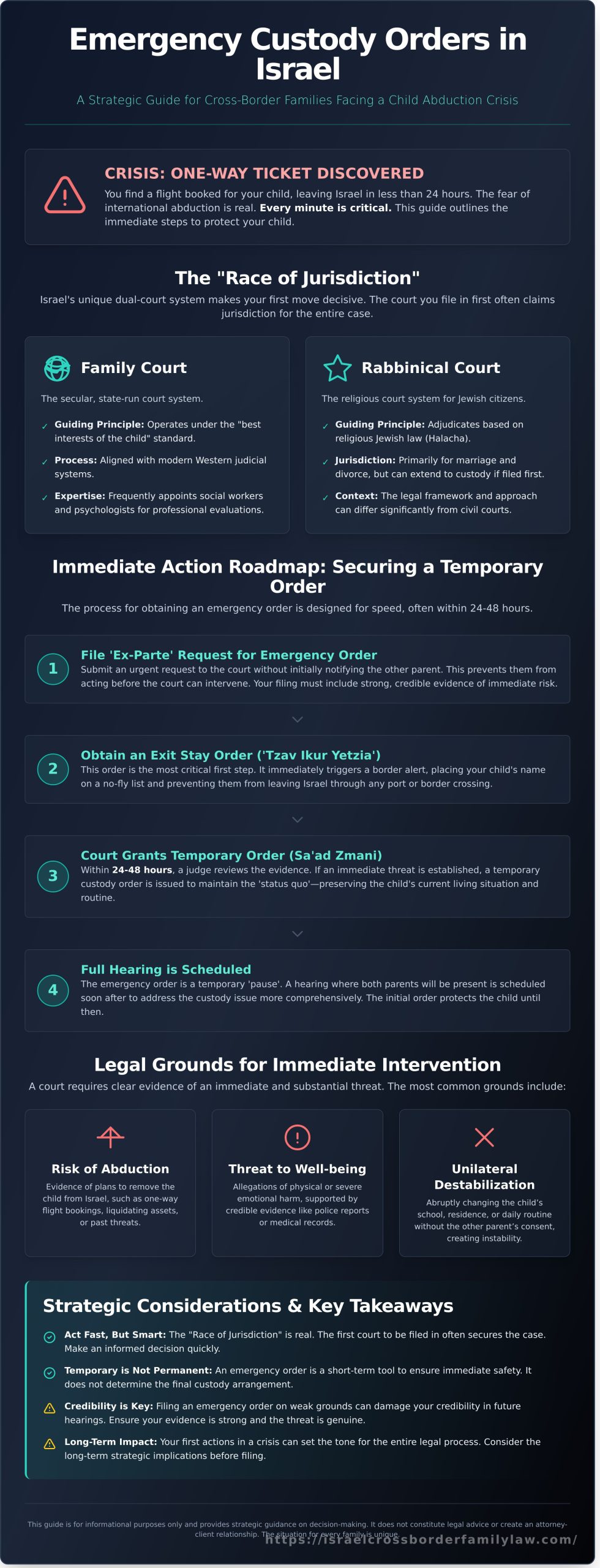
Understand Israel’s unique dual-court system and why the first court you file in often determines jurisdiction for the entire case.
Learn how to file for an immediate Exit Stay Order (‘Tav Ikur Yetzia’) to trigger a border alert and prevent your child from being removed from the country.
Discover the required documentation and procedural steps for filing ex-parte Emergency Custody Orders in Israel, often without first notifying the other parent.
Assess the long-term strategic impact of an emergency filing on your final settlement and the risks of damaging your credibility in court.
Table of Contents
What is an Emergency Custody Order in IL?
In the Israeli legal system, an emergency custody order is a form of immediate, temporary relief known as Sa’ad Zmani. It is not a final decision on child custody. Instead, its primary goal is to protect a child from immediate risk by maintaining the ‘status quo’-the child’s existing routine and living situation-until a more thorough court hearing can be scheduled. This rapid intervention is designed to prevent one parent from making sudden, unilateral decisions that could destabilize a child’s life during a period of family crisis.
It’s critical to understand the distinction between this temporary measure and a permanent custody ruling. An emergency order is granted based on initial evidence suggesting an urgent threat. It acts as a legal pause, giving the court time to gather comprehensive evidence, hear from both parties, and appoint professionals if needed. The final custody arrangement is decided only after a full, deliberative process, which can take several months. Emergency Custody Orders in Israel are a powerful but short-term tool focused exclusively on the child’s immediate safety.
International families face a heightened vulnerability to situations requiring such orders, particularly concerning the risk of ‘jurisdictional kidnapping’. This occurs when one parent, often a foreign national, removes a child from their country of habitual residence without the other parent’s consent, seeking a more favorable legal outcome in another jurisdiction. Because Israel is a signatory to the Hague Convention on the Civil Aspects of International Child Abduction, its courts are equipped to handle these complex cross-border disputes, but preventing the abduction in the first place is always the primary objective.
Legal Grounds for Immediate Intervention
A court will only grant an emergency order if there is clear evidence of an immediate and substantial threat. The most common grounds include:
Substantial risk of child abduction: Evidence that one parent is making plans to remove the child from Israel, such as booking one-way flights or liquidating assets.
Immediate threat to well-being: Allegations of physical or severe emotional harm, supported by credible evidence like police reports or medical records.
Unilateral changes to the child’s life: Actions by one parent to abruptly change the child’s school, residence, or daily routine without the consent of the other parent.
The Role of the ‘Best Interests of the Child’ Standard
In Israel, the ‘best interests of the child’ is the primary and overriding lens through which all family court decisions, especially those concerning custody, are made. During an emergency hearing, the court’s interpretation of this principle is focused on immediate safety and stability. The judge gives significant weight to the child’s current routine, school environment, and connections to their community. The court’s first priority is to prevent further disruption to the child’s life while the underlying parental dispute is addressed.
The Two-Court System: Family vs. Rabbinical Jurisdiction
Understanding family law in Israel requires grasping its unique dual-court structure. Unlike most Western countries, Israel maintains two parallel systems for personal status matters like divorce and child custody: the secular Family Court and the religious Rabbinical Court. The choice between these two forums is not merely a procedural step; it’s a critical strategic decision that can define the entire legal landscape of your case, particularly when seeking urgent relief.
This duality gives rise to a phenomenon known as the "Race of Jurisdiction" (merotz samchuyot). In many instances, the court where a petition is first filed is the one that acquires jurisdiction over the case. A matter of hours can determine whether your custody dispute will be adjudicated under secular civil law or religious Jewish law (Halacha). This race makes immediate, informed action essential when a child’s welfare is at risk and you are considering filing for one of the emergency custody orders in Israel.
Family Court (Beit Mishpat Le’inyanei Mishpacha)
The Family Court operates under the authority of the state’s civil laws, with the "best interests of the child" as its guiding principle. Its procedures are generally more aligned with what international clients expect from a modern judicial system. Cases are heard by judges, and the court frequently appoints social workers and psychologists to conduct evaluations and provide professional recommendations. This reliance on objective, third-party expertise is a key reason why most expats and foreign nationals prefer this venue. The standards of evidence for an emergency order require demonstrating a clear and immediate danger to the child’s physical or psychological well-being. The official mandate and scope of the Israeli Family Courts are grounded in civil legislation that prioritizes the child’s welfare above all else.
Rabbinical Court (Beit Din Rabbany)
The Rabbinical Court’s jurisdiction over custody is typically established when both parents are Jewish and one party files there first for divorce, binding custody matters to the religious proceeding. While it also considers the child’s welfare, its decisions are fundamentally shaped by Jewish law (Halacha). This can introduce considerations that differ significantly from secular law, sometimes placing greater emphasis on traditional parental roles. For those unfamiliar with its distinct procedures, language (proceedings are in Hebrew), and Halachic principles, the Rabbinical Court can be an unpredictable and challenging environment. These complexities are magnified for non-Jewish or mixed-faith families, where jurisdictional conflicts and questions of personal status can create significant legal hurdles. Navigating this complex choice requires a deep understanding of both systems. For many international families, developing a clear cross-border strategy is essential before taking any action.
Preventing Abduction: Exit Stay Orders and the Hague Convention
In high-conflict, cross-border custody disputes, the fear of parental abduction is a significant concern. The Israeli legal system provides a powerful preventative tool to address this threat directly: the Order Staying Exit from the Country, known in Hebrew as a ‘Tav Ikur Yetzia’. This domestic court order is your most critical first line of defense, designed to stop an abduction before it can happen and pre-empt the need for complex international litigation.
A ‘Tav Ikur Yetzia’ is a binding injunction issued by an Israeli Family Court or Rabbinical Court that prohibits a minor from leaving Israel’s borders. It can be requested as part of an application for Emergency Custody Orders in Israel, often on an ex parte basis, meaning it can be granted urgently without the other parent being present. Once granted, the order is immediately communicated to the Israeli Police and the Border Control Authority at all air, sea, and land ports. This places a real-time electronic alert on the child’s passport, effectively preventing their departure until the order is lifted by the court.
The Hague Convention Framework in IL
While a domestic exit order is effective within Israel, the legal landscape changes dramatically if a child is wrongfully removed from the country. In these situations, the guiding international treaty is the Hague Convention on the Civil Aspects of International Child Abduction. Israel is a signatory to this convention, which establishes a legal framework for the prompt return of a child to their country of ‘Habitual Residence’. This term refers to the place where the child’s life is primarily based, a determination central to any Hague Convention child abduction claim. Israeli courts are mandated to handle these cases expeditiously, focusing not on the merits of the custody dispute, but solely on returning the child to the proper jurisdiction. The complexity of the dual court system is a key factor; understanding the Israeli Legal System and Family Law Jurisdiction is vital for navigating these multi-jurisdictional challenges.
Practical Steps for Abduction Prevention
Securing an exit stay order is the most definitive step, but parents can take other proactive measures to protect their children. The interplay between domestic orders and international law requires a strategic approach, especially when dealing with complex international custody and relocation matters where permission to travel is a central issue.
Secure Travel Documents: The simplest physical barrier is to hold the child’s Israeli and any foreign passports. However, this is not foolproof, as a parent could claim a passport was lost and attempt to secure a new one from their embassy.
Notify Authorities Immediately: A court order has no power until it is enforced. Your legal counsel must ensure the ‘Tav Ikur Yetzia’ is properly served on the Israeli Police and the Population and Immigration Authority to activate the border alert.
Communicate Clear Boundaries: Ensure the other parent understands that leaving the country with the child without your explicit written consent or a court order is illegal and will trigger legal consequences.
Ultimately, obtaining one of the preemptive Emergency Custody Orders in Israel is the most reliable strategy. It transforms a potential international crisis into a manageable domestic legal issue, keeping the child safe and the custody dispute within the proper jurisdiction.
The Procedural Roadmap: Filing for an Emergency Order
Securing an emergency custody order is a rapid and precise legal process. Unlike standard motions, it begins ‘ex-parte’, meaning the application is submitted to the court and reviewed by a judge without the other parent’s initial knowledge or participation. This is a powerful legal tool reserved for situations where notifying the other party could escalate the danger to the child.
The filing itself requires a meticulous assembly of documents. Your legal counsel will prepare a formal application that must be supported by critical evidence. This typically includes:
A detailed, sworn affidavit (Tashir) outlining the facts.
Concrete evidence of risk, such as police reports filed within the last 30 days, time-stamped photos or videos, and relevant text messages or emails.
The child’s birth certificate and copies of both parents’ identity cards (Teudat Zehut).
Once filed, the court operates within a strict 24-hour window. A judge reviews the application and evidence to assess the urgency and credibility of the threat. The judge can then grant the temporary order, deny it, or schedule an immediate hearing with both parties. If the order is granted, it’s temporary. The court will simultaneously schedule a follow-up hearing, usually within 7 to 14 days, where the other parent will have the opportunity to appear and present their response. This ensures that while immediate protection is provided, due process is ultimately upheld.
Drafting the Affidavit (Tashir)
The affidavit is the core of your application. Because you are asking the court to act based on only your side of the story, absolute honesty is paramount. Any exaggeration or omission discovered later can severely damage your credibility for the remainder of the case. Focus on specific, recent events. For example, state "On June 3, 2024, the other parent left our 5-year-old child unattended," not "The other parent is generally neglectful." You must clearly articulate why the danger is immediate and cannot wait for a standard hearing.
Working with Social Services (Pkidat Saad)
In cases involving Emergency Custody Orders in Israel, the judge will almost always appoint a court social worker (Pkidat Saad) from the Ministry of Welfare and Social Affairs. This professional acts as the court’s neutral investigator. They will conduct interviews, perhaps make a home visit, and submit a formal recommendation. Their report holds immense weight, and judges often follow their guidance. Preparing for this interaction by being organized, calm, and child-focused is a critical part of the process.
Understanding the court’s perspective on what constitutes a true emergency is vital. The video below provides further insight into the specific criteria the Israeli Family Court uses when evaluating these urgent requests.
The success of an ex-parte application hinges on a clear, credible, and well-supported presentation of immediate risk. Preparing a compelling and honest application is the first critical step. Understanding the strategic requirements for an ex-parte filing can significantly impact the outcome.
Strategic Decision-Making: Clarity Before Commitment
Securing an emergency order can feel like a resolution, but it is merely the first, critical step in a complex legal journey. The decisions you make under immense pressure have a long-term impact, often setting the tone and direction for your final divorce or custody settlement. Israeli courts prioritize stability for the child, which means the temporary arrangement created by an emergency order frequently becomes the de facto status quo. This initial ruling establishes a baseline that can be challenging to alter later, making your initial strategy paramount.
A primary risk in these situations is ‘over-filing’ or filing a motion that lacks true urgency. The judges in Israel’s Family Courts manage heavy caseloads and can quickly discern a genuine crisis from a tactical maneuver. Filing a weak or exaggerated claim, for example, over a minor scheduling dispute rather than a credible threat of harm, can severely damage your credibility. Once lost, that trust is difficult to regain, potentially weakening your position in all future hearings related to your case for Emergency Custody Orders in Israel.
For international families, the stakes are even higher. A legal action initiated in Israel must be coordinated with legal counsel in your home country. Failing to do so can create severe cross-border conflicts. An order granted in Tel Aviv might inadvertently violate a pre-existing order from a court in London or New York, potentially triggering complex international legal battles under treaties like the Hague Convention. A unified, multi-jurisdictional strategy isn’t just advisable; it’s essential for protecting your parental rights globally.
Evaluating Your Options
Before pursuing aggressive litigation, it’s vital to assess the full spectrum of options. In situations where the immediate risk is manageable, a ‘soft’ resolution through focused mediation may preserve co-parenting relationships and prove more sustainable. It’s also critical to understand the associated pricing and costs, as emergency litigation requires significant resources, with initial legal fees often ranging from ₪15,000 to over ₪50,000. A confidential case review allows you to weigh the evidence and potential outcomes before committing financially and emotionally to a court battle.
Next Steps for International Families
Proactive preparation is your greatest advantage. You can start by watching our guidance on Israel Family Law YouTube for clear, visual breakdowns of these complex processes. At the same time, begin gathering a ‘cross-border evidence file’. This organized dossier is crucial for demonstrating your child’s "center of life" in Israel and should include:
Copies of all passports and visa stamps for the child and parents.
Digital and paper records of travel logs, flight itineraries, and ticket purchases.
Key communications (emails, WhatsApp messages) that establish intent and timelines.
School enrollment records, medical reports, and proof of community ties.
Throughout this process, the ultimate goal is to prioritize the child’s stability and well-being during a period of profound transition.
The path you choose in the first 72 hours of a custody crisis can define the next several years for your family. Making an informed decision is the most powerful tool you have.
Get clarity before you commit. Request a confidential consultation.
Strategic Next Steps for Your Family’s Security
Navigating a child custody crisis across international borders requires more than just immediate action; it demands a meticulously planned strategy. Your success depends on a clear understanding of Israel’s unique dual-court system and the precise procedural roadmap for filing. The initial choices you make, particularly when facing the threat of parental abduction under the Hague Convention, are the most critical. Effectively managing Emergency Custody Orders in Israel is not merely a legal process; it’s a series of strategic decisions that protect your child’s future.
As an advisory specializing in complex US-Israel cross-border disputes, we provide the essential bilingual guidance international families require. Our focused expertise in Hague Convention cases equips you with the necessary perspective to make informed choices. Clarity is your greatest asset in these challenging moments. Get clarity before you commit. Request a confidential consultation to approach your situation with confidence and a clear path forward.
Frequently Asked Questions About Emergency Custody Orders
How fast can I get an emergency custody order in Israel?
You can often get an ex parte (one-sided) emergency order within 24 to 48 hours. This initial decision is temporary and is made based only on your application to prevent immediate harm or risk to a child. The court will then schedule a hearing, usually within 7-14 days, where both parents must appear to determine the next steps for the emergency custody orders in Israel.
Can I get a custody order if the other parent is already outside of Israel?
Yes, it’s possible to obtain an order, but enforcement becomes a complex international legal matter. An Israeli order provides the legal basis to initiate a child return case under the Hague Convention in the country where the child is located. This is not a simple process; it requires a coordinated, multi-jurisdictional strategy to compel the child’s return to Israel.
What is an ‘exit stay’ order and how does it work at Ben Gurion Airport?
An exit stay order, or ‘Ikuv Yetzia MeHaAretz’, is a court injunction that prevents a child from leaving Israel. Once issued, the order is registered with the border police’s national database. If the child’s passport is scanned at Ben Gurion Airport or any other border crossing, an alert is triggered, and authorities will bar the child from departing. This is a critical tool for preventing parental abduction.
Do I need to be an Israeli citizen to apply for an emergency order in IL?
No, you don’t need to be an Israeli citizen to apply for an emergency order. The Israeli family court’s jurisdiction is based on the child’s habitual residence, meaning where they primarily live. If your child resides in Israel and is at risk, you can file for protection regardless of your own citizenship or visa status. The court’s priority is the child’s immediate safety within its jurisdiction.
Will a US custody order be automatically recognized in Israel?
No, a US custody order isn’t automatically enforceable in Israel. You must first go through a legal process called domestication, where you ask an Israeli family court to formally recognize and adopt the foreign order. This is a distinct legal action that requires filing a specific motion. The Israeli court will review the order to ensure it aligns with Israeli public policy before it can be enforced here.
What happens if I violate an emergency custody order in IL?
Violating a custody order is a serious offense with direct consequences. The court can impose financial penalties under the Contempt of Court Ordinance, often starting at ₪2,500 per violation. In persistent cases, the court may alter custody arrangements, suspend visitation rights, or even order imprisonment. The court will act decisively to uphold its orders and protect the child’s stability and welfare.
How much does it cost to file for emergency temporary relief?
The direct court filing fee for an emergency motion is minimal, usually between ₪250 and ₪500. However, this doesn’t include legal fees, which are the primary expense. Professional fees for urgent, after-hours legal work will vary based on the complexity of your case and your attorney’s fee structure. It’s essential to receive a clear cost estimate from your legal counsel before proceeding.
Can the Rabbinical court issue an emergency order against a non-Jewish parent?
Yes, under specific circumstances, a Rabbinical court can issue an order against a non-Jewish parent. This typically happens only if the couple, one Jewish and one not, previously agreed to the Rabbinical court’s jurisdiction over their divorce and related matters. For most mixed-faith or non-Jewish couples, the family court is the correct and exclusive venue for all custody disputes. Jurisdiction is a critical first question to resolve.

Article by
Gabriel Lior
A Personal Journey That Became a Mission
The advisory was founded by an American father Gabriel Lior, LLB, MBA , global entrepreneur, and cross-border advisor who spent more than a decade navigating the Israeli family court system firsthand and now lives in Singapore with his son.
As a divorced parent in a cross-border family, Gabriel faced nearly every legal challenge a foreign parent can encounter in Israel — including child custody disputes, child support proceedings, property matters in Israel and abroad, false accusations, and complex immigration and relocation proceedings.
Over the years, he learned the hard way how difficult it is for non-Israeli parents to understand the system, identify the right legal strategy, and choose the right legal representation — especially when language, culture, and jurisdictional differences are involved. He also witnessed how foreign parents and new immigrants are often disadvantaged or taken advantage of by service providers and institutions simply because they lack local knowledge or fluency.
From Client to Advisor
To truly understand — and survive — the system, Gabriel pursued formal legal education in Israel, completing two Israeli law degrees, alongside a BA and MBA earned in the United States. This was never about becoming a practicing attorney, but about gaining a deep, structural understanding of how the system works — and where it breaks down for foreign parents.
This rare combination of:
Firsthand client experience
Israeli legal and US business education
International business and negotiation training
Decades of commercial execution
created a unique perspective – one that understands both sides of the table.
After years of litigation, persistence, and at times self-representation, he ultimately succeeded in securing custody of his son and relocating abroad through a rare legal victory in the Israeli Supreme Court — becoming one of the first fathers in Israel to do so under these circumstances.
Disclaimer
Important Disclaimer:
The information provided on this website and in its content is for general informational and educational purposes only and does not constitute legal advice, legal opinion, or legal representation.
Gabriel Lior is not licensed to practice law in Israel (nor is he interested in doing so) and does not provide legal services, despite having completed 2 Law Degrees. The services offered are advisory in nature and are intended to provide general guidance, strategic insight, and information regarding cross-border family law considerations.
No attorney-client relationship is formed by accessing this website, reading its content, or communicating with us.
Any decisions made based on this information are at your own discretion and risk. For legal advice specific to your situation, you should consult a licensed attorney in the relevant jurisdiction.
Where appropriate, we may refer clients to independent, licensed attorneys or professionals. Such referrals do not constitute legal representation and no liability is assumed for services provided by third parties.