This article is published on an independent advisory platform and does not constitute legal representation or an attorney-client relationship. Legal services are only provided by licensed attorneys under a separate engagement.
A teenager’s firm refusal to move across the world can effectively halt an international relocation plan, regardless of a parent’s initial legal right to move. You’re likely feeling the weight of a strained relationship and the anxiety of potential court battles while wondering, can a teenager refuse to relocate with a parent when one home is in the United States and the other is in Israel. It’s a heavy burden to carry, especially when you’re caught between conflicting legal systems and a child’s vocal resistance.
This article provides a clear look at how courts in both jurisdictions navigate these cross-border complexities to help you move forward with a strategic, informed plan. You’ll gain a better understanding of the “Best Interests of the Child” standard, how the legal weight of a teen’s voice increases as they age, and practical ways to handle a resistant child. We’ll also explore how to manage these delicate transitions while protecting your parental rights and your child’s emotional well-being.
Key Takeaways
- Learn the distinction between a child’s legal “veto” and their right to express a preference, ensuring you understand how courts prioritize long-term welfare over immediate wants.
- Discover how the specific reasoning behind a child’s resistance impacts the question of whether can a teenager refuse to relocate with a parent, particularly as they reach age 14 or older.
- Identify the core differences between US state-level standards and the Israeli Family Court’s approach to international moves and the Hague Convention.
- Gain practical insights into building a collaborative transition plan that incorporates a teenager’s input to minimize the risk of a damaged parent-child relationship.
- Understand why early strategic planning and risk-based decision-making are essential to avoid the legal pitfalls of unilateral international relocation.
This article is published on an independent advisory platform (not a law firm) and must not imply an attorney-client relationship. Legal services are only provided by licensed attorneys under a separate engagement.
The Legal Reality: Refusal vs. Expressing a Preference
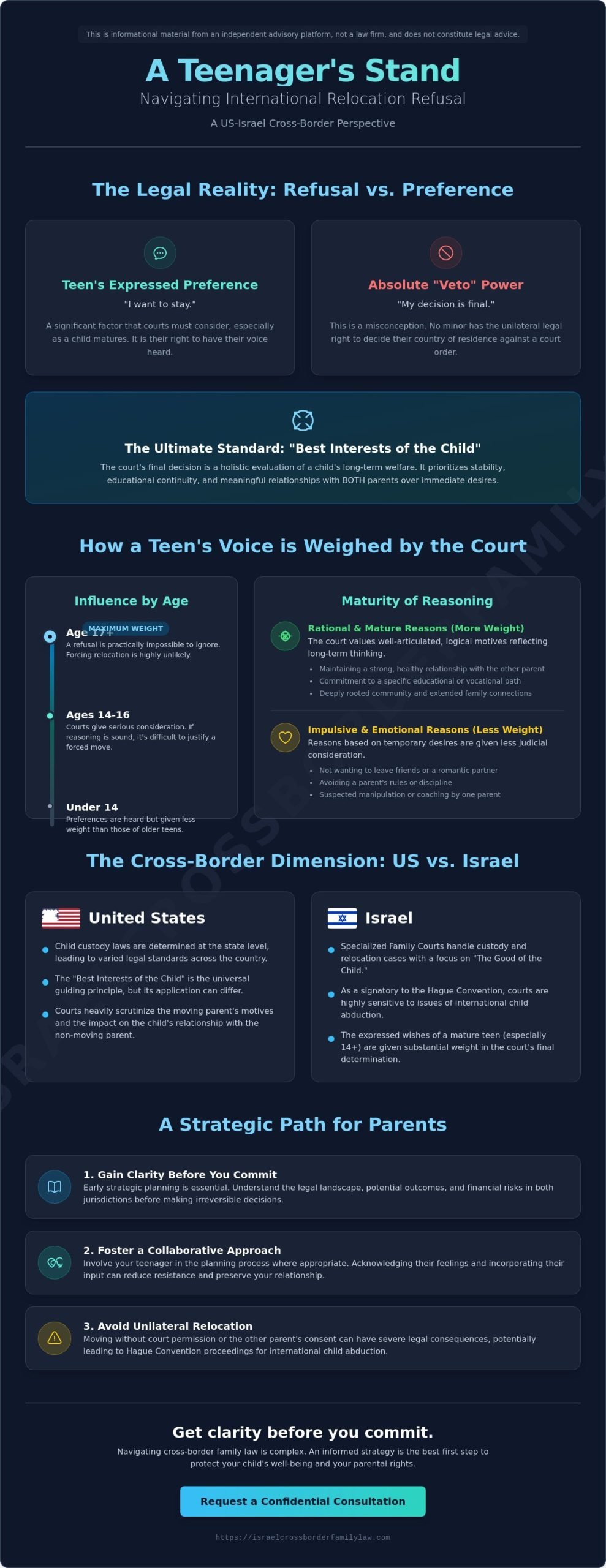
One of the most common misconceptions for parents considering an international move is the belief that once a child reaches a certain age, they hold an absolute legal veto. While it’s true that older children have a significant voice, under both United States and Israeli child custody laws, no minor has the unilateral right to decide their place of residence. The court maintains the final authority to determine whether the proposed move aligns with the child’s long-term welfare, rather than just their immediate desires.
When parents ask, “can a teenager refuse to relocate with a parent,” they’re often dealing with a child who is deeply rooted in their current social and academic environment. Legal systems distinguish between a child’s “wants” and the court’s “best interests” mandate. A teenager might want to stay behind to remain with friends or a romantic partner; however, a judge must look beyond these social preferences to assess the impact on the child’s future opportunities and parental relationships. The court also acts as a shield, ensuring the teen isn’t being pressured or coached by one parent to resist the move.
To better understand how courts view the resistance of a child, watch this helpful video:
Understanding the Best Interests Standard
The “Best Interests” standard is a holistic evaluation of the child’s welfare that prioritizes stability, educational continuity, and the preservation of meaningful bonds with both parents. Israeli family courts and US state courts will scrutinize how a move to IL or abroad affects these pillars. If a relocation threatens to sever a healthy relationship with the non-moving parent, the court may deny the request regardless of the teen’s preference. Judges focus on long-term outcomes over temporary happiness.
The Distinction of Mature Minors
As children grow, legal systems recognize their “evolving capacities,” giving their opinions more weight as they demonstrate greater maturity. Maturity is assessed by the teen’s ability to articulate rational motives rather than emotional whims.
- Ages 14-16: Courts give serious consideration to these wishes. If reasoning is sound, forcing a move becomes difficult for a judge to justify.
- Age 17: A refusal is practically impossible for a court to ignore. Forcing a nearly-adult child into a move often leads to unenforceable orders and significant emotional trauma.
Because these situations are so delicate, seeking international custody relocation guidance early is vital for developing a strategy that respects the teen’s voice while protecting your parental rights.
This article is published on an independent advisory platform (not a law firm) and must not imply an attorney-client relationship. Legal services are only provided by licensed attorneys under a separate engagement.
How Courts Weigh a Teenager’s Voice in Relocation Decisions
Courts in both the United States and Israel recognize that as a child matures, their input becomes a critical component of the “Best Interests” analysis. However, a judge doesn’t simply take a teenager’s statement at face value. Instead, the court investigates the underlying motives to determine if the refusal is a rational choice or an impulsive reaction. When evaluating whether can a teenager refuse to relocate with a parent, the court seeks to understand if the child’s perspective is independent or the result of external pressure.
Rational vs. Impulsive Refusal
A judge may quickly look past a refusal that centers solely on “not wanting to leave friends” or a romantic interest. These are often viewed as temporary emotional states that do not outweigh the long-term benefits of a parent’s relocation. Conversely, if a 16-year-old is enrolled in a specialized International Baccalaureate program or is receiving unique medical treatment in their current city, the court will likely view their objection as well-reasoned. While a child’s desire to remain with a social circle is understandable, courts distinguish between a temporary emotional whim and a well-reasoned objection rooted in the child’s developmental or educational stability.
The Expert’s Role: Social Workers and Psychologists
In the Israeli legal system, the court relies heavily on the “Tazkir,” which is a comprehensive report prepared by a court-appointed social worker. This professional interviews the parents and the child to assess the family dynamics and the child’s true feelings. In the US, a similar role is often filled by a Guardian ad Litem or a forensic psychologist. These experts are trained to identify signs of “Parental Alienation,” where the stay-behind parent may be intentionally or unintentionally coaching the teen to resist the move.
If an expert suspects that a teen’s refusal is scripted or born from a desire to please the stay-behind parent, the court may actually view the relocation as necessary for the child’s emotional health. Judges also have the option to interview the teen privately in their chambers. This allows the child to speak freely without the pressure of having their parents present. Because these evaluations are highly subjective and complex, it’s helpful to get clarity before you commit to a specific legal path.
The court also examines how deeply the teen is integrated into their current community. This includes their academic standing, participation in youth movements or sports, and their overall social adjustment. A teen who is thriving in IL may have a stronger case for staying than one who is struggling socially or academically. When a judge decides if can a teenager refuse to relocate with a parent, they are looking for evidence that the current environment provides a level of stability that cannot be replicated elsewhere. Ultimately, the court’s goal is to ensure the teen’s voice is heard while filtering out the influence of parental conflict.
This article is published on an independent advisory platform (not a law firm) and must not imply an attorney-client relationship. Legal services are only provided by licensed attorneys under a separate engagement.
The Cross-Border Dimension: US vs. Israeli Legal Systems
Managing an international relocation involves more than just a domestic custody dispute; it requires navigating the intersection of two distinct legal regimes. The primary mechanism governing these situations is the Hague Convention on the Civil Aspects of International Child Abduction. This international treaty ensures that children aren’t unilaterally moved across borders without legal clearance. If a parent attempts to move without consent, the other parent can petition for the child’s return to their home country. This framework creates a high stakes environment where early strategic planning is essential.
Relocation Trends in Israeli Family Law
In IL, family courts have seen a progressive shift toward a standard that often facilitates relocation for the primary caregiver. The court recognizes that the well-being of the primary carer directly impacts the child’s quality of life. However, Israeli judges place significant weight on the child’s connection to their Israeli identity and family heritage. When evaluating if can a teenager refuse to relocate with a parent, the court examines how the move will impact the child’s cultural roots and their relationship with the extended family remaining in IL. For specific procedural steps involved in these cases, reviewing the requirements for international custody relocation is a critical first step in understanding the local landscape.
US Jurisdictional Variations
Unlike the centralized system in IL, the United States operates on a state-by-state basis, which creates a complex burden of proof. In states like California, the moving parent typically has a presumptive right to relocate if they have sole physical custody. In contrast, New York courts require a more rigorous showing that the move is in the child’s best interests from the very beginning. This variation often leads to “forum shopping,” where parents try to establish jurisdiction in the state they believe will be most favorable to their case. US courts are particularly sensitive to a teen’s refusal when an international move is proposed, as the distance makes maintaining the relationship with the stay-behind parent significantly more difficult.
Enforcing a relocation order across borders adds another layer of multi-jurisdictional complexity. A US court order isn’t automatically enforceable in IL without a formal process of recognition. To mitigate this risk, families often seek “mirror orders” in both countries. These identical orders ensure that visitation schedules and custody rights are legally binding in both the US and IL. This prevents a situation where a teen might refuse to return from a summer visit, leading to a protracted legal battle that can damage family bonds for years. Get clarity before you commit. Request a confidential consultation.
This article is published on an independent advisory platform (not a law firm) and must not imply an attorney-client relationship. Legal services are only provided by licensed attorneys under a separate engagement.
Practical Guidance for Parents Facing Resistance
Facing a teenager’s resistance to an international move is one of the most challenging aspects of cross-border family life. While you may have a legal basis to move, forcing a resistant teen into a new country often leads to what professionals call the “litigation trap.” Even with a favorable court order, a teenager who is emotionally checked out can make the transition nearly impossible for the entire family. Instead of relying solely on the legal question of whether can a teenager refuse to relocate with a parent, focus on a strategy that reduces friction and addresses their specific concerns through negotiation and mediation.
A successful transition requires a plan that treats the teenager as a stakeholder rather than a subject of the move. This approach typically involves several practical components:
- Providing the teen with a clear timeline and a sense of control over their personal space in the new home.
- Identifying specific academic or extracurricular opportunities in IL or the US that align with their interests.
- Establishing a formal “open door” policy for communication with the stay-behind parent.
- Using mediation to reach a consensus that feels like a shared decision rather than a forced mandate.
Communication Strategies for Parents
The way you discuss the move can either bridge the gap or create an “us vs. them” dynamic. It’s essential to validate the teen’s fears about losing their social network while calmly explaining the professional or personal necessity of the relocation. Avoid dismissive language; instead, acknowledge that their grief over leaving is real. Transparency about the reasons for the move helps the teen feel respected and less like a piece of luggage. To gain more insight into handling these difficult conversations and understanding the child’s perspective, you may find it helpful to watch relevant videos at the IsraelFamilyLaw YouTube channel.
Legal Safeguards and Agreements
Reassuring a teenager often requires more than verbal promises; it requires documented legal safeguards. Drafting detailed travel and communication schedules can provide the teen with the certainty they need to feel that their old life isn’t being erased. Some families incorporate financial incentives, such as dedicated travel funds, to ensure the teen can return for major social milestones like graduations, bar mitzvahs, or birthdays. These elements are often part of broader divorce and separation agreements for international families, which serve to stabilize the family unit across borders.
Building a plan that prioritizes the child’s emotional stability reduces the likelihood of the teen attempting to “veto” the move through behavioral resistance or legal appeals. If you are struggling to reach an agreement with a resistant child or a co-parent, contact us to discuss a strategic transition plan that protects your family’s future.
This article is published on an independent advisory platform (not a law firm) and must not imply an attorney-client relationship. Legal services are only provided by licensed attorneys under a separate engagement.
Conclusion: Clarity Before Commitment
Relocating across international borders is a definitive life event that requires more than just logistical preparation; it demands a sophisticated legal strategy that accounts for the laws of both the United States and IL. Making unilateral decisions or assuming a court will simply grant permission because of a career opportunity often leads to significant legal setbacks. When a child objects, the risks of a failed relocation increase. Understanding whether can a teenager refuse to relocate with a parent isn’t just about knowing the basic legal rules; it’s about predicting how a specific judge will interpret the child’s maturity and the parent’s underlying motives.
Traditional local lawyers often focus on the immediate litigation at hand, but cross-border advisory looks at the entire transnational landscape. This specialized approach identifies how a decision made in a US court might be viewed or enforced by an Israeli Family Court. This layer of oversight is essential for preventing conflicting orders that leave families in legal limbo for years. Determining if can a teenager refuse to relocate with a parent requires a deep dive into the specific facts of your case, including the child’s academic records and the nature of their relationship with the stay-behind parent.
Assessing the Risk of Litigation
Litigation often functions as a blunt instrument that fails to account for the delicate emotional state of a resistant teen. The financial investment required for a multi-year, contested relocation case is substantial; however, the emotional cost to the family unit is often far greater. An advisory review provides a detached, expert analysis of your situation, highlighting where your strategy might fail under the scrutiny of an Israeli social worker or a US judge. By utilizing a Confidential Case Review, you can evaluate your risks with precision.
Key benefits of this review include:
- Identifying jurisdictional advantages between the US and IL systems.
- Evaluating the strength of your evidence regarding the child’s best interests.
- Developing a tailored communication strategy to minimize teenager resistance.
Next Steps for International Families
For international families, the most effective path forward involves practitioners who possess a nuanced understanding of both legal cultures. Cross-border situations are inherently complex. A strategy that works in a domestic US case may be entirely ineffective when applied to the Israeli legal system. This advisory platform acts as a bridge, providing the clarity necessary to navigate these divergent systems. Remember that the decisions you make today will define your relationship with your child for years to come.
This article is for informational and advisory purposes only. It doesn’t constitute legal representation or legal advice. Legal services are only provided by licensed attorneys under a separate engagement.
Get clarity before you commit. Request a confidential consultation.
This article is published on an independent advisory platform (not a law firm) and must not imply an attorney-client relationship. Legal services are only provided by licensed attorneys under a separate engagement.
Navigating the Path to a Successful Relocation
Resolving an international move requires a delicate balance between legal rights and family dynamics. You’ve seen that while no minor holds a formal veto, their rational objections carry immense weight in both US and Israeli family courts. Successfully managing these transitions involves more than just winning a court case; it requires a strategy that respects the teenager’s voice while protecting the primary carer’s objectives. Families often struggle with the question: can a teenager refuse to relocate with a parent? The answer lies in the intersection of the “Best Interests” standard and the practical reality of enforcement across borders.
By focusing on early strategic planning and mediation, you can avoid the emotional and financial toll of contested litigation. Our specialized advisory approach focuses on the unique needs of expats and international families, providing a calm, strategy-based guide through these multi-jurisdictional complexities. We focus on risk-based decision-making to help you achieve stability for your family in both the United States and IL.
Get clarity before you commit. Request a confidential consultation.
Making informed choices today will protect your parental rights and your child’s emotional well-being for the future.
This article is published on an independent advisory platform (not a law firm) and must not imply an attorney-client relationship. Legal services are only provided by licensed attorneys under a separate engagement.
Frequently Asked Questions
At what age can a child legally decide which parent to live with in Israel?
In Israel, a child never has the absolute legal right to choose their residence until they reach the age of 18. However, Israeli law mandates that courts must hear the child’s perspective starting from age 10. While younger children are heard, the wishes of teenagers are given serious weight in the final decision. The court still prioritizes the child’s best interests over their specific preference if those two factors conflict.
Can a judge force a 16-year-old to move to another country against their will?
A judge technically has the legal authority to order a relocation, but it’s practically very difficult to force an older teenager to move. Courts recognize that a 16-year-old can physically resist or refuse to board a flight, making such orders nearly impossible to enforce. When considering if can a teenager refuse to relocate with a parent, judges often look for a compromise or a transition plan rather than issuing a forced mandate that could damage the parent-child bond.
What happens if I move my teenager to Israel without the other parent’s consent?
Moving a child to IL without a court order or written consent from the other parent is considered a wrongful removal under international law. This action triggers the Hague Convention, which can result in an immediate court order for the child’s return to their original country. Beyond the legal risks, such a move can severely compromise your standing in future custody proceedings and may have criminal implications in certain jurisdictions.
Does the Hague Convention apply if my teenager wants to stay in the US?
The Hague Convention applies to all children under the age of 16 who have been wrongfully removed or retained away from their country of habitual residence. If your teenager is 15 or younger and you attempt to move them to Israel without permission, the Convention provides a mechanism for their return. Once a child turns 16, the Hague Convention no longer applies, though domestic custody laws and international comity still govern their residence.
How much weight does an Israeli court give to a teenager’s preference?
Israeli courts give significant weight to a teenager’s preference, especially if the child is 14 or older and can articulate rational reasons for their choice. The judge or a court-appointed social worker will assess whether the teen’s wish is independent or influenced by a parent. If the teenager’s reasons are based on educational stability or deep community ties, the court is very likely to respect their desire to stay or move.
Can a teenager choose to stay behind with a relative instead of relocating?
A teenager cannot unilaterally choose to live with a relative, such as a grandparent or aunt, unless both parents agree to the arrangement. If the parents disagree, the court must determine if staying with a relative is in the child’s best interests compared to moving with a parent. These cases are complex and usually require a formal custody evaluation to ensure the relative’s home provides a suitable and stable environment for the teen.
How do I prove that relocating is in my teenager’s best interests?
Proving best interests requires concrete evidence of how the move will improve the child’s life compared to staying. You should provide data on superior educational opportunities, better healthcare, or a stronger support network of extended family in the new location. When a parent asks can a teenager refuse to relocate with a parent, the court will weigh your evidence against the teen’s objections to see which path offers the most long-term stability.
What is a “Guardian ad Litem” and do we need one for a relocation case?
A Guardian ad Litem is an independent professional, often an attorney or social worker, appointed by the court to represent the child’s unique interests. They act as a neutral party to investigate the family situation and provide the judge with a recommendation. In complex cross-border relocation cases, having an independent voice for the child is common to ensure the teen’s perspective is heard without being filtered through the parents’ conflict.

Article by
Gabriel Lior
A Personal Journey That Became a Mission
The advisory was founded by an American father Gabriel Lior, LLB, MBA , global entrepreneur, and cross-border advisor who spent more than a decade navigating the Israeli family court system firsthand and now lives in Singapore with his son.
As a divorced parent in a cross-border family, Gabriel faced nearly every legal challenge a foreign parent can encounter in Israel — including child custody disputes, child support proceedings, property matters in Israel and abroad, false accusations, and complex immigration and relocation proceedings.
Over the years, he learned the hard way how difficult it is for non-Israeli parents to understand the system, identify the right legal strategy, and choose the right legal representation — especially when language, culture, and jurisdictional differences are involved. He also witnessed how foreign parents and new immigrants are often disadvantaged or taken advantage of by service providers and institutions simply because they lack local knowledge or fluency.
From Client to Advisor
To truly understand — and survive — the system, Gabriel pursued formal legal education in Israel, completing two Israeli law degrees, alongside a BA and MBA earned in the United States. This was never about becoming a practicing attorney, but about gaining a deep, structural understanding of how the system works — and where it breaks down for foreign parents.
This rare combination of:
Firsthand client experience
Israeli legal and US business education
International business and negotiation training
Decades of commercial execution
created a unique perspective – one that understands both sides of the table.
After years of litigation, persistence, and at times self-representation, he ultimately succeeded in securing custody of his son and relocating abroad through a rare legal victory in the Israeli Supreme Court — becoming one of the first fathers in Israel to do so under these circumstances.
Disclaimer
Important Disclaimer:
The information provided on this website and in its content is for general informational and educational purposes only and does not constitute legal advice, legal opinion, or legal representation.
Gabriel Lior is not licensed to practice law in Israel (nor is he interested in doing so) and does not provide legal services, despite having completed 2 Law Degrees. The services offered are advisory in nature and are intended to provide general guidance, strategic insight, and information regarding cross-border family law considerations.
No attorney-client relationship is formed by accessing this website, reading its content, or communicating with us.
Any decisions made based on this information are at your own discretion and risk. For legal advice specific to your situation, you should consult a licensed attorney in the relevant jurisdiction.
Where appropriate, we may refer clients to independent, licensed attorneys or professionals. Such referrals do not constitute legal representation and no liability is assumed for services provided by third parties.