This article is published on an independent advisory platform and does not constitute an attorney-client relationship. Legal services are only provided by licensed attorneys under a separate engagement.
Could your choice of court in Israel determine the outcome of your divorce before the case even begins? For many expats and international families, the realization that two separate court systems have concurrent jurisdiction over their personal lives is often startling. You likely feel that the legal path ahead is a maze of conflicting rules and cultural barriers. Understanding the strategic approach of Yacobovitch Family Law is essential when you’re managing high-value assets or parental rights across different borders. It’s natural to feel anxious about how your global interests will be treated within the Israeli framework, especially since the 1995 Spousal Property Relations Law governs many of these financial divisions.
You’ll gain a clear, strategic roadmap of the Israeli legal process to help you mitigate risks for international assets. This guide explains how to identify the right strategic partners who understand both local regulations and the complexities of multi-jurisdictional litigation. We will examine the critical differences between the Family and Rabbinical courts, the impact of early strategic decisions, and how expert guidance ensures your rights remain protected in a foreign jurisdiction. For more insights, view expert discussions on the Israel Family Law YouTube channel. Get clarity before you commit. Request a confidential consultation.
Key Takeaways
- Understand the dual nature of the Israeli legal system and how the jurisdictional differences between secular and Rabbinical courts impact international families.
- Learn why foreign prenuptial agreements are not always automatically enforceable in Israel and the steps needed to ensure cross-border financial protection.
- Explore how specialized expertise from firms like Yacobovitch Family Law is essential for navigating high-asset, multi-jurisdictional litigation.
- Identify the unique legal standards governing international child custody and relocation to effectively manage expectations within the Israeli court system.
- Discover the importance of a strategy-first advisory approach to mitigate risks and gain clarity before initiating formal legal proceedings.
The Landscape of Family Law in Israel for International Families
Note: This article is published on an independent advisory platform and is not a law firm. The content provided is for informational purposes only and does not imply an attorney-client relationship. Legal services are only provided by licensed attorneys under a separate engagement.
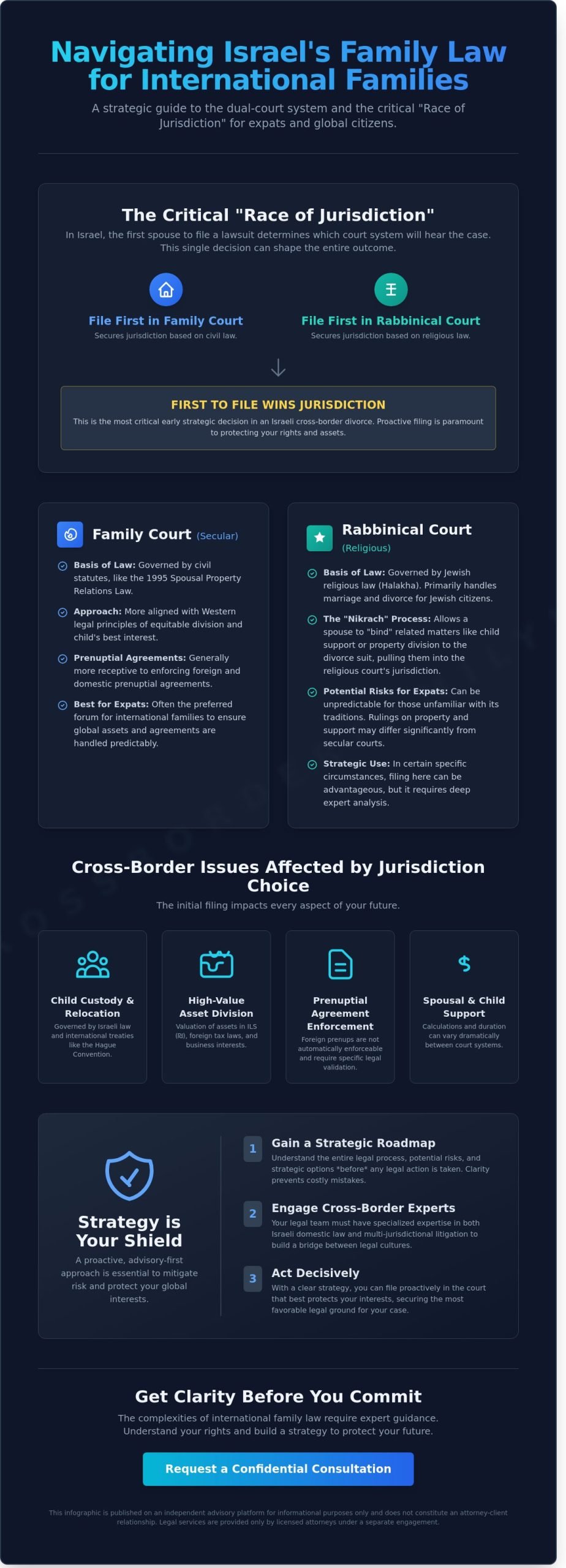
Managing family life across borders requires more than just a passport; it demands a clear grasp of how different legal systems collide. In Israel, the legal framework is a unique blend of civil statutes and religious traditions. For those accustomed to the legal structures of the US or Europe, Family Law in Israel can feel unpredictable. The system relies on a delicate balance between secular Family Courts and religious Rabbinical Courts. This duality creates what is known as the “Race of Jurisdiction.” It’s a high-stakes environment where the court that receives a filing first usually gains the authority to decide the case. For expats, this isn’t just a procedural detail. It’s the most critical factor in protecting their future.
To better understand how to approach these complex choices, watch this helpful video:
Understanding the Dual-Court System
The concurrent jurisdiction of civil and religious courts means that divorce, custody, and asset division can be heard in two very different settings. Many foreign nationals and expats find the “Nikrach” (binding) process confusing and risky. This allows a spouse to “bind” matters like child support or property division to a divorce suit in the Rabbinical Court. Without early strategic positioning, an expat might find themselves litigating in a forum they didn’t choose. Expertise found at firms like Yacobovitch Family Law focuses on helping clients manage these risks before they become permanent liabilities.
The Role of the Ministry of Justice and International Treaties
Israel is a signatory to several international treaties, including the Hague Convention. These agreements govern how cross-border child custody and abduction cases are handled between Israel and other nations like the US. These cases differ significantly from purely domestic disputes because they involve sovereign laws from multiple countries. When families hold assets in multiple jurisdictions, they must account for how ₪ (ILS) valuations and foreign tax laws interact. Success in these matters depends on a “team on the ground” that understands both local Israeli statutes and the global implications of every filing. Practitioners at Yacobovitch Family Law often highlight that cross-border cases require a bridge between different legal cultures to reach a fair outcome.
Get clarity before you commit. Request a confidential consultation.
This article is published on an independent advisory platform and is not a law firm. The content provided is for informational and advisory purposes only and does not constitute legal representation or an attorney-client relationship. Legal services are only provided by licensed attorneys under a separate engagement.
Navigating Complex Divorce and Prenuptial Agreements in IL
International families face a unique set of hurdles when dissolving a marriage in Israel. The intersection of different legal jurisdictions often creates friction, especially when assets are spread across continents. At Yacobovitch Family Law, the focus is on providing a strategic roadmap for those managing these complexities. Navigating Complex Divorce and Prenuptial Agreements requires an understanding that Israeli courts view foreign legal documents through a specific local lens. For instance, a US prenuptial agreement isn’t automatically enforceable. If it hasn’t been validated by an Israeli court or doesn’t meet specific criteria under the Spouses (Property Relations) Law of 1973, it might be disregarded during asset division.
Early decisions carry heavy financial weight. A misstep in the first 30 days of a proceeding can impact the division of assets worth millions of ₪. Risk-based decision making is vital when dealing with properties in Tel Aviv and brokerage accounts in New York. You’ve got to weigh the cost of litigation against the potential recovery in each jurisdiction. Many expats find that the Israel Family Law YouTube channel offers helpful visual context for these procedural timelines.
Cross-Border Divorce Strategy
There’s a significant difference between “getting divorced” and “litigating a divorce” in Israel. The former is a procedural end to a marriage; the latter is a complex battle over jurisdiction and assets. Protecting foreign-held assets requires a proactive approach. Much like the complexities found in the Navigating US-Israel M&A guide, corporate interests and high-value stock options require specialized valuation. If a spouse holds shares in a Delaware LLC, the Israeli court needs clear evidence of value and ownership to make a fair ruling. Understanding divorce and separation for international families helps in mapping out which court should hear which part of the case. Strategic planning with Yacobovitch Family Law ensures that foreign business interests aren’t undervalued during the discovery phase.
Prenuptial and Financial Agreements
International couples often assume a “prenup” signed in London or Los Angeles will protect them in Israel. This is a common pitfall. To ensure protection, many couples need “mirror” agreements or specific validation from an Israeli Family Court. The court’s role is to ensure both parties understand the agreement’s implications. Without this formal approval, the agreement may lack the legal strength needed to survive a challenge. Drafting these documents requires a deep dive into two legal cultures to avoid clauses that are unenforceable under Israeli law. Get clarity before you commit. Request a confidential consultation to understand your specific risks.
This article is published on an independent advisory platform and does not constitute an attorney-client relationship. Legal services are only provided by licensed attorneys under a separate engagement.
The Role of Specialized Expertise in Cross-Border Litigation
High-conflict divorces involving international assets require more than just a local lawyer. Firms like Yacobovitch Family Law are often the primary choice for expats and international families because they understand the friction between different legal cultures. A general practitioner might handle a standard Israeli divorce, but they often lack the technical depth needed for multi-jurisdictional disputes. In the Israeli Family Court system, a lawyer’s reputation for handling complex cross-border matters is a tangible asset. Judges recognize specialists who provide clear, bilingual documentation and understand the nuances of international treaties. Having a “team on the ground” means your legal representative isn’t just filing papers; they’re managing logistics across time zones and languages to ensure no detail is lost in translation.
What Defines a Cross-Border Specialist?
A specialist masters the technicalities of international service of process, ensuring legal documents are valid in both Israel and foreign jurisdictions like the US or UK. They don’t just know Israeli law; they understand how a ruling in Tel Aviv might impact a pension in London or a property in New York. This expertise allows them to coordinate effectively with foreign counsel, creating a unified strategy for multi-jurisdictional litigation. It’s about preventing conflicting orders from different countries. This coordination is essential when dealing with the 1980 Hague Convention or complex asset divisions where timing is everything.
Assessing Your Need for High-End Representation
Mediation is a valuable tool, but it’s not always suitable for cases involving hidden assets or high levels of conflict. In these scenarios, a boutique firm like Ilan Yacobovitch becomes essential to protect your interests. Choosing low-cost or DIY legal services often leads to expensive errors, such as failing to secure a “Gett” or mishandling jurisdictional claims that could lock you into an unfavorable court system for years. Understanding the pricing and value of a specialized strategy is vital for long-term planning. While specialized representation involves a higher initial investment, it typically prevents the much higher costs of fixing procedural mistakes later. You’re paying for a strategy that accounts for the specific risks of the Israeli legal landscape.
Get clarity before you commit. Request a confidential consultation.
Strategic Decisions in Child Custody and International Relocation
The “Best Interests of the Child” serves as the foundational pillar for all custodial decisions in Israel, as codified in the Legal Capacity and Guardianship Law of 1962. While this standard is universal in Western jurisdictions, its application in Israel involves specific procedural nuances that can surprise international families. The court doesn’t just look at parental preference; it focuses on the child’s developmental stability within the Israeli social and educational framework. Understanding the intricacies of Yacobovitch Family Law is essential for parents who need to bridge the gap between their home country’s expectations and the reality of the Israeli family court system.
Custody and Relocation Hurdles
Israeli courts maintain a strict distinction between temporary travel and permanent relocation. If a parent wishes to move a child abroad, they must obtain written consent or a court order. Without these, moving a child can be classified as a “wrongful removal,” triggering the Hague Convention child abduction protocols. A central figure in these cases is the “Tazkir,” a social worker for legal matters appointed by the court. This professional conducts an in depth evaluation of the family’s situation. Their recommendations carry immense weight, and the court rarely deviates from their findings when deciding on international custody and relocation. Parents should realize that the process is often slow, requiring patience and a clear strategic plan.
Child Support and Economic Fairness
The financial landscape for international families changed significantly following the 2017 Supreme Court ruling (919/15). This landmark decision shifted how support is calculated for children aged 6 to 15. In cases of joint custody, the court now considers the relative income of both parents and the actual time the child spends with each, rather than placing the entire burden on the father. When dealing with Yacobovitch Family Law matters, these calculations must account for the high cost of living in Israel and potential currency fluctuations if one parent is paid in a foreign currency.
For families spanning multiple countries, the mechanics of child support cross-border enforcement are critical. Israel is a signatory to the 2007 Hague Convention on the International Recovery of Child Support, which facilitates the collection of payments across borders. Whether you are seeking to enforce an Israeli order abroad or bring a foreign order into the Israeli system, the process involves specific ₪ (shekel) conversions and administrative filings. Managing the financial impact of dual residency requires a proactive approach to ensure the child’s needs are met without creating an unsustainable financial burden on either parent.
Get clarity before you commit. Request a confidential consultation.
Strategy Before Litigation: The Advisory Approach
In the Israeli legal system, the impulse to “file first” often stems from a fear of losing jurisdictional advantage. However, rushing into litigation without a multi-jurisdictional strategy can lead to irreversible procedural errors. When dealing with Yacobovitch Family Law or similar high-stakes cross-border matters, the initial strategy dictates the outcome more than the courtroom performance itself. An independent advisory acts as a buffer. It allows you to evaluate the landscape before committing to a specific legal path that might cost tens of thousands of shekels in unnecessary fees.
Choosing the right legal team is a decision that shouldn’t be made under duress. An advisor helps you vet attorneys based on their specific experience with international treaties and cross-border asset division rather than just their proximity to the court. This ensures that the professional you hire understands the specific needs of an Anglo family. Without this layer of strategy, you risk hiring a litigator who may be excellent in domestic cases but lacks the nuance required for a Yacobovitch Family Law context involving foreign assets or dual citizenship.
Why Seek Clarity Before Committing?
Litigation is expensive. In Israel, legal costs for complex family disputes can quickly exceed ₪60,000 or even ₪120,000 depending on the complexity of assets and custody arrangements. Poorly planned filings often trigger retaliatory actions in foreign jurisdictions, creating a legal conflict on two fronts. By seeking an advisory perspective, you identify risks that a local attorney might miss because they’re focused solely on the domestic Israeli court. You can learn how it works when you integrate high-level strategy with specific legal counsel. This approach ensures your Israeli and international interests remain aligned throughout the process.
Your Path Forward
Success in the Israeli cross-border landscape requires more than just a lawyer. It requires a bicultural and bilingual team on the ground. This team serves as a bridge, translating the nuances of the Israeli Rabbinical or Family Courts into terms an Anglo client understands. You should utilize resources from the YouTube channel @IsraelFamilyLaw to gain a deeper understanding of specific statutes and court behaviors before stepping into a courtroom. Building your international legal professional home starts with a foundation of facts, not emotions. This structured approach helps you maintain control over your future and your finances.
Get clarity before you commit. Request a confidential consultation.
Securing Your Future Through Strategic Planning
This article is published on an independent advisory platform, not a law firm. The information provided is for educational purposes and doesn’t constitute an attorney-client relationship or legal advice. Legal services are only provided by licensed attorneys under a separate engagement.
Navigating family law across borders requires more than just legal representation; it demands a strategic roadmap that accounts for the distinct differences between Israeli and international systems. Early decisions regarding jurisdiction or child relocation often dictate the long-term outcome of a case. By prioritizing an advisory approach before entering the courtroom, families can mitigate risks and avoid costly errors. It’s essential to recognize that the Israeli legal landscape operates on unique principles that don’t always align with Western expectations.
This platform offers specialized expertise in cross-border US-Israel strategy, ensuring your interests are protected in both jurisdictions. Through Yacobovitch Family Law, you gain access to bicultural and bilingual expertise designed to bridge the gap between complex legal cultures. Whether you’re dealing with prenuptial agreements or multi-jurisdictional litigation, having a clear plan is the most effective way to protect your family’s well-being. Get clarity before you commit. Request a confidential consultation.
Taking the right steps today provides the stability your family needs for tomorrow.
This article is published on an independent advisory platform and does not constitute a law firm or an attorney-client relationship. The information provided is for educational and advisory purposes only. Legal services are only provided by licensed attorneys under a separate, formal engagement.
Frequently Asked Questions
What is the difference between the Family Court and the Rabbinical Court in Israel?
The Family Court is a civil institution while the Rabbinical Court operates under religious law. Both systems have concurrent jurisdiction over many family matters, which often leads to a race for jurisdiction where the first party to file determines which court hears the case. This choice significantly impacts how assets are divided and how alimony is calculated, as the two systems apply different legal principles to the same facts.
Can an Israeli court change a US child support order?
Israeli courts have the authority to modify a US child support order if there’s a substantial change in circumstances or if the child’s needs aren’t being met within the Israeli cost of living. Because the price of housing and education in Israel differs from the US, a judge may reassess the support amount to ensure it’s appropriate for the child’s life in Israel. This process requires a formal petition and a clear demonstration that the original order is no longer sufficient.
Is Ilan Yacobovitch a good choice for my cross-border divorce case?
Engaging a professional with expertise in Yacobovitch Family Law is beneficial for clients who require a deep understanding of both Israeli and international legal landscapes. His experience navigating complex multi-jurisdictional disputes provides a strategic advantage for families with assets or residency ties in multiple countries. Having a representative who acts as a bridge between different legal cultures helps ensure your interests are protected in both jurisdictions.
How does the Hague Convention work if my child is taken to Israel?
The 1980 Hague Convention is an international treaty designed to return children who’ve been wrongfully removed from their country of habitual residence. In Israel, these cases are prioritized and usually follow an expedited schedule to reach a decision within 6 to 12 weeks. The court doesn’t decide long-term custody during these proceedings; it only determines if the child should be returned to their original home country for those decisions to be made there.
Do I need an Israeli lawyer if I already have a US lawyer for my family matter?
You’ll need a licensed Israeli lawyer because US attorneys aren’t authorized to practice in Israeli courts or sign official Hebrew-language pleadings. While your US lawyer handles the American aspects of your case, your Israeli counsel serves as your team on the ground to navigate local procedures and the Ministry of Justice requirements. A collaborative approach between both sets of lawyers is the most effective way to manage a cross-border strategy.
How long does the average cross-border family law case take in Israel?
Most complex cross-border cases in Israel take between 12 and 24 months to reach a final judgment. If the case involves the Hague Convention or urgent safety issues, the timeline is much shorter, often concluding in 3 to 6 months. The duration depends heavily on the cooperation of both parties and the complexity of the international financial discovery required to verify assets held outside of Israel.
Can I relocate with my children from Israel back to the US without my ex’s consent?
You cannot legally move your children out of Israel without the other parent’s written consent or a specific relocation order from an Israeli court. Doing so without permission is considered international child abduction and can trigger immediate legal action under the Hague Convention. To relocate legally, you’ll need to prove to a judge that the move is in the child’s best interests, a process that involves detailed evaluations by court-appointed social workers.
Are prenuptial agreements signed in the US valid in Israel?
Prenuptial agreements signed in the US are generally recognized in Israel, but they must be validated to ensure they comply with the Spousal Property Relations Law of 1973. It’s common for Israeli courts to require a formal approval process to confirm that both parties signed the document willingly and understood its implications. Without this local validation, you may face difficulties enforcing the agreement’s terms if a dispute arises within the Israeli legal system.
Get clarity before you commit. Request a confidential consultation.
For more information on navigating these complex issues, you can view educational resources on our YouTube channel: https://www.youtube.com/@IsraelFamilyLaw

Article by
Gabriel Lior
A Personal Journey That Became a Mission
The advisory was founded by an American father Gabriel Lior, LLB, MBA , global entrepreneur, and cross-border advisor who spent more than a decade navigating the Israeli family court system firsthand and now lives in Singapore with his son.
As a divorced parent in a cross-border family, Gabriel faced nearly every legal challenge a foreign parent can encounter in Israel — including child custody disputes, child support proceedings, property matters in Israel and abroad, false accusations, and complex immigration and relocation proceedings.
Over the years, he learned the hard way how difficult it is for non-Israeli parents to understand the system, identify the right legal strategy, and choose the right legal representation — especially when language, culture, and jurisdictional differences are involved. He also witnessed how foreign parents and new immigrants are often disadvantaged or taken advantage of by service providers and institutions simply because they lack local knowledge or fluency.
From Client to Advisor
To truly understand — and survive — the system, Gabriel pursued formal legal education in Israel, completing two Israeli law degrees, alongside a BA and MBA earned in the United States. This was never about becoming a practicing attorney, but about gaining a deep, structural understanding of how the system works — and where it breaks down for foreign parents.
This rare combination of:
Firsthand client experience
Israeli legal and US business education
International business and negotiation training
Decades of commercial execution
created a unique perspective – one that understands both sides of the table.
After years of litigation, persistence, and at times self-representation, he ultimately succeeded in securing custody of his son and relocating abroad through a rare legal victory in the Israeli Supreme Court — becoming one of the first fathers in Israel to do so under these circumstances.
Disclaimer
Important Disclaimer:
The information provided on this website and in its content is for general informational and educational purposes only and does not constitute legal advice, legal opinion, or legal representation.
Gabriel Lior is not licensed to practice law in Israel (nor is he interested in doing so) and does not provide legal services, despite having completed 2 Law Degrees. The services offered are advisory in nature and are intended to provide general guidance, strategic insight, and information regarding cross-border family law considerations.
No attorney-client relationship is formed by accessing this website, reading its content, or communicating with us.
Any decisions made based on this information are at your own discretion and risk. For legal advice specific to your situation, you should consult a licensed attorney in the relevant jurisdiction.
Where appropriate, we may refer clients to independent, licensed attorneys or professionals. Such referrals do not constitute legal representation and no liability is assumed for services provided by third parties.