This article is published on an independent advisory platform, not a law firm, and does not establish an attorney-client relationship.
Parental rights are not automatically portable across international borders; they are maintained through the deliberate documentation of a child’s habitual residence. When you move between Israel and the United States, you might assume your existing custody orders remain valid, but the transition often creates a multi-jurisdictional complexity that can leave your family vulnerable. You are likely wondering how to protect my parental rights internationally before you even board the plane. It’s natural to feel uncertain about which country’s laws apply when your family life spans two different legal cultures.
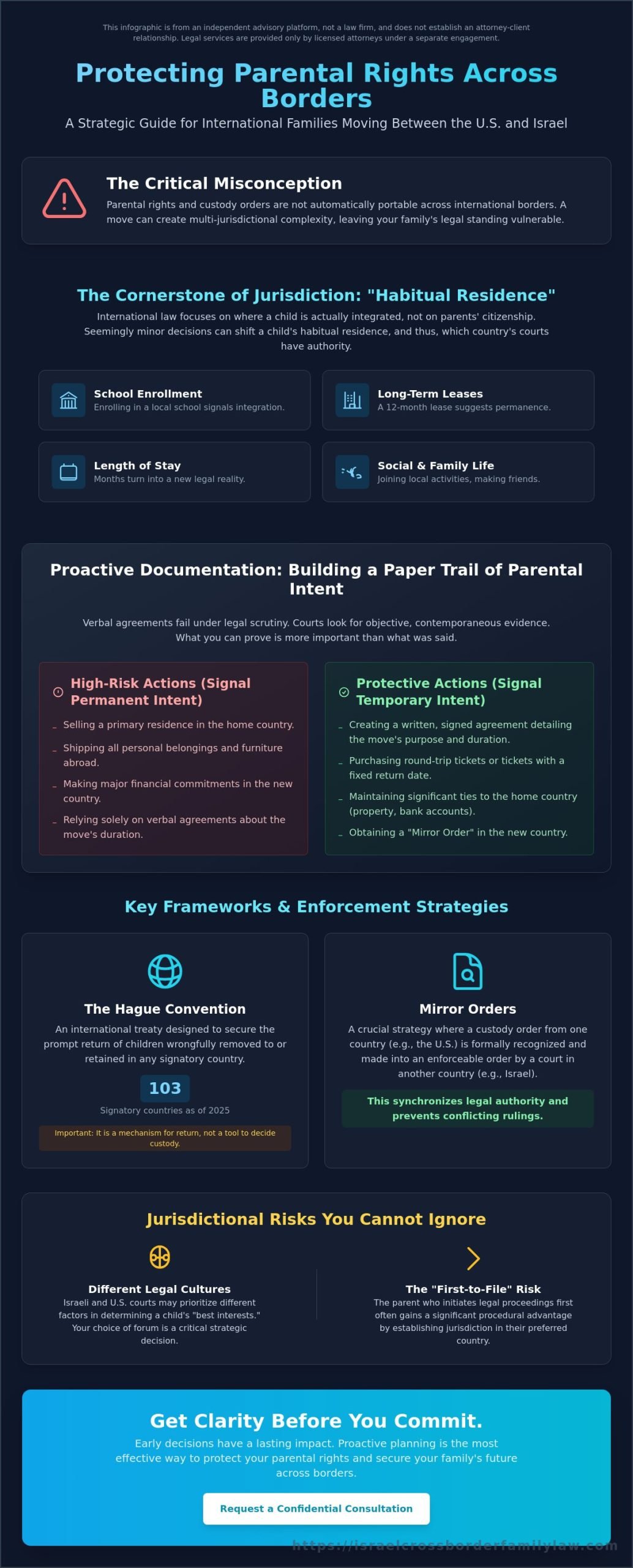
This guide provides a clear roadmap to secure your legal standing through strategic preparation rather than reactive litigation. You’ll learn how the Hague Convention on the Civil Aspects of International Child Abduction, which currently includes 103 signatory countries as of 2025, serves as a critical framework for your protection. We will examine the proactive steps required to synchronize legal orders between jurisdictions and establish a stable foundation for your move. Get clarity before you commit. Request a confidential consultation.
Key Takeaways
- Understand how the legal concept of “habitual residence” determines which country’s courts have the authority to make decisions regarding your child’s future.
- Discover the essential steps for how to protect my parental rights internationally by establishing a contemporaneous paper trail that documents the intent and purpose of every move.
- Learn how the Hague Convention acts as a primary international framework for addressing the wrongful removal or retention of children across borders.
- Identify the role of “Mirror Orders” in ensuring that custody and visitation rights granted in one jurisdiction are recognized and enforceable in another.
- Recognize the importance of early strategic planning to navigate the inherent complexities and cultural differences between the Israeli and U.S. legal systems.
This article is published on an independent advisory platform (not a law firm) and must not imply an attorney-client relationship. Legal services are only provided by licensed attorneys under a separate engagement.
Understanding the Foundation: Habitual Residence and International Law
Protecting your family requires a shift in perspective. Most parents believe their citizenship or the location of their primary home base determines which court decides their future. In reality, international law relies on the concept of habitual residence. This is the legal determination of where a child is actually integrated. It is the cornerstone of how to protect my parental rights internationally. If a child has lived in Israel for several months, enrolled in school, and joined local activities, an Israeli court may claim jurisdiction even if the family holds U.S. passports.
The 1980 Hague Convention provides a mechanism to return children who are wrongfully removed from their habitual residence. As of 2025, 103 countries are parties to this treaty, providing a standardized framework for cross-border disputes. However, it is not a guarantee of a specific outcome. Courts also look to the Hague Convention on Parental Responsibility to understand broader child protection frameworks. You should realize that early, seemingly minor decisions often change a child’s legal residence without your knowledge. Signing a long-term apartment lease in Tel Aviv or enrolling a child in a Hebrew-speaking daycare can be used as evidence that a move was intended to be permanent rather than temporary.
The Concept of ‘Intent’ in Relocation
Courts analyze the shared intent of both parents at the time of the move. If you agree to a one-year work assignment in Israel, that intent should be documented clearly. Without a written strategy, a temporary stay can easily transform into a permanent change of residence in the eyes of the law. Common traps include selling a primary residence in the U.S. or shipping all personal belongings abroad. These actions signal a degree of permanence that can override a verbal agreement between spouses. Learning how to protect my parental rights internationally involves creating a paper trail that supports your specific intent from the very beginning.
Why Jurisdiction is Your First Line of Defense
Your choice of forum is a strategic decision that impacts the entire legal process. Laws regarding international custody and relocation vary significantly between Israel and the United States. Israel, for example, may prioritize different factors in the child’s best interests than a court in New York or California. There is also a first-to-file risk; the parent who initiates proceedings first in their preferred country often gains a significant procedural advantage. Seeking clarity on jurisdiction before a child crosses a border is the most effective way to manage these risks. Get clarity before you commit. Request a confidential consultation.
This article is published on an independent advisory platform (not a law firm) and must not imply an attorney-client relationship. Legal services are only provided by licensed attorneys under a separate engagement.
Proactive Documentation: Building a Paper Trail of Parental Intent
Verbal agreements are the most common point of failure in cross-border family disputes. In the context of how to protect my parental rights internationally, what you say matters far less than what you can prove with physical evidence. If a disagreement arises later, a court in Israel or the U.S. will look for objective, contemporaneous evidence created at the time of the move. Relying on a handshake or a phone call is a high-risk strategy that often leads to jurisdictional confusion. The U.S. Department of State on International Parental Child Abduction emphasizes that clear documentation is a primary tool in preventing and resolving these complex situations.
When a parent gives consent for a child to travel or relocate for a specific period, that consent must be documented with precision. Emails and text messages serve as digital breadcrumbs that establish the original agreement. These communications should clearly state the agreed-upon return date and the specific purpose of the trip. School registrations and medical records also play a pivotal role in establishing intent. If you register a child for a single semester rather than a full academic year, it reinforces the temporary nature of the stay. These small details provide the necessary context for a judge to understand the family’s true plans.
The Essential International Parenting Agreement
A robust cross-border agreement acts as a strategic shield for your family. It should include specific clauses such as “choice of law” and “jurisdiction,” which define which country’s legal system will govern the family’s affairs. Explicit return dates and detailed communication schedules for the non-traveling parent are equally vital to prevent claims of abandonment. These documents must be drafted to meet the legal standards of both Israel and the U.S. to be truly effective. For visual guidance on how to structure these agreements, you can explore the YouTube channel resources available for international families. Understanding how to protect my parental rights internationally requires this level of formal synchronization.
Evidence Checklist for Relocating Parents
Intent evidence is the objective proof of a family’s planned future. It demonstrates that a relocation was never intended to be a permanent abandonment of the original home or the other parent’s rights.
- Return tickets booked at the time of departure to show a planned end date.
- Active lease agreements or property management contracts for your home in the country of origin.
- “Leave of absence” letters from employers that specify a clear return-to-work date.
- A consistent log of daily video calls and messages maintained during periods of separation.
Before finalizing any travel plans, it’s wise to review your documentation strategy to ensure your paper trail is legally sound. Get clarity before you commit. Request a confidential consultation.
This article is published on an independent advisory platform (not a law firm) and must not imply an attorney-client relationship. Legal services are only provided by licensed attorneys under a separate engagement.
Navigating Jurisdictional Conflicts: Hague Convention and Local Courts
When a cross-border dispute escalates, the legal landscape shifts from private agreements to international treaties and sovereign court systems. Understanding how to protect my parental rights internationally requires a clear grasp of the 1980 Hague Convention on the Civil Aspects of International Child Abduction. This treaty serves as a critical mechanism for the immediate return of children wrongfully removed or retained across borders. In the U.S.-Israel context, the Central Authorities of both nations facilitate communication and cooperation. According to the U.S. Department of State on International Parental Child Abduction, there were 721 active cases involving 982 children globally between 2024 and 2025, with 77% of new abductions occurring in Convention partner countries.
A common point of confusion involves the ‘grave risk’ exception. Under Article 13(b) of the Convention, a court is not bound to return a child if there is a grave risk that the return would expose them to physical or psychological harm. While intended as a narrow safety net, this exception is frequently misused as a tactical delay in international cases. Parents must be prepared to counter such claims with the documentation strategies discussed in the previous section. Developing a strategy that anticipates these defenses is a key part of how to protect my parental rights internationally during a move.
The 1980 Hague Convention Process
It’s vital to recognize that a Hague proceeding is not a custody trial. The court doesn’t decide who is the better parent or who should have long-term custody; it only decides which country has the jurisdiction to make those decisions. Speed is essential. The “one-year rule” is a significant threshold. If a parent waits more than a year to file, the court may consider whether the child is now “settled” in the new environment, making a return order more difficult to obtain. For those who fear a child won’t be returned after a visit, following specific Hague Convention child abduction protocols is the most effective way to maintain the legal status quo.
Managing Concurrent Jurisdiction in Israel
Israel presents a unique challenge for international families due to its dual-court system. Both the Civil Family Court and the Rabbinical Court can have concurrent jurisdiction over family matters. This often results in a “race to the court,” where the parent who files first determines which system will hear the case. For a U.S.-based parent, having a case opened in an IL Rabbinical court can introduce significant cultural and procedural differences compared to the American legal system. A successful strategy must account for both legal cultures to ensure your rights aren’t marginalized by a choice of forum you didn’t anticipate. Get clarity before you commit. Request a confidential consultation.
This article is published on an independent advisory platform (not a law firm) and must not imply an attorney-client relationship. Legal services are only provided by licensed attorneys under a separate engagement.
Enforcement Strategies: Mirror Orders and Cross-Border Recognition
Securing a court order is only half the battle in a cross-border family situation. A common misconception is that a custody decree from a U.S. court carries automatic legal weight in Israel. Because family law is a matter of national sovereignty, a foreign order often requires a formal process of recognition before local authorities will enforce its terms. This gap in enforcement is a primary reason why parents should understand how to protect my parental rights internationally through proactive legal synchronization. Without this step, a parent might travel to another country and attempt to restart litigation in a more favorable forum, leading to conflicting orders that are difficult to resolve.
Enforcement also extends to financial responsibilities, which can become complicated when parents live in different economies. Establishing and enforcing child support across borders requires a strategy that accounts for different cost-of-living standards and currency fluctuations. While international treaties like the 2007 Hague Child Support Convention provide a framework for cooperation, practical success often depends on having orders that are clearly understood and recognized by both the U.S. and Israeli systems. Using international mediation can also help parents create voluntary agreements that address these financial complexities before they become a source of conflict.
How Mirror Orders Protect Your Rights
A Mirror Order is one of the most effective tools for families moving between the U.S. and Israel. This process involves taking a custody or visitation order issued in one country and having it registered or mirrored by a court in the second country. By doing this, you create a dual-jurisdiction framework where the legal terms are identical in both locations. This prevents a parent from re-litigating the case in a new country to seek a different outcome. To be truly effective, these orders should include consent to jurisdiction clauses. These clauses state that both parents agree to the authority of the specific court, making it much harder for either party to claim the court lacks the power to act later. This is a foundational step in how to protect my parental rights internationally.
Mediation and Voluntary Compliance
Mediation is often more effective than high-stakes litigation in international cases because it focuses on sustainable, voluntary agreements. When parents work together to create a plan, they are statistically more likely to follow it over the long term. A mediated agreement can be structured to meet the legal requirements of both the U.S. and IL systems simultaneously. Once signed, this agreement is submitted to the courts in both jurisdictions to be turned into binding court orders. This dual-filing approach ensures that the agreement is enforceable regardless of where the family is physically located. Voluntary compliance is also a powerful shield against the long-term risk of parental alienation. If you are facing an enforcement challenge, you should speak with a cross-border professional to discuss your options. Get clarity before you commit. Request a confidential consultation.
This article is published on an independent advisory platform (not a law firm) and must not imply an attorney-client relationship. Legal services are only provided by licensed attorneys under a separate engagement.
The Advisory Role: Developing a Cross-Border Strategy
Navigating international family law requires more than just knowing the rules. It requires a high-level strategy. There’s a distinct difference between legal advice and strategic advisory services. Legal advice is the specific application of law to your case by a licensed attorney. Strategic advisory is the broader planning phase where you map out potential risks before they become legal crises. When you’re determining how to protect my parental rights internationally, this distinction is vital. An advisory approach allows you to evaluate the “what if” scenarios of moving between the U.S. and Israel without the immediate pressure of active litigation.
Early consultation serves as your primary risk-mitigation tool. Most families only seek help after a child’s been retained in another country or a court case has already begun. By then, your options are often limited by previous decisions you didn’t realize were significant. Choosing a professional who understands the divergent business and legal cultures of both the U.S. and Israel is essential. You need someone who can act as a bridge between these two systems. This ensures that the documents you sign in one country don’t inadvertently undermine your rights in the other. Seeking clarity before making any commitments or signing documents is the only way to ensure your long-term standing is secure.
Risk-Based Decision Making
It’s easy to let emotions drive your choices during a relocation or separation. However, a successful cross-border strategy relies on objective risk assessment. You should evaluate your situation based on jurisdictional hurdles and the likelihood of enforcement rather than personal feelings. A confidential case review helps you identify these hurdles early. For those currently living in IL, specialized resources for expats and foreign nationals provide the necessary context for how the local system operates. Making informed choices now prevents costly mistakes later. It’s about protecting your future through logic and preparation.
Taking the First Step Toward Clarity
This guide has outlined the essential steps to secure your family’s future: document your intent, understand the rules of jurisdiction, and synchronize your orders through tools like Mirror Orders. These proactive measures are the foundation of how to protect my parental rights internationally. Remember that legal services are only provided under a separate, licensed engagement with a qualified attorney. The goal of this advisory platform is to provide you with the knowledge needed to make strategy-based decisions. For more in-depth explanations of these topics, you can visit the Israel Family Law YouTube channel.
Get clarity before you commit. Request a confidential consultation to begin building your international protection strategy.
This article is published on an independent advisory platform, not a law firm, and does not establish an attorney-client relationship.
Securing Your Family’s Global Future
The transition between the U.S. and Israel involves more than a physical move; it requires a strategic alignment of two distinct legal systems. Success depends on moving beyond verbal agreements and establishing a verifiable record of parental intent through the documentation strategies discussed in this guide. By prioritizing the synchronization of court orders and understanding the nuances of habitual residence, you can mitigate the risks of jurisdictional conflict. These steps provide a foundation for long-term stability across borders.
We offer specialized expertise in US-Israel family law and authoritative guidance for international families and expats. With a physical presence and deep connections in both Tel Aviv and New York, we act as a strategic bridge between these complex legal cultures. Learning how to protect my parental rights internationally is a proactive process that starts with seeking clarity before any legal commitments are made. Secure your standing through informed, risk-based decision-making. Get clarity before you commit. Request a confidential consultation.
Your family’s security is within reach when you approach cross-border challenges with a clear, documented strategy.
This article is published on an independent advisory platform, not a law firm, and does not establish an attorney-client relationship.
Frequently Asked Questions
What is ‘habitual residence’ in international custody cases?
Habitual residence is the legal concept that identifies the country where a child has become integrated into their social and family environment. It is the primary factor used by courts to determine which country has jurisdiction over custody matters. Unlike citizenship, it focuses on the child’s actual life, including school enrollment and social ties. Establishing this location is the first step in understanding how to protect my parental rights internationally during a move.
Can my spouse move our child to Israel without my consent?
No parent should move a child to Israel permanently without the explicit consent of the other parent or a valid court order. Such a move may be classified as a wrongful removal under international law, specifically the Hague Abduction Convention. If you suspect a move is planned without your permission, you should seek a stay of exit order in the current country of residence to prevent the child from leaving the jurisdiction.
How does the Hague Convention work between the US and Israel?
The Hague Convention acts as a procedural bridge between the U.S. and Israel to ensure the return of children wrongfully removed from their habitual residence. Both countries are signatories and work through their respective Central Authorities to process applications for return. The process focuses solely on returning the child to their original jurisdiction so that the local courts there can decide on long-term custody arrangements without jurisdictional confusion.
What should I do if my child is not returned after a vacation abroad?
You must act immediately by filing a Hague Convention application if your child is not returned following an agreed-upon visit abroad. Time is a critical factor, as waiting more than one year can allow the other parent to argue the child is now settled in the new country. You should also contact the U.S. Department of State’s Office of Children’s Issues to report the retention and begin the formal recovery process.
Is a US custody order valid in Israel?
A U.S. custody order is not automatically enforceable in Israel without a formal recognition process. Israeli courts generally respect foreign orders, but they must be validated through a local legal proceeding to gain domestic authority. Without this recognition, Israeli police and social services may not have the power to enforce the specific terms of your American decree, leaving your parental rights in a vulnerable and uncertain legal state.
What is a mirror order and do I need one for my international move?
A mirror order is a secondary court order obtained in a new country that matches the terms of your original custody agreement exactly. It provides a seamless transition of legal authority and ensures that your rights are recognized by local Israeli officials. Getting a mirror order is a highly effective strategy for how to protect my parental rights internationally, as it prevents the other parent from attempting to modify the agreement later.
How do Israeli Rabbinical courts affect international parental rights?
Israeli Rabbinical courts hold concurrent jurisdiction with civil family courts over certain aspects of domestic life. If a parent files for divorce or custody in a Rabbinical court first, that court may gain the authority to decide the case according to religious law. This can introduce unique procedural rules and cultural considerations that differ significantly from U.S. civil standards, making the initial choice of court a critical factor in your overall strategy.
What steps can I take to prevent my child from being taken abroad without permission?
You can prevent unauthorized travel by obtaining a “stay of exit” order from an Israeli court or a similar restraining order in the U.S. These orders alert border authorities and prevent a child from leaving the country. Additionally, you should ensure you hold the child’s passport or place it in the custody of a neutral third party to add a physical layer of security against an unexpected or unapproved relocation.

Article by
Gabriel Lior
A Personal Journey That Became a Mission
The advisory was founded by an American father Gabriel Lior, LLB, MBA , global entrepreneur, and cross-border advisor who spent more than a decade navigating the Israeli family court system firsthand and now lives in Singapore with his son.
As a divorced parent in a cross-border family, Gabriel faced nearly every legal challenge a foreign parent can encounter in Israel — including child custody disputes, child support proceedings, property matters in Israel and abroad, false accusations, and complex immigration and relocation proceedings.
Over the years, he learned the hard way how difficult it is for non-Israeli parents to understand the system, identify the right legal strategy, and choose the right legal representation — especially when language, culture, and jurisdictional differences are involved. He also witnessed how foreign parents and new immigrants are often disadvantaged or taken advantage of by service providers and institutions simply because they lack local knowledge or fluency.
From Client to Advisor
To truly understand — and survive — the system, Gabriel pursued formal legal education in Israel, completing two Israeli law degrees, alongside a BA and MBA earned in the United States. This was never about becoming a practicing attorney, but about gaining a deep, structural understanding of how the system works — and where it breaks down for foreign parents.
This rare combination of:
Firsthand client experience
Israeli legal and US business education
International business and negotiation training
Decades of commercial execution
created a unique perspective – one that understands both sides of the table.
After years of litigation, persistence, and at times self-representation, he ultimately succeeded in securing custody of his son and relocating abroad through a rare legal victory in the Israeli Supreme Court — becoming one of the first fathers in Israel to do so under these circumstances.
Disclaimer
Important Disclaimer:
The information provided on this website and in its content is for general informational and educational purposes only and does not constitute legal advice, legal opinion, or legal representation.
Gabriel Lior is not licensed to practice law in Israel (nor is he interested in doing so) and does not provide legal services, despite having completed 2 Law Degrees. The services offered are advisory in nature and are intended to provide general guidance, strategic insight, and information regarding cross-border family law considerations.
No attorney-client relationship is formed by accessing this website, reading its content, or communicating with us.
Any decisions made based on this information are at your own discretion and risk. For legal advice specific to your situation, you should consult a licensed attorney in the relevant jurisdiction.
Where appropriate, we may refer clients to independent, licensed attorneys or professionals. Such referrals do not constitute legal representation and no liability is assumed for services provided by third parties.