This article is published on an independent advisory platform and does not constitute an attorney-client relationship or legal advice. Legal services are provided only by licensed attorneys under a separate engagement.
Claiming an estate in Israel as a non-resident is less about simple paperwork and more about managing a high-stakes strategic puzzle between two different legal systems. If you feel overwhelmed by the prospect of navigating a foreign bureaucracy in a language you don’t speak, you aren’t alone. It’s natural to worry about whether your home country’s laws or Israeli regulations take precedence, or if you’ll face a surprise tax bill from the IRS. Many families fear that a lack of local knowledge will lead to costly delays or legal missteps.
This guide provides the clarity you need to understand israel inheritance law for foreigners, helping you move from confusion to a structured plan of action. We’ll examine the mandatory digital probate process, the reality of capital gains obligations, and the specific steps required to ensure assets are transferred legally. You’ll gain a clear understanding of the probate timeline and a strategic path to minimize cross-border friction while ensuring your family’s interests are protected.
Key Takeaways
- Understand why assets located in Israel fall under the jurisdiction of the 1965 Inheritance Law, regardless of your current citizenship or place of residence.
- Learn to distinguish between a Succession Order and a Probate Order to ensure the estate is distributed according to the correct legal framework.
- Identify the specific documentation and the mandatory Foreign Law Opinion required to navigate israel inheritance law for foreigners effectively.
- Gain insight into how cross-border rules like “Situs” for real estate and “Domicile” for movable assets determine which country’s laws govern your inheritance.
- Recognize the importance of a strategic assessment before filing any paperwork to avoid procedural errors that can delay the probate process for years.
This article is published on an independent advisory platform and does not constitute an attorney-client relationship or legal advice. Legal services are provided only by licensed attorneys under a separate engagement.
Understanding the Scope of Israeli Inheritance Law for Foreigners
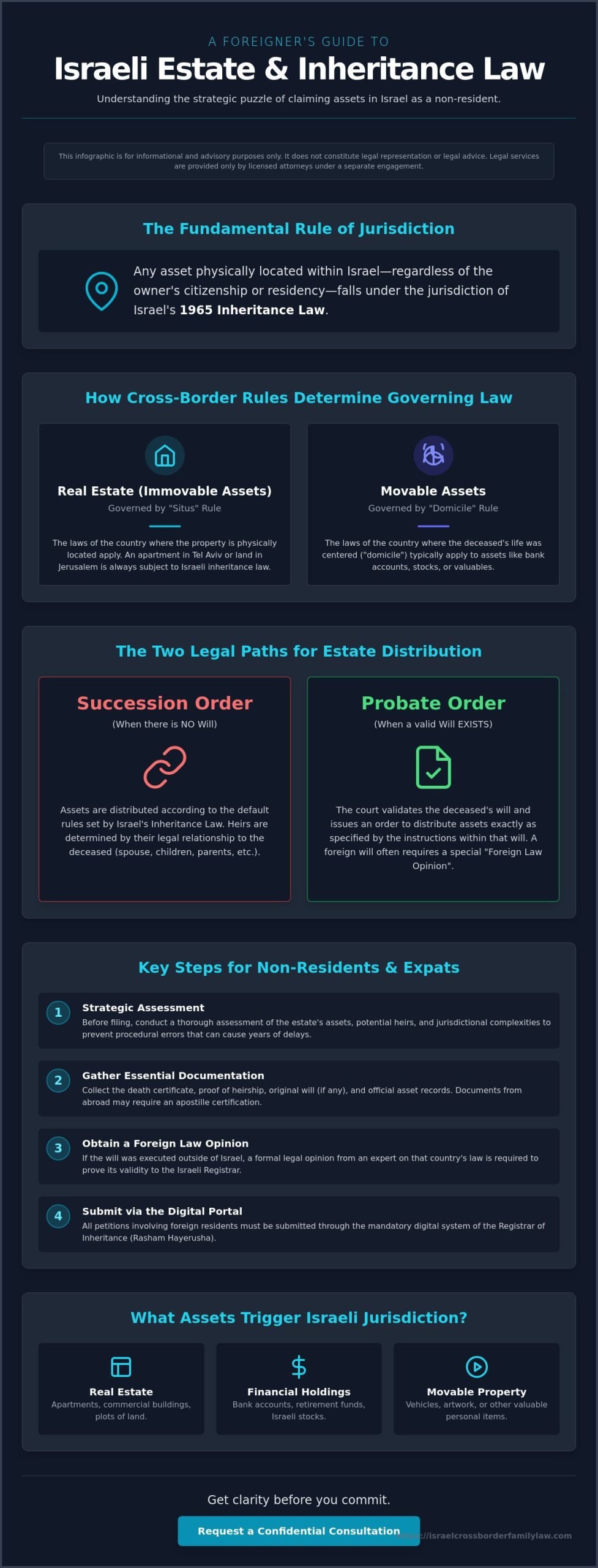
The Israeli Inheritance Law of 1965 serves as the primary framework for distributing assets after a person’s death. This statute provides the rules for both testate succession, when there is a will, and intestate succession, when no will exists. Because the Israeli legal system combines elements of common law and civil law, it can feel unfamiliar to those accustomed to North American or European standards. One of the most critical aspects of israel inheritance law for foreigners is that it asserts jurisdiction over any property physically located within Israel, regardless of where the deceased lived or what passport they held.
Understanding where you stand requires looking at two factors: the location of the assets and the “domicile” of the deceased. While the law of the country where the person lived at the time of death often governs movable assets like cash or jewelry, real estate is almost always governed by the law where the land sits. If your family member owned an apartment in Jerusalem or Tel Aviv, you’ll need to engage with the Israeli system to transfer that title. This is a cornerstone of israel inheritance law for foreigners that often surprises families who expect their home country’s probate to cover everything.
The concept of “domicile” is a frequent point of confusion. In this context, it refers to the place where a person’s life was centered at the time of their passing. If the deceased was a resident of London but owned a home in Herzliya, the Israeli authorities will apply local law to the house. They may defer to UK law for bank accounts, provided a proper legal opinion is submitted to the authorities.
When Does Israeli Law Apply to a Foreigner?
Israeli jurisdiction is triggered the moment an asset is identified within the country’s borders. This includes:
- Real estate such as residential apartments, commercial buildings, or plots of land.
- Financial holdings, including bank accounts, retirement funds, or stocks in Israeli companies.
- Movable property like vehicles or valuable personal items stored in Israel.
The “Unity of the Estate” principle suggests that an estate should be handled as a single entity. However, in practice, Israeli authorities require a local probate or succession order to release any local assets. This is especially true for expats and foreign nationals who may have complex portfolios spanning multiple countries. You can’t simply present a US or UK grant of probate to an Israeli bank and expect them to release funds.
The Role of the Israeli Registrar of Inheritance
The Registrar of Inheritance Affairs (known in Hebrew as Rasham Hayerusha) is the administrative body that oversees most inheritance applications. Its primary function is to verify the validity of claims and ensure that all legal requirements are met before an order is issued. Most cases are handled through an administrative process that doesn’t require a courtroom appearance.
Non-residents often face higher levels of scrutiny during this phase. The Registrar must confirm that no other wills exist and that all potential heirs have been properly notified. As of 2026, all petitions involving foreign residents must be submitted through a mandatory digital portal. If an objection is filed or if the case involves complex legal questions, the file is transferred from the Registrar to the Family Court for a judicial hearing.
This article is published on an independent advisory platform and does not constitute an attorney-client relationship or legal advice. Legal services are provided only by licensed attorneys under a separate engagement.
Succession Order vs. Probate Order: Which Path Do You Need?
Determining the correct legal path for an estate begins with a simple question: did the deceased leave a valid will? In the context of israel inheritance law for foreigners, the answer isn’t always straightforward. A will that’s perfectly valid in New York or London may face significant hurdles when presented to Israel’s Inheritance Registrar. If a recognized will exists, you’ll pursue a Probate Order. If there’s no will, or if the document isn’t legally recognized in IL, you’ll need a Succession Order. Understanding these distinctions early prevents procedural delays that often plague cross-border estates.
Many international families worry that if a relative died “intestate” (without a will), the Israeli state will seize the assets. This is a common misconception. Israeli law provides a clear, structured hierarchy for distribution to ensure property reaches the natural heirs. However, relying on the default law might not align with the deceased’s actual intentions. It’s vital to review the status of existing documents before initiating any formal application with the Registrar.
The Probate Order (Tzav Kiyum Tzava’ah)
A Probate Order is the legal instrument used to validate and execute a will. When a foreign resident leaves assets in Israel, the Registrar must verify that the will meets the formal requirements of the 1965 Inheritance Law. This involves examining signatures, witness statements, and the physical integrity of the document. A foreign will isn’t “Israeli-friendly” by default; it requires a specialized “Foreign Law Expert Opinion” to confirm it was validly executed under the laws of the jurisdiction where it was signed. Challenges often arise if the will lacks specific language regarding Israeli property or if it contradicts mandatory local protections.
The Succession Order (Tzav Yerusha)
When no will is found, the estate follows the path of a Succession Order. This order declares who the legal heirs are based on their relationship to the deceased. Under israel inheritance law for foreigners, the estate is typically divided between the surviving spouse and children. If there’s no spouse or children, the law looks to parents and their descendants. This default system is designed to protect family rights, but it lacks the flexibility of a will. For expats, the challenge lies in proving these family relationships through foreign birth and marriage certificates, all of which must be authenticated with an apostille and translated into Hebrew.
This article is published on an independent advisory platform and does not constitute an attorney-client relationship or legal advice. Legal services are provided only by licensed attorneys under a separate engagement.
The Step-by-Step Process for Non-Residents and Expats
Successfully submitting an application under israel inheritance law for foreigners requires a meticulous approach to the initial stages of documentation. As of 2026, the entire process is handled through a mandatory digital portal managed by the Registrar of Inheritance Affairs. This transition to a digital-first system has streamlined the filing process, but it also means that even minor errors in your paperwork can lead to an immediate rejection. Understanding the sequence of events is the best way to manage expectations and ensure the estate moves toward a resolution without unnecessary friction.
The timeline for a standard, uncontested case typically ranges from 90 to 180 days. This period accounts for the administrative review by the Registrar and a mandatory public notice period. During this time, a notice is published in an Israeli daily newspaper to allow any potential creditors or unknown heirs to come forward. If no objections are filed within the specified window, the Registrar can proceed with issuing the final order.
Essential Documentation for Foreign Heirs
The burden of proof rests on the heirs to provide authenticated evidence of their claims. You’ll need the original will, if one exists, along with official death certificates and identity documents. For any document issued outside of Israel, an Apostille is mandatory to verify its authenticity for international use. Furthermore, all English documents must be accompanied by notarized Hebrew translations. These translations must be precise, as legal terminology often lacks a direct one-to-one equivalent between systems. For a deeper look at these requirements, you can review our guide for expats and foreign nationals.
The Foreign Law Opinion (Havát Da’at)
A unique and critical requirement for non-resident cases is the Foreign Law Opinion, known in Hebrew as Havát Da’at. Because the Israeli Registrar is not an expert in the laws of foreign jurisdictions, they require a formal document explaining how inheritance works in the deceased’s home country or state. This opinion bridges the gap between, for example, US probate standards and Israeli succession rules. It must be authored by a professional qualified to certify the legal standards of that foreign territory. This document is often the most complex part of the application, as it must clearly demonstrate that the foreign will or the proposed distribution of assets complies with both local and international legal thresholds.
This article is published on an independent advisory platform and does not constitute an attorney-client relationship or legal advice. Legal services are provided only by licensed attorneys under a separate engagement.
Jurisdiction and US-Israel Cross-Border Complications
When an estate spans multiple countries, the legal systems involved don’t always align. These “conflicts of laws” can create significant friction for heirs trying to settle an estate. Under israel inheritance law for foreigners, the system distinguishes between different types of property using two primary rules: the “Situs” rule and the “Domicile” rule. Understanding these distinctions is essential for a strategic approach to asset distribution.
The Situs rule dictates that real estate is always governed by the law of the place where the land is located. If your relative owned an apartment in Tel Aviv, Israeli law will determine how that property is inherited. Conversely, the Domicile rule generally applies to “movable” assets like cash, jewelry, or stocks. These are typically governed by the law of the country where the deceased lived at the time of their death. However, applying a foreign law to an Israeli bank account requires a formal legal opinion, and local institutions may still insist on an Israeli probate order before releasing funds.
A common complication for American families involves the use of “Living Trusts.” While these are standard tools in US estate planning, they aren’t always recognized by Israeli financial institutions. Israeli banks often operate under a different legal definition of a trust and may refuse to transfer assets based solely on US trust documents. In many cases, the family must still obtain a local probate order to prove the successor’s rights to the account. If you’re managing complex family dynamics alongside these technical hurdles, it may be helpful to understand how divorce and separation for international families can further complicate estate claims.
The US-Israel Tax Intersection
Israel abolished its inheritance and estate tax in 1981, and as of June 2026, there are no plans to reintroduce it. This is a significant advantage, but it doesn’t mean the process is tax-free. When heirs sell an inherited property in Israel, they’re subject to a 25% Capital Gains Tax, known as Mas Shevach. Unlike the US, Israel does not offer a “step-up in basis” at the time of death. The gain is calculated from the date the deceased originally purchased the property. US citizens also face reporting requirements; if you inherit more than $100,000 from a foreign estate, you must file Form 3520 with the IRS to avoid substantial penalties.
Handling Israeli Bank Accounts and Real Estate
Obtaining a Probate Order is only the first step in the process. To actually take possession of real estate, the order must be registered with the Land Registry, known as the Tabu. For bank accounts, you’ll need to navigate the bank’s internal compliance department, which may require additional documentation regarding the source of funds. Because these steps involve distinct bureaucratic bodies, a coordinated strategy is vital to avoid years of delay. To ensure your filings are handled correctly from the start, request a strategic review of your cross-border assets.
This article is published on an independent advisory platform and does not constitute an attorney-client relationship or legal advice. Legal services are provided only by licensed attorneys under a separate engagement.
Strategic Advisory: Navigating the System with Confidence
Navigating the intricacies of israel inheritance law for foreigners requires more than just filling out forms; it demands a high-level strategy that considers the interplay between two distinct legal systems. Rushing into the probate process without a clear roadmap is a common mistake that can lead to years of administrative gridlock. An early, incorrect filing with the Registrar of Inheritance Affairs can create procedural knots that are difficult and expensive to untie later. Approaching israel inheritance law for foreigners with a structured plan allows you to anticipate these hurdles rather than reacting to them as they arise.
The “Israeli way” of legal administration often relies on specific cultural nuances and informal channels that aren’t immediately obvious to those living abroad. While the system has become more digital, the underlying logic remains rooted in local practice. Understanding these systemic differences is the first step toward gaining confidence that your family’s assets are being handled legally and efficiently. A strategic approach ensures that you aren’t just following a process, but actively managing the outcome to minimize cross-border friction.
Clarity Before Commitment
Before you commit to a specific path, it’s essential to understand the full scope of the journey ahead. This includes a realistic assessment of the time, effort, and financial investment required to settle the estate. In some cases, the cost of securing an Israeli probate order and paying for foreign law opinions might exceed the value of a small, dormant bank account. A Confidential Case Review can help you evaluate the cost-benefit ratio of different assets. Decisions made in the first few weeks after a loss often have the most significant impact on the final outcome. Seeking clarity before signing any representation agreements ensures that your choices are based on logic rather than urgency.
The Role of Cross-Border Advisory
A cross-border advisor serves as a bridge between your local estate planner in the US and the legal practitioners in Israel. This role goes beyond simple representation; it’s about strategic asset management across multiple jurisdictions. You need someone who can translate not just the language, but the legal concepts that often get lost in translation. For example, ensuring your US tax professional is aware of Israeli capital gains obligations is just as important as filing the probate petition itself. By coordinating these moving parts, you move away from a fragmented approach and toward a unified strategy. Knowledge is your most effective tool against the anxiety of dealing with a foreign legal system.
Get clarity before you commit. Request a confidential consultation via an advisory call or WhatsApp.
This article is published on an independent advisory platform and does not constitute an attorney-client relationship or legal advice. Legal services are provided only by licensed attorneys under a separate engagement.
Securing Your Family’s Legacy Across Borders
Managing an international estate is a significant responsibility that requires a nuanced understanding of both local regulations and cross-border tax implications. We have explored how the location of your assets and the specifics of your existing will dictate whether you need a Probate or Succession Order. By prioritizing a clear strategy and gathering authenticated documentation early, you can avoid the common procedural pitfalls that often stall these cases for months. While Israel currently has no inheritance tax, US citizens must remain aware of their federal reporting obligations and local capital gains rules. Knowledge of these intersections is your strongest asset.
Our specialized US-Israel cross-border expertise is designed to meet the unique needs of the Anglo and expat community. We provide a calm, advisory-centered approach that bridges the gap between different legal cultures, ensuring you have a deep understanding of every step. Navigating israel inheritance law for foreigners doesn’t have to be a source of anxiety when you have a structured roadmap and professional guidance. Get clarity before you commit. Request a confidential consultation to move forward with confidence.
This article is published on an independent advisory platform and does not constitute an attorney-client relationship or legal advice. Legal services are provided only by licensed attorneys under a separate engagement.
Frequently Asked Questions
Does a US will work for property in Israel?
A US will can be used to claim property in Israel, but it doesn’t grant automatic access to assets. Under israel inheritance law for foreigners, the document must be validated by the Israeli Registrar through a Probate Order. You’ll need to provide a Foreign Law Expert Opinion to prove the will is valid under the laws of the US state where it was signed. This process ensures the document meets both local and international legal standards.
How long does the probate process take in Israel for a foreigner?
The probate process for non-residents generally takes between 90 and 180 days for standard, uncontested cases. This timeline includes the mandatory period for publishing a notice in an Israeli daily newspaper, which allows creditors or other heirs to come forward. While the digital portal has made submissions more efficient, the need to authenticate foreign documents and obtain expert legal opinions means the process takes longer than a local application.
Is there an inheritance tax in Israel for US citizens?
Israel does not impose an inheritance or estate tax on US citizens or any other heirs as of June 2026. However, US citizens must report any inheritance from a foreign estate exceeding $100,000 to the IRS using Form 3520. Additionally, while there’s no tax on the inheritance itself, you’ll face a 25% Capital Gains Tax (Mas Shevach) on the real gain if you decide to sell an inherited Israeli property later.
What happens if an American dies in Israel without a will?
If an American dies without a will, their Israeli assets are distributed according to the default provisions of the 1965 Inheritance Law. This statute generally divides the estate between the surviving spouse and the children. Because israel inheritance law for foreigners governs all property located within the country, heirs must prove their relationship to the deceased through apostilled birth and marriage certificates. This default path is often more rigid than a personalized estate plan.
Do I need to travel to Israel to claim my inheritance?
Can I sell my inherited Israeli apartment immediately?
Inherited property can be sold once the Probate or Succession Order is registered with the Land Registry, known as the Tabu. You can’t sign a legally binding sale agreement until the title is officially transferred into your name. It’s also vital to account for the 25% capital gains tax on the property’s appreciation since the deceased originally purchased it. Israel doesn’t offer a step-up in basis, so early tax planning is essential before listing the home.
What is an Apostille and why do I need one for my documents?
An Apostille is an international certification that allows a document issued in one country to be recognized as legal in another. Israeli authorities won’t accept foreign death certificates, marriage licenses, or wills without this seal. It confirms the document is authentic and was issued by a legitimate government body. Without an Apostille, your paperwork won’t be processed by the Registrar or the banks, leading to significant delays in the probate timeline.
How much does it cost to obtain a Succession Order in Israel?
Mandatory costs for a Succession Order include a government filing fee of 1.5% of the estate’s value and a newspaper publication fee of 215 NIS. For foreign residents, you must also factor in the cost of a Foreign Law Expert Opinion, which typically ranges from 3,000 to 7,000 ILS in 2026. These statutory fees are separate from any translation or notarization costs. If the case is contested in Family Court, additional court fees starting at 568 NIS may apply.

Article by
Gabriel Lior
A Personal Journey That Became a Mission
The advisory was founded by an American father Gabriel Lior, LLB, MBA , global entrepreneur, and cross-border advisor who spent more than a decade navigating the Israeli family court system firsthand and now lives in Singapore with his son.
As a divorced parent in a cross-border family, Gabriel faced nearly every legal challenge a foreign parent can encounter in Israel — including child custody disputes, child support proceedings, property matters in Israel and abroad, false accusations, and complex immigration and relocation proceedings.
Over the years, he learned the hard way how difficult it is for non-Israeli parents to understand the system, identify the right legal strategy, and choose the right legal representation — especially when language, culture, and jurisdictional differences are involved. He also witnessed how foreign parents and new immigrants are often disadvantaged or taken advantage of by service providers and institutions simply because they lack local knowledge or fluency.
From Client to Advisor
To truly understand — and survive — the system, Gabriel pursued formal legal education in Israel, completing two Israeli law degrees, alongside a BA and MBA earned in the United States. This was never about becoming a practicing attorney, but about gaining a deep, structural understanding of how the system works — and where it breaks down for foreign parents.
This rare combination of:
Firsthand client experience
Israeli legal and US business education
International business and negotiation training
Decades of commercial execution
created a unique perspective – one that understands both sides of the table.
After years of litigation, persistence, and at times self-representation, he ultimately succeeded in securing custody of his son and relocating abroad through a rare legal victory in the Israeli Supreme Court — becoming one of the first fathers in Israel to do so under these circumstances.
Disclaimer
Important Disclaimer:
The information provided on this website and in its content is for general informational and educational purposes only and does not constitute legal advice, legal opinion, or legal representation.
Gabriel Lior is not licensed to practice law in Israel (nor is he interested in doing so) and does not provide legal services, despite having completed 2 Law Degrees. The services offered are advisory in nature and are intended to provide general guidance, strategic insight, and information regarding cross-border family law considerations.
No attorney-client relationship is formed by accessing this website, reading its content, or communicating with us.
Any decisions made based on this information are at your own discretion and risk. For legal advice specific to your situation, you should consult a licensed attorney in the relevant jurisdiction.
Where appropriate, we may refer clients to independent, licensed attorneys or professionals. Such referrals do not constitute legal representation and no liability is assumed for services provided by third parties.