This article is published on an independent advisory platform and does not constitute legal representation or legal advice. Legal services are only provided by licensed attorneys under a separate engagement.
Did you know that 47% of millennials now enter into prenuptial agreements as a practical financial planning tool? When your life spans two continents, the complexity of protecting separate property in an international marriage grows significantly. You may feel concerned that a US pre-nuptial agreement won’t be recognized by an Israeli court, or perhaps you’re worried about accidentally “commingling” assets you owned long before your wedding day.
It’s understandable to feel overwhelmed by the conflicting rules of different legal systems. We’ll help you understand the strategic steps needed to safeguard your individual assets when your property is located across both US and Israeli jurisdictions. This article provides a clear framework for keeping separate property separate, explains the fundamental differences between US and Israeli property division, and offers actionable steps to document your assets for international recognition. For more insights on these topics, you can view helpful resources at https://www.youtube.com/@IsraelFamilyLaw. Get clarity before you commit. Request a confidential consultation.
Key Takeaways
- Understand how Israel’s “Balancing of Resources” principle differs from US community property or equitable distribution laws when dividing assets.
- Learn the essential criteria for protecting separate property in an international marriage, including the specific treatment of inheritances and third-party gifts.
- Discover why maintaining strict financial segregation is the most effective way to prevent the unintentional “commingling” of pre-marital assets.
- Recognize why a standard US pre-nuptial agreement may not be sufficient in Israel and how “mirror agreements” can bridge the gap between jurisdictions.
- Identify the proactive steps needed to document and inventory cross-border assets to minimize the risk of future litigation and ensure international recognition.
This article is published on an independent advisory platform and does not constitute legal representation or legal advice. Legal services are only provided by licensed attorneys under a separate engagement.
Defining Separate Property in a Cross-Border Context
The standard definition of separate property includes assets you acquired before your wedding day, inheritances received at any time, or gifts given to you by a third party. While this sounds straightforward, the “international” status of a marriage adds significant layers of complexity. The laws governing your assets often depend on your domicile, which is the place you call your permanent home, and the physical location of the property itself. Successfully protecting separate property in an international marriage requires more than just knowing what you own; it requires understanding how different matrimonial property systems classify those assets when they cross borders.
One of the greatest risks for global families is “transmutation,” a process where separate property is legally transformed into marital property. This often happens without the owner’s intent. For example, if you use an inheritance to pay off a mortgage on a family home in Israel, or if you deposit pre-marital US dividends into a joint Israeli bank account, you may be inadvertently “commingling” those funds. For international couples, separate property is defined as any asset acquired prior to the marriage or through specific external transfers that remains legally and financially distinct from the marital estate according to the laws of both the asset’s location and the couple’s primary domicile.
To better understand this concept, watch this helpful video:
Common Types of Separate Property for US-Israel Families
- Real Estate: Property held in the US may follow different disclosure rules than property registered in the Israeli Land Registry (Tabu). If an Israeli property was purchased before marriage but marital funds were used for renovations, its “separate” status could be challenged.
- Tech Equity: Many expats hold stock options or RSUs. If these were granted before the marriage but vested during the marriage while living in Israel, the division of these assets becomes a primary point of contention.
- Trusts and Inheritances: An inheritance held in a US-based trust might be protected by state law, but if the distributions are used to support a lifestyle in Israel, an Israeli court might view those funds differently during divorce or separation.
The Burden of Proof: Why Definitions Aren’t Enough
In most international legal disputes, there is a strong presumption that any property owned by a married couple is marital property. The burden of proof lies entirely on the spouse claiming the asset is separate. This is particularly difficult when the “source of funds” must be traced across different currencies and decades of bank statements. You must be able to show a clear, unbroken paper trail that proves the asset was never mixed with shared family finances. Establishing this documentation early is the only way to ensure that your definitions of “separate” hold up under the scrutiny of two different legal systems.
This article is published on an independent advisory platform and does not constitute legal representation or legal advice. Legal services are only provided by licensed attorneys under a separate engagement.
The Legal Collision: US Property Regimes vs. Israeli Law
Property division in the United States typically follows one of two frameworks: community property or equitable distribution. In community property states, assets acquired during the marriage are generally split 50/50. Equitable distribution states focus on a “fair” division, which doesn’t always result in an equal share. Israel operates under the Spouses’ Property Relations Law of 1973, which utilizes the “Balancing of Resources” (Izun Mashabim) principle. This law mandates a default equal division of the value of all assets accumulated during the marriage. When a couple holds assets in both countries, a “conflict of laws” occurs. Courts must determine which jurisdiction’s rules take precedence, a decision often based on the couple’s primary domicile and where the majority of their life is centered.
The complexity increases when considering Israel’s dual legal system. For Jewish citizens, divorce can involve both civil Family Courts and Rabbinical Courts. These venues sometimes view property rights through different lenses, especially regarding the “attachment” of property claims to a divorce suit. The U.S. State Department on Israeli family law notes that these overlapping jurisdictions can create unique challenges for Americans. Protecting separate property in an international marriage requires a sophisticated understanding of how these two distinct legal cultures interact and which court is likely to assert authority over your global portfolio.
The “Balancing of Resources” in Israel
Israeli law aims to equalize the financial positions of spouses upon divorce. While property owned before the marriage is technically excluded, the risk of “Active Appreciation” is high. If a separate asset, such as a pre-marital business, increases in value because of your professional efforts during the marriage, that growth may be subject to balancing. Exceptions to this rule are narrow. You must demonstrate that the asset remained entirely distinct and that no marital resources or efforts contributed to its increased value. This makes proactive asset management essential for international families.
Jurisdictional “Race to the Court”
In cross-border disputes, the location of the initial filing often dictates the legal outcome. This “race to the court” is a strategic reality. A US court might decline jurisdiction under the doctrine of “Forum Non Conveniens” if it determines that Israel is the more appropriate venue. Conversely, filing first in the US may protect certain assets from Israeli balancing rules. Strategy must be established long before any legal papers are served to ensure your interests are protected in the most favorable forum. You can request a review of your specific situation to evaluate these jurisdictional risks.
This article is published on an independent advisory platform and does not constitute legal representation or legal advice. Legal services are only provided by licensed attorneys under a separate engagement.
Steps to Protect Individually Owned Assets
The first step in protecting separate property in an international marriage is creating a comprehensive inventory of all pre-marital assets. This list should include US brokerage accounts, retirement funds, and real estate, as well as any Israeli bank accounts or property registered in the Land Registry (Tabu). Since most marriages performed abroad are recognized as valid under U.S. government guidance on international marriages, the financial entanglements created by your union are legally binding across borders. You must establish a clear “Chain of Title” for every asset, especially those that move between countries, to ensure their separate status remains intact.
Adhering to the “Golden Rule” of separate accounts is the most effective way to prevent legal disputes. You should never use marital income, such as your salary earned while living in Israel, to pay for expenses related to separate property. If you use joint funds to pay the mortgage on a pre-marital home or to fund a US-based investment account, you risk a court ruling that the asset has become marital property. It’s also vital to update your wills and beneficiary designations to reflect your cross-border intentions, as these documents serve as critical evidence of your desire to keep specific assets distinct from the marital estate.
Preventing Commingling Across Borders
Commingling often occurs through small, seemingly insignificant financial decisions. Mixing US rental income with your daily Israeli household expenses is a common mistake that can lead to the loss of separate property status. When performing renovations on a separate property, ensure all costs are paid from a separate account rather than a joint one. You must also maintain meticulous records for every international wire transfer. These documents prove that the funds originated from a separate source and were not mixed with shared family wealth during the transfer process.
Managing Appreciation and Active Effort
Israeli law distinguishes between passive and active appreciation under the “Balancing of Resources” (Izun Mashabim) principle. Passive growth, such as a rise in the value of US stocks due to market trends, usually remains separate. However, active effort, such as managing a pre-marital business or personally overseeing real estate developments, can lead an Israeli court to award a portion of that growth to your spouse. The court often considers the “contribution” of the non-owning spouse, even if that contribution was indirect, such as managing the household. To avoid the balancing of resources, you should maintain annual valuation reports and bank statements that prove the asset’s value grew solely due to market fluctuations rather than your personal labor or marital investment. If you are concerned about how these rules apply to your portfolio, you may want to request a review of your asset structure.
This article is published on an independent advisory platform and does not constitute legal representation or legal advice. Legal services are only provided by licensed attorneys under a separate engagement.
Drafting Effective Cross-Border Financial Agreements
A standard US pre-nuptial agreement often fails to provide adequate protection when it encounters the Israeli legal system. While American courts generally focus on the contractual intent of the parties, Israeli courts require specific formalities under the Spouses’ Property Relations Law of 1973. For protecting separate property in an international marriage, a “Mirror Agreement” strategy is frequently the most robust approach. This involves creating synchronized documents that satisfy the evidentiary standards and registration requirements of both jurisdictions simultaneously. These agreements must include precise “Choice of Law” and “Choice of Forum” clauses to establish which legal framework governs the assets and which court has the authority to resolve disputes.
The most critical step for any agreement intended for use in Israel is the “Validation” (Ishur) process. Unlike the US, where a simple notarization often suffices, an Israeli pre-nuptial agreement must be validated by a judge or a qualified notary. The official must verify that both spouses entered the agreement voluntarily and fully understand its financial consequences. Without this formal validation, an Israeli court may refuse to enforce the agreement, leaving your pre-marital assets vulnerable to the balancing of resources principle discussed in previous sections.
Pre-nuptial vs. Post-nuptial Considerations
If you did not sign an agreement before your wedding, you may still seek protection by drafting a postnuptial agreement. These documents are particularly useful when a family relocates to Israel or acquires new transnational assets. Full and transparent financial disclosure is a non-negotiable requirement for these agreements to remain enforceable. Because of the multi-jurisdictional complexity involved, obtaining independent legal counsel in both the US and Israel is essential to ensure that the agreement respects the public policy of both nations. If you are ready to document your cross-border assets, you can schedule a strategy session to discuss your options.
Enforceability Challenges
Even a well-drafted agreement can face hurdles. Israeli courts may invoke public policy exceptions to void clauses that they deem unconscionable or that violate basic rights. A significant risk involves the “Lifestyle” of the couple while living in Israel. If your daily financial conduct contradicts the written agreement, such as using separate dividends to fund the family’s primary residence, a court might determine that you intended to commingle the assets. Regular periodic reviews of your financial agreements are necessary as you move between countries or change your investment strategies to ensure your legal protections evolve alongside your family’s life.
This article is published on an independent advisory platform and does not constitute legal representation or legal advice. Legal services are only provided by licensed attorneys under a separate engagement.
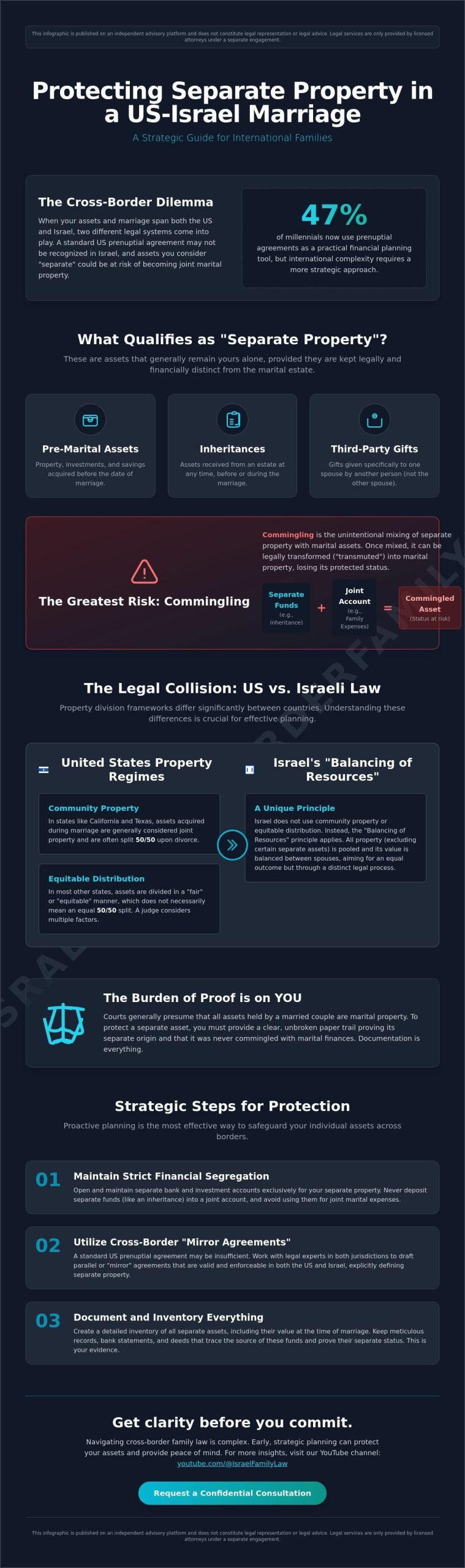
Strategic Planning for International Families
Strategic planning serves as the foundation for long-term financial security in cross-border relationships. It moves the focus away from reactive litigation and toward proactive risk management. Every financial decision you make, from registering a property title to opening a high-yield savings account, carries specific implications for protecting separate property in an international marriage. Early decisions often determine whether an asset remains distinct or becomes vulnerable during a later resource balancing process in Israel. Understanding the nuances of the Israeli legal system for foreigners is essential because the rules governing asset registration and marital rights differ significantly from common US practices.
Adopting a risk-based strategy means evaluating the potential impact of every investment through a dual-jurisdictional lens. When you acquire property or receive an inheritance, you aren’t just making a financial move; you’re making a legal one that must withstand scrutiny in two different countries. Proactive planning helps you identify these “friction points” before they turn into costly disputes. By establishing a clear framework for your assets early in the marriage, you reduce the ambiguity that often leads to years of legal conflict.
The Advisory Approach to Cross-Border Law
A successful strategy requires a bridge between US and Israeli legal cultures. Knowing the written code is only half the battle; you must also understand how judges in different jurisdictions interpret that code in a global context. This advisory approach integrates your matrimonial property protection with your broader estate planning goals. For example, a US trust might offer tax benefits, but its structure must also respect Israeli spousal rights to be truly effective. For visual guides on these multi-jurisdictional complexities, you can explore the resources available on the YouTube channel Israel Family Law. These guides provide additional clarity for international families navigating the intersection of two distinct legal systems.
Next Steps for Asset Security
The most effective way to secure your financial future is to conduct a thorough “Cross-Border Audit” of your current holdings. This process involves reviewing how each asset is titled, where the funds originated, and whether your existing legal documents are recognized in both the US and Israel. Seeking clarity before you make significant financial commitments, such as purchasing a home or moving large sums of money between countries, is vital. It’s much easier to structure an asset correctly from the start than to try and untangle a commingled account years later. Get clarity before you commit. Request a confidential consultation to evaluate your current asset structure and identify potential risks.
This article is published on an independent advisory platform and does not constitute legal representation or legal advice. Legal services are only provided by licensed attorneys under a separate engagement.
Securing Your Global Financial Future
Navigating the intersection of US and Israeli legal systems requires a specialized approach that accounts for the specific risks of each jurisdiction. You now understand how the Israeli “Balancing of Resources” principle can impact your pre-marital assets and why maintaining strict financial segregation is a non-negotiable requirement. By implementing a “Mirror Agreement” strategy and conducting regular audits of your global holdings, you can significantly reduce the risk of future litigation and ensure your assets remain distinct.
Successfully protecting separate property in an international marriage is a continuous process that involves strategic planning and proactive risk management. Our advisory platform offers decades of experience in US-Israel cross-border family law to help international families and English-speaking expats. With bilingual and multi-jurisdictional legal expertise, we serve as a bridge between divergent legal cultures. Get clarity before you commit. Request a confidential consultation. We are here to help you make informed choices that protect your individual interests and your family’s future.
This article is published on an independent advisory platform and does not constitute legal representation or legal advice. Legal services are only provided by licensed attorneys under a separate engagement.
Frequently Asked Questions
Will my US pre-nuptial agreement be honored by an Israeli court?
A US pre-nuptial agreement isn’t automatically enforceable in Israel. For the document to be legally binding, it must undergo a process called “validation” or “Ishur” by an Israeli Family Court or a qualified notary. This step ensures both parties entered the agreement voluntarily and fully understand the financial consequences. Without this formal validation, a spouse may successfully challenge the agreement’s terms during a divorce in IL.
What happens to my US real estate if I get divorced in Israel?
Israeli courts apply the “Balancing of Resources” principle to a couple’s global asset portfolio, regardless of where the property is located. While an Israeli judge may not directly transfer the title of a house in California, they can factor the property’s value into the overall division of assets. If the US real estate is deemed marital property, you might be required to compensate your spouse with other assets to achieve an equal balance.
Can my spouse claim a share of the inheritance I received during our marriage?
Under the Spouses’ Property Relations Law of 1973, inheritances and gifts are generally excluded from the balancing of resources. However, protecting separate property in an international marriage becomes significantly more difficult if those funds are deposited into a joint account. If the inheritance is used for family purposes, such as home renovations in Israel, your spouse may claim that the asset was intentionally commingled and should be shared.
Is it possible to protect my separate property if we have already commingled some funds?
You can still take proactive steps to protect your assets even after some commingling has occurred. A post-nuptial agreement can clearly define which remaining funds or assets should be treated as separate from that point forward. While it’s harder to untangle finances once they’ve been mixed, documenting the source of your remaining capital helps establish a clear legal boundary for any future disputes.
How does the Israeli Rabbinical court handle property division compared to civil courts?
Rabbinical courts are legally required to follow civil law regarding the division of property between spouses. However, the procedural approach can differ, particularly concerning how property claims are “attached” to a divorce suit. Strategic decisions about which court system to approach first can significantly impact the financial outcome, making it essential for international families to understand the dual legal system in IL before filing any paperwork.
Do I need a separate will in Israel to protect my individual assets?
It’s highly advisable to have a separate Israeli will if you own assets in the country. While your US will might be legally valid, the probate process in Israel is much faster and less expensive when a local document exists. A local will ensures your intentions regarding individual assets are perfectly clear and helps your heirs avoid the default distribution rules of the Israeli Succession Law.
What is the best way to document assets I owned before moving to Israel?
The most effective way to document pre-marital assets is through certified valuation reports and bank statements dated close to your wedding or your move to Israel. You should maintain an unbroken paper trail that shows the asset’s growth is purely passive. protecting separate property in an international marriage relies on your ability to prove that marital effort or joint funds never contributed to the asset’s increased value over time.
Can a post-nuptial agreement be signed after we have already moved to Israel?
Yes, signing a post-nuptial agreement after moving to Israel is a common and effective strategy for international families. It allows couples to address assets acquired after their move and provides an opportunity to validate earlier US agreements under Israeli law. This document must be approved by an Israeli Family Court to ensure it meets local legal standards and provides the intended protection for both spouses.

Article by
Gabriel Lior
A Personal Journey That Became a Mission
The advisory was founded by an American father Gabriel Lior, LLB, MBA , global entrepreneur, and cross-border advisor who spent more than a decade navigating the Israeli family court system firsthand and now lives in Singapore with his son.
As a divorced parent in a cross-border family, Gabriel faced nearly every legal challenge a foreign parent can encounter in Israel — including child custody disputes, child support proceedings, property matters in Israel and abroad, false accusations, and complex immigration and relocation proceedings.
Over the years, he learned the hard way how difficult it is for non-Israeli parents to understand the system, identify the right legal strategy, and choose the right legal representation — especially when language, culture, and jurisdictional differences are involved. He also witnessed how foreign parents and new immigrants are often disadvantaged or taken advantage of by service providers and institutions simply because they lack local knowledge or fluency.
From Client to Advisor
To truly understand — and survive — the system, Gabriel pursued formal legal education in Israel, completing two Israeli law degrees, alongside a BA and MBA earned in the United States. This was never about becoming a practicing attorney, but about gaining a deep, structural understanding of how the system works — and where it breaks down for foreign parents.
This rare combination of:
Firsthand client experience
Israeli legal and US business education
International business and negotiation training
Decades of commercial execution
created a unique perspective – one that understands both sides of the table.
After years of litigation, persistence, and at times self-representation, he ultimately succeeded in securing custody of his son and relocating abroad through a rare legal victory in the Israeli Supreme Court — becoming one of the first fathers in Israel to do so under these circumstances.
Disclaimer
Important Disclaimer:
The information provided on this website and in its content is for general informational and educational purposes only and does not constitute legal advice, legal opinion, or legal representation.
Gabriel Lior is not licensed to practice law in Israel (nor is he interested in doing so) and does not provide legal services, despite having completed 2 Law Degrees. The services offered are advisory in nature and are intended to provide general guidance, strategic insight, and information regarding cross-border family law considerations.
No attorney-client relationship is formed by accessing this website, reading its content, or communicating with us.
Any decisions made based on this information are at your own discretion and risk. For legal advice specific to your situation, you should consult a licensed attorney in the relevant jurisdiction.
Where appropriate, we may refer clients to independent, licensed attorneys or professionals. Such referrals do not constitute legal representation and no liability is assumed for services provided by third parties.