A court order from a judge in New York or Tel Aviv is essentially a local document until it crosses the legal bridge of international authentication. Without the correct stamps, a hard-won custody agreement or divorce decree can leave you in a state of jurisdictional limbo where your rights aren’t recognized once you step off the plane. We understand the frustration of realizing that a signed judgment isn’t automatically enforceable across borders, especially when the stakes for your family are so high. This guide provides a clear roadmap for obtaining an apostille for international court documents, ensuring your legal decrees are valid in both the U.S. and Israel.
Navigating the requirements of the Hague Apostille Convention requires precision, particularly with the 10 to 12 week backlogs currently reported for federal authentications in 2026. You’ll learn the critical differences between state and federal processes and how to handle the specific requirements for Israeli court judgments. By the end of this article, you’ll have the clarity needed to protect your cross-border interests and ensure your family’s legal standing remains secure in both jurisdictions. Understanding these steps is the first move toward achieving peace of mind and legal certainty for your international lifestyle.
Key Takeaways
- Understand how an apostille for international court documents serves as the essential legal bridge to verify the authenticity of your U.S. or Israeli judgments abroad.
- Discover how the principle of reciprocity between the U.S. and Israel allows for the formal recognition and enforcement of foreign divorce decrees and custody orders.
- Learn the specific step-by-step requirements for obtaining certified copies and navigating the significant processing delays currently affecting federal authentication.
- Identify why securing multiple authenticated copies of your legal documents before a crisis arises is a critical strategy for protecting your family’s cross-border rights.
- Recognize the common pitfalls in the authentication process that could lead to jurisdictional limbo and delay important personal status updates in Israel.
What is an Apostille for International Court Documents?
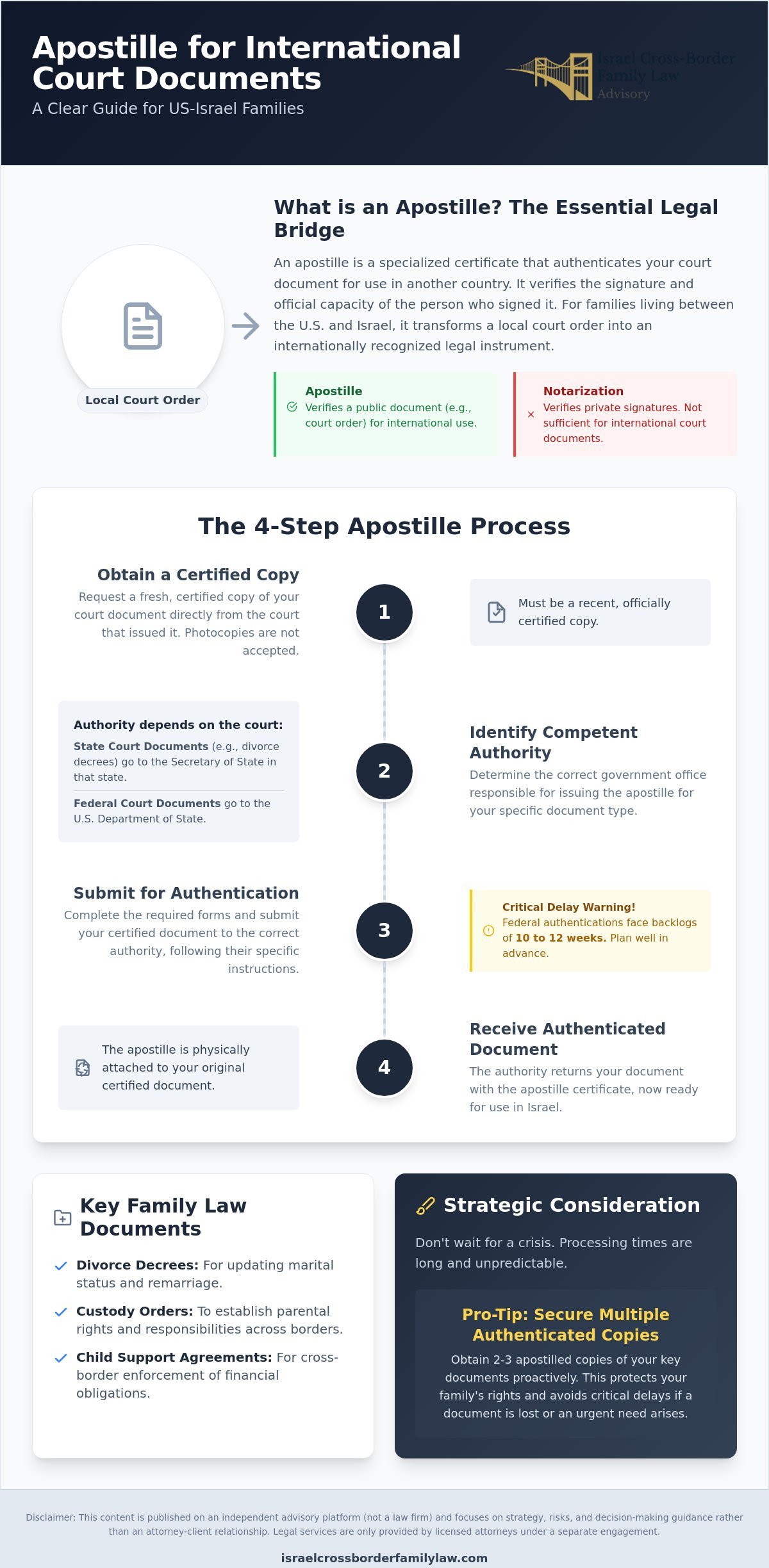
An apostille is a specialized certificate issued by a competent authority to authenticate a document for use in another country. It serves as a formal verification, confirming the legitimacy of the signature and the official capacity of the person who signed the document. For families navigating lives between two nations, obtaining an apostille for international court documents is what transforms a local court order into an internationally recognized legal instrument. Without this specific authentication, an Israeli court or government agency may refuse to acknowledge a U.S. court decree, regardless of its original legal weight.
This verification process ensures that a document issued in one jurisdiction is accepted as genuine in another. It’s the essential first step for any expat or international family needing to enforce rights established in a foreign court. To see how this process facilitates the movement of legal documents between the U.S. and Israel, watch this helpful overview:
The Hague Convention of 1961
The Apostille Convention is the international treaty that standardized the authentication process across member nations. Before this agreement, families had to endure a complex “chain legalization” process involving multiple government departments and consulates. Today, because both the United States and Israel are active members of this convention, a single apostille certificate is sufficient. This treaty simplifies the bureaucratic burden for international families, providing a clear and recognized path for document validation.
Why Notarization is Not Enough
A common point of confusion for many families is the difference between a notary public’s seal and an official government apostille. While a notary verifies private signatures on contracts, court documents are considered public documents issued by a government branch. A notary does not have the authority to certify the signature of a court clerk or a judge. Presenting a document with only a notary stamp often leads to immediate rejection by Israeli authorities. Only the designated state or federal office can provide the high-level authentication required for these official judicial records.
Disclaimer: This content is published on an independent advisory platform (not a law firm) and focuses on strategy, risks, and decision-making guidance rather than an attorney-client relationship. Legal services are only provided by licensed attorneys under a separate engagement.
The Legal Framework: US-Israel Reciprocity
Reciprocity is the legal principle that allows a judgment from one jurisdiction, such as a New York family court, to be recognized and potentially enforced by a court in another, like Tel Aviv. This relationship isn’t automatic. It relies on a mutual trust that both legal systems adhere to fair and recognized standards. An apostille for international court documents serves as the primary evidence that your court document is genuine. It bridges the gap between different judicial systems, providing a standardized way for an Israeli official to verify that a U.S. judge’s signature is authentic without needing to contact the original court directly.
It’s vital to understand the distinction between authenticity and enforcement. While an apostille proves that the document is real, it doesn’t guarantee that the receiving court will automatically grant the relief you’re seeking. The Israeli court will still review the order to ensure it doesn’t contradict local public policy or specific Israeli laws. Because of this complexity, families often benefit from having their documents reviewed to ensure they meet local standards before starting the formal submission process.
Competent Authorities in the United States
The authority responsible for your apostille depends on where the document was issued. For most family law matters, such as state-level divorce decrees, the Secretary of State in the state where the court sits is the competent authority. However, if you’re dealing with federal court orders, you must work with the U.S. Department of State Office of Authentications. You can find detailed guidance on the U.S. Department of State apostille requirements for these specific cases. In 2026, families should prepare for significant federal backlogs, with reports of processing times stretching up to 12 weeks for mail-in requests.
Competent Authorities in Israel
In Israel, the Ministry of Foreign Affairs (MFA) in Jerusalem handles the authentication of Israeli public documents for use abroad. For judicial documents, such as a decree from an Israeli Family Court, you’ll typically need an authentication from a court registrar before the MFA applies the final apostille. The standard fee for an apostille from the MFA is 35 NIS, while a court-level apostille on a notarized document is 41 NIS. For expats living in Israel, these services are generally accessible in Jerusalem, though it’s wise to verify current operational hours, as temporary pauses in service were reported earlier in 2026.
Disclaimer: This content is published on an independent advisory platform and is intended for informational purposes only. It does not constitute legal representation or formal legal advice. Legal services are only provided by licensed attorneys under a separate engagement. This platform focuses on strategy, risks, and decision-making guidance rather than an attorney-client relationship.
Key Court Documents Requiring Authentication in Family Law
In the context of international family law, certain documents carry more weight than others. While a birth certificate is a standard administrative record, a court order represents a judicial decision that affects your fundamental rights and obligations. Obtaining an apostille for international court documents is the only way to ensure these specific decrees are recognized by the relevant authorities in Israel. Without this authentication, you may find yourself unable to update your marital status, travel with your children, or enforce financial support agreements across borders.
The following categories of documents are most frequently subject to these requirements:
- Divorce Decrees: These are essential for updating your personal status at the Israeli Population and Immigration Authority or for obtaining a marriage license in the future.
- Child Custody Orders: These documents are critical for international travel, school enrollment, and proving legal guardianship to Israeli medical or educational institutions.
- Child Support Judgments: Authentication is necessary for the cross-border enforcement of financial obligations, ensuring that support payments continue regardless of where the parents reside.
- Probate and Inheritance Orders: These are required to transfer assets, close bank accounts, or manage real estate holdings located in Israel following the passing of a family member.
Authentication for Divorce and Marital Status
For a “Final Judgment of Divorce” to be recorded in Israel, it must be more than just a signed paper from a judge. You must first obtain a certified copy from the court clerk, which usually includes a raised seal or a specific stamp of authenticity. Only then can the apostille be attached. This process is vital for Divorce in Israel for US Citizens who need to ensure their Israeli records accurately reflect their current marital status. Failing to authenticate these documents correctly can lead to significant complications regarding taxes, residency, and future family planning.
Custody Orders and the Hague Convention
Authenticated custody orders play a defensive role in preventing allegations of international parental child abduction. In many cases, Israeli border officials or the Ministry of Interior will require proof that a parent has the legal right to relocate or travel with a child. An apostille provides this proof in a format that the Israeli legal system is treaty-bound to accept. This becomes especially relevant in enforcing US child support orders in Israel or managing custody disputes that fall under the Hague Convention. Having these documents ready before a conflict arises is a key strategic move for any international family.
Disclaimer: This content is published on an independent advisory platform and is intended for informational purposes only. It does not constitute legal representation or formal legal advice. Legal services are only provided by licensed attorneys under a separate engagement. This platform focuses on strategy, risks, and decision-making guidance rather than an attorney-client relationship.
The Step-by-Step Process: Obtaining Your Apostille
Securing an apostille for international court documents follows a rigid, multi-stage workflow that leaves little room for error. The process is designed to ensure that a document’s journey from a local courthouse to a foreign ministry is documented at every level of government. For families managing cross-border affairs, understanding this sequence is vital to avoid the common pitfalls that lead to document rejection. If you are unsure which level of authentication your specific judgment requires, it’s advisable to request a professional case review to avoid costly delays.
- Step 1: Obtain a certified copy of the court document from the issuing court clerk. This must be a fresh copy with an original signature and seal; a simple photocopy is never sufficient.
- Step 2: Verify if the document requires a county-level certification. In states like New York or California, the County Clerk must often certify the signature of the court official before the state will issue an apostille.
- Step 3: Submit the document to the correct competent authority. This is typically the Secretary of State for state orders or the U.S. Department of State for federal orders.
- Step 4: Pay the required fees. For federal documents, the U.S. Department of State fee is $20.00 per document. You must also include a pre-paid return envelope for the completed paperwork.
- Step 5: Verify the apostille’s validity upon receipt. Once received, ensure the seal is intact and the information matches your document exactly before sending it to Israel.
Handling State Court Documents
The vast majority of family law matters, including divorce and custody, are adjudicated at the state level. To authenticate these, you must coordinate with the Secretary of State’s authentication office in the state where the order was issued. It’s essential to check if your specific jurisdiction requires an “exemplified copy” or a “triple seal” before the apostille can be applied. This is a more robust form of certification where the judge and the clerk cross-verify each other’s authority. Without this specific format, the Secretary of State may refuse to attach the apostille certificate, forcing you to restart the process from the beginning.
Handling Federal Court Documents
While less common, some family law matters end up in federal court, particularly those involving international parental child abduction under the Hague Convention. These documents require a different path. You first obtain a certified copy from the Clerk of the U.S. District Court. Afterward, the document must be sent to the U.S. Department of State Office of Authentications. In 2026, it’s critical to account for significant federal backlogs. Reports indicate that mail-in processing can take 10 to 12 weeks. Planning for these delays is the only way to ensure your legal rights are protected without interruption during a transition between the U.S. and Israel.
Disclaimer: This content is published on an independent advisory platform (not a law firm). We focus on strategy, risks, and decision-making guidance. Legal services are only provided by licensed attorneys under a separate engagement. Get clarity before you commit. Request a confidential consultation.
Strategic Considerations for Cross-Border Families
Managing a family’s legal status across two nations requires a proactive approach that goes beyond simple compliance. Waiting until a legal crisis arises to secure an apostille for international court documents is a common but avoidable mistake. Given the administrative backlogs at the federal level, the time to authenticate your divorce decree or custody order is before you need it. Strategic planning ensures that your legal rights remain portable and enforceable the moment you arrive in a new jurisdiction.
Early Planning and Risk Management
The weight of early decisions in international family law cannot be overstated. A decision made during the initial filing of a divorce or custody case in the U.S. can have long-lasting effects on how that document is perceived in Israel. We recommend seeking clarity on jurisdictional requirements before you commit to a move between the U.S. and Israel. While keeping a digital archive of your records is a helpful organizational tool, remember that Israeli authorities will only accept physical documents with original apostille seals. Secure these documents during the “quiet” periods of your life so you’re prepared for the unexpected.
Navigating the Translation Requirement
An apostille confirms the document is real, but it doesn’t translate the content. Israeli authorities, including the Population and Immigration Authority and the Family Courts, usually require a Hebrew translation of U.S. court documents. This translation often needs a separate certification by an Israeli notary to be considered legally valid. It’s usually more efficient to have the translation performed in Israel by a professional familiar with legal terminology in both systems. For more visual guides on managing these requirements, you can visit the Israel Family Law YouTube channel.
Disclaimer: This content is published on an independent advisory platform (not a law firm). We focus on strategy, risks, and decision-making guidance. Legal services are only provided by licensed attorneys under a separate engagement. Get clarity before you commit. Request a confidential consultation.
Securing Your Family’s Legal Future Across Borders
Navigating the intersection of two legal systems requires a focused strategy and a clear understanding of administrative requirements. Securing an apostille for international court documents isn’t a mere formality; it’s the critical bridge that ensures your U.S. judgments are recognized in Israel. With federal backlogs reaching up to 12 weeks in 2026, early action is your best defense against jurisdictional uncertainty. It’s much easier to authenticate documents during a time of stability than in the middle of a legal crisis.
Success in the Israeli legal system also depends on precise Hebrew translations and maintaining multiple authenticated copies for various government agencies. This independent advisory platform provides strategic guidance for US-Israel families, focusing on risk management and cross-border complexity. By taking these steps now, you protect your family’s rights and ensure your legal standing remains secure in both jurisdictions. Get clarity before you commit. Request a confidential consultation.
Disclaimer: This content is published on an independent advisory platform and is intended for informational purposes only. It does not constitute legal representation or formal legal advice. Legal services are only provided by licensed attorneys under a separate engagement.
Frequently Asked Questions
Does an apostille expire on a court document?
The apostille certificate itself does not have an expiration date. However, the receiving authority in Israel may require that the underlying court order or record be issued within a specific timeframe. For example, documents used for residency or Aliyah applications often must be no more than six months old. You should verify the “freshness” requirements with the Israeli Ministry of Interior before submitting your paperwork.
Can I get an apostille for a court document online?
You cannot currently obtain an apostille for international court documents entirely online. While some U.S. states allow you to start the application via a web portal, you must still submit the physical, certified copy of the court order by mail or in person. The authenticating office must examine the physical seal and signature on the original court document to ensure its legitimacy before attaching the certificate.
What is the difference between an apostille and an authentication?
An apostille is a specific type of authentication certificate used exclusively between countries that are members of the Hague Convention, such as the U.S. and Israel. General “authentication” usually refers to a more complex, multi-step process required for countries that haven’t signed the treaty. Since both nations are members, the streamlined apostille process is the standard requirement for your legal documents.
Do I need an apostille for an Israeli court order to be used in the US?
Yes, an Israeli court order must be authenticated by the Israeli Ministry of Foreign Affairs to be legally recognized in the United States. A standard court stamp from a judge in Israel is insufficient for U.S. authorities. You must obtain the apostille in Jerusalem to prove the document’s validity to U.S. courts, schools, or government agencies.
How much does it cost to get an apostille for a court order in 2026?
In 2026, the fee for a federal apostille from the U.S. Department of State is $20.00 per document. If you’re authenticating an Israeli document, the Ministry of Foreign Affairs charges 35 NIS, while an Israeli court apostille on a notarized document costs 41 NIS. These fees cover the government’s administrative costs and are generally non-refundable regardless of the processing outcome.
Can a notary public issue an apostille?
No, a notary public cannot issue an apostille. A notary only has the authority to witness signatures on private documents. For an apostille for international court documents, only a designated “competent authority,” such as a Secretary of State or the U.S. Department of State, can verify the signature of a court official or clerk.
What happens if the country I am sending the document to is not part of the Hague Convention?
If a country is not a member of the Hague Convention, you must undergo a process called “chain legalization.” This involves multiple stamps from the state level, the federal level, and finally the embassy or consulate of the destination country. Fortunately, since both the U.S. and Israel are members, you can avoid this lengthy procedure by using a standard apostille.
How long does it take to get an apostille from the US Department of State?
Standard processing time at the U.S. Department of State is approximately 10 to 12 business days. However, significant backlogs reported in 2026 have pushed total turnaround times to between 10 and 12 weeks for mail-in requests. Families should plan their legal transitions well in advance to account for these delays and avoid being left without recognized documentation.
Disclaimer: This content is published on an independent advisory platform and is intended for informational purposes only. It does not constitute legal representation or formal legal advice. Legal services are only provided by licensed attorneys under a separate engagement. Get clarity before you commit. Request a confidential consultation.

Article by
Gabriel Lior
A Personal Journey That Became a Mission
The advisory was founded by an American father Gabriel Lior, LLB, MBA , global entrepreneur, and cross-border advisor who spent more than a decade navigating the Israeli family court system firsthand and now lives in Singapore with his son.
As a divorced parent in a cross-border family, Gabriel faced nearly every legal challenge a foreign parent can encounter in Israel — including child custody disputes, child support proceedings, property matters in Israel and abroad, false accusations, and complex immigration and relocation proceedings.
Over the years, he learned the hard way how difficult it is for non-Israeli parents to understand the system, identify the right legal strategy, and choose the right legal representation — especially when language, culture, and jurisdictional differences are involved. He also witnessed how foreign parents and new immigrants are often disadvantaged or taken advantage of by service providers and institutions simply because they lack local knowledge or fluency.
From Client to Advisor
To truly understand — and survive — the system, Gabriel pursued formal legal education in Israel, completing two Israeli law degrees, alongside a BA and MBA earned in the United States. This was never about becoming a practicing attorney, but about gaining a deep, structural understanding of how the system works — and where it breaks down for foreign parents.
This rare combination of:
Firsthand client experience
Israeli legal and US business education
International business and negotiation training
Decades of commercial execution
created a unique perspective – one that understands both sides of the table.
After years of litigation, persistence, and at times self-representation, he ultimately succeeded in securing custody of his son and relocating abroad through a rare legal victory in the Israeli Supreme Court — becoming one of the first fathers in Israel to do so under these circumstances.
Disclaimer
Important Disclaimer:
The information provided on this website and in its content is for general informational and educational purposes only and does not constitute legal advice, legal opinion, or legal representation.
Gabriel Lior is not licensed to practice law in Israel (nor is he interested in doing so) and does not provide legal services, despite having completed 2 Law Degrees. The services offered are advisory in nature and are intended to provide general guidance, strategic insight, and information regarding cross-border family law considerations.
No attorney-client relationship is formed by accessing this website, reading its content, or communicating with us.
Any decisions made based on this information are at your own discretion and risk. For legal advice specific to your situation, you should consult a licensed attorney in the relevant jurisdiction.
Where appropriate, we may refer clients to independent, licensed attorneys or professionals. Such referrals do not constitute legal representation and no liability is assumed for services provided by third parties.