This article is published on an independent advisory platform and does not constitute legal representation or an attorney-client relationship. Legal services are only provided by licensed attorneys under a separate engagement.
What if the most effective way to protect your American retirement account in an Israeli court isn’t to fight for its physical division, but to trade against it? If you are an expat or part of an international family, you likely feel a deep sense of anxiety regarding the process of dividing us assets in israeli divorce. It’s natural to worry that a local judge might not understand the tax implications of a 401(k) or the nuances of US real estate. We understand that the fear of losing your hard-earned savings to an unfamiliar system is overwhelming.
This guide explains the strategic reality of cross-border property division, focusing on the principle of “balancing of resources” to help you avoid unnecessary litigation and tax penalties. You’ll learn how jurisdiction between Family and Rabbinical courts impacts your case, why a US court order remains essential for retirement funds, and how to reach an equitable settlement without moving a single dollar across the ocean. Get clarity before you commit. Request a confidential consultation.
Key Takeaways
- Understand how the “race to the courthouse” determines whether a Family or Rabbinical court governs your international property division.
- Learn how the Israeli principle of “balancing of resources” applies to dividing us assets in israeli divorce, often resulting in financial offsets rather than physical transfers.
- Discover why US retirement accounts like 401(k)s require specialized legal orders and how they are treated as deferred income within the Israeli system.
- Identify the importance of forensic accounting and full disclosure to ensure an accurate valuation of your cross-border financial interests.
- Explore how a comprehensive settlement agreement can resolve complex disputes while minimizing tax penalties and avoiding prolonged litigation.
This article is published on an independent advisory platform and does not constitute legal representation or an attorney-client relationship. Legal services are only provided by licensed attorneys under a separate engagement.
Jurisdiction and the “Race to the Courthouse” for US Assets
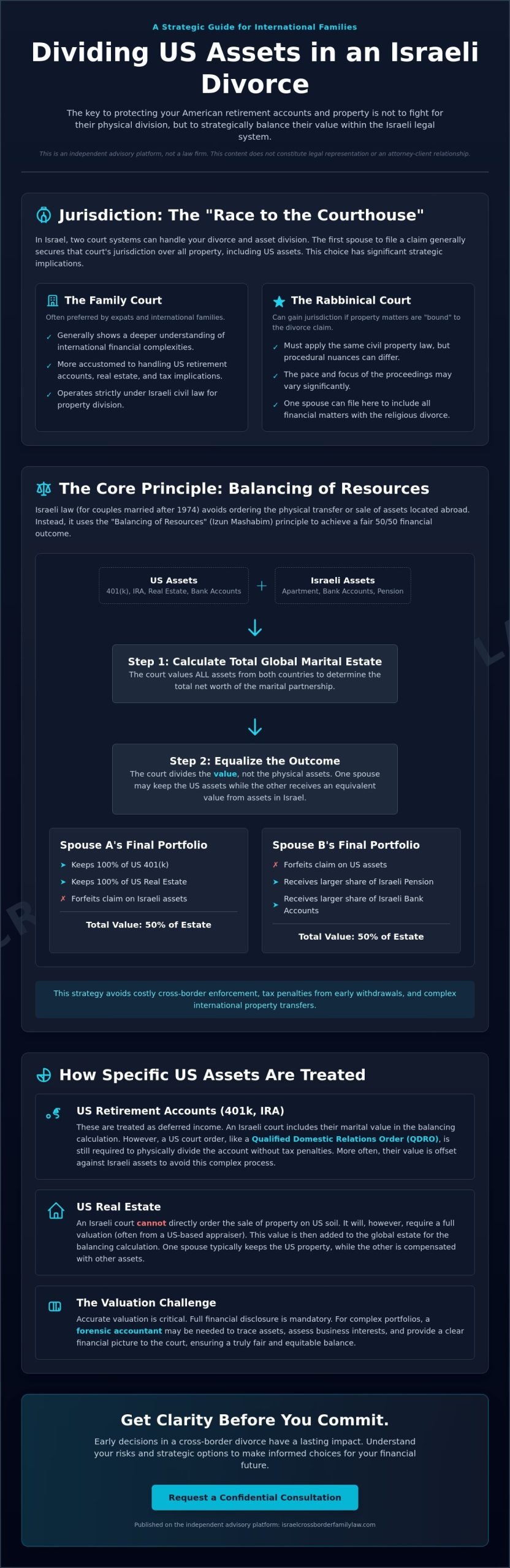
In Israel, the legal system for ending a marriage is unique because two separate court systems have the authority to hear your case. The Family Court and the Rabbinical Court both claim jurisdiction over the process of dividing us assets in israeli divorce, but they often apply different perspectives to the same financial facts. This dual system creates what is known as the “Race to the Courthouse.”
The first spouse to file a lawsuit in one of these courts generally secures that court’s jurisdiction over the couple’s property. This concept, often called forum shopping, is critical when you own US based assets. The division of property can be handled differently depending on where the claim is first registered. While both courts must follow Israeli civil law regarding marital property, the procedural nuances and the speed of the case can vary significantly. Understanding these differences is essential for anyone with a footprint in both countries.
To better understand how assets are evaluated and divided in this system, watch this helpful video:
Family Court vs. Rabbinical Court Jurisdiction
The Rabbinical Court can “bind” property issues to a divorce claim. If one spouse files for divorce there and includes a request to settle property, that court may take control of your US bank accounts and real estate. Many expats prefer the Family Court because it often shows a deeper understanding of international comity. They are generally more accustomed to the complexities of divorce for international families and US financial portfolios.
The Reach of Israeli Orders in the United States
It’s a common misconception that an Israeli judge can directly order the sale of a home in New York or a condo in Florida. Israeli courts don’t have the physical power to seize property located on American soil. Instead, they use a “balancing” approach. They calculate the total value of all global assets and then adjust the distribution of the assets located within IL to achieve a fair result.
If most of your wealth is in the US, you might face challenges. Enforcing an Israeli “balancing” order in a US state court isn’t automatic; it requires a separate legal process in the US to recognize the foreign judgment. In some complex situations, families might consider strategic dual-filing in both IL and the US to ensure their rights are protected in both jurisdictions. This requires a clear strategy before any papers are served.
Get clarity before you commit. Request a confidential consultation.
This article is published on an independent advisory platform and does not constitute legal representation or an attorney-client relationship. Legal services are only provided by licensed attorneys under a separate engagement.
The Legal Framework: Balancing of Resources (Izun Mashabim)
The primary statute governing the division of property for couples married after January 1, 1974, is the Spouses (Property Relations) Law of 1973. This law establishes the “balancing of resources” principle, which treats the marriage as a financial partnership. When you are dividing us assets in israeli divorce proceedings, the court does not necessarily look to split every individual account or property in half. Instead, it calculates the total value of the global estate and seeks to equalize the final numbers.
Israeli judges generally avoid ordering the actual transfer of US titles or the physical sale of American real estate. They recognize that their jurisdiction stops at the border. To achieve a fair result, the court typically awards one spouse a larger share of assets located within IL to offset the value of assets kept by the other spouse in the United States. This mathematical approach helps avoid the technical and tax hurdles often found in IRS Publication 504, which details how the US tax authority views property settlements. By keeping the “balancing” within Israeli borders, families can often bypass the need for complex international wire transfers or foreign deed registrations.
Separate Property vs. Joint Marital Assets
Not every asset is subject to the balancing pot. Assets you owned before the marriage, or those received as an inheritance or gift, are generally considered separate property. However, this protection isn’t absolute. If you commingle US pre-marital funds by moving them into a joint Israeli bank account or using them to pay off a local mortgage, the court may view those funds as joint property. The burden of proof rests on the spouse claiming the asset is separate. You’ll need clear documentation to trace the origin of US funds and prove they were never intended to be shared. If you are unsure about the status of your accounts, it’s wise to seek clarity on international property rules early in the process.
The Valuation Date and Its Impact
The “Date of Separation” or the “Kera” date is the moment the financial partnership officially ends. This date is critical when dealing with market volatility in US brokerage accounts or tech stocks. If the stock market drops significantly between the separation date and the final judgment, the spouse holding the account might be stuck “buying out” the other spouse at a value that no longer exists. Delayed valuation often creates a financial smokescreen that hides the true growth or decline of US based investments during lengthy legal disputes. Selecting the right valuation date is a strategic decision that can save or cost you thousands of dollars.
Get clarity before you commit. Request a confidential consultation.
This article is published on an independent advisory platform and does not constitute legal representation or an attorney-client relationship. Legal services are only provided by licensed attorneys under a separate engagement.
Complex US Assets: 401(k)s, IRAs, and Social Security
Israeli judicial authorities classify US retirement accounts as “deferred income” accumulated during the marital partnership. While this makes them part of the global estate, the mechanics of dividing us assets in israeli divorce are rarely straightforward. A primary challenge is that US plan administrators require a Qualified Domestic Relations Order (QDRO), a document an Israeli court cannot effectively issue. This jurisdictional gap often leaves spouses with a valid Israeli judgment that US financial institutions cannot honor. Without a US court’s involvement, moving these funds can lead to unintended complications.
Social Security benefits present a different hurdle. Since these are federal entitlements, an IL court cannot order their division. However, the court may factor the anticipated income from Social Security into its broader assessment of each spouse’s financial standing. This often leads to a strategy where one spouse “buys out” the other’s interest in a US pension using local Israeli assets, such as savings or home equity. Given that the median 401(k) balance for those aged 55-64 was $537,560 in late 2024, the stakes for getting these valuations right are exceptionally high for international families.
The 401(k) and IRA “Offset” Strategy
The most practical way to handle these accounts is through a financial offset. Instead of attempting to split the US account physically, the court calculates its present value. This calculation must account for the 10% early withdrawal penalty and future US income taxes to be accurate. Citing resources like Understanding How Assets Get Divided In Divorce can help clarify how these valuations differ between jurisdictions. It’s often simpler to leave the US accounts intact and adjust the equity in an IL apartment to compensate the other spouse, avoiding the risk of triggering immediate tax events.
US Real Estate and Foreign Business Interests
When a couple owns a US-based LLC or family business, the Israeli court may appoint an expert, known as an Agmon, to determine its value. These experts are tasked with assessing assets that they cannot physically visit, relying instead on tax returns and financial statements. This makes the discovery process for divorce and separation for international families particularly intense. You’ll need to provide comprehensive records, as the court relies heavily on these valuations to determine the final balancing payment. Without clear data, you risk a valuation that doesn’t reflect the true market reality of your US interests.
Get clarity before you commit. Request a confidential consultation.
This article is published on an independent advisory platform and does not constitute legal representation or an attorney-client relationship. Legal services are only provided by licensed attorneys under a separate engagement.
The Valuation Challenge: Discovery and Forensic Accounting
Israeli family law operates on the principle of full disclosure, requiring both parties to provide a transparent view of their global finances. When dividing us assets in israeli divorce, this duty is absolute. If a spouse attempts to shield a US brokerage account or a property in the Midwest, the consequences can be severe. Israeli courts have the authority to impose financial sanctions or draw negative inferences, which often results in the non-compliant spouse receiving a significantly smaller portion of the local Israeli assets to compensate for the “missing” American wealth.
Obtaining records from US financial institutions for a case in IL requires a specific strategy. While US banks may not respond to an Israeli subpoena directly, an Israeli judge can order a spouse to sign a disclosure waiver or provide certified copies of their statements. In complex cases, the court often appoints a joint forensic accountant. These professionals are trained to trace funds across borders and identify “hidden” assets. If there is a credible risk that a spouse might liquidate US holdings during the proceedings, the court may issue a Mareva injunction. This is a powerful freezing order designed to prevent the dissipation of assets before a final balancing can occur.
Tax Treaty Implications and the “Net” Value
A common mistake in international divorce is valuing US assets at their “gross” market price. A $1,000,000 retirement account is not worth $1,000,000 once you account for US federal taxes and potential early withdrawal penalties. The US-Israel Tax Treaty plays a vital role here; it helps determine which country has the primary taxing rights on liquidated assets. Under Section 4A of Israel’s Real Estate Taxation Law, property transfers incidental to a divorce are often tax-deferred in IL, but this does not erase the eventual US tax liability. You should understand how cross-border financial strategies impact the “net” value of what you actually keep.
Evidence and Documentation from the US
To be admissible in an Israeli court, US documents like tax returns, W-2s, and bank statements must meet specific evidentiary standards. The court typically requires professional Hebrew translations and, in many instances, an apostille to verify the document’s authenticity. These requirements ensure that the valuation of your US interests is based on verified data rather than mere assertions. For more detailed guidance on these procedures, you can watch Cross-Border Family Law Insights. Ensure your global estate is valued accurately before you sign any binding agreements. Request a confidential consultation.
This article is published on an independent advisory platform and does not constitute legal representation or an attorney-client relationship. Legal services are only provided by licensed attorneys under a separate engagement.
Strategic Resolution: Moving Toward a Financial Agreement
The most effective way to manage the complexities of dividing us assets in israeli divorce is through a Comprehensive Settlement Agreement, known in IL as a Heskem Gerushin. This document serves as a private contract that outlines exactly how global property, from Tel Aviv apartments to Delaware LLCs, will be balanced. By drafting a detailed agreement, families can avoid the unpredictability of a court ruling and ensure that the specific tax treatments of US instruments are respected. A well-structured agreement provides a clear roadmap that both parties can rely on, reducing the emotional and financial toll of prolonged conflict.
Mediation is particularly effective for expats with US based interests because it allows for the pre-negotiation of asset offsets. Unlike a judge who may apply a rigid formula, mediation provides the flexibility to trade equity in an Israeli home for the full retention of a US based 401(k). This “Anglo strategy” focuses on domesticating the financial resolution, keeping the actual movement of funds to a minimum. To be legally binding, this agreement must be validated by the Israeli Family Court or Rabbinical Court. Once approved, it carries the weight of a judicial judgment, providing security for both parties.
Risk-Based Decision Making
Every decision in a cross-border divorce should be viewed through the lens of risk and reward. You must evaluate the high cost of international litigation against the potential gain from a court-mandated balancing payment. Engaging in a legal battle over a US brokerage account often leads to the freezing of those funds by US institutions once they are notified of the dispute. Early strategy is essential to prevent these administrative lockouts. Understanding how it works: the cross-border advisory process can help you identify these risks before they escalate into costly legal errors.
Seeking Specialized Cross-Border Counsel
A standard Israeli divorce lawyer may have deep local expertise but might miss the critical nuances of US tax treaties or federal pension laws. Relying on a professional who does not understand both legal cultures can result in an agreement that is unenforceable in the United States or carries hidden tax penalties. An advisor who understands the transnational nature of your estate can bridge the gap between the two systems. To understand your specific exposure and protect your American earnings, you may request a confidential case review. Making informed choices now will determine your financial stability for years to come.
Get clarity before you commit. Request a confidential consultation.
This article is published on an independent advisory platform and does not constitute legal representation or an attorney-client relationship. Legal services are only provided by licensed attorneys under a separate engagement.
Securing Your International Financial Future
Successfully dividing us assets in israeli divorce requires more than just local legal knowledge. It demands a strategic understanding of how two different systems interact. You now know that the “balancing of resources” principle allows for creative offsets that protect your US retirement accounts and real estate from unnecessary liquidation. By prioritizing full disclosure and accurate forensic valuation, you can avoid the risks of hidden tax penalties or jurisdictional lockouts. Early strategy is your most powerful tool in preserving the wealth you’ve built across borders.
Our advisory platform provides authoritative guidance on complex international portfolios, drawing on decades of US-Israel cross-border experience. We specialize in the unique legal needs of the Anglo and expat community living in IL. We understand the nuances of both cultures and legal frameworks. Get clarity before you commit. Request a confidential consultation to discuss your specific situation and exposure. Taking the right steps today ensures a stable and predictable financial path as you move forward with your life.
This article is published on an independent advisory platform and does not constitute legal representation or an attorney-client relationship. Legal services are only provided by licensed attorneys under a separate engagement.
Frequently Asked Questions
Can an Israeli court order the sale of my house in the United States?
An Israeli court cannot physically order the sale of a house located in the United States. It lacks the jurisdictional power to enforce deeds or property titles on American soil. Instead, the judge will calculate the market value of the home and adjust the distribution of your assets in IL to compensate the other spouse. This balancing act ensures a fair financial result without requiring a foreign real estate transaction.
How does the “balancing of resources” affect my US 401(k)?
The “balancing of resources” treats your 401(k) as a joint asset but usually leaves the account itself untouched. The court determines the account’s present value, including potential tax liabilities, and gives your spouse a larger share of local Israeli property or cash. This strategy simplifies dividing us assets in israeli divorce by avoiding the technical hurdles and administrative requirements of American retirement plan providers.
Is my US inheritance considered marital property in an Israeli divorce?
A US inheritance is typically viewed as separate property and is not included in the marital balancing pot. Under the Spouses (Property Relations) Law, assets received through inheritance or as gifts remain with the original owner. However, if you move those funds into a joint Israeli account or use them for shared family expenses, they may lose their protected status through a process called commingling.
What happens if my spouse hides assets in a US bank account?
If a spouse hides assets in the US, the Israeli court can impose significant financial penalties. The principle of full disclosure is mandatory in family law. Judges may draw a negative inference, assuming the hidden funds exist and awarding the other spouse a larger portion of the known global estate. In extreme cases, specialized orders can be used to freeze local assets to prevent financial loss.
Do I need a separate lawyer in the US and Israel for my divorce?
You don’t strictly need two separate lawyers, but having counsel with cross-border experience is vital. While an Israeli lawyer handles the primary divorce proceedings, an American attorney is often necessary to draft specific US court orders like a QDRO for retirement funds. Coordinating between both jurisdictions ensures that your settlement is enforceable in both countries and that no international tax nuances are overlooked.
How does the US-Israel Tax Treaty impact our property settlement?
The US-Israel Tax Treaty helps prevent double taxation and determines which country has the primary right to tax liquidated assets. It’s a critical tool for calculating the true net value of your portfolio. Understanding the treaty ensures that your property settlement accounts for the actual cash you’ll receive after the IRS and the Israeli Tax Authority take their respective shares during the distribution.
Can I enforce an Israeli divorce decree regarding property in a US court?
You can enforce an Israeli decree in the US, but the process is not automatic. A US state court must formally recognize the Israeli judgment through a legal principle called comity. This often requires a separate filing in the US to confirm that the Israeli proceedings met American standards of due process. This step is essential when dividing us assets in israeli divorce that cannot be balanced using local holdings.

Article by
Gabriel Lior
A Personal Journey That Became a Mission
The advisory was founded by an American father Gabriel Lior, LLB, MBA , global entrepreneur, and cross-border advisor who spent more than a decade navigating the Israeli family court system firsthand and now lives in Singapore with his son.
As a divorced parent in a cross-border family, Gabriel faced nearly every legal challenge a foreign parent can encounter in Israel — including child custody disputes, child support proceedings, property matters in Israel and abroad, false accusations, and complex immigration and relocation proceedings.
Over the years, he learned the hard way how difficult it is for non-Israeli parents to understand the system, identify the right legal strategy, and choose the right legal representation — especially when language, culture, and jurisdictional differences are involved. He also witnessed how foreign parents and new immigrants are often disadvantaged or taken advantage of by service providers and institutions simply because they lack local knowledge or fluency.
From Client to Advisor
To truly understand — and survive — the system, Gabriel pursued formal legal education in Israel, completing two Israeli law degrees, alongside a BA and MBA earned in the United States. This was never about becoming a practicing attorney, but about gaining a deep, structural understanding of how the system works — and where it breaks down for foreign parents.
This rare combination of:
Firsthand client experience
Israeli legal and US business education
International business and negotiation training
Decades of commercial execution
created a unique perspective – one that understands both sides of the table.
After years of litigation, persistence, and at times self-representation, he ultimately succeeded in securing custody of his son and relocating abroad through a rare legal victory in the Israeli Supreme Court — becoming one of the first fathers in Israel to do so under these circumstances.
Disclaimer
Important Disclaimer:
The information provided on this website and in its content is for general informational and educational purposes only and does not constitute legal advice, legal opinion, or legal representation.
Gabriel Lior is not licensed to practice law in Israel (nor is he interested in doing so) and does not provide legal services, despite having completed 2 Law Degrees. The services offered are advisory in nature and are intended to provide general guidance, strategic insight, and information regarding cross-border family law considerations.
No attorney-client relationship is formed by accessing this website, reading its content, or communicating with us.
Any decisions made based on this information are at your own discretion and risk. For legal advice specific to your situation, you should consult a licensed attorney in the relevant jurisdiction.
Where appropriate, we may refer clients to independent, licensed attorneys or professionals. Such referrals do not constitute legal representation and no liability is assumed for services provided by third parties.