Making Aliyah is a profound personal and national milestone, yet understanding the full impact of aliyah on divorce proceedings is critical when this dream coincides with the dissolution of a marriage. This intersection creates a formidable legal challenge, often overshadowed by urgent anxieties: Which country’s laws will govern your separation? How will complex assets held in both the United States and Israel be divided? And, most critically, how can you protect your parental rights and access to your children across international borders? Navigating this multi-jurisdictional landscape requires sophisticated legal insight. This comprehensive guide is designed to provide that clarity, advising on the pivotal issues of legal jurisdiction, the equitable division of cross-border assets, and the nuances of child custody agreements between the US and Israel. Our objective is to equip you with a strategic framework for protecting your financial interests and parental rights, empowering you to approach the process with confidence, whether in the US courts or the Israeli Rabbinical Court system.
Key Takeaways
- Establishing jurisdiction between Israeli and US courts is the foundational first step; this strategic decision will fundamentally shape every subsequent aspect of your divorce.
- Discover how the choice of jurisdiction dramatically alters the legal frameworks governing the division of multi-jurisdictional marital assets and the calculation of spousal support.
- Understand the complex international laws, including the Hague Convention, that govern child relocation to or from Israel in order to safeguard your parental rights.
- Uncover proactive legal strategies to manage the impact of aliyah on divorce proceedings, whether you are contemplating Aliyah amidst a separation or are already living in Israel.
The Critical First Question: Establishing Jurisdiction in a US-Israel Divorce
In any multi-jurisdictional dissolution of marriage, no question is more fundamental than that of jurisdiction. This legal principle determines which country’s courts possess the authority to hear your case, and its resolution will dictate the entire trajectory of your divorce. The process of making Aliyah-the immigration to Israel under the Law of Return (for more on What is Aliyah?)-by one or both spouses introduces significant complexity to this determination, creating a sophisticated legal challenge where the initial strategic decisions are paramount. To better understand how personal conduct can influence judicial perspectives in these matters, the following video offers valuable insights:
What is Legal Jurisdiction and Why Does It Matter?
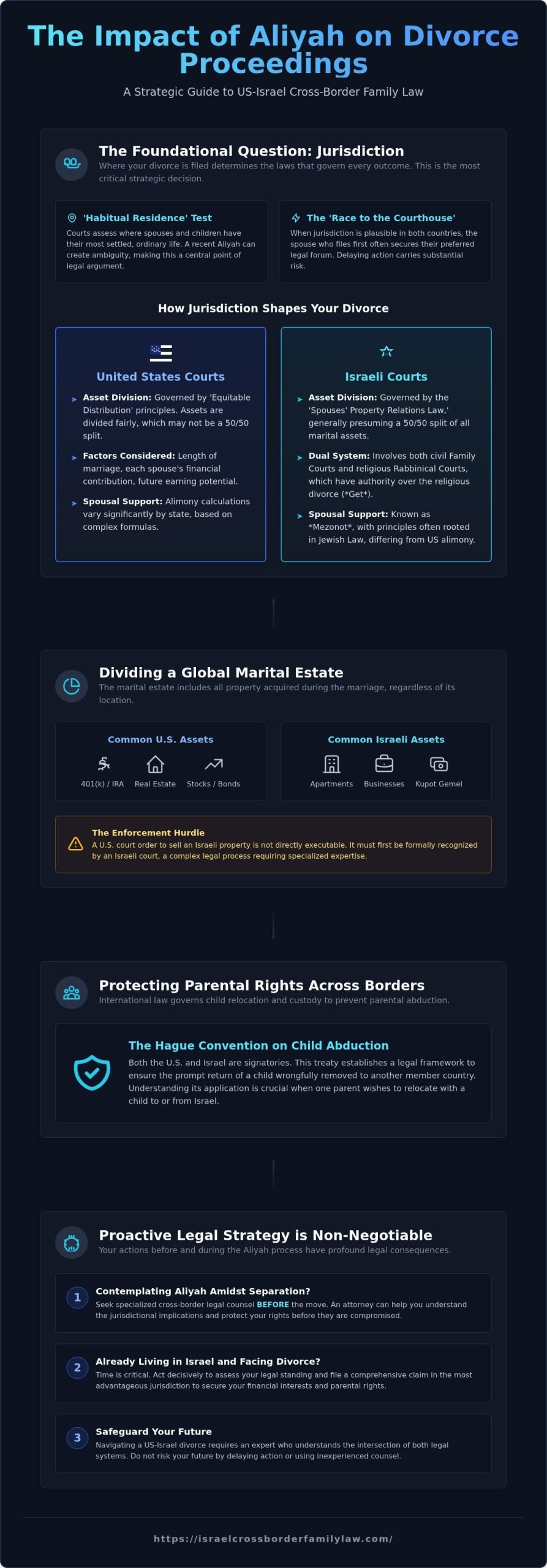
Legal jurisdiction is the court’s power over the parties and the subject matter of the dispute. Its establishment is not a mere formality; it determines the substantive law that will govern critical outcomes, including division of assets, spousal support (mezonot), and child custody arrangements. The legal frameworks of a U.S. state, which may follow principles of equitable distribution, can differ profoundly from Israeli law, which operates under the Spouses’ Property Relations Law. This distinction can have a substantial financial impact, making the choice of forum a decisive factor in the final divorce decree.
How Courts Determine Jurisdiction: ‘Habitual Residence’ and Other Factors
Courts in both the United States and Israel primarily apply a test of ‘habitual residence’ to establish jurisdiction. This assesses where each spouse and any children have their most settled, ordinary course of life. A recent move to Israel can create significant ambiguity, as one party may claim Israel as their new habitual residence while the other maintains ties to the U.S. Courts will also consider secondary factors, such as the location of significant marital assets, business interests, and real property. The ultimate impact of aliyah on divorce proceedings often hinges on how these factors are presented and argued before the court.
The ‘Race to the Courthouse’: The Impact of Filing First
When jurisdiction could plausibly be established in either the U.S. or Israel, a ‘race to the courthouse’ often ensues. The spouse who files a comprehensive claim first can often secure their preferred legal forum, effectively forcing the other party to litigate in that country. Delaying legal action, particularly when an international move is planned or has just occurred, carries substantial risk. It is imperative to seek immediate, specialized legal counsel to assess your strategic position and act decisively to protect your interests.
How Aliyah Transforms Key Aspects of Divorce Proceedings
While establishing jurisdiction is the foundational first step, the true impact of aliyah on divorce proceedings manifests in the substantive handling of core financial and familial matters. The transition from a U.S. legal framework to Israel’s sophisticated, and often complex, system requires strategic navigation. A divorce decree issued in one country is not automatically applied in the other; it involves a multi-layered process of recognition and enforcement that fundamentally alters how assets, support, and even the divorce itself are adjudicated.
Division of Marital Assets and Property Across Borders
For couples with assets in both the United States and Israel, the process of equitable distribution becomes a multi-jurisdictional challenge. The marital estate includes all property acquired during the marriage, regardless of location. This requires a comprehensive valuation of U.S.-based assets like 401(k)s and real estate alongside Israeli assets such as apartments, businesses, and Kupot Gemel (provident funds). A significant hurdle is enforcement; a U.S. court order to sell an Israeli property, for instance, is not directly executable. It must first be recognized by an Israeli court, a process that requires expert legal guidance to ensure compliance with local law and prevent costly delays.
Spousal Support (Alimony) and Child Support Enforcement
The calculation and enforcement of support obligations differ markedly between the two nations. While a U.S. support order can be enforced in Israel under international treaties, the initial determination of amounts can vary. U.S. courts typically rely on statutory guidelines considering factors like income and length of marriage. In Israel, particularly if the case is before a Rabbinical Court, spousal support may be tied to obligations under Jewish law. For child support, both countries are signatories to conventions that facilitate cross-border child support enforcement, but procedural complexities necessitate experienced counsel to manage the international collection process effectively.
Navigating Israeli Family Courts vs. Rabbinical Courts
Israel possesses a unique dual-court system for family law, a critical factor affecting the impact of aliyah on divorce proceedings for Jewish citizens. Spouses may file for divorce in either the secular Family Court or the religious Rabbinical Court (Beit Din). This can lead to a “race to jurisdiction,” where the first to file can secure the forum more favorable to their position. As the U.S. Department of State notes, religious courts have exclusive jurisdiction in a US-Israel divorce over the act of marriage and divorce itself. The Rabbinical Court holds exclusive authority to grant a Get, the Jewish religious divorce document, which is essential for the parties to remarry within the Jewish faith. The choice of court profoundly influences outcomes on matters ranging from property division to custody, making this initial strategic decision paramount.
Child Custody and Relocation: Protecting Your Parental Rights During Aliyah
Among the most complex legal challenges facing families, matters concerning minor children are invariably the most emotionally charged. When Aliyah is a factor, the stakes are elevated, creating a multi-jurisdictional scenario that demands sophisticated legal navigation. A critical aspect of the impact of aliyah on divorce proceedings involves securing the right to relocate with a child, a process governed by stringent international laws designed to protect parental rights and the child’s stability.
The Hague Convention and International Child Abduction
Before any parent considers relocating a child to Israel amidst a separation or divorce, it is imperative to understand the framework of international law. The primary treaty governing these matters is the Hague Convention on the Civil Aspects of International Child Abduction. This convention, to which both Israel and many other nations are signatories, is designed to prevent the wrongful removal or retention of a child from their country of “habitual residence.” Relocating a child to Israel without the explicit consent of the other parent or a court order can be deemed international child abduction, potentially triggering a Hague Convention case for the child’s immediate return. The treaty’s core function is to protect the ‘status quo’ and ensure that custody disputes are adjudicated in the child’s home jurisdiction.
The Legal Process for International Relocation Approval
To legally relocate a child to Israel, a parent must follow one of two established paths. The most direct route is obtaining clear, unequivocal, and notarized written consent from the other parent. In the absence of such an agreement, the parent wishing to make Aliyah with the child must petition the court in the child’s current jurisdiction for permission. The court’s decision will be guided by one paramount standard: the “best interests of the child.” This comprehensive analysis weighs factors such as the child’s ties to their current home, the potential benefits of the move, and the ability to maintain a meaningful relationship with the non-relocating parent.
Crafting a Viable Long-Distance Co-Parenting Plan
A court will not grant permission for an international move without a detailed and practical long-distance co-parenting plan. This document is crucial evidence that the moving parent is committed to fostering the child’s relationship with the other parent. A compelling plan must address several key components:
- Visitation Schedules: Specific schedules for school holidays, summer breaks, and other significant occasions.
- Travel Cost Allocation: A clear and equitable proposal for how the substantial costs of international travel will be managed.
- Communication Protocols: Regular, scheduled video calls, phone calls, and other forms of consistent communication to maintain the parent-child bond.
Exploring modern solutions like virtual visitation can demonstrate a proactive approach to overcoming the challenges of distance. Successfully navigating these cross-border parental rights issues is a significant part of managing the impact of aliyah on divorce proceedings and requires meticulous legal strategy. For expert guidance on these complex international family law matters, contact our firm.
Strategic Legal Planning for Different Aliyah & Divorce Scenarios
Navigating a divorce in a cross-border context requires more than reactive legal action; it demands a proactive and sophisticated strategy tailored to your unique circumstances. Whether you are contemplating Aliyah amidst a separation or facing a marital breakdown after establishing your life in Israel, understanding the legal landscape is paramount. A forward-thinking approach can mitigate future conflicts, protect your assets, and provide a clear path forward. The impact of aliyah on divorce proceedings is significant, and your legal strategy must account for multi-jurisdictional complexities from the outset.
Scenario 1: You Are Divorcing in the US and Plan to Make Aliyah
Finalizing your divorce in the United States before moving to Israel can provide certainty, but the decree must be structured with international realities in mind. We advise clients on incorporating specific clauses that address future relocation, jurisdiction for modifications of support or custody, and international travel arrangements for children. A standard US agreement is often insufficient. Properly structuring agreements for a divorce for international families ensures the judgment is not only valid in the US but also practical and enforceable in Israel, preventing future legal challenges.
Scenario 2: You Made Aliyah and Now Face Divorce in Israel
For new Olim, initiating a divorce in Israel presents unique challenges. The process involves choosing the appropriate forum-either the civil Family Court or the religious Rabbinical Court-a decision with profound implications. A primary concern is how Israeli courts will treat assets located in the US. Under Israeli law, foreign assets are typically considered part of the marital estate and subject to division. Navigating this complex process, often in a new language and legal culture, requires experienced counsel to protect your rights and global financial interests.
Scenario 3: Enforcing a Foreign (US) Divorce Judgment in Israel
A divorce decree issued in the United States is not automatically recognized in Israel. To formalize your status, update records with the Ministry of the Interior (Misrad HaPnim), or remarry in Israel, you must have the foreign judgment formally recognized by an Israeli Family Court. This legal process involves filing a claim to declare the foreign judgment enforceable. While often straightforward, challenges can arise if the original decree conflicts with Israeli public policy or if jurisdictional requirements were not met. Experienced legal representation is crucial to navigate the nuances of this process, ensuring your legal status is secured without delay. Effectively managing the impact of aliyah on divorce proceedings requires specialized, cross-border legal expertise. To discuss your specific situation, contact our firm for a confidential consultation.
Securing Your Future: Strategic Guidance for Aliyah and Divorce
Making Aliyah introduces significant complexities into the dissolution of a marriage, fundamentally altering legal standing and strategic options. As we have explored, the initial determination of jurisdiction is a critical first step that dictates the entire legal path forward. Furthermore, understanding the profound impact of aliyah on divorce proceedings is essential for navigating the intricate challenges related to child custody, international relocation, and the division of multi-jurisdictional assets. Proactive and sophisticated legal planning is not merely advisable; it is imperative for a favorable outcome. Navigating these challenges requires a legal team with proven, dual-system expertise. With decades of experience guiding families through complex cross-border divorces, our firm offers strategic counsel grounded in a deep understanding of both US and Israeli family law. We are dedicated to providing robust asset protection and vigorously defending your parental rights in all child custody matters. To gain clarity and develop a strategy tailored to your circumstances, we invite you to Schedule a Confidential Case Review to Discuss Your Unique Situation. With the right legal partner, you can face this transition with confidence and security, ready to begin the next chapter of your life.
Frequently Asked Questions: Navigating Aliyah and Divorce
What happens if my spouse makes Aliyah in the middle of our US divorce proceedings without my consent?
This action introduces significant multi-jurisdictional complexity. While the US court may retain its jurisdiction, your spouse could attempt to initiate parallel proceedings in Israel. It is imperative to seek immediate counsel from a firm experienced in international family law to enforce US court orders and prevent conflicting rulings. Proactive legal strategy is essential for navigating this challenging scenario and protecting your interests across both legal systems, as this development has a profound impact on divorce proceedings.
Is my US-drafted prenuptial agreement automatically valid in Israel after Aliyah?
A US-drafted prenuptial agreement is not automatically enforceable in Israel. For the agreement to be considered valid, it must be ratified by an Israeli court, either the Family Court or the Rabbinical Court. The court will scrutinize the document to ensure it aligns with Israeli public policy and that both parties entered into it with full comprehension and consent. Our firm provides expert guidance on domesticating such cross-border agreements to ensure their legal standing within Israel.
How long do I need to live in Israel before its courts have jurisdiction over my divorce?
Generally, Israeli courts can assume jurisdiction if one or both spouses have resided in Israel for at least one year. However, jurisdiction can be established under other circumstances, such as if the couple’s last marital home was in Israel or if the defendant spouse is a resident. Determining jurisdiction is a sophisticated legal analysis that depends on the specific, nuanced facts of your case, requiring an assessment by counsel with deep cross-border experience.
Are the outcomes for property division significantly different in Israeli Rabbinical Courts versus Family Courts?
While both courts apply the Spouses’ Property Relations Law, which mandates an equitable division of marital assets, the interpretive framework can differ. Family Courts adhere strictly to secular civil law principles. In contrast, Rabbinical Courts may occasionally allow principles of Jewish law to influence their application, which can, in certain cases, alter the final asset distribution. Understanding this distinction is critical when considering the impact of aliyah on divorce proceedings and selecting the proper legal venue.
Can I continue to receive US social security or pension payments if I divorce and live permanently in Israel?
Yes, in most cases, you can continue receiving US social security and private pension payments while residing in Israel. The United States and Israel maintain a Totalization Agreement that coordinates social security benefits. However, the division of these assets within a divorce requires careful legal planning to ensure compliance with both US and Israeli regulations. Advising clients on the international tax and legal implications of such cross-border retirement assets is a core component of our practice.
If I make Aliyah, will I be forced to use the Rabbinical Court for my divorce?
No, you are not automatically forced into the Rabbinical Court. For Jewish couples, Israel operates under a system known as the “jurisdictional race,” where the first court to receive a filing-either the civil Family Court or the religious Rabbinical Court-typically gains jurisdiction over ancillary matters like property and custody. While only the Rabbinical Court can grant the final religious divorce (`get`), strategic and swift legal action can ensure that all other matters are adjudicated in the secular Family Court.

Article by
Gabriel Lior
A Personal Journey That Became a Mission The advisory was founded by an American father Gabriel Lior, LLB, MBA , global entrepreneur, and cross-border advisor who spent more than a decade navigating the Israeli family court system firsthand and now lives in Singapore with his son.
As a divorced parent in a cross-border family, Gabriel faced nearly every legal challenge a foreign parent can encounter in Israel — including child custody disputes, child support proceedings, property matters in Israel and abroad, false accusations, and complex immigration and relocation proceedings. Over the years, he learned the hard way how difficult it is for non-Israeli parents to understand the system, identify the right legal strategy, and choose the right legal representation — especially when language, culture, and jurisdictional differences are involved. He also witnessed how foreign parents and new immigrants are often disadvantaged or taken advantage of by service providers and institutions simply because they lack local knowledge or fluency. From Client to Advisor To truly understand — and survive — the system, Gabriel pursued formal legal education in Israel, completing two Israeli law degrees, alongside a BA and MBA earned in the United States. This was never about becoming a practicing attorney, but about gaining a deep, structural understanding of how the system works — and where it breaks down for foreign parents. This rare combination of: Firsthand client experience Israeli legal and US business education International business and negotiation training Decades of commercial execution created a unique perspective – one that understands both sides of the table. After years of litigation, persistence, and at times self-representation, he ultimately succeeded in securing custody of his son and relocating abroad through a rare legal victory in the Israeli Supreme Court — becoming one of the first fathers in Israel to do so under these circumstances.
Disclaimer
Important Disclaimer: The information provided on this website and in its content is for general informational and educational purposes only and does not constitute legal advice, legal opinion, or legal representation. Gabriel Lior is not licensed to practice law in Israel (nor is he interested in doing so) and does not provide legal services, despite having completed 2 Law Degrees. The services offered are advisory in nature and are intended to provide general guidance, strategic insight, and information regarding cross-border family law considerations. No attorney-client relationship is formed by accessing this website, reading its content, or communicating with us. Any decisions made based on this information are at your own discretion and risk. For legal advice specific to your situation, you should consult a licensed attorney in the relevant jurisdiction. Where appropriate, we may refer clients to independent, licensed attorneys or professionals. Such referrals do not constitute legal representation and no liability is assumed for services provided by third parties.