This article is published on an independent advisory platform and does not constitute an attorney-client relationship or legal advice. Legal services are only provided by licensed attorneys under a separate engagement.
The success of your return petition in Israel often depends more on your strategy in the first 48 hours than on the final trial itself. For many parents, the discovery that a child has been taken to or retained in Israel brings a paralyzing wave of fear and confusion. Finding an experienced hague convention lawyer israel is a vital step toward regaining control, but early procedural choices often dictate the eventual outcome. It’s natural to feel overwhelmed by the intersection of international treaties and a local legal system that operates differently than what you know in the US or Europe.
We understand the distress of this situation and the fear of making a mistake that could impact your child’s future. This guide provides a strategic, reassuring roadmap to help you understand the Israeli legal process and protect your family’s interests. You’ll learn about the strict timelines of the Family Court, where preliminary hearings are sought within fifteen days and final verdicts are expected within six weeks. We also explain how to find a representative who understands your language and culture. For additional guidance, visit the Israel Family Law YouTube channel. Get clarity before you commit. Request a confidential consultation.
Key Takeaways
- Understand the core principle of “habitual residence” and how it determines which country has the legal authority to decide custody.
- Learn about the procedural reality in Israeli Family Courts, including the difference between the theoretical six-week target and practical timelines.
- Identify why a qualified hague convention lawyer israel focuses on narrow exceptions like “Grave Risk” to build a strategic and evidence-based defense.
- Discover the importance of early procedural actions, such as “Stay of Removal” orders, to secure your child’s location while the case is pending.
- Evaluate the strategic choice between high-stakes litigation and specialized mediation to reach a sustainable resolution for your family.
Understanding the Hague Convention in the Israeli Context
This article is published on an independent advisory platform and does not constitute an attorney-client relationship. Legal services are only provided by licensed attorneys under a separate engagement. The Hague Convention on the Civil Aspects of International Child Abduction is a civil treaty designed to ensure the prompt return of children who have been wrongfully removed or retained away from their country of “habitual residence.” Israel became a full signatory to this treaty in 1991, which means its courts are legally bound to follow international standards when a child is brought into or kept in the country without consent.
The primary goal of the convention isn’t to decide which parent is “better” or who should have custody. Instead, it determines which country has the legal jurisdiction to make those long-term decisions. If you’re facing this crisis, consulting a hague convention lawyer israel is essential because the court’s focus is narrow and procedural. It’s about restoring the status quo that existed before the abduction occurred, rather than relitigating the entire family history.
To better understand this concept, watch this helpful video:
Dealing with cases between the US and Israel introduces significant complexity due to the inherent differences between legal systems and cultures. A hague convention lawyer israel helps bridge the gap between these two jurisdictions, ensuring that your case follows the specific requirements of the Israeli Family Court while respecting international obligations. For more information on how these cases are managed, you can read about the Hague Convention process on our platform.
The Definition of Habitual Residence
In Hague proceedings, “habitual residence” is often described as the child’s center of life. Israeli courts don’t just look at where a child is physically standing; they examine the degree of integration into a new environment. This includes factors like schooling, social activities, and the shared intent of the parents. Early decisions, such as enrolling a child in an Israeli school or signing a long-term lease, can unintentionally signal a change in habitual residence. You should seek clarity on how these actions impact your case before making permanent commitments.
The Role of the Central Authority
The Israeli Ministry of Justice serves as the designated Central Authority for these matters. They coordinate with the US State Department and other international bodies to facilitate the return process. While the Central Authority provides administrative support, they don’t act as your personal legal representative in court. Their role is to ensure the treaty is upheld, which is why having your own strategic guidance is necessary to protect your specific interests and navigate the local court’s expectations. Get clarity before you commit. Request a confidential consultation.
This article is published on an independent advisory platform and does not constitute an attorney-client relationship. Legal services are only provided by licensed attorneys under a separate engagement.
The Role of Israeli Family Courts in Hague Proceedings
The Israeli Family Court holds exclusive jurisdiction over all Hague Convention matters. Unlike standard civil litigation, these proceedings are designed to move at a rapid pace to minimize the time a child spends away from their home country. According to information from Israel’s Central Authority for Hague cases, the court’s mandate is to determine if a “wrongful removal” or “wrongful retention” occurred. This happens when a child is taken or kept in violation of custody rights exercised in the country of habitual residence.
While the law seeks a final verdict within six weeks, the practical reality often differs. Complex cases involving international evidence can stretch between six to twelve months. This discrepancy makes it vital to work with a hague convention lawyer israel who understands how to manage these timelines effectively. Judges in these courts are well-versed in family law and international treaties, though they also handle standard domestic cases. They focus strictly on the return of the child rather than long-term custody arrangements.
Expedited Procedures and Regulations
Under Rule 295 of the Regulations of Civil Procedure-1984, Hague cases receive priority on the court’s docket. To lower barriers for searching parents, court filing fees are generally not imposed for these specific applications. If you’re located abroad, the court may allow video testimony so you don’t have to travel to Israel immediately. These rules aim to ensure that the facts are heard quickly. If you’re navigating these hurdles from abroad, you might find it helpful to review how we support expats and foreign nationals in these situations.
Evidence and Testimony Standards
Evidence in Hague cases is strictly limited to the issues of the treaty. The court focuses only on the facts of the removal and potential defenses, not on who is the “better” parent. Affidavits serve as the primary form of testimony, and judges frequently exclude evidence related to general custody disputes. This prevents the “abductor’s advantage,” where a parent tries to delay the return by proving they provide a better home environment in Israel.
In some instances, the court appoints social workers or psychological experts to interview the child. This is particularly relevant if a “mature child” objects to returning. Because these reports carry significant weight, your strategy must account for how these experts are briefed and how their findings are presented to the judge. If you’re feeling uncertain about the next step, it’s wise to reach out for a perspective on your specific circumstances. Get clarity before you commit. Request a confidential consultation.
This article is published on an independent advisory platform and does not constitute an attorney-client relationship. Legal services are only provided by licensed attorneys under a separate engagement.
Key Legal Defences and Strategies in Israel
Israeli courts approach Hague Convention cases with a strong presumption in favor of returning the child. They interpret legal defences narrowly to prevent what is often called the “abductor’s advantage.” This is the idea that a parent shouldn’t be able to create a new reality on the ground by moving a child and then using that time to claim the child is now “settled.” A hague convention lawyer israel focuses on the high burden of proof required to overcome this presumption. Because Israel is committed to its role in the official list of signatory countries, judges generally expect children to be returned unless an exception is proven with clear evidence.
Navigating the Grave Risk Exception
The “Grave Risk” defence under Article 13b is perhaps the most frequently cited but hardest to prove. In Israel, general claims of parental unfitness or a difficult home environment aren’t enough. The domestic violence or instability must reach a threshold where the child’s physical or psychological safety is in immediate jeopardy. Israeli judges often look at whether the “home” country’s legal system is capable of protecting the child. If the court believes the US or UK courts can handle the safety issues, they’ll likely order the return. Don’t risk your case by attempting to create a “grave risk” through your own actions during the dispute, as courts often see through these tactical moves.
The Child’s Maturity and Voice
At what point does a child get a say? Israeli courts may consider the objections of a child if they’ve reached an age and degree of maturity where it’s appropriate to take their views into account. This isn’t a simple interview. It often involves “layettes,” which are specialized sessions with trained professionals who assess the child’s true feelings. It’s vital to distinguish between a child’s preference (which parent they like more) and a child’s objection (a reasoned refusal to return). This nuance is a common point of confusion in international custody and relocation matters.
Consent and Acquiescence
The court also looks at whether the left-behind parent originally agreed to the move or later accepted it. There’s a major difference between a parent saying “I agree you can move to Israel” and a parent who simply didn’t file a lawsuit for several months. Consent must be clear and unequivocal. Acquiescence involves the parent’s conduct after the move. If you’ve sent emails or signed documents that suggest you’ve accepted the new living arrangement, it can significantly weaken your case for a return. Get clarity before you commit. Request a confidential consultation.
This article is published on an independent advisory platform and does not constitute an attorney-client relationship. Legal services are only provided by licensed attorneys under a separate engagement.
The Timeline and Procedural Reality of a Hague Case
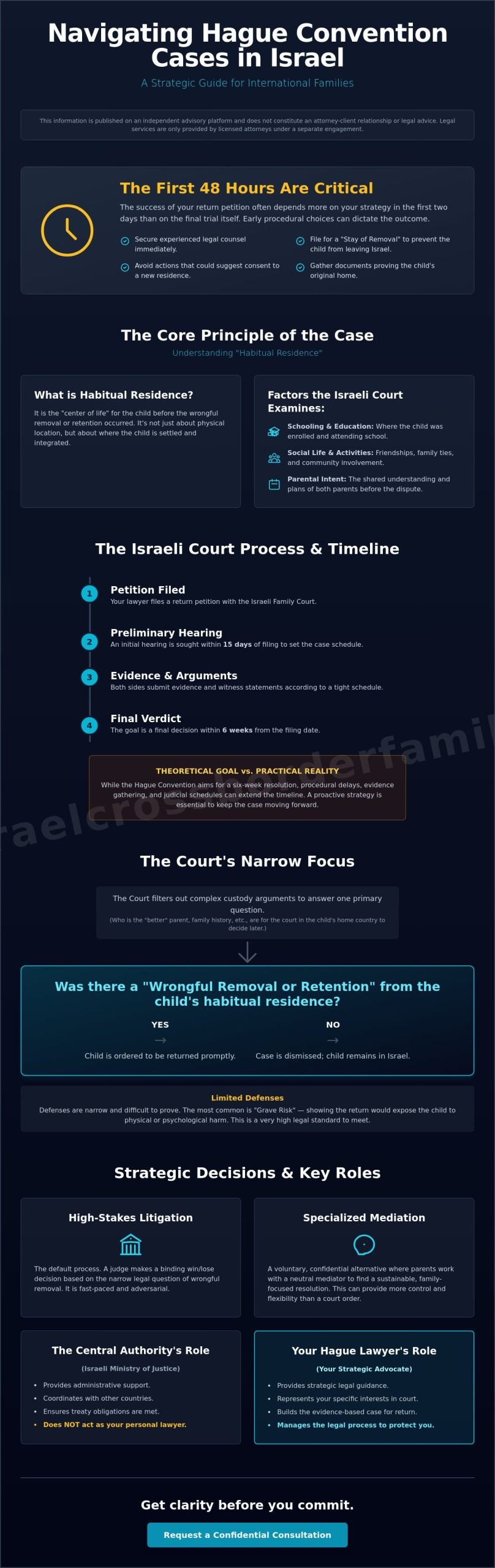
While the treaty aims for a resolution within six weeks, the practical reality of litigating in Israel often looks different. Most cases involving international evidence and expert testimony take between six to twelve months to reach a final conclusion. This delay is why securing a hague convention lawyer israel as early as possible is vital. One of the first strategic actions involves requesting a “Stay of Removal” order. This prevents the child from being moved again or taken out of the country while the legal process unfolds.
A return order from the court is not the end of the journey. If the judge orders a return, they’ll also set a specific date and conditions for the travel. If the other parent refuses to comply, enforcement involves the Israeli Center for Collection of Fines and the police. Understanding these mechanics helps you plan for the transition. You can learn more about the procedural steps of a Hague case to prepare for what lies ahead.
Step-by-Step Procedural Roadmap
- Filing the Application: You can file through the Central Authority in your home country or directly in the Israeli Family Court. Direct filing is often faster.
- Preliminary Hearing: The court usually schedules an initial hearing within fifteen days to set the ground rules and determine if any immediate protections are needed.
- Evidence and Judgment: Unlike standard cases, Hague trials are condensed. The judge reviews affidavits and cross-examines witnesses before issuing a written judgment.
The Appeals Process in Israel
In Israel, the window to appeal a Family Court decision in a Hague case is exceptionally short. You have only seven days to file an appeal with the District Court. This rapid turnaround requires a hague convention lawyer israel who can mobilize quickly. The District Court then aims to issue its decision within thirty days, though this target is also frequently extended.
A final level of appeal exists with the Supreme Court, but it isn’t a right. You must request “leave to appeal,” and the Supreme Court only accepts cases that present a significant legal question or a potential miscarriage of justice. While rare, these appeals are strategically important for setting precedents in complex cross-border situations. If you’re facing a looming deadline, it’s critical to seek a case review immediately. Get clarity before you commit. Request a confidential consultation.
This article is published on an independent advisory platform and does not constitute an attorney-client relationship. Legal services are only provided by licensed attorneys under a separate engagement.
Strategic Decision-Making in Cross-Border Family Disputes
Litigation under the Hague Convention is often an all-or-nothing scenario. The court either orders the child’s return or refuses it entirely. This binary outcome creates extreme pressure, which is why a hague convention lawyer israel should be consulted to evaluate the strength of your evidence before you file. Specialized mediation can often serve as a bridge between two legal systems, allowing families to reach an agreement that a court might not have the flexibility to order. Mediation isn’t just about compromise; it’s about finding a sustainable path forward that avoids the emotional and financial toll of a prolonged international trial.
Early strategy is always more cost-effective than reacting to a crisis after the fact. Once a case is filed in the Family Court, the procedural clock starts ticking and costs begin to mount quickly. By setting a clear roadmap from the start, you avoid expensive mistakes that could ruin your case later. It’s better to spend time on strategy now than to spend months trying to fix a procedural error that happened in the first few days of the dispute.
Assessing the Risks of Hague Litigation
One way to mitigate risk is through the use of Mirror Orders. These are legal protections issued in the home country that mirror the conditions set by the Israeli court. For example, if an Israeli judge orders a return on the condition that the left-behind parent provides separate housing or financial support, a Mirror Order ensures this is enforceable in a US court. Beyond safety, you must consider the financial impact. International litigation involves significant expenses, including travel, expert fees, and translation services. You can review our information on pricing and legal costs to understand the potential investment required for your situation.
The Importance of Multi-Jurisdictional Strategy
A successful outcome depends on a seamless connection between your legal teams in both countries. Your hague convention lawyer israel must coordinate closely with your US counsel to ensure your arguments are consistent across both borders. If you have simultaneous proceedings in both Israel and the US, a mistake in one jurisdiction can be used against you in the other. This complexity is why a unified strategy is necessary for international families.
Handling these cases requires a deep understanding of both legal systems and the cultural nuances of the Israeli court. For a more visual explanation of these dynamics, you can watch our detailed video on Hague Convention Child Abduction. Making informed choices through risk-based decision-making is the best way to protect your child’s future.
Get clarity before you commit. Request a confidential consultation.
This article is published on an independent advisory platform and does not constitute an attorney-client relationship. Legal services are only provided by licensed attorneys under a separate engagement.
Securing Your Family’s Future Through Strategic Action
Navigating international child abduction requires more than just legal knowledge; it demands a comprehensive understanding of how two distinct legal systems interact. As we explored, the success of a case often rests on the initial strategy and the ability to act within the strict procedural windows of the Israeli Family Court. Whether you’re dealing with the narrow “Grave Risk” exception or coordinating mirror orders across borders, the decisions you make today will shape your family’s long-term security. Early clarity is the most effective tool you have to protect your child’s interests.
Our advisory platform draws on decades of multi-jurisdictional litigation experience and maintains a physical presence in both Tel Aviv and New York. This dual-market expertise ensures that your strategy remains cohesive across both the US and Israeli legal landscapes. Finding a hague convention lawyer israel who understands your culture and language is the first step toward regaining control of the situation. Get clarity before you commit. Request a confidential consultation. You don’t have to face this complexity alone; expert guidance is available to walk you through every step of the process.
This article is published on an independent advisory platform and does not constitute an attorney-client relationship. Legal services are only provided by licensed attorneys under a separate engagement.
Frequently Asked Questions
How long does a Hague Convention case typically take in Israel?
While Israeli law aims for a final verdict within six weeks, the practical reality is that most cases take between six to twelve months. This timeframe accounts for the complexity of gathering international evidence, conducting expert evaluations, and the likelihood of an appeal. Your hague convention lawyer israel will focus on navigating these procedural hurdles to keep the case moving as quickly as possible within the court system.
Can I stop my child from being taken out of Israel during a dispute?
Yes, you can request an immediate “Stay of Removal” or stop order from the Family Court to prevent the child from leaving the country. This order is a standard protective measure in abduction cases and is designed to ensure the child remains within the jurisdiction of the Israeli court while the return petition is being decided. It’s often one of the first strategic steps taken in a cross-border dispute.
What is considered “habitual residence” for a child moving between the US and Israel?
Habitual residence is defined as the child’s “center of life” immediately before the alleged abduction or retention. Israeli courts look at a variety of factors, including the child’s integration into school, social activities, and the shared intent of both parents regarding the move. It is a factual determination based on the child’s daily reality rather than their legal citizenship or immigration status.
Does the Hague Convention apply if the parents were never married?
Yes, the convention applies to all children under the age of 16 regardless of their parents’ marital status. The key requirement is that the left-behind parent was actually exercising custody rights under the law of the child’s habitual residence at the time of the removal. Marital status does not change the treaty’s focus on returning the child to their original home environment.
What are the main defences against a Hague return order in Israel?
The most common defences include proving that returning the child would create a “grave risk” of physical or psychological harm or that a mature child strongly objects to the return. Other defences involve showing that the left-behind parent consented to the move or that the petition was filed more than a year after the move and the child is now well-settled in Israel.
How much does it cost to hire a Hague Convention lawyer in Israel?
Legal fees for Hague cases vary depending on the complexity of the multi-jurisdictional issues and the amount of evidence required. You’ll typically encounter hourly rates for litigation or flat-fee retainers for specific stages of the case. It’s important to discuss the fee structure with your hague convention lawyer israel early on to understand the potential financial commitment for travel, translations, and expert witnesses.
Will the Israeli court consider the child’s preference in a return hearing?
The court will only consider a child’s views if they have reached an age and degree of maturity where it’s appropriate to take their opinions into account. However, a child’s simple preference to stay in Israel is generally not enough to stop a return order. The court looks for a reasoned objection that is independent of parental influence or “alienation” strategies.
What happens if a parent refuses to follow a court-ordered return?
If a parent fails to comply with a return order, the Israeli court can involve the Center for Collection of Fines and the Israel Police to enforce the child’s departure. Non-compliance can also result in significant financial sanctions or contempt of court proceedings. The legal system is designed to ensure that the return order is respected and that the child is safely transported back to their home country.

Article by
Gabriel Lior
A Personal Journey That Became a Mission
The advisory was founded by an American father Gabriel Lior, LLB, MBA , global entrepreneur, and cross-border advisor who spent more than a decade navigating the Israeli family court system firsthand and now lives in Singapore with his son.
As a divorced parent in a cross-border family, Gabriel faced nearly every legal challenge a foreign parent can encounter in Israel — including child custody disputes, child support proceedings, property matters in Israel and abroad, false accusations, and complex immigration and relocation proceedings.
Over the years, he learned the hard way how difficult it is for non-Israeli parents to understand the system, identify the right legal strategy, and choose the right legal representation — especially when language, culture, and jurisdictional differences are involved. He also witnessed how foreign parents and new immigrants are often disadvantaged or taken advantage of by service providers and institutions simply because they lack local knowledge or fluency.
From Client to Advisor
To truly understand — and survive — the system, Gabriel pursued formal legal education in Israel, completing two Israeli law degrees, alongside a BA and MBA earned in the United States. This was never about becoming a practicing attorney, but about gaining a deep, structural understanding of how the system works — and where it breaks down for foreign parents.
This rare combination of:
Firsthand client experience
Israeli legal and US business education
International business and negotiation training
Decades of commercial execution
created a unique perspective – one that understands both sides of the table.
After years of litigation, persistence, and at times self-representation, he ultimately succeeded in securing custody of his son and relocating abroad through a rare legal victory in the Israeli Supreme Court — becoming one of the first fathers in Israel to do so under these circumstances.
Disclaimer
Important Disclaimer:
The information provided on this website and in its content is for general informational and educational purposes only and does not constitute legal advice, legal opinion, or legal representation.
Gabriel Lior is not licensed to practice law in Israel (nor is he interested in doing so) and does not provide legal services, despite having completed 2 Law Degrees. The services offered are advisory in nature and are intended to provide general guidance, strategic insight, and information regarding cross-border family law considerations.
No attorney-client relationship is formed by accessing this website, reading its content, or communicating with us.
Any decisions made based on this information are at your own discretion and risk. For legal advice specific to your situation, you should consult a licensed attorney in the relevant jurisdiction.
Where appropriate, we may refer clients to independent, licensed attorneys or professionals. Such referrals do not constitute legal representation and no liability is assumed for services provided by third parties.