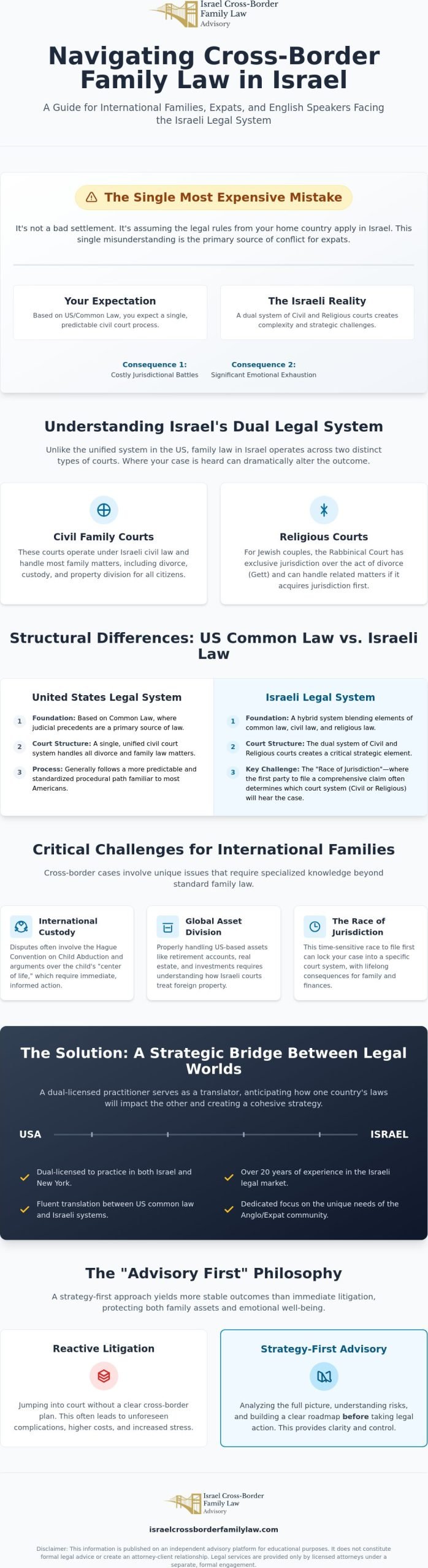
The most expensive mistake in an international divorce isn’t a bad settlement; it’s assuming the legal rules from your home country apply in Israel. For many expats and international families, the realization that Israel operates under a dual legal system of civil and religious courts often comes too late. This confusion can lead to costly jurisdictional battles and significant emotional exhaustion. Jay Hait serves as a strategic bridge for those caught between these two legal worlds, translating the complexities of the Israeli system into a clear, actionable roadmap for his clients.
You likely feel the weight of every decision, knowing that a single misstep in a foreign court can have lifelong consequences for your family and your assets. It is natural to feel overwhelmed by the “Race of Jurisdiction” or the evolving standards of joint parental responsibility in the Israeli courts. This article provides an objective overview of how a strategic approach can protect your future. We will examine the critical differences between US and Israeli law, the importance of early decision-making, and how authoritative expertise can provide the security you need during a period of profound transition.
Key Takeaways
- Identify the structural differences between US common law and the Israeli dual legal system to help prevent costly procedural mistakes.
- Discover how Jay Hait applies a multi-jurisdictional perspective to help international families manage the complexities of cross-border divorce and estate planning.
- Understand the critical role of the Hague Convention and “center of life” arguments in resolving international custody and relocation disputes.
- Learn why a strategy-first approach often yields more stable outcomes than immediate litigation when protecting family assets and emotional well-being.
- Note that this information is published on an independent advisory platform and doesn’t constitute legal advice or a formal attorney-client relationship.
Who is Jay Hait? A Bridge Between Legal Jurisdictions
Jay Hait holds a unique position as a legal practitioner licensed to practice in both Israel and the United States, specifically in the state of New York. This dual qualification allows him to act as a strategic translator between two distinct legal cultures, providing a necessary bridge for those who find the Israeli system foreign or unforgiving. For international families, the transition from US common law expectations to the realities of the Israeli system is often jarring. His core philosophy focuses on providing strategic clarity, ensuring that families understand the risks and opportunities inherent in cross-border matters before they commit to a significant legal course of action.
It’s essential to understand that this overview is provided by an independent advisory platform. While the insights here reflect deep professional experience, they are intended for educational purposes and don’t constitute formal legal representation. You can learn more about the advisory approach to see how strategic planning differs from traditional litigation. Legal services are only provided by licensed attorneys under a separate, formal engagement.
To better understand how this dual perspective benefits international families, watch this helpful overview:
The Multijurisdictional Advantage
Dual licensing isn’t just a credential; it’s a strategic necessity when your life spans two continents. Managing assets such as US-based retirement accounts or real estate while navigating an Israeli divorce requires a practitioner who understands how one jurisdiction’s rulings affect the other. Jay Hait leverages over two decades of experience in the Israeli market to help clients anticipate how local judges might interpret international agreements. This historical longevity is vital when dealing with the Hague Convention on International Child Abduction, as these cases move quickly and require immediate, informed action. Understanding the nuances of Hague Convention child abduction protocols in Israel is often the difference between a successful return and a protracted legal battle.
A Focus on the Anglo and Expat Community
The fear of making a mistake in a foreign language is a primary driver of stress for English speakers in Israel. Most legal proceedings, documents, and negotiations happen in Hebrew, leaving many expats feeling sidelined in their own cases. By focusing on the Anglo community, the advisory ensures that communication remains clear and accessible. Educational tools, including the Israel Family Law YouTube channel, empower families with knowledge before they enter a courtroom. This focus on education helps demystify the “Race of Jurisdiction” and other unique aspects of the Israeli system, providing a sense of security through authoritative expertise and cultural understanding.
Specialized Advocacy for International Families in Israel
International families face a layer of complexity that local families simply don’t. While a standard Israeli practitioner might focus on local assets, an international family often has a global footprint. This includes US-based retirement accounts, real estate in multiple states, and tax implications that span borders. Jay Hait specializes in this intersection, ensuring that legal strategies account for both the Israeli legal framework and US common law traditions. As noted in the Dun’s 100 Profile of Hait Family Law, this dual-country expertise is a critical differentiator for those navigating the Israeli system for the first time.
Standard Israeli legal advice often overlooks the long-term impact of early decisions in international litigation. In Israel, the “Race of Jurisdiction” between civil Family Courts and religious Rabbinical Courts can dictate the entire trajectory of a case. For an expat, choosing the wrong venue or failing to secure a “Stay of Exit” order early can lead to irreversible consequences. These decisions carry significant weight. They determine which laws will govern your children’s future and your financial security. Finding clarity before making these commitments is the most effective way to avoid costly procedural errors.
International Divorce and Asset Division
Dividing assets across borders requires more than just a list of property. US-based retirement accounts, like 401(k)s and IRAs, follow specific federal and state rules that an Israeli court may not fully grasp. Without a strategy that translates these assets into the Israeli context, you risk losing significant value or facing unexpected tax penalties. Strategic management involves deciding where to file first and how to present these complex financial structures to an Israeli judge. This is particularly vital for expats and foreign nationals who must prove their “center of life” to maintain residency or status during the legal process.
Cross-Border Wills and Estate Planning
Estate planning for international families is rarely a “one-size-fits-all” solution. A will drafted in the US might be valid there but face hurdles in an Israeli probate court if it doesn’t meet specific local requirements. Ensuring your US will is recognized and enforceable in Israel requires a nuanced understanding of how dual-country inheritance works. Protecting assets for future generations means accounting for different tax regimes and legal definitions of heirs. If you are unsure how your current arrangements will hold up under Israeli law, it is wise to request a strategic review of your situation.
Strategic Management of International Custody and Support
When children are involved in a cross-border dispute, the legal stakes rise exponentially. Jay Hait emphasizes that these cases aren’t just about parental rights; they’re about navigating a rigid international regulatory framework that prioritizes the “best interests of the child.” In US-Israel matters, the primary governing body is the Hague Convention. It’s designed to return children to their country of “habitual residence” following a wrongful removal. A measured, strategic approach is necessary because decisions made in the heat of a dispute can have irreversible consequences for your family’s future residency and status.
Israeli courts take relocation and “center of life” arguments very seriously. To maintain residency or succeed in a relocation petition, you must prove that your primary social, financial, and educational ties are rooted in the country. This “center of life” requirement is a critical factor in how judges view the stability of a child’s environment. Without a clear strategy that addresses these cultural and legal benchmarks, international families often find themselves trapped in a foreign system without a clear exit or entry plan.
Hague Convention and Child Abduction
The legal thresholds for international child abduction are strict and time-sensitive. In Israel, Hague Convention proceedings move much faster than standard family law cases. You can expect an initial hearing within 15 days of filing. While the treaty’s goal is a final decision within six weeks, the practical reality in Israeli courts is typically 45 to 90 days. This accelerated pace leaves little room for error. Understanding the specific evidentiary requirements for Hague Convention & Child Abduction is vital for any parent facing a potential or actual removal situation.
Cross-Border Child Support Enforcement
Enforcing child support across borders is a complex regulatory journey. A support judgment issued by a US court isn’t automatically enforceable in Israel; it requires a formal recognition process through the Israeli civil court system. Common pitfalls arise when US citizens move to Israel with existing support obligations, assuming their foreign status protects them from local enforcement. In reality, failing to manage these obligations can lead to:
- “Stay of Exit” orders that prevent you from leaving Israel until debts are settled.
- Freezing of Israeli bank accounts or assets.
- Direct enforcement through the Israeli Collection and Enforcement Agency.
Securing professional guidance on Child Support Cross-Border Enforcement helps ensure that your international transition doesn’t result in unexpected legal or financial blockades.
The “Advisory First” Philosophy: Strategy Over Litigation
Litigation in cross-border family law is frequently the most expensive and emotionally draining path. While local practitioners might push for immediate court filings to secure jurisdiction, Jay Hait advocates for a strategy-first model. This approach prioritizes “Clarity Before Commitment,” allowing families to understand the full scope of their legal standing before entering a courtroom. It’s a risk-mitigation tool that recognizes the unique complexities of the Israeli system, where the wrong initial filing can lock you into an unfavorable legal venue for years.
This content is published on an independent advisory platform and is intended for informational purposes only. It doesn’t establish an attorney-client relationship or constitute formal legal advice. Legal representation is provided exclusively through separate, licensed engagements. Choosing an advisory model over aggressive litigation helps you maintain control over the process rather than leaving decisions entirely to a judge who may not understand your cultural background.
Mediation and negotiation serve as vital alternatives for preserving family assets. In Israel, complex and contested divorce cases can often exceed ₪100,000 per parent in legal fees. By focusing on advisory services, families can often reach settlements that protect their US-based retirement accounts and real estate without the unpredictability of a court ruling. This collaborative approach focuses on long-term stability rather than short-term legal victories.
Predictive Risk Assessment
Before any formal legal proceedings begin, it’s essential to analyze potential outcomes. An independent case review identifies hidden jurisdictional risks that a standard lawyer might miss. This predictive assessment helps you understand how Israeli courts might view your “center of life” or how foreign support orders might be enforced. You can explore how it works to see how this structured review provides the clarity needed to make informed decisions before you sign any binding documents.
Collaborative Professional Networks
A unified global strategy requires more than just local expertise. It involves working seamlessly with your US-based counsel to ensure that actions taken in Israel don’t negatively impact your legal standing or tax liabilities in the United States. International family law frequently intersects with complex financial and tax regulations that require specialized oversight. Positioning the advisory as a partner to your existing professional team ensures that every decision is commercially aware and strategically sound. If you’re ready to move from confusion to a clear plan, contact us for a strategic review of your situation.
Preparing for Your Consultation: Next Steps for Clarity
Organizing your documentation is the first step toward gaining control over a complex cross-border situation. When you prepare for a review with Jay Hait, it’s helpful to gather all relevant international records. This includes marriage certificates, prenuptial agreements, and comprehensive financial statements for assets located in both the US and Israel. Having US-based retirement account details and real estate valuations ready allows for a more precise analysis of how these assets might be treated under the Israeli dual legal system.
It’s important to understand the distinction between an advisory consultation and formal legal representation. This platform provides strategic guidance and educational resources to help you understand risks and decision-making frameworks. Formal legal services, such as appearing in court or filing motions, are only provided by licensed attorneys under a separate, signed engagement. This advisory-first approach ensures you have a clear roadmap before you commit to the financial and emotional costs of a courtroom battle.
Seeking Early Guidance
Waiting to seek advice can frequently jeopardize your jurisdictional advantages. In Israel, the “Race of Jurisdiction” means that being the first to file in the correct court can fundamentally change the outcome of your case. A Confidential Case Review allows you to explore these risks in a secure environment. During an initial strategy session, you can expect a calm assessment of your current standing and a discussion of the potential paths forward, helping you avoid the panic that often leads to costly legal mistakes.
Conclusion and Call to Action
Navigating the legal landscape between the United States and Israel requires more than just local knowledge; it requires a strategic bridge between two cultures. Jay Hait provides the authoritative expertise needed to help international families move forward with confidence. By prioritizing strategy over immediate litigation, you can protect your assets and your family’s well-being. You can learn more about the advisory and how this specialized advocacy supports the expat community.
Get clarity before you commit. Request a confidential consultation.
Securing Your Family’s Future Across Borders
Navigating the intersection of US and Israeli law doesn’t have to be a source of constant anxiety. By prioritizing a strategic, advisory-first approach, you can manage the complexities of international divorce, custody, and estate planning with confidence. Jay Hait brings over 20 years of specialized experience as a multi-jurisdictional practitioner to help families translate foreign legal realities into actionable plans. As a firm recognized by Duns 100, the focus remains on protecting your assets and your children’s best interests through calm, authoritative advocacy.
This platform serves as an independent advisory resource. It’s designed to provide the clarity you need before making lifelong commitments. While the legal landscape is inherently complex, starting with a predictive risk assessment ensures you aren’t walking into a foreign courtroom unprepared. You can take the first step toward a more secure future by organizing your documentation and seeking a professional review of your specific circumstances.
Get clarity before you commit. Request a confidential consultation.
You have the power to protect your future through informed, strategic choices. We look forward to helping you find the right path forward.
Frequently Asked Questions
Is Jay Hait licensed to practice law in both the US and Israel?
Yes, he is licensed to practice in both jurisdictions, specifically in Israel and the State of New York. This dual qualification is essential for international families who need their US legal expectations translated into the realities of the Israeli system. It allows for a comprehensive understanding of how rulings in one country may impact assets or legal standing in the other.
How does Jay Hait’s approach to divorce differ from other Israeli lawyers?
His approach prioritizes strategic clarity and risk mitigation before any formal legal action begins. While many local practitioners focus on the immediate “Race of Jurisdiction,” Jay Hait emphasizes an “advisory first” model. This method helps families understand the long-term consequences of their choices, such as venue selection and asset protection, rather than rushing into aggressive and costly litigation.
Can Jay Hait help with enforcing a US divorce decree in Israel?
Yes, the firm provides guidance on the formal recognition process required to make foreign judgments enforceable in Israeli courts. A US divorce decree isn’t automatically valid in Israel; it must undergo a specific legal procedure. This involves demonstrating that the judgment doesn’t contradict local public policy and that both parties were given a fair opportunity to be heard during the original proceedings.
What is the role of the Israel Family Law YouTube channel in his practice?
The channel serves as a primary educational resource for the Anglo and expat community living in Israel. It provides accessible, plain-English explanations of complex legal topics like custody, support, and inheritance. By offering these videos, the practice empowers families with knowledge, helping them feel more secure and less overwhelmed by the Hebrew-dominant legal environment they must navigate.
Does the firm handle cases involving the Hague Convention on Child Abduction?
Yes, managing international child abduction cases is a core area of expertise within the practice. These proceedings are highly specialized and operate on an accelerated timeline, with initial hearings in Israel often scheduled within 15 days of filing. The firm focuses on meeting the strict evidentiary requirements of the Hague Convention to secure the prompt return of children to their habitual residence.
Can I schedule a consultation if I am still living in the United States?
Yes, many consultations are conducted remotely for clients who are still in the United States or are planning a move to Israel. Early strategic planning is often most effective before a physical relocation occurs. This allows you to understand potential jurisdictional risks and residency requirements, such as the “center of life” test, before you make any binding legal commitments.
How does Jay Hait manage the division of US-based assets like 401ks or IRAs?
He manages these assets by applying a multi-jurisdictional perspective that accounts for both Israeli property laws and US federal tax regulations. Dividing a 401k or IRA requires a strategy that prevents unexpected tax penalties while ensuring the asset’s value is accurately recognized by an Israeli judge. Jay Hait often collaborates with financial professionals to ensure these complex assets are protected during a divorce.
Is the advisory platform different from a standard law firm engagement?
Yes, this advisory platform focuses on providing informational and strategic guidance rather than formal legal representation. Content published here is intended to help families navigate risks and make informed decisions. Formal legal services, such as filing court documents or appearing in hearings, are only provided by licensed attorneys under a separate and distinct engagement agreement specifically for legal representation.

Article by
Gabriel Lior
A Personal Journey That Became a Mission
The advisory was founded by an American father Gabriel Lior, LLB, MBA , global entrepreneur, and cross-border advisor who spent more than a decade navigating the Israeli family court system firsthand and now lives in Singapore with his son.
As a divorced parent in a cross-border family, Gabriel faced nearly every legal challenge a foreign parent can encounter in Israel — including child custody disputes, child support proceedings, property matters in Israel and abroad, false accusations, and complex immigration and relocation proceedings.
Over the years, he learned the hard way how difficult it is for non-Israeli parents to understand the system, identify the right legal strategy, and choose the right legal representation — especially when language, culture, and jurisdictional differences are involved. He also witnessed how foreign parents and new immigrants are often disadvantaged or taken advantage of by service providers and institutions simply because they lack local knowledge or fluency.
From Client to Advisor
To truly understand — and survive — the system, Gabriel pursued formal legal education in Israel, completing two Israeli law degrees, alongside a BA and MBA earned in the United States. This was never about becoming a practicing attorney, but about gaining a deep, structural understanding of how the system works — and where it breaks down for foreign parents.
This rare combination of:
Firsthand client experience
Israeli legal and US business education
International business and negotiation training
Decades of commercial execution
created a unique perspective – one that understands both sides of the table.
After years of litigation, persistence, and at times self-representation, he ultimately succeeded in securing custody of his son and relocating abroad through a rare legal victory in the Israeli Supreme Court — becoming one of the first fathers in Israel to do so under these circumstances.
Disclaimer
Important Disclaimer:
The information provided on this website and in its content is for general informational and educational purposes only and does not constitute legal advice, legal opinion, or legal representation.
Gabriel Lior is not licensed to practice law in Israel (nor is he interested in doing so) and does not provide legal services, despite having completed 2 Law Degrees. The services offered are advisory in nature and are intended to provide general guidance, strategic insight, and information regarding cross-border family law considerations.
No attorney-client relationship is formed by accessing this website, reading its content, or communicating with us.
Any decisions made based on this information are at your own discretion and risk. For legal advice specific to your situation, you should consult a licensed attorney in the relevant jurisdiction.
Where appropriate, we may refer clients to independent, licensed attorneys or professionals. Such referrals do not constitute legal representation and no liability is assumed for services provided by third parties.