This article is published on an independent advisory platform and does not constitute an attorney-client relationship. Legal services are only provided by licensed attorneys under a separate engagement.
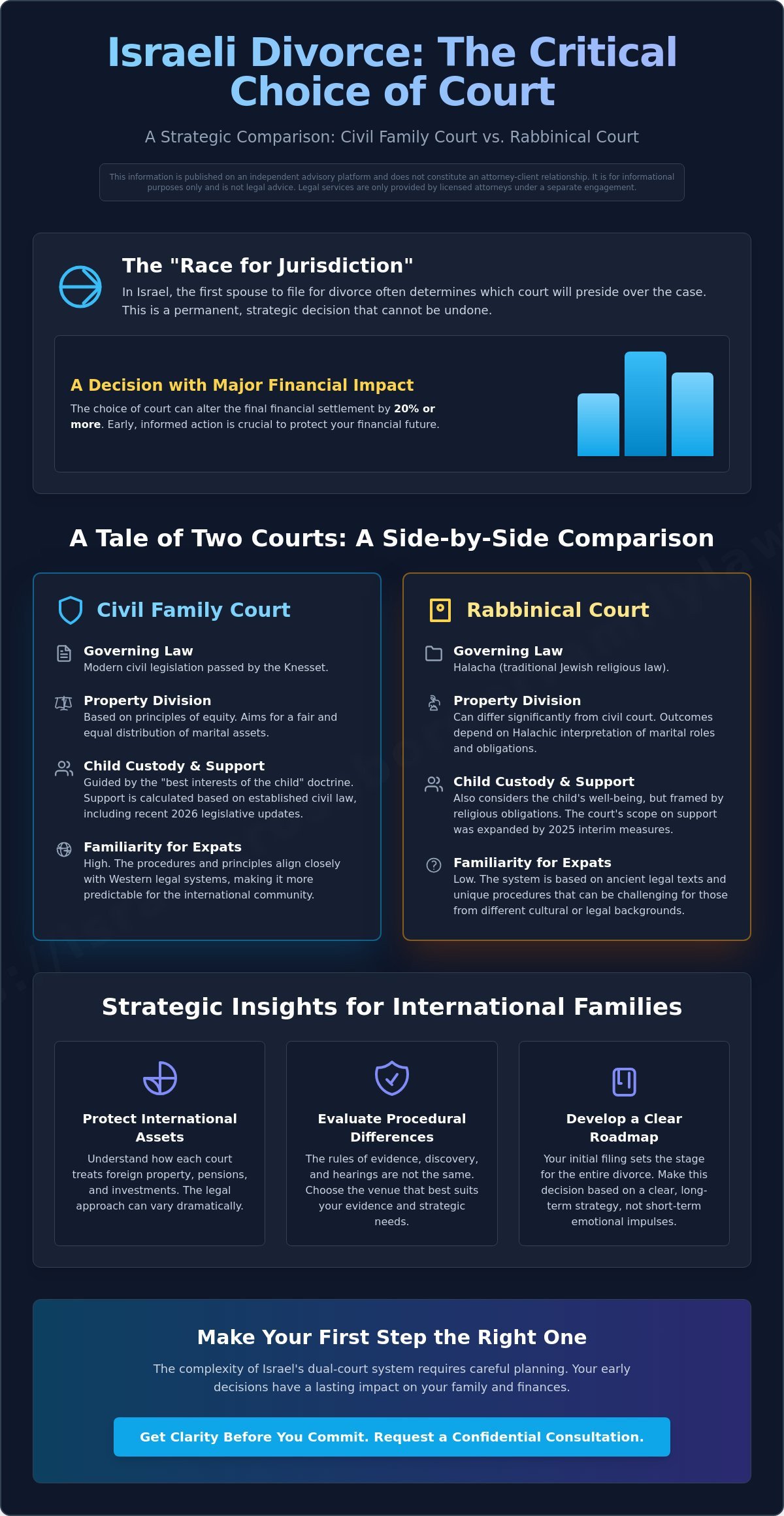
The first person to file for divorce in IL doesn’t just start the clock; they often decide which set of laws will govern your family’s future. This phenomenon, known as the “race for jurisdiction,” means the choice between the Israeli Divorce Court vs Rabbinical Court is one of the most critical strategic decisions you’ll face. While both systems are legitimate, they operate under different principles that can impact your financial settlement by 20% or more according to current legal trends.
It’s natural to feel overwhelmed by the complexity of navigating a dual legal system, especially when you’re balancing the expectations of an international life with the strict requirements of local law. This guide will help you understand the jurisdictional nuances so you can protect your assets and your children’s well-being with confidence. We’ll examine how recent 2026 legislative updates affect child support and property division, providing the clarity you need to move forward strategically. For more visual insights, you can also explore our resources on the Israel Family Law YouTube channel. Get clarity before you commit. Request a confidential consultation.
Key Takeaways
- Understand how Israel’s unique legal structure requires navigating both secular and religious courts to finalize a divorce.
- Learn why the “Race for Jurisdiction” makes the timing and location of your initial filing a permanent strategic decision.
- Evaluate the procedural differences between the Israeli Divorce Court vs Rabbinical Court to determine which venue best suits your specific needs.
- Discover how to protect international assets and address the specific vulnerabilities faced by the Anglo and expat community in IL.
- Develop a clear roadmap for your divorce strategy that prioritizes informed decision-making over emotional impulses.
This article is published on an independent advisory platform and does not constitute an attorney-client relationship. Legal services are only provided by licensed attorneys under a separate engagement.
Understanding the Dual Court System: Family Court vs. Rabbinical Court
Israel operates under a unique legal framework where two distinct court systems hold concurrent jurisdiction over family matters. For Jewish residents, this means the process of separating involves navigating a landscape where the Civil Family Court and the Rabbinical Court coexist. While this structure offers different procedural paths, it also introduces significant complexity for those unfamiliar with the local environment. Decisions made in one court can drastically differ from the other, particularly regarding asset division or parental responsibilities.
The fundamental tension in the Israeli Divorce Court vs Rabbinical Court debate lies in the source of law applied. The secular system relies on modern legislation passed by the Knesset, while the religious system is rooted in Halacha, or Jewish law. This dualism creates a situation where the same set of facts might lead to different outcomes depending on which bench hears the case. Understanding these core distinctions is the first step toward building a strategy that protects your future.
To better understand how these systems can intersect in practice, watch this report on the Rabbinical Court’s authority:
The Role of the Civil Family Court
The Civil Family Court, known as *Beit Mishpat Le’inyanei Mishpacha*, serves as the secular judicial body. It prioritizes civil rights and modern principles of equity. This court handles nearly all aspects of a separation, including property division, child support, and custody arrangements. For many international families and expats, this venue often feels more familiar because it operates based on written statutes and precedents that align with Western standards. The court emphasizes the “best interests of the child” and the equitable distribution of assets acquired during the marriage.
The Role of the Rabbinical Court
The Rabbinical Court, or *Beit Din Rabani*, holds exclusive jurisdiction over the “Get,” the religious act of divorce. Without this decree, a Jewish couple in IL remains legally married. Beyond the divorce itself, this court can rule on financial and custodial matters if a party “binds” these issues to their initial divorce claim. This procedural maneuver is a cornerstone of the Israeli Divorce Court vs Rabbinical Court strategic landscape. Because the Rabbinical Court applies Halacha, its interpretation of marital obligations and property rights may vary significantly from secular standards. For instance, recent interim measures passed in late 2025 have expanded the Rabbinical Court’s ability to rule on the full scope of child support payments, making the choice of venue even more consequential for financial planning.
This article is published on an independent advisory platform and does not constitute an attorney-client relationship. Legal services are only provided by licensed attorneys under a separate engagement.
The Race for Jurisdiction: Why Where You File First Matters
In the Israeli legal landscape, timing is often the most decisive factor. The “Race for Jurisdiction,” or Merotz Hasamchuyot, refers to the legal competition between spouses to choose the court that will hear their case. Because both systems have parallel authority over certain matters, the court where the first valid claim is filed typically secures the power to rule on them. This means a delay of a few hours can fundamentally shift the legal framework of your divorce, potentially impacting financial settlements by 20% or more.
The complexity of this system is highlighted in the U.S. State Department report on Israeli religious freedom, which notes the parallel jurisdiction for matters such as alimony and child custody. Choosing between the Israeli Divorce Court vs Rabbinical Court requires understanding how each venue views marital assets and parental roles. The first valid petition sets a precedent that is difficult to reverse once the court establishes its authority.
How the Race Works in Practice
To win the race, a filing must be sincere and legally complete. Simply being first isn’t enough if the petition is deemed a tactical maneuver without substance. A common mistake among expats is failing to account for the Dispute Resolution Law, which mandates a cooling-off period. During this time, parties must attend mediation sessions before they can litigate. However, the party that initiates this process first often gains the right to choose the court once the mandatory stay expires. Understanding the timing of these filings is essential to protecting your rights in IL.
The Impact of “Binding” Issues
Binding is the legal mechanism of attaching civil claims to a divorce petition. By binding issues like property division or child custody to a divorce claim in the Rabbinical Court, that court gains the authority to decide them using religious principles. This can lead to different results than the Family Court, which applies civil statutes. For example, while the Family Court generally favors a strictly equal split of assets, the Rabbinical Court might weigh traditional marital obligations or grounds for divorce differently. It’s vital to evaluate your specific circumstances before any papers are filed to ensure your strategy aligns with your long-term goals.
This article is published on an independent advisory platform and does not constitute an attorney-client relationship. Legal services are only provided by licensed attorneys under a separate engagement.
Key Differences in Legal Outcomes and Procedures
The physical and procedural environment of an Israeli Divorce Court vs Rabbinical Court differs significantly. A secular Family Court session resembles a standard Western legal proceeding, focusing on statutory compliance and judicial precedent. In contrast, a Rabbinical tribunal consists of three Dayanim, or religious judges, who apply centuries of Jewish legal tradition to the modern family unit. This shift in atmosphere isn’t merely aesthetic; it fundamentally changes how evidence is weighed and how the narrative of the marriage is presented.
Rules of evidence are often more flexible in religious courts. Judges there may prioritize oral testimony and character assessments over the rigid documentation typically required in civil court. A central feature of the Rabbinical system is the Get, the religious divorce decree. Because this court holds exclusive authority over the Get, it must manage the risk of “Get-refusal,” where one spouse withholds the decree to gain leverage in negotiations. While the court can impose sanctions to compel the Get, the process remains rooted in religious consent rather than civil mandate.
When a ruling is challenged, the appellate paths are entirely separate. Civil cases move through the District Court and potentially the Supreme Court. Rulings from the Rabbinical system must be appealed to the Great Rabbinical Court in Jerusalem, which operates under its own distinct set of procedural rules. Understanding these divergent paths is crucial for international families who may need to project the long-term trajectory of their case.
Religious Law vs. Civil Law Principles
In Rabbinical courts, the concept of “fault” continues to play a significant role. Actions such as adultery or abandonment can directly influence the division of property or spousal maintenance, known as Mezonot Isha. The Family Court generally ignores fault in favor of economic equity and modern statutes. While both courts must follow “The Best Interests of the Child,” their interpretations may vary based on religious or secular frameworks. For example, a religious court might place more weight on the child’s religious education, while a civil court focuses on secular stability.
Procedural Nuances for Foreigners
For expats, the language barrier is a primary concern. All proceedings are conducted in Hebrew, and the court requires certified translations of all foreign documents. Dayanim may also interpret international prenuptial agreements through the lens of Halacha, which can lead to unexpected outcomes compared to the secular bench. It’s essential to understand these procedural risks before committing to a specific court. Get clarity before you commit. Request a confidential consultation.
This article is published on an independent advisory platform and does not constitute an attorney-client relationship. Legal services are only provided by licensed attorneys under a separate engagement.
Strategic Considerations for Anglos and Expats in Israel
Expats living in IL face a distinct set of challenges when entering the dual legal system. While a local Israeli citizen might instinctively understand the cultural weight of a religious tribunal, an Anglo or expat often lacks the deep-rooted support system and linguistic fluency required to navigate these waters safely. The strategic choice between the Israeli Divorce Court vs Rabbinical Court is not just about local statutes; it is about how an Israeli ruling will interact with your home country’s legal system. For instance, a property division order issued in IL may not be easily enforceable against real estate held in New York or London without a carefully drafted agreement that meets specific international standards.
International assets require a sophisticated approach that accounts for transnational tax implications and multi-jurisdictional complexity. While the Family Court may be more accustomed to dealing with global portfolios and foreign pension funds, the Rabbinical Court’s interpretation of marital property can lead to different outcomes. Achieving a result that is recognized both locally and abroad requires a strategy that bridges the gap between divergent legal cultures. Get clarity before you commit. Request a confidential consultation.
Navigating the System as a Non-Hebrew Speaker
Language barriers present a significant risk in any legal proceeding. Signing Hebrew documents based on a verbal summary is a common, yet dangerous, practice that can lead to the unintended waiver of rights. Standard Israeli legal advice often overlooks the specific tax and disclosure requirements that apply to US citizens or green card holders. We provide specialized resources for divorce and separation for international families to help ensure that your local strategy does not create foreign liabilities. Every document must be understood in its full legal context before any commitment is made.
International Custody and Relocation Risks
Custody is perhaps the most sensitive area for the international community. The choice of court can influence your future ability to relocate or even take children on vacation. A “Stay of Exit” order, or Tzav Ikur Yetzia Min Ha’aretz, is a common feature in IL divorce cases that prevents a child from leaving the country without a bank guarantee or specific court permission. Understanding the nuances of international custody and relocation and the Hague Convention is vital for any parent considering a move. To ensure your parental rights are protected across all relevant jurisdictions, speak with a professional who understands cross-border complexities.
This article is published on an independent advisory platform and does not constitute an attorney-client relationship. Legal services are only provided by licensed attorneys under a separate engagement.
Making an Informed Decision: Strategy Over Emotion
Decisions made during the initial stages of a separation carry a weight that persists long after the emotional dust has settled. In IL, the selection between the Israeli Divorce Court vs Rabbinical Court is a high-stakes strategic maneuver that determines the very rules of the legal process. Cross-border situations are inherently fragile; an ill-timed filing or an incorrectly worded petition can trigger jurisdictional conflicts that take years to resolve. You don’t want to find yourself in a position where your local legal strategy inadvertently compromises your rights in your home country or creates unforeseen liabilities abroad.
Relying on a “default” court or following the path of least resistance can lead to significant strategic errors. Every family situation is unique, and what worked for a colleague or neighbor may not be appropriate for your specific financial or custodial goals. For international families, the stakes are even higher, as an Israeli ruling must often be coordinated with foreign legal requirements to ensure it is recognized and enforceable in other jurisdictions. Achieving this balance requires a steady hand and a clear understanding of how different legal systems interact.
Determining the Right Forum for Your Case
Factors such as the location of global real estate, the nature of international retirement accounts, and specific religious considerations must be weighed against the procedural tendencies of each court. The first move is frequently the most critical step in the entire process. A strategic approach prevents the “limping marriage” scenario, where a divorce is recognized in IL but remains invalid in the US or Europe. This state of legal inconsistency can lead to unexpected tax burdens, complications regarding future inheritance, and significant hurdles if you plan to remarry. Selecting the right forum is about looking five to ten years into the future, not just solving the immediate crisis.
The Role of Independent Advisory
Litigation should be the final step in a well-considered plan, not the first reaction to a family crisis. An independent advisor serves as a vital bridge between US and IL legal expectations, helping you understand how local decisions will impact your global standing. This perspective provides the objective distance necessary to evaluate risks without the immediate pressure of courtroom deadlines. Seeking clarity before committing to a specific court path allows you to minimize the inherent complexity of cross-border law and move forward with confidence. Get clarity before you commit. Request a confidential consultation.
This article is published on an independent advisory platform and does not constitute an attorney-client relationship. Legal services are only provided by licensed attorneys under a separate engagement.
Navigating Your Future with Strategic Clarity
Deciding between the Israeli Divorce Court vs Rabbinical Court is a choice that defines the trajectory of your family’s legal and financial landscape. As we have examined, the “race for jurisdiction” is a permanent strategic decision that dictates which set of laws will govern your assets and parental rights. For international families, the added layer of cross-border enforcement makes it essential to align your IL strategy with the requirements of your home jurisdiction to avoid future legal inconsistencies.
With decades of experience in cross-border US-Israel litigation, our practitioners are licensed in multiple jurisdictions to provide a nuanced understanding of these divergent systems. We maintain a specialized focus on the unique needs of Anglo and expat families, ensuring that every decision is backed by established expertise. Get clarity before you commit. Request a confidential consultation.
Taking the time to build a deliberate strategy today protects your future and provides the reassurance you need to move forward with confidence. You don’t have to manage these complexities alone.
This article is published on an independent advisory platform and does not constitute an attorney-client relationship. Legal services are only provided by licensed attorneys under a separate engagement.
Frequently Asked Questions
Do I have to go to the Rabbinical Court if I had a civil marriage abroad?
Jewish residents who married in a civil ceremony abroad still require a religious divorce through the Rabbinical Court to be considered legally divorced in IL. While the Civil Family Court can manage property division and custody, the act of dissolving the marriage itself remains under religious jurisdiction. This requirement ensures the divorce is recognized by the Ministry of Interior and allows for future remarriage within the country.
Can a woman file for divorce in the Civil Family Court first?
A woman can absolutely initiate proceedings in the Civil Family Court before her spouse takes action in another forum. Filing first in the secular system is a common strategy in the Israeli Divorce Court vs Rabbinical Court jurisdictional race. By securing the Family Court’s authority early, she can ensure that matters like alimony and asset distribution are decided based on secular statutes rather than religious law.
What happens if my spouse files in the Rabbinical Court and I file in the Family Court on the same day?
When both spouses file on the same day, the court that officially records the valid claim first generally secures jurisdiction. The specific timestamp of each filing is critical. If a dispute arises, judges will examine whether the Rabbinical claim was “sincere” and legally complete. Courts rely on precise digital logging to determine which party won the race by minutes or even seconds.
Is child support handled differently in the Rabbinical Court vs. the Family Court?
Child support procedures changed following a November 2025 interim measure that expanded Rabbinical Court authority. While the Family Court uses secular formulas based on parental income and shared parenting time, the Rabbinical Court now has temporary power to rule on all child support needs. This includes upbringing, education, and medical expenses. The choice of court can significantly influence the total monthly obligation for several years.
Can I appeal a decision made by the Rabbinical Court to a civil court?
You cannot appeal a substantive Rabbinical Court decision to a civil court. Any appeal must be filed with the Great Rabbinical Court in Jerusalem. The secular High Court of Justice only intervenes in rare circumstances where the religious court exceeded its legal authority or violated basic principles of natural justice. It does not serve as a standard appellate body for religious rulings or factual disputes.
How does being a US citizen affect which Israeli court I should choose?
US citizens must evaluate how a decision in the Israeli Divorce Court vs Rabbinical Court will interact with American legal and tax requirements. A ruling in IL might not be recognized by a US court if it is found to violate American public policy or due process. Strategy for US citizens should account for IRS disclosure rules and the potential for parallel litigation in their home state regarding international assets.
What is a “Get” and why do I need one even if I use the Family Court?
A “Get” is the formal Jewish divorce document required to end a marriage religiously and legally for Jewish citizens in IL. Even if the Family Court resolves every financial and custodial dispute, the marriage is not officially dissolved until the Get is delivered. Without this document, you cannot remarry in IL, and any children from a future relationship could face significant legal complications regarding their status.
Can the Rabbinical Court freeze my bank accounts or stop me from leaving the country?
The Rabbinical Court has the authority to issue temporary restraining orders, including freezing bank accounts or issuing a “Stay of Exit” order. These measures are often used to prevent a spouse from leaving the country or hiding assets before the divorce is finalized. Similar powers exist within the Family Court. These orders are intended to maintain the status quo and ensure that all court mandates are eventually honored.

Article by
Gabriel Lior
A Personal Journey That Became a Mission
The advisory was founded by an American father Gabriel Lior, LLB, MBA , global entrepreneur, and cross-border advisor who spent more than a decade navigating the Israeli family court system firsthand and now lives in Singapore with his son.
As a divorced parent in a cross-border family, Gabriel faced nearly every legal challenge a foreign parent can encounter in Israel — including child custody disputes, child support proceedings, property matters in Israel and abroad, false accusations, and complex immigration and relocation proceedings.
Over the years, he learned the hard way how difficult it is for non-Israeli parents to understand the system, identify the right legal strategy, and choose the right legal representation — especially when language, culture, and jurisdictional differences are involved. He also witnessed how foreign parents and new immigrants are often disadvantaged or taken advantage of by service providers and institutions simply because they lack local knowledge or fluency.
From Client to Advisor
To truly understand — and survive — the system, Gabriel pursued formal legal education in Israel, completing two Israeli law degrees, alongside a BA and MBA earned in the United States. This was never about becoming a practicing attorney, but about gaining a deep, structural understanding of how the system works — and where it breaks down for foreign parents.
This rare combination of:
Firsthand client experience
Israeli legal and US business education
International business and negotiation training
Decades of commercial execution
created a unique perspective – one that understands both sides of the table.
After years of litigation, persistence, and at times self-representation, he ultimately succeeded in securing custody of his son and relocating abroad through a rare legal victory in the Israeli Supreme Court — becoming one of the first fathers in Israel to do so under these circumstances.
Disclaimer
Important Disclaimer:
The information provided on this website and in its content is for general informational and educational purposes only and does not constitute legal advice, legal opinion, or legal representation.
Gabriel Lior is not licensed to practice law in Israel (nor is he interested in doing so) and does not provide legal services, despite having completed 2 Law Degrees. The services offered are advisory in nature and are intended to provide general guidance, strategic insight, and information regarding cross-border family law considerations.
No attorney-client relationship is formed by accessing this website, reading its content, or communicating with us.
Any decisions made based on this information are at your own discretion and risk. For legal advice specific to your situation, you should consult a licensed attorney in the relevant jurisdiction.
Where appropriate, we may refer clients to independent, licensed attorneys or professionals. Such referrals do not constitute legal representation and no liability is assumed for services provided by third parties.