This article is published on an independent advisory platform, not a law firm. It is for informational purposes only and does not create an attorney-client relationship. Legal services are only provided by licensed attorneys under a separate engagement.
Did you know that in Israel, a final divorce decree does not automatically revoke a will you signed while you were still married? Many expats believe a signed divorce agreement overrides previous estate plans, but updating your will in israel after divorce is the only certain way to prevent an ex-spouse from inheriting your assets through a legal loophole. It’s a common point of confusion for international families who assume their foreign documents or local settlements will naturally align with the Israeli inheritance system.
We understand the stress of navigating a Hebrew-centric probate process while managing assets across different jurisdictions. This guide provides a clear path to ensuring your children are protected and your wishes are honored. We’ll examine the priority between divorce agreements and wills, helping you resolve any legal contradictions before they become a problem for your heirs. You will learn how to bridge the gap between your cross-border divorce and your long-term estate goals.
For more detailed explanations on protecting your family’s future, you can also view our latest videos at https://www.youtube.com/@IsraelFamilyLaw. Get clarity before you commit. Request a confidential consultation.
Key Takeaways
- Learn why Israeli law does not automatically invalidate your existing will after a divorce decree is finalized, potentially leaving assets to an ex-spouse by mistake.
- Understand the critical steps for updating your will in israel after divorce to ensure your court-approved divorce agreement and estate plan are fully aligned.
- Identify “non-estate” assets like provident funds (Kupat Gemel) that require separate beneficiary updates because they are not governed by your primary will.
- Discover the “Two-Will Strategy” for effectively managing cross-border assets and protecting your legacy in both Israel and the US jurisdictions.
- Establish a comprehensive “clean break” strategy to secure your children’s inheritance across all global financial accounts and legal documents.
This article is published on an independent advisory platform, not a law firm. It is for informational purposes only and does not create an attorney-client relationship. Legal services are only provided by licensed attorneys under a separate engagement.
The Legal Reality: Does Divorce Revoke a Will in Israel?
Many international families assume that a finalized divorce decree automatically wipes out old estate plans. This is a dangerous misconception. Under the Israeli Succession Law of 1965, a divorce does not automatically invalidate an existing will. If you named your former spouse as a beneficiary in a legal document years ago, they remain the legal heir until you formally revoke or amend that document. The Israeli probate court is bound by the written instructions you leave behind, not by your change in marital status.
This creates a significant risk of “accidental inheritance.” Even if your relationship ended on bitter terms, the Israeli probate system prioritizes the written word of the deceased over what might seem like common sense. Relying on verbal agreements or the general spirit of a divorce settlement is a high-stakes gamble. Without updating your will in israel after divorce, your assets could flow to a former partner instead of your children or current loved ones. The court will not assume you intended to disinherit an ex-spouse simply because you are no longer married.
To better understand the risks of leaving an old estate plan in place, watch this helpful video:
Israeli Succession Law vs. US Jurisdictions
The legal landscape in IL differs sharply from many US jurisdictions. In several US states, a divorce decree automatically revokes any provisions in a will that benefit a former spouse. Israel has no such “revocation by divorce” rule. The Registrar of Inheritance Affairs is tasked with validating wills based on strict adherence to the Succession Law, and they don’t have the authority to assume your intentions. For those managing divorce and separation for international families, it’s vital to treat your IL estate as a distinct legal entity, separate from your US-based assets, to avoid unintended consequences.
The ‘Status Quo’ Trap During Separation
The period between physical separation and the final divorce decree is particularly vulnerable. If you pass away before the “Get” (divorce decree) is issued, your spouse is still legally considered your husband or wife under Israeli law. Until the “Get” is officially granted, the parties remain legally married in the eyes of the state, regardless of how long they have lived apart. This means they could inherit your entire estate if you don’t have a valid will in place. Drafting an “interim will” or updating your will in israel after divorce as soon as the separation is permanent ensures your legacy remains under your control during what can be a lengthy litigation process.
Get clarity before you commit. Request a confidential consultation.
This article is published on an independent advisory platform, not a law firm. It is for informational purposes only and does not create an attorney-client relationship. Legal services are only provided by licensed attorneys under a separate engagement.
Reconciling Your Divorce Agreement with Your Estate Plan
The Heskem Girushin, or court-approved divorce agreement, is the cornerstone of your post-separation life. It functions as a binding judgment that outlines the division of assets and future financial obligations. However, a common mistake is assuming this agreement automatically updates your estate plan. While the agreement might state that neither party has future claims against the other, this “Waiver of Claims” clause is often insufficient to override an existing will. If your old will still names your ex-spouse as a beneficiary, the court may interpret this as a voluntary gift that remains valid despite the divorce.
This ambiguity often leads to litigation between a former spouse and other family members. The Israeli Family Court and the Rabbinical Court sometimes apply different nuances when interpreting these overlapping documents. To avoid these conflicts, you must ensure the language in your divorce agreement aligns perfectly with your testamentary documents. Updating your will in israel after divorce allows you to explicitly state that the provisions of your Heskem Girushin are reflected in your estate plan, leaving no room for judicial interpretation.
Common Conflicts Between Agreements and Wills
Conflicts arise when a divorce agreement promises a specific asset to a child or third party, yet the existing will leaves that same asset to the former spouse. In the eyes of an Israeli judge, the legal hierarchy can be complex. Generally, the will governs the distribution of the estate, but the divorce agreement represents a prior binding commitment. You can prevent these disputes by drafting a “clearance” clause in your new will. This clause should specifically reference your divorce decree and confirm that all previous spousal bequests are revoked in accordance with the settlement. If you are unsure how these documents interact, it is wise to review your current documents with a professional.
Protecting Minor Children as Beneficiaries
For international families, protecting minor children is a primary concern. You can establish a trust, known as a Hekdesh, within your will to manage assets on behalf of your children until they reach a certain age. This is often preferable to leaving assets directly to minors, which might inadvertently give a former spouse control over the funds as their natural guardian. You also have the right to nominate an Apotropos (guardian) for the estate who is not your former spouse. This ensures that the inheritance is managed by someone you trust. These decisions often intersect with broader family matters, such as International Custody & Relocation, making a coordinated legal strategy essential for your peace of mind.
Get clarity before you commit. Request a confidential consultation.
This article is published on an independent advisory platform, not a law firm. It is for informational purposes only and does not create an attorney-client relationship. Legal services are only provided by licensed attorneys under a separate engagement.
The Section 147 Trap: Assets That Fall Outside the Will
One of the most significant risks for international families involves the “Section 147 Trap.” This refers to Section 147 of the Israeli Succession Law (1965), which explicitly states that certain financial instruments and insurance payouts are not considered part of the deceased’s estate. Consequently, these assets are not governed by the instructions in your will. If you are focused only on updating your will in israel after divorce, you might inadvertently leave your most liquid assets to a former spouse.
Assets like a Kupat Gemel (provident fund) or a Keren Hishtalmut (study fund) operate under a separate legal framework. These funds are distributed according to beneficiary designations, known as Motanim, which are filed directly with the financial institution. If you fail to update these specific records, the fund manager is legally required to pay the named beneficiary, even if your new will explicitly disinherits your ex-spouse. This administrative reality can lead to life insurance payouts being delivered to a former partner despite a finalized divorce and a new estate plan.
Updating Israeli Pension and Insurance Funds
To avoid an unintended transfer of wealth, you should conduct a thorough review of all Israeli financial accounts. The records held by the financial institution usually override the instructions found in a will. Ensure you have updated the following:
- Bituah Menahalim: Manager’s insurance policies often contain significant savings and death benefits.
- Keren Pensia: Pension funds require formal notification of a change in marital status and beneficiary.
- Life Insurance: Stand-alone Bituah Chaim policies must be updated to reflect your current beneficiaries.
Notifying these institutions involves a specific administrative process. You must provide the fund managers with your divorce decree and updated beneficiary forms to ensure the change is legally recorded in their internal systems.
The Role of the ‘Enduring Power of Attorney’ (EPA)
While a will handles your affairs after death, an Enduring Power of Attorney (Yipuy Koach Mitmashech) manages your life while you are still here but unable to make decisions. Divorce necessitates an immediate update to this document. If your former spouse is still named as your agent, they could retain the legal authority to make critical healthcare and financial decisions on your behalf if you become incapacitated. Removing an ex-spouse from your EPA is just as vital as updating your will in israel after divorce. You can find more information on comprehensive estate and EPA protection by viewing our pricing for integrated packages.
Get clarity before you commit. Request a confidential consultation.
This article is published on an independent advisory platform, not a law firm. It is for informational purposes only and does not create an attorney-client relationship. Legal services are only provided by licensed attorneys under a separate engagement.
Cross-Border Nuances: US Assets and Israeli Wills
For international families, the end of a marriage in Israel doesn’t just impact local bank accounts. It ripples across the Atlantic to US-based retirement funds and property holdings. A common mistake is believing that updating your will in israel after divorce is a “one and done” task that covers your entire global footprint. In reality, a broad Israeli will might inadvertently revoke a carefully crafted US estate plan if the language isn’t handled with extreme precision. This happens because many standard Israeli templates include a clause that cancels all prior wills, which could leave your US assets in a state of legal limbo.
Adopting a “Two-Will Strategy” is often the most robust way to manage this complexity. By maintaining separate documents for each jurisdiction, you ensure that the probate process in one country doesn’t interfere with the other. This approach also respects the US-Israel Tax Treaty. While Israel abolished its inheritance tax in 1981, US citizens remain subject to federal estate taxes. A change in your marital status can significantly alter your available exemptions and filing requirements, making it vital to coordinate your Israeli documents with your US tax obligations.
Jurisdictional Friction in Probate
Israeli probate courts often struggle with US “Living Trusts.” Because the Israeli legal system does not have an identical trust structure, a trust that functions perfectly in the US might not be recognized in the same way by the Registrar of Inheritance Affairs in IL. This is a critical area for expats and foreign nationals to review. Without proper coordination, your heirs could face the administrative burden and significant expense of conducting probate proceedings in two different countries simultaneously.
US Beneficiary Designations
Much like the Section 147 assets previously discussed, many US accounts use Transfer on Death (TOD) or beneficiary designations. These include 401(k) plans, IRAs, and life insurance policies. An Israeli divorce decree does not automatically notify a US financial institution to remove an ex-spouse from a policy. You must manually update these designations with each US provider. Coordinating this with US-based counsel while living in IL ensures that your global legacy is protected and that your US-based assets don’t accidentally fall into the hands of a former partner. To ensure your global strategy is sound, coordinate your cross-border strategy with a professional.
Get clarity before you commit. Request a confidential consultation.
This article is published on an independent advisory platform, not a law firm. It is for informational purposes only and does not create an attorney-client relationship. Legal services are only provided by licensed attorneys under a separate engagement.
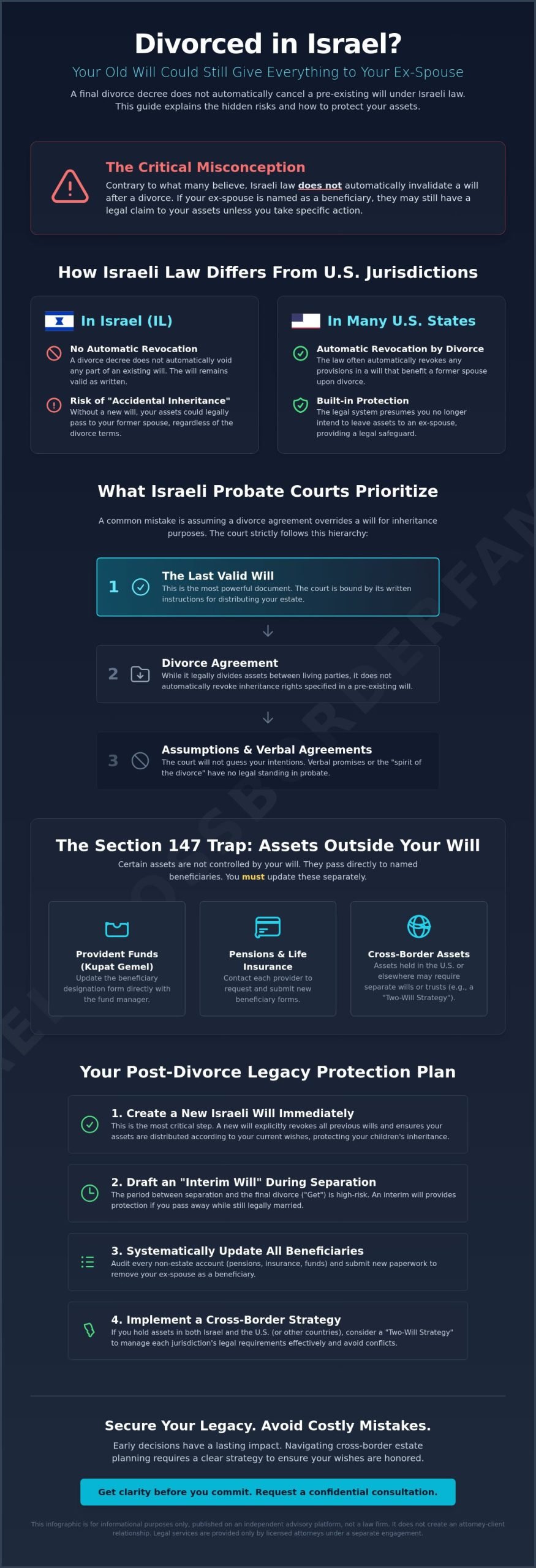
Strategic Steps to Securing Your Legacy Post-Divorce
Achieving a “clean break” after a divorce requires more than just a signed court order. It demands a systematic realignment of your entire legal and financial infrastructure. For international families, this transition begins with a comprehensive audit of global assets. You must look beyond local bank accounts to include real estate, digital assets, and cross-border business interests. Updating your will in israel after divorce is a critical component of this process, but it should be viewed as part of a broader strategy to insulate your heirs from future litigation.
An advisory platform provides the strategic framework needed before you involve a litigator. By mapping out your risks and identifying jurisdictional friction early, you can make informed choices based on strategy rather than emotion. Once your new documents are finalized, the final step involves formalizing the update. In Israel, this often includes depositing your new will with the Registrar of Inheritance Affairs. A digital record at the Registrar ensures the court follows your most recent instructions when the time comes, preventing old documents from resurfacing.
Your Post-Divorce Estate Checklist
To ensure no detail is overlooked, follow these three essential steps to protect your interests:
- Step 1: Review the Heskem Girushin. Carefully examine your divorce agreement for any specific inheritance restrictions or promises that might conflict with your new estate goals.
- Step 2: Draft a new Israeli will and EPA. Ensure these documents explicitly revoke all previous versions and address the specific needs of your international family.
- Step 3: Update all pension and insurance beneficiaries. As discussed, these assets fall outside the estate and require direct notification to the financial institutions to change the named beneficiaries.
Seeking Clarity Before Commitment
The impact of early decisions cannot be overstated. A risk-based approach to cross-border estate planning prevents long-term probate disputes that can drain your children’s inheritance and create years of unnecessary conflict. By seeking clarity now, you protect your legacy from the inherent complexity of divergent legal systems and cultures. Updating your will in israel after divorce isn’t merely an administrative task; it’s a strategic move to secure your family’s future. Get clarity before you commit. Request a confidential consultation.
This article is published on an independent advisory platform, not a law firm. It is for informational purposes only and does not create an attorney-client relationship. Legal services are only provided by licensed attorneys under a separate engagement.
Protecting Your Legacy in a Cross-Border Context
Navigating the intersection of Israeli inheritance law and international divorce requires a proactive and strategic approach. As we have explored, relying on a divorce agreement alone is insufficient because Israeli law does not automatically revoke a spouse’s beneficiary status in an existing will. Ensuring you are updating your will in israel after divorce is the only certain way to prevent accidental inheritance and resolve potential conflicts between your settlement and your estate plan. Remember that liquid assets like pension funds and life insurance require direct administrative updates with each financial institution to ensure they don’t fall into the wrong hands.
Our advisory platform provides specialized cross-border expertise with a dedicated focus on the unique needs of the Anglo and expat community in IL. We offer a strategic, risk-based advisory service designed to bridge the gap between divergent legal systems and cultures. By addressing these complexities early, you can avoid costly probate disputes and secure your global assets with confidence. Your children’s future depends on the clarity you establish today.
Get clarity before you commit. Request a confidential consultation to discuss your specific cross-border needs and protect your legacy.
This article is published on an independent advisory platform, not a law firm. It is for informational purposes only and does not create an attorney-client relationship. Legal services are only provided by licensed attorneys under a separate engagement.
Frequently Asked Questions
Does an Israeli divorce agreement automatically update my will?
A divorce agreement does not automatically update or revoke your existing will. The Heskem Girushin is a contract between you and your former spouse, whereas a will is a separate legal instrument governed by the Succession Law. Even if your divorce settlement includes a waiver of future claims, an old will naming your ex-spouse as a beneficiary remains legally binding in the eyes of the probate court until it is formally replaced.
What happens if I die in Israel without updating my will after divorce?
If you pass away without an update, your estate may be distributed according to your last valid will, even if it names your ex-spouse. If you have no will at all, the Law of Succession dictates the distribution. While a divorced spouse does not inherit under intestacy laws, the lack of a clear, updated plan can lead to lengthy probate delays and uncertainty for your children and other intended heirs.
Can I leave my assets to my children and skip my ex-spouse entirely?
You have the full legal right to leave your assets to your children and exclude an ex-spouse. Israel does not have forced heirship rules that require you to leave a portion of your estate to a former partner once the divorce is finalized. When updating your will in israel after divorce, you can explicitly name your children as primary beneficiaries to ensure your legacy remains within your control.
How do I remove my ex-spouse from my Israeli pension fund?
Removing an ex-spouse from a pension fund requires updating your “Motanim” designations directly with the financial institution. These funds are considered non-estate assets under Section 147 of the Succession Law, meaning they are not governed by your will. You must submit a formal request to your Keren Pensia or Bituah Menahalim manager along with your finalized divorce decree to ensure the records reflect your new beneficiaries.
Is my US will still valid in Israel after I get divorced here?
A US will may be legally recognized, but it often creates significant hurdles in the Israeli probate system. You will likely need to provide an authenticated translation and an Apostille stamp for it to be accepted. US documents frequently fail to address Israeli-specific assets or the nuances of local law. This often leads to administrative delays and increased costs for your heirs during an already difficult time.
Do I need a new Enduring Power of Attorney (EPA) if I am divorced?
A new Enduring Power of Attorney is critical following a divorce. If your former spouse is named as your attorney-in-fact, they retain the legal authority to make your medical and financial decisions if you become incapacitated. You must revoke the previous Yipuy Koach Mitmashech and file a new one with the Ministry of Justice to ensure your current wishes are respected and a trusted person is in control.
How much does it cost to update a will in Israel?
When considering the cost of updating your will in israel after divorce, you should account for both government fees and professional advisory. As of early 2026, the fee for an online probate application was 444 ILS, though notarial fees for the certification of a will are set separately by the Ministry of Justice. The total investment depends on whether you require a simple amendment or a complex cross-border plan.
Can my ex-spouse challenge my new will in the Israeli Family Court?
An ex-spouse can technically challenge any will in the Israeli Family Court, but their success depends on specific legal grounds. Most challenges are based on claims of lack of capacity or undue influence at the time the document was signed. You can minimize this risk by having a professionally drafted will that explicitly references your finalized divorce agreement, demonstrating a clear and independent intent to the court.

Article by
Gabriel Lior
A Personal Journey That Became a Mission
The advisory was founded by an American father Gabriel Lior, LLB, MBA , global entrepreneur, and cross-border advisor who spent more than a decade navigating the Israeli family court system firsthand and now lives in Singapore with his son.
As a divorced parent in a cross-border family, Gabriel faced nearly every legal challenge a foreign parent can encounter in Israel — including child custody disputes, child support proceedings, property matters in Israel and abroad, false accusations, and complex immigration and relocation proceedings.
Over the years, he learned the hard way how difficult it is for non-Israeli parents to understand the system, identify the right legal strategy, and choose the right legal representation — especially when language, culture, and jurisdictional differences are involved. He also witnessed how foreign parents and new immigrants are often disadvantaged or taken advantage of by service providers and institutions simply because they lack local knowledge or fluency.
From Client to Advisor
To truly understand — and survive — the system, Gabriel pursued formal legal education in Israel, completing two Israeli law degrees, alongside a BA and MBA earned in the United States. This was never about becoming a practicing attorney, but about gaining a deep, structural understanding of how the system works — and where it breaks down for foreign parents.
This rare combination of:
Firsthand client experience
Israeli legal and US business education
International business and negotiation training
Decades of commercial execution
created a unique perspective – one that understands both sides of the table.
After years of litigation, persistence, and at times self-representation, he ultimately succeeded in securing custody of his son and relocating abroad through a rare legal victory in the Israeli Supreme Court — becoming one of the first fathers in Israel to do so under these circumstances.
Disclaimer
Important Disclaimer:
The information provided on this website and in its content is for general informational and educational purposes only and does not constitute legal advice, legal opinion, or legal representation.
Gabriel Lior is not licensed to practice law in Israel (nor is he interested in doing so) and does not provide legal services, despite having completed 2 Law Degrees. The services offered are advisory in nature and are intended to provide general guidance, strategic insight, and information regarding cross-border family law considerations.
No attorney-client relationship is formed by accessing this website, reading its content, or communicating with us.
Any decisions made based on this information are at your own discretion and risk. For legal advice specific to your situation, you should consult a licensed attorney in the relevant jurisdiction.
Where appropriate, we may refer clients to independent, licensed attorneys or professionals. Such referrals do not constitute legal representation and no liability is assumed for services provided by third parties.