This article is published on an independent advisory platform and is not a law firm. It provides informational and advisory content only and does not establish an attorney-client relationship. Legal services are only provided by licensed attorneys under a separate engagement.
For many international families, the Israeli courtroom represents a logistical and financial trap that demands frequent international travel and constant management across conflicting time zones. You likely feel that a judicial ruling is the only path to finality, yet the sustained toll of litigation frequently undermines the very stability you seek to protect. Resolving disputes without going back to court is a strategic necessity for those who prioritize efficient, cross-border resolutions over prolonged legal conflict.
In this guide, you’ll discover how to navigate cross-border family law conflicts in Israel using strategic out-of-court methods that prioritize stability and minimize international travel. We provide clarity on the mandatory “Mahut” sessions, the technicalities of mediation within the Israeli system, and the process for securing a legally binding settlement without leaving your home country. This overview helps you understand the risks and strategic options available for your family’s future. Get clarity before you commit. Request a confidential consultation.
Key Takeaways
- Identify why traditional litigation acts as a logistical trap for international families, often requiring expensive travel and rigid court appearances in Israel.
- Gain clarity on the mandatory “Mahut” process, a unique Israeli requirement designed to facilitate agreement before a case ever reaches a judge.
- Explore the strategic benefits of resolving disputes without going back to court, including the preservation of privacy and the reduction of cross-border conflict.
- Compare mediation and collaborative law to see which method provides the most stability for complex US-Israel asset division and jurisdictional issues.
- Learn how to formally propose an out-of-court resolution through a strategic advisory approach that prioritizes your family’s long-term stability.
This article is published on an independent advisory platform and is not a law firm. It provides informational and advisory content only and does not establish an attorney-client relationship. Legal services are only provided by licensed attorneys under a separate engagement.
The ‘Litigation Trap’ in Cross-Border Family Law
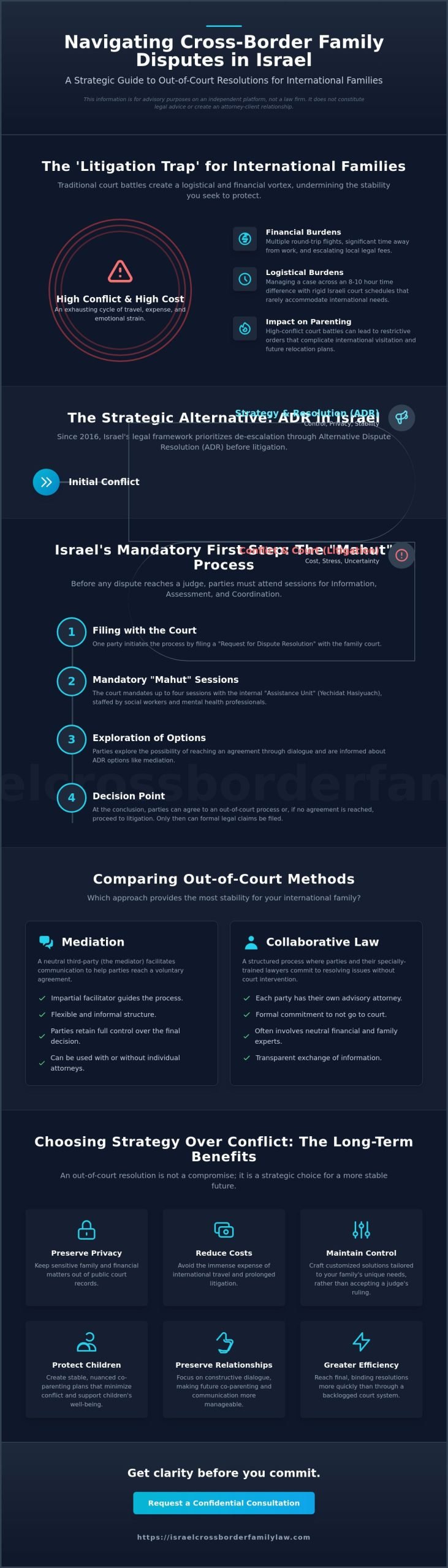
Traditional litigation within the IL legal system often creates a logistical and financial vortex for families split between Israel and the US. While a local resident might drive thirty minutes to a courthouse, an expat or foreign national faces a transcontinental ordeal. This “litigation trap” isn’t just about the law; it’s about the physical and emotional exhaustion of managing a case across an eight-to-ten-hour time difference. Families frequently find that the adversarial nature of the courtroom escalates tension, making resolving disputes without going back to court a more viable strategic path for long-term stability.
The hidden costs of international litigation are substantial. You must account for multiple round-trip flights, significant time away from work, and the reality that IL judges often require physical presence for critical testimony. These logistical hurdles are compounded by the psychological weight of navigating a system conducted in a foreign language and rooted in a different legal culture. Decisions made early in an IL courtroom can have permanent, unintended consequences for your US-based assets and financial standing, especially if the court issues orders regarding property or support without a full understanding of your international portfolio.
Financial and Logistical Burdens of Israeli Courtroom Battles
Retaining local counsel in IL involves costs that can quickly outpace the actual value of the dispute. While some assume technology has bridged the gap, the reality of “Zoom hearings” in IL is complex. Courts may allow remote appearances for minor procedural matters, but they often insist on in-person attendance for substantive evidentiary hearings. The Israeli court schedule is notoriously rigid; it rarely accommodates the needs of international travelers or the professional obligations of those living abroad. This lack of flexibility forces many to choose between their livelihoods and their legal rights.
The Impact of Conflict on Cross-Border Parenting
Litigation entrenchment is particularly damaging when children are involved. High-conflict court battles often lead to restrictive orders that complicate international visitation and future relocation plans. The risk of “forum shopping,” where one party tries to gain a tactical advantage by filing first in a specific jurisdiction, typically results in increased hostility. Utilizing Alternative Dispute Resolution (ADR) allows families to bypass this aggression. A negotiated settlement, such as those discussed in divorce and separation strategies for international families, is often more favorable than a judge’s decision. It allows for nuanced parenting plans that a standard court ruling might overlook. Choosing strategy over conflict helps maintain the stability necessary for cross-border co-parenting.
This article is published on an independent advisory platform and is not a law firm. It provides informational and advisory content only and does not establish an attorney-client relationship. Legal services are only provided by licensed attorneys under a separate engagement.
Alternative Dispute Resolution (ADR) Options in Israel
In the Israeli legal framework, Alternative Dispute Resolution is not merely a suggestion for those seeking a peaceful exit. Since the implementation of the “Regulating Litigation in Family Conflicts Regulations” in 2016, the system has prioritized de-escalation over immediate judicial intervention. Resolving disputes without going back to court has become the procedural baseline for families. This shift ensures that the first step in any family conflict is an assessment of whether an agreement can be reached through dialogue rather than a contested hearing.
Central to this process is the “Assistance Unit” (Yechidat Hasiyuach), a specialized department within the family court system staffed by social workers and mental health professionals. They facilitate the mandatory “Mahut” sessions, which stands for information, assessment, and coordination. These meetings are designed to help parties understand their options and the impact of their choices on their children. Research by the Myers-JDC-Brookdale Institute indicates that 58% of families resolve their disputes within these mandatory meetings, while an additional 26% choose to continue toward mediation. This high success rate demonstrates why ADR is now considered the standard path for international families navigating the IL legal system.
What is the Israeli ‘Family Dispute Resolution Law’?
The 2016 law establishes a mandatory 60-day “cooling off” period. During this time, parties are generally prohibited from filing substantive lawsuits while they attend up to four Mahut sessions. This stay of proceedings prevents the “jurisdiction race” from escalating and allows families to focus on coordination. ADR functions as a strategic tool for risk management in IL by providing a controlled environment to test settlement terms before they become permanent court orders. You can explore how this fits into your specific situation by requesting a confidential case review.
Mediation: The Most Common Path in Israel
Mediation allows a neutral third party to facilitate dialogue between parties who may be separated by oceans and time zones. For international families, an Israeli mediator helps bridge the gap between US expectations and IL legal realities. One of the primary advantages of this path is confidentiality. Anything said during mediation is privileged and cannot be used as evidence in court if the process fails. This protection encourages honest communication and creative problem-solving. Specialized lawyers often support this process from abroad, ensuring that any agreement reached is enforceable in both jurisdictions and aligns with the family’s long-term goals as outlined in our guide for expats and foreign nationals.
This article is published on an independent advisory platform and is not a law firm. It provides informational and advisory content only and does not establish an attorney-client relationship. Legal services are only provided by licensed attorneys under a separate engagement.
Comparing Mediation and Collaborative Law for Expats
Choosing the correct framework for negotiation depends heavily on the complexity of your international footprint. While both mediation and collaborative law prioritize resolving disputes without going back to court, their structures offer different levels of support. Mediation involves a neutral facilitator who helps you reach a compromise. Collaborative law, conversely, provides each party with a specially trained lawyer. Both paths aim to keep your family out of the IL courtroom, but the choice between them can significantly impact your financial and emotional recovery.
The cost-benefit analysis for international families is clear. Mediation is typically the most affordable route for straightforward disagreements. In contrast, collaborative law requires a higher initial investment because you are paying for a team of professionals. However, both methods represent a fraction of the cost of contested litigation. In IL, a full-scale court battle can easily exceed ₪200,000 per person, making these strategic alternatives a logical choice for preserving family wealth.
When Mediation is the Right Strategy
Mediation is ideal for specific, well-defined issues. If you need to make simple child support adjustments or minor visitation tweaks, a mediator can facilitate these changes quickly. It’s a streamlined process that works best when there is a baseline of trust. Even in simple cases, you should retain a “Consulting Attorney” to review any draft agreements. This ensures that the terms are enforceable in both Israel and your home country. For a deeper look at these dynamics, explore our resources on Divorce & Separation for International Families.
The Power of Collaborative Practice in Complex Cases
Collaborative practice is often superior for families with complex US-Israel asset divisions. This method uses a “No-Court” agreement as its foundation. If either party decides to litigate, the entire professional team must withdraw. This creates a powerful incentive for everyone to stay at the table. A team of experts, including financial neutrals and child specialists, works across borders to manage dual-country tax implications and property valuations. This structured environment protects the “Anglo” expat from the cultural misunderstandings and aggressive tactics often found in the IL family court system. Get clarity before you commit. Request a confidential consultation.
This article is published on an independent advisory platform and is not a law firm. It provides informational and advisory content only and does not establish an attorney-client relationship. Legal services are only provided by licensed attorneys under a separate engagement.
5 Steps to Initiating an Out-of-Court Resolution
Transitioning from a potential court battle to a structured negotiation requires a deliberate and tactical approach. Resolving disputes without going back to court is often more effective when you follow a clear sequence that accounts for both the IL and US legal environments. This process ensures that you remain in control of the narrative rather than reacting to judicial deadlines.
- Step 1: Seek clarity on your legal standing in both Israel and the US. You must understand how IL law views your specific situation, particularly regarding recent 2025 and 2026 updates to religious court jurisdiction, before making any offers.
- Step 2: Propose ADR formally through a strategic advisory. Avoid aggressive demands that might trigger a defensive lawsuit. A neutral, strategic proposal is safer in high-conflict cross-border cases than a direct, informal conversation.
- Step 3: Select a professional with cross-border experience. Choose a mediator or collaborative professional who understands the nuances of dual-jurisdiction families and speaks your native language.
- Step 4: Gather documentation for assets in both IL and the US. Transparent data is the foundation of any settlement. You’ll need records for property, pensions, and bank accounts in both countries to ensure a fair division.
- Step 5: Draft a ‘Settlement Agreement’ for court validation. The final step is translating your verbal agreement into a formal document that can be recognized by the Israeli judicial system.
Preparing Your Strategy Before Proposing Settlement
You should never enter negotiations without knowing your “Best Alternative to a Negotiated Agreement” (BATNA). This simply means knowing what your likely outcome would be if you actually went to court. Without this baseline, you cannot accurately judge if a settlement offer is fair. You must also assess the risk of the other party participating in the “jurisdiction race,” where they might try to file in the Rabbinical Court to gain a tactical advantage. For practical tips on preparing for these discussions, you can find helpful guidance on the IsraelFamilyLaw YouTube channel.
Making the Agreement Legally Binding in Israel
Once you reach an agreement, it must be submitted to the IL Family Court or Rabbinical Court to receive the status of a “Judgment.” This step is vital because it gives the agreement the same legal weight as a court order. For international families, you must also ensure the agreement is enforceable in the US through “Mirror Orders” or reciprocal recognition. This dual-layer protection prevents future disputes from crossing borders. You can learn more about how we facilitate this process by visiting our page on how it works. If you’re ready to start this process, you can reach out to discuss your strategy.
This article is published on an independent advisory platform and is not a law firm. It provides informational and advisory content only and does not establish an attorney-client relationship. Legal services are only provided by licensed attorneys under a separate engagement.
Choosing Strategy Over Conflict: The Long-Term Benefits
Privacy in family matters is a significant asset within the IL legal system. While family courts generally maintain closed doors, the litigation process still creates a permanent record that can be accessed under specific circumstances. Resolving disputes without going back to court through mediation or collaborative law keeps your sensitive personal and financial information entirely outside the court’s database until a final agreement is ready for validation. This level of discretion is vital for international families who wish to avoid the professional exposure that can accompany high-conflict cross-border litigation.
Co-parenting across an ocean is a logistical challenge that requires more than a standard judicial decree. A judge in IL may not fully appreciate the complexities of US school schedules, summer camp durations, or the specific requirements of international airline travel for minors. ADR allows you to build a nuanced parenting plan that accounts for these variables. This collaborative approach preserves the ability to coordinate across time zones without the constant threat of a court appearance hanging over every minor scheduling conflict or holiday adjustment.
The financial implications of your chosen path are equally compelling. As verified in recent legal data, the total cost of a complete mediation process in IL typically ranges between ₪10,000 and ₪30,000, which is shared between the parties. Contrast this with contested litigation, which frequently starts at ₪50,000 and can escalate beyond ₪200,000 per person. Choosing an out-of-court resolution allows you to invest that capital in your children’s future or your own financial security. Often, the most sophisticated legal strategy is the one that avoids the courtroom altogether.
Risk-Based Decision Making for International Families
You must evaluate the “cost of being right” against the “cost of being done.” An unpredictable IL court ruling carries inherent jurisdictional risks that a customized, negotiated agreement avoids. Selecting a path based on risk management rather than emotional retribution protects your assets and your sanity. A judge’s blunt ruling can rarely match the precision of an agreement you have helped craft. Get clarity before you commit by requesting a confidential case review.
The Role of an Independent Advisory in Your Journey
An advisory platform serves as a critical bridge between the IL legal system and your home culture. It allows you to seek strategy and clarity before committing to an aggressive litigation path that may be difficult to reverse. Early decisions dictate the next decade of your life. By prioritizing strategy over conflict, you ensure that your family’s transition is handled with the corporate formality and established expertise it deserves. This approach guides you toward making an informed choice through risk-based decision-making rather than reactive litigation.
This article is published on an independent advisory platform and is not a law firm. It provides informational and advisory content only and does not establish an attorney-client relationship. Legal services are only provided by licensed attorneys under a separate engagement.
Securing Your Family’s Future Through Strategic Resolution
The path toward family stability in cross-border situations requires a shift from reactive litigation to proactive strategy. By prioritizing mediation or collaborative law, you avoid the logistical trap of the Israeli courtroom and protect your US-based interests from unpredictable judicial rulings. These methods ensure your personal records remain private while allowing for nuanced parenting plans that account for international travel and different time zones. Resolving disputes without going back to court is the most strategic move an international family can make to preserve both their wealth and their long-term co-parenting relationship.
Our advisory platform provides specialized US-Israel cross-border expertise designed to reduce jurisdictional risk through a calm, educational approach. We focus on providing the clarity you need before you commit to a legal path that may have permanent consequences. By choosing strategy over conflict, you remain in control of your family’s narrative and financial future. Get clarity before you commit. Request a confidential consultation today. You have the opportunity to move forward with confidence and peace of mind.
This article is published on an independent advisory platform and is not a law firm. It provides informational and advisory content only and does not establish an attorney-client relationship. Legal services are only provided by licensed attorneys under a separate engagement.
Frequently Asked Questions
Can I do mediation if I am in the US and my spouse is in Israel?
Yes, remote mediation is a standard practice for international families. Mediators in IL often utilize video conferencing to bridge the distance between the US and Israel. This approach allows for flexible scheduling across time zones. It’s a key method for resolving disputes without going back to court when one party cannot easily travel.
Is an out-of-court settlement legally binding in the Israeli Family Court?
A settlement becomes legally binding once it’s submitted to and approved by the IL Family Court or Rabbinical Court. Once validated, the agreement receives the status of a “Judgment.” This ensures it’s enforceable just like a ruling issued after a trial. For international families, this judgment can then be used to seek “Mirror Orders” in other jurisdictions.
What happens if the other party refuses to participate in ADR?
If one party refuses to engage in voluntary ADR, you’re still legally required to attend the mandatory “Mahut” sessions if a case is opened. These sessions are held at the court’s Assistance Unit. If the other party remains unwilling to negotiate after these meetings, the 60-day stay of proceedings expires. You may then proceed with traditional litigation in the appropriate court.
How much does mediation cost compared to going to court in Israel?
Mediation is significantly more cost-effective than contested litigation in the IL system. Industry data from 2026 shows that a full mediation process typically costs between ₪10,000 and ₪30,000 in total, which is split between the parties. In contrast, contested family law litigation often begins at ₪50,000 per person and can exceed ₪200,000 depending on the complexity of the battle.
Do I still need a lawyer if we are doing collaborative law?
Yes, collaborative law is built on a team-based approach where each party retains their own specially trained attorney. Unlike mediation, where one neutral professional facilitates the discussion, collaborative law ensures you have an advocate by your side. These lawyers work together with a shared goal of resolving disputes without going back to court, often involving financial specialists.
How long does it take to resolve a dispute through ADR in Israel?
The timeline for ADR is generally much shorter than the court process. Most mediation or collaborative cases are resolved within a few months. Traditional litigation in IL can span several years due to court backlogs and procedural delays. The speed of ADR depends on the willingness of both parties to provide documentation and engage in honest, strategy-based negotiation.
Can we resolve international child support issues without a judge?
International child support can be resolved through a mutual agreement that is later validated by the court. This path allows families to create customized payment schedules that account for currency fluctuations and different costs of living. While a judge must still approve the final terms to ensure the child’s needs are met, the actual negotiation happens entirely outside the courtroom environment.
What is the ‘Mahut’ meeting and do I have to attend it?
The Mahut meeting is a mandatory session at the court’s Assistance Unit (Yechidat Hasiyuach) designed to assess the conflict and provide information on ADR. Attendance is a legal requirement under the 2016 regulations before any substantive family law claims can be filed. These meetings are held with a social worker and don’t involve lawyers, focusing on de-escalation and exploring amicable solutions.

Article by
Gabriel Lior
A Personal Journey That Became a Mission
The advisory was founded by an American father Gabriel Lior, LLB, MBA , global entrepreneur, and cross-border advisor who spent more than a decade navigating the Israeli family court system firsthand and now lives in Singapore with his son.
As a divorced parent in a cross-border family, Gabriel faced nearly every legal challenge a foreign parent can encounter in Israel — including child custody disputes, child support proceedings, property matters in Israel and abroad, false accusations, and complex immigration and relocation proceedings.
Over the years, he learned the hard way how difficult it is for non-Israeli parents to understand the system, identify the right legal strategy, and choose the right legal representation — especially when language, culture, and jurisdictional differences are involved. He also witnessed how foreign parents and new immigrants are often disadvantaged or taken advantage of by service providers and institutions simply because they lack local knowledge or fluency.
From Client to Advisor
To truly understand — and survive — the system, Gabriel pursued formal legal education in Israel, completing two Israeli law degrees, alongside a BA and MBA earned in the United States. This was never about becoming a practicing attorney, but about gaining a deep, structural understanding of how the system works — and where it breaks down for foreign parents.
This rare combination of:
Firsthand client experience
Israeli legal and US business education
International business and negotiation training
Decades of commercial execution
created a unique perspective – one that understands both sides of the table.
After years of litigation, persistence, and at times self-representation, he ultimately succeeded in securing custody of his son and relocating abroad through a rare legal victory in the Israeli Supreme Court — becoming one of the first fathers in Israel to do so under these circumstances.
Disclaimer
Important Disclaimer:
The information provided on this website and in its content is for general informational and educational purposes only and does not constitute legal advice, legal opinion, or legal representation.
Gabriel Lior is not licensed to practice law in Israel (nor is he interested in doing so) and does not provide legal services, despite having completed 2 Law Degrees. The services offered are advisory in nature and are intended to provide general guidance, strategic insight, and information regarding cross-border family law considerations.
No attorney-client relationship is formed by accessing this website, reading its content, or communicating with us.
Any decisions made based on this information are at your own discretion and risk. For legal advice specific to your situation, you should consult a licensed attorney in the relevant jurisdiction.
Where appropriate, we may refer clients to independent, licensed attorneys or professionals. Such referrals do not constitute legal representation and no liability is assumed for services provided by third parties.