This article is published on an independent advisory platform and does not constitute a law firm or an attorney-client relationship. All information is for educational purposes only.
If your cross-border parenting plan hasn’t been updated since the introduction of the mandatory ETA-IL travel authorization or the 2026 shifts in Israeli child support baselines, it might already be obsolete. You likely recognize that a document drafted years ago cannot account for the logistical friction of conflicting school calendars or the rising costs of international travel. It’s natural to feel a sense of unease regarding jurisdictional clarity or potential Hague Convention issues when your family lives across two different legal systems.
By conducting a thorough annual review of international parenting plan, you can transform a static legal document into a proactive strategy that reduces daily conflict. This guide will walk you through a practical checklist to ensure your arrangement remains functional and legally sound across both US and Israeli jurisdictions. We’ll explore how to audit your schedule for the coming year, address specific travel mandates like the 25 NIS authorization fee, and clarify the latest shifts in how Israeli courts calculate support for children over six. Get clarity before you commit. Request a confidential consultation.
Key Takeaways
- Conducting an annual review of international parenting plan allows you to identify logistical gaps before they become legal disputes, ensuring your agreement reflects current travel costs and school schedules.
- Synchronizing the Israeli school calendar with US holiday breaks is essential for preventing scheduling conflicts that often arise due to differing academic years and religious holidays.
- You will learn how to evaluate “habitual residence” status and Hague Convention risks to protect your family’s legal standing in both jurisdictions as your children grow.
- A 10-point audit helps you verify critical travel requirements, including US and IL passport validity and the mandatory ETA-IL travel authorization for the 2026 travel season.
- Discover how to use international mediation to propose plan updates, allowing for a collaborative approach that prioritizes your child’s stability over adversarial litigation.
This article is published on an independent advisory platform and does not constitute a law firm or an attorney-client relationship. All information is for educational purposes only.
Why an Annual Review of Your International Parenting Plan is Essential
A proactive audit of your custody arrangement ensures the legal framework matches the current reality of your family’s life. While some local practitioners emphasize stability above all else, international families face unique logistical shifts that make a static Parenting Plan risky. An annual review of international parenting plan serves as a stress test for your existing orders. It helps identify friction points before they escalate into high-stakes legal disputes in the Israeli or US court systems.
To better understand how professional evaluations shape these frameworks, watch this helpful video:
Waiting too long to update a plan creates a “status quo” bias. This is a situation where courts may be reluctant to change an arrangement simply because it has been in place for a long time, even if it’s no longer practical for the child. Reviewing your strategy every 12 months is the ideal interval. It allows you to synchronize with upcoming school calendars and adjust for the significant differences between legal systems and cultures before the next major holiday cycle. This proactive annual review of international parenting plan helps you stay ahead of potential logistical failures.
The Dynamic Nature of Cross-Border Life
Life in 2026 presents challenges that didn’t exist in 2024. As children age, their needs shift from intensive supervision to more flexible travel requirements. For example, airline rules for unaccompanied minors change as a child reaches 12 or 15, which can drastically alter the cost and logistics of a US-IL flight path. Job changes or relocations within IL also impact visitation windows. A plan that worked when a child was in preschool will likely fail when they enter the Israeli school system with its unique vacation schedule and Sunday-to-Friday work week.
Avoiding the Trap of Informal Agreements
Many parents rely on “handshake” deals to manage minor changes. While this feels easier, it’s a dangerous strategy for international families. Informal deviations from a court-ordered plan can complicate future enforcement efforts under the Hague Convention or in Israeli Family Courts. Without clear documentation, a temporary favor can be misinterpreted as a permanent waiver of parental rights. Seeking clarity through formal updates ensures both parents remain protected. You can learn more about how this fits into the broader process on our page about divorce and separation for international families.
Get clarity before you commit. Request a confidential consultation.
This article is published on an independent advisory platform and does not constitute a law firm or an attorney-client relationship. All information is for educational purposes only.
Key Elements to Audit in Your US-Israel Parenting Framework
The success of a cross-border arrangement depends on precision. When you begin your annual review of international parenting plan, you must look beyond general custody terms and focus on the granular logistics that govern daily life in two different hemispheres. A plan that ignores the specific rhythmic differences between Israel and the United States is likely to result in mid-year friction and unnecessary stress for both parents and children.
The ‘Calendar Conflict’ Audit
One of the most significant oversights in international cases is the discrepancy between the Israeli and American work weeks. In Israel, the work and school week typically runs from Sunday to Thursday or Friday morning. In the US, the Monday-Friday standard prevails. This creates a “dead zone” on Sundays where one parent is starting their work week while the other is still in weekend mode. When auditing your schedule, you must account for these “bridge days” to ensure travel doesn’t interfere with school attendance or parental obligations.
You should also synchronize the 2026-2027 academic calendars. Israeli schools follow the Jewish holiday cycle, meaning long breaks for Sukkot and Passover often do not align with US spring or fall breaks. If your plan doesn’t explicitly state which calendar takes precedence for specific years, you risk a “race for jurisdiction” or scheduling deadlocks. Reviewing these dates early allows you to address international custody and relocation logistics well before flight prices peak.
Communication and Digital Access
Time zone fatigue is a real factor for children, especially with the seven to ten-hour difference between Israel and various US regions. An annual review of international parenting plan should evaluate whether current video call windows still suit the child’s developmental stage and school workload. For older children, rigid “Tuesday at 7 PM” calls might become a burden. In high-conflict or long-distance situations, many families find success by adopting a Parallel Parenting approach. This method reduces direct parental interaction by utilizing shared digital calendars and expense-tracking apps, ensuring transparency without the need for constant, potentially tense negotiation.
Travel Logistics and Financial Transparency
Travel requirements are constantly shifting. As of 2026, all travelers to Israel must have a valid ETA-IL, which costs 25 NIS and is generally valid for two years. Additionally, US law requires dual citizens to enter and exit the US on a American passport, while Israeli law mandates the same for Israeli passports. However, a temporary provision in Israel currently allows citizens to use foreign passports for entry until September 30, 2026. Your audit should verify that all passports for minors under 16 are valid for the next 18 months, as these documents expire every five years and require both parents to appear in person for renewal. If you find these logistics overwhelming, you may wish to request a confidential case review to gain clarity on your specific obligations.
Finally, address financial inflation. Flight costs and unaccompanied minor fees have risen significantly. Your review should confirm that the division of these costs remains equitable and that the currency exchange rates (USD vs. NIS) haven’t created an unfair burden on one party. Get clarity before you commit. Request a confidential consultation.
This article is published on an independent advisory platform and does not constitute a law firm or an attorney-client relationship. All information is for educational purposes only.
Navigating Jurisdictional Risks and Legal Differences
Jurisdiction in cross-border parenting is not a permanent status. It is a fluid legal concept that shifts based on where your child physically resides and spends their daily life. An annual review of international parenting plan is the best time to evaluate your child’s “habitual residence.” As of 2026, Israeli courts have adopted clearer rules to determine this status, which serves as the primary factor in deciding which country’s laws apply to your custody arrangement. If a child has spent the last 12 months integrated into an Israeli school and community, a US court might no longer be the appropriate venue for modifications.
Enforcement in Israel vs. the United States
Enforcing a foreign order across borders remains one of the most complex aspects of international family law. Israeli Family Courts generally respect US orders, but they often require “mirror orders” filed locally to be fully actionable. Without these, you may face significant delays if a dispute arises. For instance, the enforcement of financial obligations requires navigating a bilateral agreement between the US and Israel. You can find more details on the procedural requirements for child-support cross-border enforcement to ensure your financial protections remain intact in both countries.
The 1980 Hague Convention provides the framework for the prompt return of a child to their country of habitual residence. This convention applies to children under 16. It is vital to understand that the convention does not settle the underlying custody dispute; it only determines which country should hear the case. For a deeper understanding of these protections, the U.S. Department of Justice Guide to International Parental Kidnapping offers a comprehensive overview of how clear custody orders can prevent unauthorized relocations.
Risk Assessment: Relocation and Abduction
Your annual review of international parenting plan should include a candid assessment of potential “red flags.” These might include a co-parent’s refusal to provide travel consent or a sudden change in their financial ties to their current country of residence. In the US, renewing a passport for a minor under 16 requires the consent of both parents via Form DS-3053. In Israel, a “stay of exit” order can be issued to prevent a parent from leaving the country if child support debts are outstanding. This is a significant consideration for parents who travel frequently for work.
Understanding the legal impact of extended stays is essential. A temporary visit can inadvertently become a new habitual residence if the child’s life becomes centered in that location. You should review our guidance on the Hague Convention and child abduction to identify early warning signs and protect your parental rights. This proactive strategy ensures that your travel remains a source of connection rather than a legal risk. Get clarity before you commit. Request a confidential consultation.
This article is published on an independent advisory platform and does not constitute a law firm or an attorney-client relationship. All information is for educational purposes only.
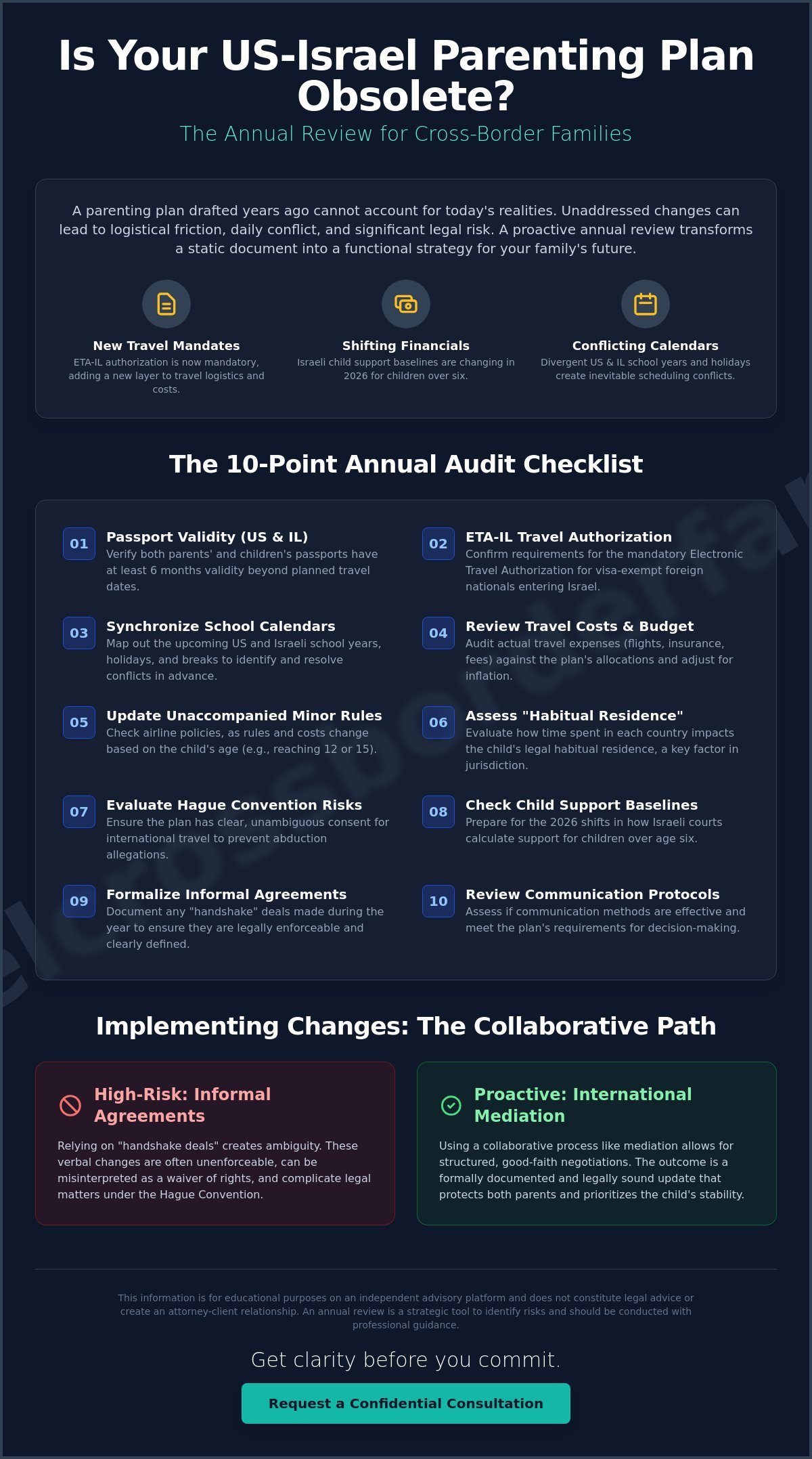
The Annual Review Checklist: A 10-Point Audit
Executing an annual review of international parenting plan requires moving from legal theory to operational reality. This audit identifies where your current arrangement may fail during the 2026-2027 calendar year. By reviewing these specific points, you can address logistical friction before it disrupts your child’s stability or triggers a jurisdictional dispute.
- Verify Passports: Confirm that both US and IL passports for minors are valid for at least the next 18 months. Remember that US passports for children under 16 expire every five years and require both parents to appear in person for renewal.
- Check Israeli Travel Provisions: Ensure you are compliant with the temporary provision allowing Israeli citizens to use foreign passports for entry, which is currently set to expire on September 30, 2026.
- Confirm ETA-IL Status: Verify that all travelers have a valid Electronic Travel Authorization. This 25 NIS requirement is mandatory for all visitors to Israel as of 2024.
- Sync School Calendars: Cross-reference the Israeli school portal with the US district calendar. Look specifically for “bridge days” where one system is in session while the other is on holiday.
- Audit the Travel Fund: Review whether monthly contributions are keeping pace with 2026 flight costs and unaccompanied minor fees.
- Review Medical Insurance: Confirm the child has active coverage in both jurisdictions, including specialized travel insurance for long-haul transitions.
- Update Emergency Contacts: Ensure both parents have current local contact information for schools, doctors, and emergency services in both countries.
- Notice of Intent Templates: Refresh the templates used to notify the other parent of travel dates to ensure they meet the specific notice windows required by your court order.
- Right of First Refusal: Evaluate if the “right of first refusal” clause is still practical. As children age and their extracurricular schedules grow, rigid clauses may need more flexibility.
- Propose an Annual Summit: Set a specific date to meet with the other parent to finalize the coming year’s dates.
Step-by-Step Logistics Audit
Begin by logging into the respective school portals for both the US and IL institutions. You should draft a concise summary of proposed travel dates for the next 12 months and share this with the other parent. This proactive transparency is a hallmark of successful strategies for expats and foreign nationals living in Israel. Setting a formal “Annual Parenting Summit” meeting allows you to resolve minor scheduling conflicts in a neutral setting rather than through urgent, last-minute emails.
Documentation and Compliance
Your annual review of international parenting plan must also ensure that your documentation remains legally robust. Update your “Notice of Intent to Travel” templates to include any new flight paths or escort responsibilities. If your audit reveals significant gaps in your current arrangement, you can contact us to discuss a formal strategy for updating your plan. This ensures your family remains compliant with both Israeli Family Court expectations and US state requirements. Get clarity before you commit. Request a confidential consultation.
This article is published on an independent advisory platform and does not constitute a law firm or an attorney-client relationship. All information is for educational purposes only.
Implementing Changes and Seeking Professional Clarity
Proposing updates to a co-parent can feel like an invitation to conflict. However, presenting the findings of your annual review of international parenting plan as a shared logistical necessity shifts the focus from personal grievances to the child’s well-being. Frame the discussion around the concrete data you’ve gathered, such as the 2026-2027 school dates or the expiration of the Israeli passport provision on September 30, 2026. This objective approach encourages collaboration rather than defense.
If consensus remains elusive, international mediation serves as a critical bridge. Mediation allows both parties to resolve disputes over flight costs or holiday rotations without the high stakes of a courtroom. It is a strategic choice that can prevent the escalation of a simple scheduling disagreement into a complex jurisdictional battle. When changes are agreed upon, they should be formalized. In Israel, filing a modification in the Family Court typically costs approximately NIS 802 for claims up to NIS 50,000 in annual value. Relying on an unfiled “handshake” agreement can jeopardize your legal standing if the other parent decides to revert to the original court order later.
Strategy Over Litigation
Early decisions in cross-border cases often have long-term legal consequences. By using your review to build a documented history of cooperative parenting, you strengthen your position in any future “habitual residence” or relocation disputes. Courts in both the US and IL value parents who demonstrate a proactive commitment to the child’s stability. For additional visual guidance on handling these transitions, you can find expert advice on the Israel Family Law YouTube channel. These resources help explain the significant differences between legal systems and cultures in plain English.
Next Steps for International Families
Finalizing your strategy for the upcoming year requires a nuanced understanding of how two different legal systems interact. Working with cross-border practitioners ensures that your updated plan is enforceable in both your US home state and the Israeli Family Court system. This level of professional oversight is essential for managing the inherent complexity of transnational family life.
Before you commit to a new schedule or sign a stipulation, it is wise to prepare for a confidential case review. This allows you to assess potential risks and ensure your plan remains legally sound as your family’s needs evolve. Clarity is the most effective tool for preventing future litigation. Get clarity before you commit. Request a confidential consultation.
This article is published on an independent advisory platform and does not constitute a law firm or an attorney-client relationship. All information is for educational purposes only.
Building a Resilient Strategy for Your International Family
A successful cross-border arrangement requires more than just a court order; it demands an ongoing commitment to logistical precision and legal awareness. By conducting an annual review of international parenting plan, you ensure that your family remains protected against the shifting realities of travel mandates and school calendars. You now have the tools to audit flight logistics, evaluate “habitual residence” risks, and use mediation to resolve disputes before they escalate into high-stakes litigation.
As an independent advisory platform, we specialize in providing international families with the expertise needed to navigate US-Israel cross-border matters. Our focus remains entirely on strategy and risk-based decision-making to help you avoid the common pitfalls of dual legal systems. Whether you’re adjusting for the 2026 travel provisions or re-syncing your communication protocols, being proactive is your best defense. This structured approach allows you to address complexities with confidence and maintain stability for your children.
Get clarity before you commit. Request a confidential consultation. With a robust strategy in place, you can move forward with the peace of mind that your family’s future is secure in both countries.
This article is published on an independent advisory platform and does not constitute a law firm or an attorney-client relationship. All information is for educational purposes only.
Frequently Asked Questions
Do we need to go to court every time we want to change the parenting schedule?
No, you don’t always need a full court hearing for every adjustment. Parents can often agree on changes through a written stipulation that is then submitted to the court for a judge’s signature. This process formalizes the update without an adversarial trial. However, for international cases, ensuring these changes are recognized as “mirror orders” in both the US and IL is vital for long-term enforceability.
What happens if the school calendars in Israel and the US overlap for a holiday?
You should establish a tie-breaker rule within your agreement to handle overlapping dates. Usually, the academic calendar of the country where the child primarily resides takes precedence. An annual review of international parenting plan allows you to spot these overlaps 12 months in advance. This foresight gives you time to negotiate “bridge days” or holiday trade-offs before flight prices become prohibitive.
How do I handle a child who is now old enough to refuse international travel?
Israeli and US courts both place increasing weight on a child’s preferences as they mature. If a teenager expresses a desire to stop traveling, it’s often a sign that the current plan needs a strategic update. You might consider transitioning to more robust digital visitation or shorter, more frequent trips. Ignoring these developmental shifts can lead to unenforceable orders and significant family friction.
Can I enforce a parenting plan update if the other parent lives in Israel and I am in the US?
Yes, enforcement is possible through the Hague Convention or specific bilateral agreements between the US and Israel. For an update to be actionable in Israel, the Israeli Family Court must formally recognize the foreign modification. This process, often called registering a foreign judgment, provides the local legal authority needed to ensure the other parent complies with the updated terms.
What should I do if my child’s US or Israeli passport is about to expire?
You must begin the renewal process at least six months before the expiration date to avoid travel disruptions. US law requires both parents to appear in person for passport services for children under 16. In the Israeli context, remember that the temporary provision allowing citizens to enter on foreign passports is set to expire on September 30, 2026. Early renewal prevents “stay of exit” complications at the border.
Is an annual review mandatory for an international parenting plan?
While an annual review of international parenting plan isn’t legally mandated by statute, it’s a strategic necessity for cross-border families. It serves as a proactive stress test for your logistics. Failing to review your plan can leave you relying on an obsolete document that doesn’t account for new travel requirements, such as the mandatory 25 NIS ETA-IL fee introduced in 2024.
How do we split the rising costs of international flights fairly?
Costs are generally split proportionally based on the net income of each parent. For children over the age of six, Israeli courts have moved toward a more egalitarian approach that considers both parents’ earnings and the time the child spends in each home. Reviewing these costs annually is essential to account for currency fluctuations between the USD and NIS and rising travel inflation.
What if my ex-partner refuses to participate in an annual review?
If a co-parent refuses to cooperate, international mediation is often the most effective next step. Mediation provides a neutral environment to resolve scheduling deadlocks without the cost of a full court battle. If the current plan is no longer functional and mediation fails, you may need to file a motion for modification in the court that holds primary jurisdiction over the child.

Article by
Gabriel Lior
A Personal Journey That Became a Mission
The advisory was founded by an American father Gabriel Lior, LLB, MBA , global entrepreneur, and cross-border advisor who spent more than a decade navigating the Israeli family court system firsthand and now lives in Singapore with his son.
As a divorced parent in a cross-border family, Gabriel faced nearly every legal challenge a foreign parent can encounter in Israel — including child custody disputes, child support proceedings, property matters in Israel and abroad, false accusations, and complex immigration and relocation proceedings.
Over the years, he learned the hard way how difficult it is for non-Israeli parents to understand the system, identify the right legal strategy, and choose the right legal representation — especially when language, culture, and jurisdictional differences are involved. He also witnessed how foreign parents and new immigrants are often disadvantaged or taken advantage of by service providers and institutions simply because they lack local knowledge or fluency.
From Client to Advisor
To truly understand — and survive — the system, Gabriel pursued formal legal education in Israel, completing two Israeli law degrees, alongside a BA and MBA earned in the United States. This was never about becoming a practicing attorney, but about gaining a deep, structural understanding of how the system works — and where it breaks down for foreign parents.
This rare combination of:
Firsthand client experience
Israeli legal and US business education
International business and negotiation training
Decades of commercial execution
created a unique perspective – one that understands both sides of the table.
After years of litigation, persistence, and at times self-representation, he ultimately succeeded in securing custody of his son and relocating abroad through a rare legal victory in the Israeli Supreme Court — becoming one of the first fathers in Israel to do so under these circumstances.
Disclaimer
Important Disclaimer:
The information provided on this website and in its content is for general informational and educational purposes only and does not constitute legal advice, legal opinion, or legal representation.
Gabriel Lior is not licensed to practice law in Israel (nor is he interested in doing so) and does not provide legal services, despite having completed 2 Law Degrees. The services offered are advisory in nature and are intended to provide general guidance, strategic insight, and information regarding cross-border family law considerations.
No attorney-client relationship is formed by accessing this website, reading its content, or communicating with us.
Any decisions made based on this information are at your own discretion and risk. For legal advice specific to your situation, you should consult a licensed attorney in the relevant jurisdiction.
Where appropriate, we may refer clients to independent, licensed attorneys or professionals. Such referrals do not constitute legal representation and no liability is assumed for services provided by third parties.