This article is published on an independent advisory platform and does not constitute a law firm or an attorney-client relationship. Legal services are only provided by licensed attorneys under a separate engagement. It is for informational and advisory purposes only.
Your new partner might be the primary reason you are looking to move abroad, but in an Israeli courtroom, they don’t actually hold independent legal standing. It is a common fear among expats that a new spouse will be viewed as a replacement parent, yet the legal rights of new spouse in relocation cases are limited to their role as a stabilizing factor for the child’s environment. While their presence is significant to the family’s future, they aren’t a party to the litigation in the same way biological parents are under Israeli law.
We understand the anxiety that comes with merging a new family while navigating the complex US-Israel legal landscape. You will gain clarity on how a new marriage influences international relocation litigation and the specific standing of stepparents in these sensitive proceedings. We’ll preview how courts apply the Best Interests test to your new family unit and how a partner’s income might impact child support expectations. For more visual guidance, you can also explore our insights on the Israel Family Law YouTube channel. Get clarity before you commit. Request a confidential consultation.
Key Takeaways
- Learn why Israeli courts categorize a new partner as a “supportive third party” rather than a primary litigant in relocation disputes.
- Understand the specific limitations regarding the legal rights of new spouse in relocation cases and how their presence influences the court’s view of a stable family unit.
- Discover how court-appointed professionals evaluate the “Step-Parent Bond” and its impact on the child’s future standard of living.
- Identify the critical differences between Israeli and US relocation standards, including how the “Right to Start a New Life” is weighed against notice requirements.
- Gain strategic guidance on building a relocation plan that prioritizes the child’s welfare while addressing the concerns of the non-relocating parent.
This article is published on an independent advisory platform and does not constitute a law firm or an attorney-client relationship. Legal services are only provided by licensed attorneys under a separate engagement. It is for informational and advisory purposes only.
The Role of the New Spouse in International Relocation
When an international family transitions into a new phase through remarriage, the legal landscape shifts significantly. Israeli courts don’t view a new spouse as a primary party to the litigation. Instead, they’re seen as a supportive third party whose presence impacts the case’s outcome. This distinction is vital for anyone dealing with the Israeli legal system. While a new partner doesn’t have the same standing as a biological parent, their entry into the family is often classified as a material change in circumstances. This classification allows the court to revisit existing custody or visitation orders that were previously considered final.
To better understand how these dynamics play out in court, watch this helpful video:
There’s a clear line between the legal rights of new spouse in relocation cases and their evidentiary influence. A new spouse doesn’t have an independent right to demand relocation or influence the child’s schedule. However, their presence provides the court with evidence regarding the child’s future environment. If a parent plans to move to the US to join a new spouse, the court must ensure the move isn’t a unilateral action that violates the other parent’s rights. This is why understanding the Hague Convention on the Civil Aspects of International Child Abduction is so important. It sets the ground rules for cross-border parental rights and prevents parents from moving children without proper legal authorization or consent.
Why a New Marriage Often Triggers Relocation Requests
Relocation requests are rarely impulsive. They’re usually driven by the practical needs of a growing family. In many cross-border cases, the new spouse has secured a high-level professional opportunity in the US or another global hub. This move often triggers the original parent’s desire to relocate so the family isn’t split across continents. Families often seek to consolidate their household in one location to pool resources and provide a stable home for the children. This shift from two separate households to one unified unit can significantly alter the financial and emotional support available to the child, making the relocation plan more viable in the eyes of a judge.
The Legal Status of the “New Family Unit”
Israeli courts generally recognize the right to start a new life. Judges understand that parents shouldn’t be indefinitely tethered to a specific location if their personal circumstances change. However, this right isn’t absolute. It constantly sits in tension with the child’s right to maintain a consistent relationship with both biological parents. When considering the legal rights of new spouse in relocation cases and international custody and relocation, the court examines whether the new family unit offers a genuine improvement for the child. They look for evidence that the new spouse is committed to the child’s welfare and that the transition won’t cause irreparable harm to the bond with the parent remaining in Israel.
This article is published on an independent advisory platform and does not constitute a law firm or an attorney-client relationship. Legal services are only provided by licensed attorneys under a separate engagement. It is for informational and advisory purposes only.
Evaluating the New Spouse’s Impact on the Child’s Best Interests
The “best interests of the child” serves as the primary lens through which Israeli courts view every relocation application. While we’ve established that the legal rights of new spouse in relocation cases are not independent of the biological parent, their presence is a critical environmental factor. Judges examine whether the new spouse will provide a stabilizing influence or cause further disruption. They want to see a genuine bond between the child and the stepparent rather than a forced transition that creates emotional distress. Stability isn’t just about a new house; it’s about maintaining old bonds while building new ones.
A major concern for courts is the risk of parental alienation. If the move feels like an attempt to replace the biological parent in Israel, judges will likely hesitate. The court assesses if the new spouse will help the child integrate into the new country’s culture and school system. This is often framed as finding the “least detrimental alternative” for the child’s welfare. To mitigate the fear of the left-behind parent being replaced, courts sometimes order a financial guarantee, such as 200,000 shekels, to ensure the child maintains contact with both parents. Evaluating these risks requires a strategic approach to your international custody and relocation plan.
Financial Stability and Resource Pooling
Financial resource pooling is a tangible benefit often cited in relocation cases. A new spouse’s income can provide access to better housing or private schooling that wasn’t previously affordable. In US-Israel moves, access to employer-sponsored health insurance and comprehensive benefits is a significant factor that courts weigh heavily. It’s helpful to clarify that while a new spouse’s wealth might improve the child’s standard of living, it doesn’t automatically reduce the biological parent’s obligation to provide for essential needs. As of 2026, the recognized minimum for a child’s essential needs is approximately NIS 1,300 to NIS 1,500 per month, which serves as a baseline before other expenses are factored in.
The Psychological Assessment of the New Spouse
Court-appointed psychologists or social workers often interview the new spouse to evaluate the “stranger in the house” objection frequently raised by the parent staying behind. The goal is to prove the stepparent is a supportive figure who respects the biological parent’s role. These professionals look for consistency and emotional maturity in the new relationship. Understanding the Israeli Ministry of Justice guidance on international child abduction helps families see how seriously the state views the preservation of parental rights during these transitions. Preparing your partner for these evaluations is a vital part of the process. You might find it helpful to request a confidential case review to explore how these factors apply to your specific situation.
This article is published on an independent advisory platform and does not constitute a law firm or an attorney-client relationship. Legal services are only provided by licensed attorneys under a separate engagement. It is for informational and advisory purposes only.
Legal Standing: Do New Spouses Have Independent Rights?
A fundamental principle in Israeli family law is that the “standing” to litigate child related matters belongs almost exclusively to the biological parents. In the context of the Israeli legal system, standing refers to the right to be a party to the case and make formal legal claims. While a new partner is deeply involved in the family’s daily life, they aren’t considered a “party” to the relocation trial. This means they cannot independently file a motion to relocate with the child or prevent a move from happening. The legal rights of new spouse in relocation cases are derivative, meaning they only exist through their relationship with the biological parent who is seeking the court’s permission to move.
This lack of independent standing can be frustrating for stepparents who have invested years in a child’s upbringing. However, the court’s focus remains on the “Natural Guardianship” of the biological parents. This doctrine presumes that the mother and father are the primary decision makers for the child’s welfare. While the new spouse’s circumstances are a factor, they don’t have the legal power to mandate a change in the child’s residence. Their role is to support the relocating parent’s plan rather than to lead the legal strategy themselves.
Stepparent Rights in Israel vs. the United States
The distinction between legal systems is particularly sharp when comparing Israel and the United States. In Israel, both the Family Court and the Rabbinical Court place heavy emphasis on biological lineage. There’s very little recognition for “psychological parents” who aren’t biological. In contrast, many US states recognize the concept of “in loco parentis,” where a stepparent who has acted as a parent for a long time may gain limited visitation or even custody rights. These differences become critical when managing divorce and separation for international families. A stepparent might have rights in New York that simply don’t exist under Israeli law, creating a complex jurisdictional puzzle during relocation disputes.
Can a New Spouse Testify in a Relocation Trial?
While a new spouse isn’t a party to the case, they frequently appear as a key witness. Their testimony is used to prove the stability of the new home and their commitment to the child’s care. However, taking the stand carries risks. The opposing lawyer will likely cross-examine the new spouse on their background, financial history, and past relationships. A stable history and a clean background check are essential. If the other parent can prove the new spouse has a volatile history, it could jeopardize the entire relocation application. The new spouse’s role is to be a reliable witness who demonstrates that the move is in the child’s best interest, rather than a replacement for the parent left behind.
Get clarity before you commit. Request a confidential consultation.
This article is published on an independent advisory platform and does not constitute a law firm or an attorney-client relationship. Legal services are only provided by licensed attorneys under a separate engagement. It is for informational and advisory purposes only.
Navigating Jurisdictional Differences (US vs. Israel)
Israeli courts primarily rely on the “Center of Life” test to determine whether they have the authority to hear a relocation case. If a child has been living in Israel for a significant period, the Family Court will likely maintain jurisdiction, even if a parent marries a US citizen and wishes to move. While Israeli judges increasingly recognize “The Right to Start a New Life,” this doesn’t grant a parent a free pass to move. In contrast, many US states have specific relocation statutes that require formal notice to the other parent months in advance. These statutes often place a heavy burden of proof on the relocating parent to show the move is in good faith. Even if you feel the legal rights of new spouse in relocation cases should carry weight, both systems prioritize the preservation of the existing parental bond above all else.
One of the most dangerous misconceptions is that having a new spouse in the destination country somehow “cures” a move made without consent. Under the Hague Convention, moving a child without a court order or the other parent’s permission is considered wrongful removal. A new marriage or a stable home in the US doesn’t change the fact that the child was taken from their habitual residence. Israeli courts are very strict about this. They won’t hesitate to order a child’s return, regardless of how welcoming or wealthy the new stepparent might be. The presence of a new partner is never a legal substitute for proper judicial authorization.
Israeli Family Court vs. US Best Interest Standards
There is a subtle but significant difference in how these two systems view the “Best Interests” of the child. Historically, Israel has been influenced by the “Tender Years Doctrine,” which often favors the mother as the primary caregiver for children under six. However, the system is shifting toward more egalitarian, shared parenting for children aged six to eighteen. US courts, meanwhile, focus heavily on “Frequent and Continuing Contact” with both parents. This creates an emotional hurdle: the “replacement” narrative. Left-behind parents often fear the new spouse is intended to replace them. Israeli judges are sensitive to this fear. They look for relocation plans that explicitly protect the child’s cultural and emotional ties to the parent staying in Israel.
Enforcement and Travel Orders
A successful relocation plan must include enforceable visitation schedules that work across time zones. Israeli judges frequently require the relocating parent to deposit a substantial financial bond, often reaching 200,000 shekels, to guarantee the child returns for scheduled visits. This bond acts as a safeguard against the risk of the child losing contact with their roots. You must also consider how orders will be recognized across borders. Understanding child support cross-border enforcement is essential for maintaining financial stability in the new family unit. If you are struggling with these conflicting standards, you should contact us for a strategic evaluation.
This article is published on an independent advisory platform and does not constitute a law firm or an attorney-client relationship. Legal services are only provided by licensed attorneys under a separate engagement. It is for informational and advisory purposes only.
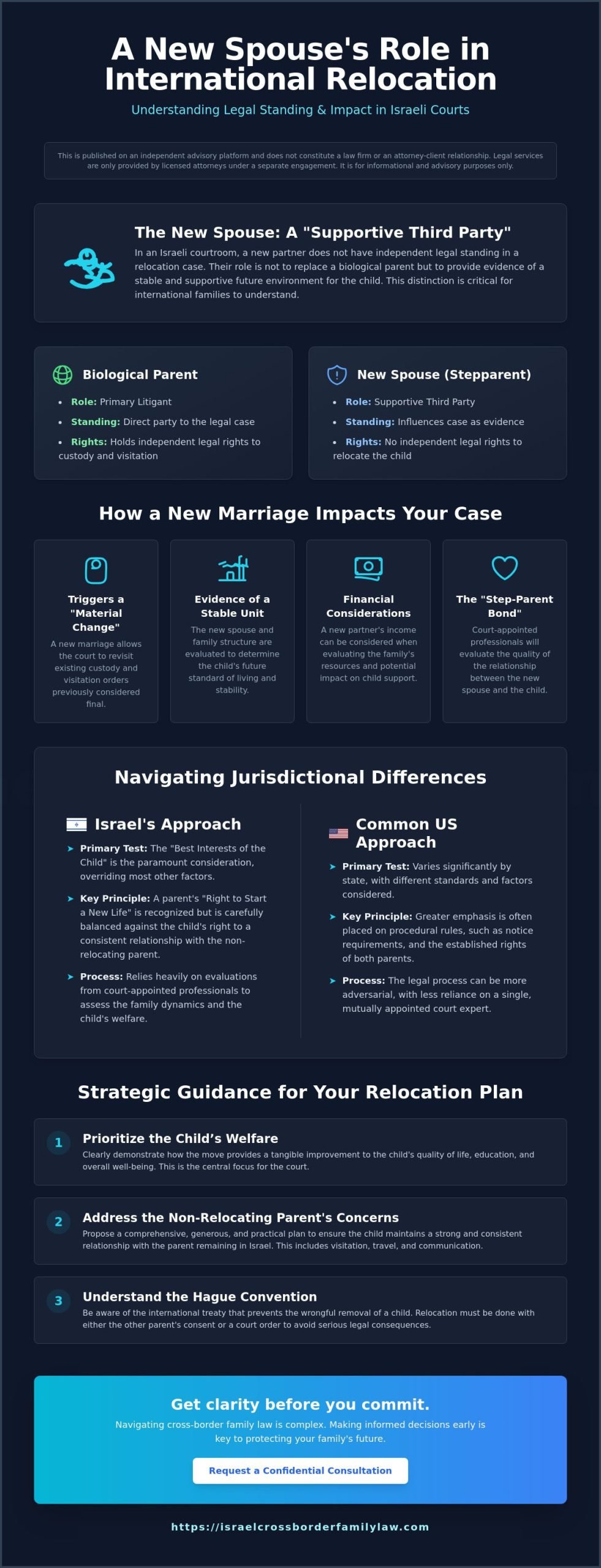
Strategic Planning for Families with a New Spouse
A successful relocation application requires a fundamental shift in perspective. You must move away from a narrative centered on your new marriage and toward one that prioritizes the child’s continuity. While the legal rights of new spouse in relocation cases are not independent, their role as a facilitator of the child’s relationship with the non-relocating parent is a major strategic asset. Courts in Israel look for evidence that the new family unit will actively support, rather than obstruct, the bond with the parent staying behind. Early strategy is always more effective than reactive litigation. Proposing a detailed plan that includes travel subsidies and robust “virtual visitation” schedules demonstrates good faith and a commitment to the child’s long-term welfare.
Transparent communication with the other parent is often the most overlooked component of a relocation plan. Addressing their fears directly can sometimes prevent a lengthy court battle. If the left-behind parent feels the new spouse is a partner in the child’s upbringing rather than a replacement, they may be more open to negotiation. A well-structured plan should detail how the child will spend holidays, how flights will be funded, and how the new spouse will help manage the logistics of cross-border parenting. This level of detail provides the court with the reassurance it needs to approve a move into a multi-jurisdictional environment.
The Importance of Clarity Before Commitment
You should never make physical or financial commitments to a move before a court order is finalized. The risks of “self-help” relocation, where a parent moves without permission, are severe. Israeli courts view such actions through the lens of the Hague Convention, and it can lead to an immediate order for the child’s return. This type of early mistake can permanently damage your standing in future proceedings. Seeking a confidential case review before you sign a lease or resign from a job in Israel is essential. Understanding the legal rights of new spouse in relocation cases requires a move away from emotional narratives toward data-driven family planning and risk assessment.
Incorporating the New Spouse into the Transition
A “Step-Parenting Agreement” can be a powerful tool in your relocation strategy. This document defines the boundaries and roles of the new spouse, clarifying that they aren’t intended to replace the biological parent. It outlines how the new spouse will facilitate communication and respect the existing parental hierarchy. This proactive approach shows the court that you’ve considered the emotional complexities of the move. For further guidance on these transitions, you can explore the Israel Family Law YouTube channel. Get clarity before you commit. Request a confidential consultation.
This article is published on an independent advisory platform and does not constitute a law firm or an attorney-client relationship. Legal services are only provided by licensed attorneys under a separate engagement. It is for informational and advisory purposes only.
Securing Your Family’s Future Across Borders
Navigating the intersection of a new marriage and international relocation requires a sophisticated understanding of both Israeli and US legal frameworks. You’ve learned that while the legal rights of new spouse in relocation cases are derivative of the biological parent’s standing, their role as a supportive environmental factor is essential for a successful “Best Interests” assessment. A successful application depends on a transparent relocation plan that proactively addresses the concerns of the left-behind parent and prioritizes child stability over a partner’s career goals or personal preferences.
We bring decades of experience in complex US-Israel cross-border litigation to every international family we advise. Our specialized focus on expats is supported by practitioners licensed in multiple jurisdictions, ensuring you receive guidance that reflects the nuances of both legal systems. This cross-cultural expertise serves as a bridge between divergent cultures and courts. Get clarity before you commit. Request a confidential consultation to discuss your specific strategy. Moving forward with the right information is the most effective way to protect your children and your new family unit during this transition.
This article is published on an independent advisory platform and does not constitute a law firm or an attorney-client relationship. Legal services are only provided by licensed attorneys under a separate engagement. It is for informational and advisory purposes only.
Frequently Asked Questions
Does my new spouse’s income count toward child support in a relocation case?
A new spouse’s income is generally not used to calculate child support for children from a previous relationship. Israeli law focuses on the financial capacity of the biological parents. While the spouse’s resources might improve the child’s overall standard of living, they don’t create a legal obligation for the stepparent to provide direct financial support. The court primarily looks at the biological parents’ income and assets.
Can my ex-partner block my relocation just because they dislike my new spouse?
Personal dislike is not a valid legal ground to block a relocation application. The court’s primary focus is the “Best Interests of the Child” rather than the personal feelings of the parents. Unless the ex-partner can provide evidence that the new spouse poses a specific risk to the child’s physical or emotional welfare, personal animosity carries very little weight in a judicial decision.
Will the court interview my new spouse during the relocation trial?
Professionals appointed by the court frequently interview the new partner to evaluate the family dynamic. They want to ensure the child is entering a stable and healthy home environment. While the legal rights of new spouse in relocation cases don’t grant them a vote in the move, their character and bond with the child are heavily scrutinized to ensure the transition is beneficial for the child.
What happens if my new spouse is the one who got a job offer in the US?
A spouse’s job offer is considered a legitimate professional opportunity that can justify a relocation request. The court will examine if this move provides the child with a higher standard of living or better educational opportunities. It serves as a practical, good faith reason for wanting to unify the family in a new location, rather than an attempt to alienate the other parent.
Do stepparents have any visitation rights if the new marriage ends after relocation?
In Israel, stepparents generally do not have automatic visitation rights if the marriage ends. Israeli law prioritizes biological lineage and the natural guardianship of the original parents. While some US states recognize “in loco parentis” status for long term stepparents, these rights are difficult to enforce in the Israeli Family Court system without a specific legal agreement or formal adoption in place.
How do Israeli courts view a move to a US state where the new spouse has family?
Judges often view proximity to an extended family network as a positive factor for the child’s support system. Having a built in community of grandparents, aunts, or cousins in the US can help mitigate the isolation of moving to a new country. It strengthens the argument that the relocation provides a stable, supportive environment that will help the child thrive during the transition.
Can a prenuptial agreement affect the outcome of a relocation case?
A prenuptial agreement between the new spouses usually does not affect the relocation case outcome. Relocation is decided based on the child’s best interests, not the financial or contractual arrangements of the adults. However, if an agreement outlines specific long term housing or financial stability for the child, it might be presented as evidence of a well planned and secure move.
What is the “Center of Life” test and how does a new spouse affect it?
The “Center of Life” test identifies the country where the child’s primary social, educational, and family ties exist. A new spouse can shift this balance if they provide a permanent home and financial foundation in a new jurisdiction. When determining the legal rights of new spouse in relocation cases, judges assess if the spouse’s presence helps establish a new, viable center of life abroad.

Article by
Gabriel Lior
A Personal Journey That Became a Mission
The advisory was founded by an American father Gabriel Lior, LLB, MBA , global entrepreneur, and cross-border advisor who spent more than a decade navigating the Israeli family court system firsthand and now lives in Singapore with his son.
As a divorced parent in a cross-border family, Gabriel faced nearly every legal challenge a foreign parent can encounter in Israel — including child custody disputes, child support proceedings, property matters in Israel and abroad, false accusations, and complex immigration and relocation proceedings.
Over the years, he learned the hard way how difficult it is for non-Israeli parents to understand the system, identify the right legal strategy, and choose the right legal representation — especially when language, culture, and jurisdictional differences are involved. He also witnessed how foreign parents and new immigrants are often disadvantaged or taken advantage of by service providers and institutions simply because they lack local knowledge or fluency.
From Client to Advisor
To truly understand — and survive — the system, Gabriel pursued formal legal education in Israel, completing two Israeli law degrees, alongside a BA and MBA earned in the United States. This was never about becoming a practicing attorney, but about gaining a deep, structural understanding of how the system works — and where it breaks down for foreign parents.
This rare combination of:
Firsthand client experience
Israeli legal and US business education
International business and negotiation training
Decades of commercial execution
created a unique perspective – one that understands both sides of the table.
After years of litigation, persistence, and at times self-representation, he ultimately succeeded in securing custody of his son and relocating abroad through a rare legal victory in the Israeli Supreme Court — becoming one of the first fathers in Israel to do so under these circumstances.
Disclaimer
Important Disclaimer:
The information provided on this website and in its content is for general informational and educational purposes only and does not constitute legal advice, legal opinion, or legal representation.
Gabriel Lior is not licensed to practice law in Israel (nor is he interested in doing so) and does not provide legal services, despite having completed 2 Law Degrees. The services offered are advisory in nature and are intended to provide general guidance, strategic insight, and information regarding cross-border family law considerations.
No attorney-client relationship is formed by accessing this website, reading its content, or communicating with us.
Any decisions made based on this information are at your own discretion and risk. For legal advice specific to your situation, you should consult a licensed attorney in the relevant jurisdiction.
Where appropriate, we may refer clients to independent, licensed attorneys or professionals. Such referrals do not constitute legal representation and no liability is assumed for services provided by third parties.