The strategy you choose in the first forty-eight hours of a cross-border dispute often dictates the financial and emotional outcome for the next decade. If you’re an Anglo living in Beit Shemesh, you likely understand that your legal reality is split between two distinct worlds. It’s natural to feel overwhelmed by the prospect of navigating the Israeli Rabbinical court system while simultaneously worrying about how your US-based assets will be treated. Finding an international family lawyer in Beit Shemesh who understands this unique cultural and legal friction is the first step toward regaining control.
This guide provides the clarity you need to understand which legal system takes precedence and how to protect your interests in both jurisdictions. We’ll examine the multi-jurisdictional complexity of the “race to court,” the 2025 legislative shift regarding Rabbinical jurisdiction over child support, and the strategic importance of cultural fluency. For visual explanations of these topics, we recommend the Israel Family Law YouTube channel. Please note that this content is published on an independent advisory platform, not a law firm. It focuses on strategy and risk management rather than formal legal advice. You’ll gain a comprehensive overview of how to bridge the gap between US expectations and Israeli legal realities.
Key Takeaways
- Understand how the Israeli “race to jurisdiction” between civil and religious courts determines the legal framework for your divorce and asset division.
- Identify the essential qualifications when selecting an international family lawyer in Beit Shemesh to ensure your US-based assets and tax obligations are protected.
- Learn about the 2025 legislative shifts that expanded Rabbinical court jurisdiction over child support and what this means for your initial filing strategy.
- Gain clarity on the complexities of international relocation and the enforcement of support orders across the US-Israel border.
- Discover why multi-jurisdictional licensing is a critical requirement for attorneys managing complex family matters involving two divergent legal systems.
The Role of an International Family Lawyer in Beit Shemesh
International family law addresses the intersection of two or more legal jurisdictions in domestic matters. For residents of Beit Shemesh, this often involves the complex interplay between Israeli statutes and United States federal or state laws. Because Beit Shemesh is home to one of the largest concentrations of English-speaking immigrants in Israel, the demand for specialized cross-border expertise is uniquely high. The primary objective is to protect rights and assets that span the US-Israel border, ensuring that a decision made in a local courtroom doesn’t inadvertently trigger negative consequences abroad. This field is often referred to as international matrimonial law, covering everything from divorce to complex property division.
To better understand how these two systems interact, watch this helpful video:
Representation in this context requires more than just a translation of the law. It demands an understanding of cultural nuances and the strategic foresight to manage how the legal process works across borders. An international family lawyer in Beit Shemesh acts as a bridge, translating not just words, but legal concepts that often have no direct equivalent in the other system. A specialized advisor ensures that the strategy accounts for the long-term impact on your global financial standing. This content is published on an independent advisory platform, not a law firm, and focuses on strategy rather than an attorney-client relationship.
Why General Practice Lawyers May Fall Short
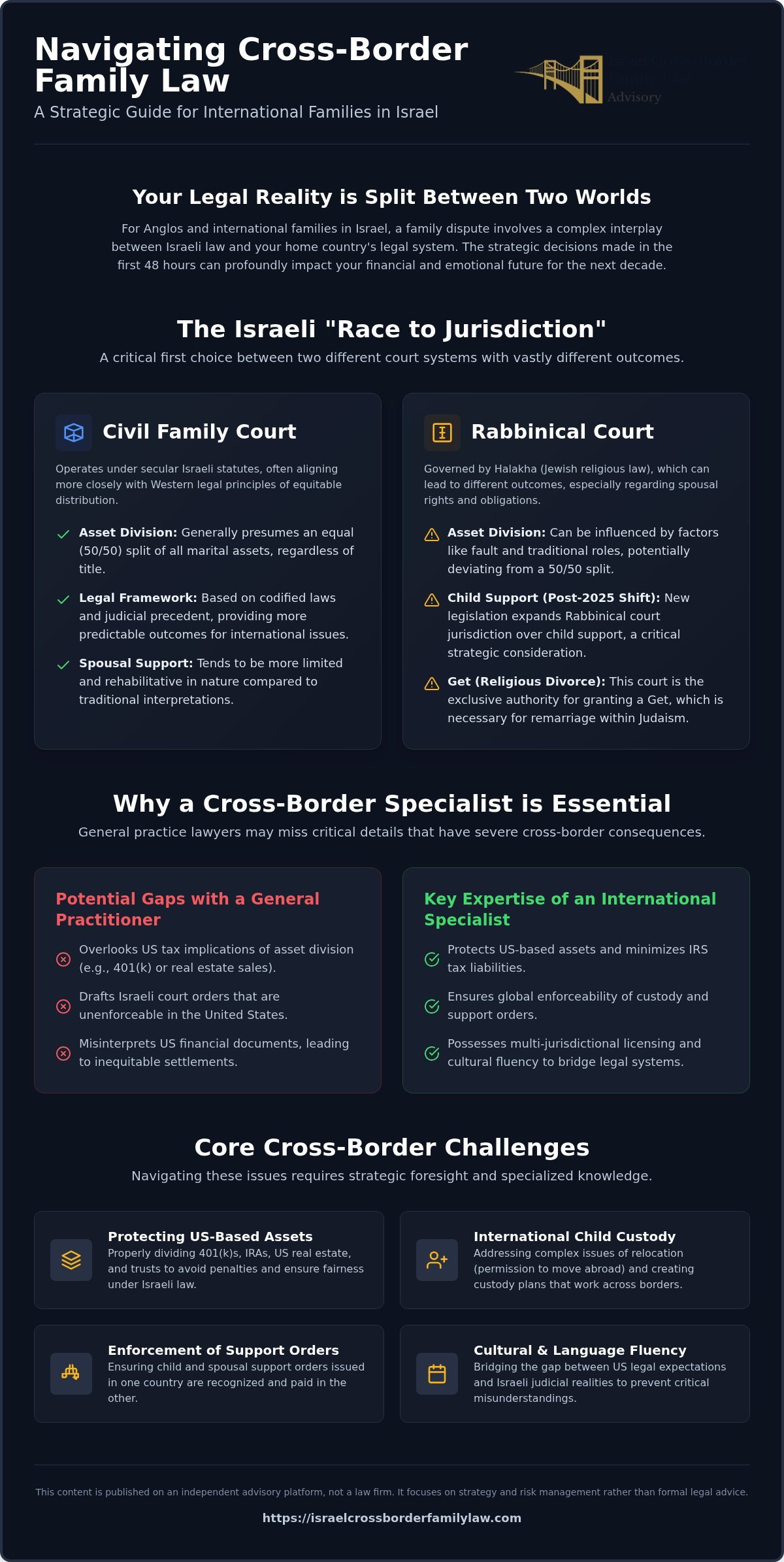
General practitioners often lack the specific training to identify US tax implications within an Israeli divorce settlement. For example, the division of a 401(k) or the sale of US real estate can lead to significant IRS liabilities if the agreement isn’t structured correctly. Local practitioners might also overlook whether an Israeli court order is actually enforceable in the United States. Misinterpreting US financial documents, such as brokerage statements or trust agreements, can lead to an inequitable distribution of assets in Israeli courts. These oversights can cost families thousands in unforeseen penalties or lost inheritance rights.
The Anglo Experience in the Beit Shemesh Legal Landscape
Navigating a family dispute within the close-knit Anglo community of Beit Shemesh adds another layer of social complexity. Decisions made early in the process carry significant weight, and language clarity is the first step toward securing your future. Many expats arrive with expectations rooted in the US legal system, only to find that Israeli realities, such as the “race to jurisdiction,” function quite differently. Establishing clear communication early prevents the common misunderstandings that arise when US legal concepts are applied to the Israeli family court framework. Bridging this gap requires a representative who understands both the cultural background of the client and the rigid requirements of the Israeli judiciary.
Navigating the Israeli “Race to Jurisdiction” from Beit Shemesh
Beit Shemesh families face a unique legal landscape where two separate court systems hold concurrent jurisdiction over family matters. The Civil Family Court and the Rabbinical Court often apply different standards to the same issues, creating a “race to jurisdiction” where the court that receives the first filing typically gains the authority to decide the case. Because many residents hold dual residency or significant assets in the United States, the choice of court can result in vastly different financial outcomes. An international family lawyer in Beit Shemesh can help evaluate which venue offers the most equitable framework for your specific circumstances, particularly when US citizenship or residency affects where a case should be heard.
The Civil Family Court vs. Rabbinical Court
Residents of Beit Shemesh generally fall under the authority of the Jerusalem district courts. While the Civil Family Court operates under secular law, the Rabbinical Court applies religious law. Historically, these courts differed greatly on child support and asset division. However, a November 2025 law change now allows Rabbinical Courts to rule on child support when it is part of a divorce lawsuit, even without both parents’ consent. This change has intensified the strategic importance of where you file first. Additionally, since March 2026, Rabbinical courts can serve as arbitration forums for certain civil disputes if both parties agree. For international couples, the Rabbinical Court also manages the “Gett” (religious divorce), which is a separate requirement from the civil dissolution of marriage.
Steps to Take Before Filing Your Case
Strategic planning begins before any legal action is initiated, as early decisions often carry the most weight in cross-border disputes. Seeking clarity on how your US-based assets and Israeli residency interact is the first step toward legal security.
- Consult a cross-border expert: Determine the most favorable jurisdiction by analyzing the Israeli Law on International Child Abduction and Hague Convention protocols if children are involved.
- Gather comprehensive records: Collect financial documents from both the US and Israel, including 401(k) statements, property deeds, and tax returns, to ensure all assets are accounted for.
- Evaluate 2026 standards: As of January 2026, the mandatory “Settlement of Dispute” application filing fee is 119 NIS. This is a required first step before any litigation can begin in either court system.
Understanding these procedural hurdles is the best way to protect your global interests and ensure your rights are upheld in both countries. You can request a confidential case review to explore your options before making a formal commitment. This content is published on an independent advisory platform, not a law firm, and focuses on strategy, risks, and decision-making guidance rather than an attorney-client relationship.
International Child Custody and Support in Beit Shemesh
For many families in Beit Shemesh, child custody and support are not merely local matters but complex international issues. Whether you moved to Israel on Aliyah or are considering a return to the United States, the legal framework governing your children’s residence and financial care shifts significantly once you cross a border. An international family lawyer in Beit Shemesh can help you understand how Israeli courts interpret the “best interests of the child” within an expat context. As of 2026, while the law regarding custody of children under six still exists, courts no longer apply the “Tender Age Doctrine” automatically. The modern trend in Israel is a strong move toward joint parental responsibility and shared physical care, even for very young children.
This content is published on an independent advisory platform, not a law firm. It focuses on strategy and risk management rather than an attorney-client relationship. Understanding these nuances early is the best way to ensure your family’s stability during a transition.
Relocation and Travel Restrictions
Relocation disputes often arise when one parent wishes to move back to the US with the children. In Israel, this requires either the other parent’s consent or a court order. To prevent a child from being removed from the country during a dispute, courts often issue a “Stay of Exit” order, known as a Tzav Ikur Yetzia Min Haaretz. This order is a common preventative measure for Anglo families in Beit Shemesh, ensuring that children remain in the jurisdiction until a final custody arrangement is reached. If a child is removed without permission, the Hague Convention on the Civil Aspects of International Child Abduction applies. Under Israeli law in 2026, Hague Convention cases must be concluded with a final decision within six weeks from the date the application is filed. You can find more detailed guidance on international custody and relocation through our advisory resources.
Enforcing US Support Orders in Israel
The legal mechanism for recognizing a US child support order in an Israeli court involves a formal registration process. If the order is disputed, you may need to file a petition with the Family Court to obtain a declaratory judgment confirming its validity in Israel. Several challenges often arise during this process:
- Currency Fluctuations: Child support amounts set in US dollars can vary significantly in value when converted to New Shekels, impacting the actual purchasing power in Beit Shemesh.
- Cost-of-Living Differences: Israeli courts may adjust support expectations based on local expenses, which often differ from US standards for education and healthcare.
- Enforcement Tools: Israel provides robust tools for collection, but they must be triggered through the proper local channels.
Navigating these hurdles requires a strategic approach to ensure that support remains fair and consistent across both jurisdictions. For more information on the mechanics of this process, see our guide on child support cross-border enforcement. Establishing clarity on these financial obligations early can prevent years of litigation and ensure the children’s needs are met without interruption.
Criteria for Choosing Representation for Cross-Border Cases
Selecting an international family lawyer in Beit Shemesh requires a rigorous evaluation of professional credentials that extend beyond the local Israeli judiciary. For families with significant ties to the United States, your primary objective is to secure a representative who possesses the multi-jurisdictional licensing necessary to navigate two distinct legal environments. It’s essential to prioritize practitioners who are admitted to practice in both Israel and at least one US state. This dual qualification ensures an intimate understanding of the procedural friction that often arises during cross-border litigation. This expertise is critical when managing the treatment of US-based assets, such as 401(k) accounts or real estate, within the framework of an Israeli divorce settlement.
Effective representation must also include a deep proficiency in the US-Israel Tax Treaty and international asset protection strategies. A common risk for Anglo families in Beit Shemesh is the unintended trigger of IRS liabilities during the division of global property. Your representative should demonstrate the ability to translate complex Israeli legal doctrines into plain English, providing the clarity required to make informed decisions. This content is published on an independent advisory platform, not a law firm, and focuses on strategy and risk management rather than an attorney-client relationship.
The Importance of a Strategic Advisory Approach
In complex international matters, the role of a strategist is often more valuable than that of a traditional litigator. A strategic advisor looks beyond the immediate courtroom conflict to evaluate how every decision impacts your long-term financial and personal security in both countries. You should assess the firm’s philosophy regarding alternative dispute resolution, especially given the 2026 trend toward mediation for settling property disputes efficiently. To understand the nuances of this methodical approach, you may review the how it works page, which delineates the advisory process for international families.
Verifying Cross-Border Credentials
During your initial consultation, it’s vital to ask specific questions regarding the lawyer’s experience with multi-jurisdictional litigation and the recognition of foreign divorce decrees. A firm that maintains a physical presence or an integrated professional network in both the US and Israel offers a significant advantage in managing global scale complexity. Verify that your representative has a dedicated focus on the specific needs of foreign nationals and expats. Their experience with the unique social dynamics of the Beit Shemesh community can be a decisive factor in achieving a favorable outcome.
If you’re ready to secure a strategic framework for your case, contact us to discuss your cross-border strategy.
Strategic Representation for Complex International Family Matters
Achieving a successful resolution in cross-border family matters requires a representative who functions as a strategic bridge between divergent legal cultures. An international family lawyer in Beit Shemesh provides the specialized perspective necessary to align Israeli courtroom procedures with the expectations of the US legal system. Modern technology plays a vital role in this process, as Zoom hearings and digital evidence tracking allow for seamless participation from parties located in different time zones. The team at Israel Cross Border Law Firm provides the calm, authoritative guidance needed to navigate these complexities, ensuring that your global interests remain protected throughout the proceedings. This content is published on an independent advisory platform, not a law firm, and focuses on strategy and risk management rather than an attorney-client relationship.
Managing US-Based Assets in an Israeli Divorce
Property division for Anglo families often involves sophisticated US-based assets such as 401(k) plans, IRAs, and residential real estate. Israeli courts may not intuitively understand the regulatory restrictions or tax penalties associated with these financial instruments, which can lead to inequitable settlements. Effective representation involves a robust “Discovery” process that spans both countries to identify and value all marital property accurately. This cross-border investigation prevents the concealment of assets and allows for strategic planning to minimize tax liabilities in both jurisdictions. Without this dual-lens approach, an Israeli court order might inadvertently trigger significant IRS penalties or lose the tax-deferred status of retirement funds, resulting in substantial financial loss.
Securing Your Future
The first thirty days of a family law dispute are often the most critical because the initial decisions you make set the trajectory for the entire case. Moving from a state of crisis to a state of clarity requires making informed choices based on a comprehensive understanding of the long-term risks involved. Early strategic planning helps you understand how the Israeli judiciary will view your international obligations and US-based wealth. To further your understanding of these dynamics, we recommend watching the relevant videos on the Israel Family Law YouTube channel. Protecting your future begins with seeking clarity before you commit to a specific legal path. Get clarity before you commit. Request a confidential consultation.
Securing Your Cross-Border Interests
Navigating the intersection of US and Israeli law requires more than local representation; it demands a strategic bridge between two distinct legal cultures. By understanding the implications of the “race to jurisdiction” and the specific requirements for managing US-based assets, you can move from a state of crisis to one of informed clarity. Early decisions carry significant weight, and securing specialized US-Israel legal expertise is the most effective way to protect your family’s future and financial stability. This content is published on an independent advisory platform, not a law firm, and focuses on strategy and risk management rather than an attorney-client relationship.
If you’re an Anglo resident seeking authoritative guidance on complex cross-border disputes, consulting an international family lawyer in Beit Shemesh ensures your rights are upheld in both countries. Specialized advisory services provide the cultural nuance and technical oversight necessary to manage multi-jurisdictional litigation successfully. Protecting your assets and your children’s welfare begins with seeking expert guidance before taking the first legal step in either jurisdiction.
Get clarity before you commit. Request a confidential consultation today.
Frequently Asked Questions
Do I need a lawyer in Beit Shemesh if my divorce was filed in the US?
Yes, because a US filing does not automatically resolve your legal status or obligations within the Israeli system. You still need to address the religious divorce or “Gett” and ensure that any foreign decree is formally recognized by the Israeli Family Court. An international family lawyer in Beit Shemesh acts as a strategic bridge to ensure your US proceedings don’t conflict with local requirements. This content is published on an independent advisory platform, not a law firm.
Can an Israeli court divide my assets located in the United States?
Israeli courts hold the authority to include global assets in a property division settlement if they have jurisdiction over the parties. This includes US-based real estate, 401(k) accounts, and IRAs. However, enforcing these Israeli orders in the United States requires specific legal maneuvers. Strategic planning is essential to prevent hidden assets and to minimize the significant tax liabilities that can arise when dividing property across two different tax jurisdictions.
What is the “Race to Court” and how does it affect my case in Beit Shemesh?
The “Race to Court” describes the competition for jurisdiction between the secular Family Court and the religious Rabbinical Court. In Israel, the court where the first valid claim is filed generally gains the authority to decide the case. For residents of Beit Shemesh, this choice is critical because each court may apply different standards to asset division and spousal support. Early filing can dictate the entire legal framework of your divorce.
Is a US prenuptial agreement enforceable in the Israeli Family Court?
Enforcement of a US prenuptial agreement is possible, but it is not automatic. The Israeli court must review the document to ensure it doesn’t contradict local public policy and was entered into voluntarily by both parties. Often, these agreements require a formal validation process within the Israeli system to be fully recognized. It is vital to have an international family lawyer in Beit Shemesh review your US agreement against current Israeli legal standards.
How is child support calculated for a parent living in Beit Shemesh with a US-based income?
Israeli courts calculate support by evaluating total global income, including US salaries, bonuses, and investment returns. The calculation accounts for the cost of living in Israel and fluctuating currency exchange rates between the Dollar and the Shekel. Following a 2025 law change, Rabbinical courts now have expanded jurisdiction to rule on child support matters when included in a divorce suit, making the initial filing strategy more impactful for parents with international income streams.
What happens if my spouse tries to take our children back to the US without my consent?
This situation is governed by the Hague Convention on International Child Abduction. If you suspect an unauthorized move, you should immediately seek a “Stay of Exit” order from the court to prevent the children from leaving Israel. If they have already been removed, Israeli law in 2026 requires Hague Convention cases to reach a final decision within six weeks. This rapid timeline is designed to return children to their habitual residence as quickly as possible.
How long does a cross-border divorce typically take in the Israeli system?
The duration depends on the complexity of the assets and whether the parties are in conflict. All cases begin with a mandatory “Settlement of Dispute” period, which typically lasts 45 to 60 days. An amicable, uncontested divorce might be finalized within six months. However, contested litigation involving international custody or the discovery of US-based assets can extend for eighteen months to two years as the courts navigate multi-jurisdictional evidence.
Can I handle my Israeli family law case in English?
While Hebrew is the official language of the Israeli court system, you can manage your case through an English-speaking representative. All official court filings and protocols will be in Hebrew, but your advisor will provide translations and explanations in plain English. This ensures you maintain full clarity on every strategic decision. Having a representative who understands your native language and culture is the first step toward securing your future in a foreign legal system.

Article by
Gabriel Lior
A Personal Journey That Became a Mission
The advisory was founded by an American father Gabriel Lior, LLB, MBA , global entrepreneur, and cross-border advisor who spent more than a decade navigating the Israeli family court system firsthand and now lives in Singapore with his son.
As a divorced parent in a cross-border family, Gabriel faced nearly every legal challenge a foreign parent can encounter in Israel — including child custody disputes, child support proceedings, property matters in Israel and abroad, false accusations, and complex immigration and relocation proceedings.
Over the years, he learned the hard way how difficult it is for non-Israeli parents to understand the system, identify the right legal strategy, and choose the right legal representation — especially when language, culture, and jurisdictional differences are involved. He also witnessed how foreign parents and new immigrants are often disadvantaged or taken advantage of by service providers and institutions simply because they lack local knowledge or fluency.
From Client to Advisor
To truly understand — and survive — the system, Gabriel pursued formal legal education in Israel, completing two Israeli law degrees, alongside a BA and MBA earned in the United States. This was never about becoming a practicing attorney, but about gaining a deep, structural understanding of how the system works — and where it breaks down for foreign parents.
This rare combination of:
Firsthand client experience
Israeli legal and US business education
International business and negotiation training
Decades of commercial execution
created a unique perspective – one that understands both sides of the table.
After years of litigation, persistence, and at times self-representation, he ultimately succeeded in securing custody of his son and relocating abroad through a rare legal victory in the Israeli Supreme Court — becoming one of the first fathers in Israel to do so under these circumstances.
Disclaimer
Important Disclaimer:
The information provided on this website and in its content is for general informational and educational purposes only and does not constitute legal advice, legal opinion, or legal representation.
Gabriel Lior is not licensed to practice law in Israel (nor is he interested in doing so) and does not provide legal services, despite having completed 2 Law Degrees. The services offered are advisory in nature and are intended to provide general guidance, strategic insight, and information regarding cross-border family law considerations.
No attorney-client relationship is formed by accessing this website, reading its content, or communicating with us.
Any decisions made based on this information are at your own discretion and risk. For legal advice specific to your situation, you should consult a licensed attorney in the relevant jurisdiction.
Where appropriate, we may refer clients to independent, licensed attorneys or professionals. Such referrals do not constitute legal representation and no liability is assumed for services provided by third parties.