This article is published on an independent advisory platform and is not a law firm. The information provided is for educational purposes only and does not establish an attorney-client relationship.
What if the most significant challenge for your child isn’t learning Hebrew, but navigating a fundamental shift from a protected childhood to a culture that prizes radical independence? For many international families, the prospect of cultural adjustment for children relocating to Israel brings up valid anxieties regarding language barriers and the fear that Israeli directness might be perceived as bullying. It’s understandable to feel overwhelmed by the loss of your existing social support networks while trying to build a new life in a complex, multi-jurisdictional environment.
We recognize that your family’s stability depends on more than just a smooth move; it requires a strategic approach to a new social and academic reality. This guide offers a clear roadmap for integration, helping you understand how these cultural shifts intersect with schooling expectations and your family’s broader legal residency status. You’ll gain the confidence to turn a period of uncertainty into a stable foundation for your children’s future. Get clarity before you commit. Request a confidential consultation. For additional guidance on family matters in Israel, you can explore our resources here: https://www.youtube.com/@IsraelFamilyLaw
Key Takeaways
- Understand the “Dugri” ethos and how shifting from a protected parenting style to fostering early independence is essential for success in Israeli playgrounds.
- Learn how the cultural adjustment for children relocating to israel impacts their social integration, especially within the informal environment of the state school system.
- Identify the “golden window” for language and social adaptation that changes as your child moves from early childhood into their teenage years.
- Recognize the legal connection between cultural integration and “habitual residence” to protect your family’s status in cross-border situations.
- Bridge the gap between Anglo and Israeli parenting expectations to ensure your family’s transition is both stable and strategically sound.
The Israeli Childhood Ethos: Understanding the “Dugri” Culture
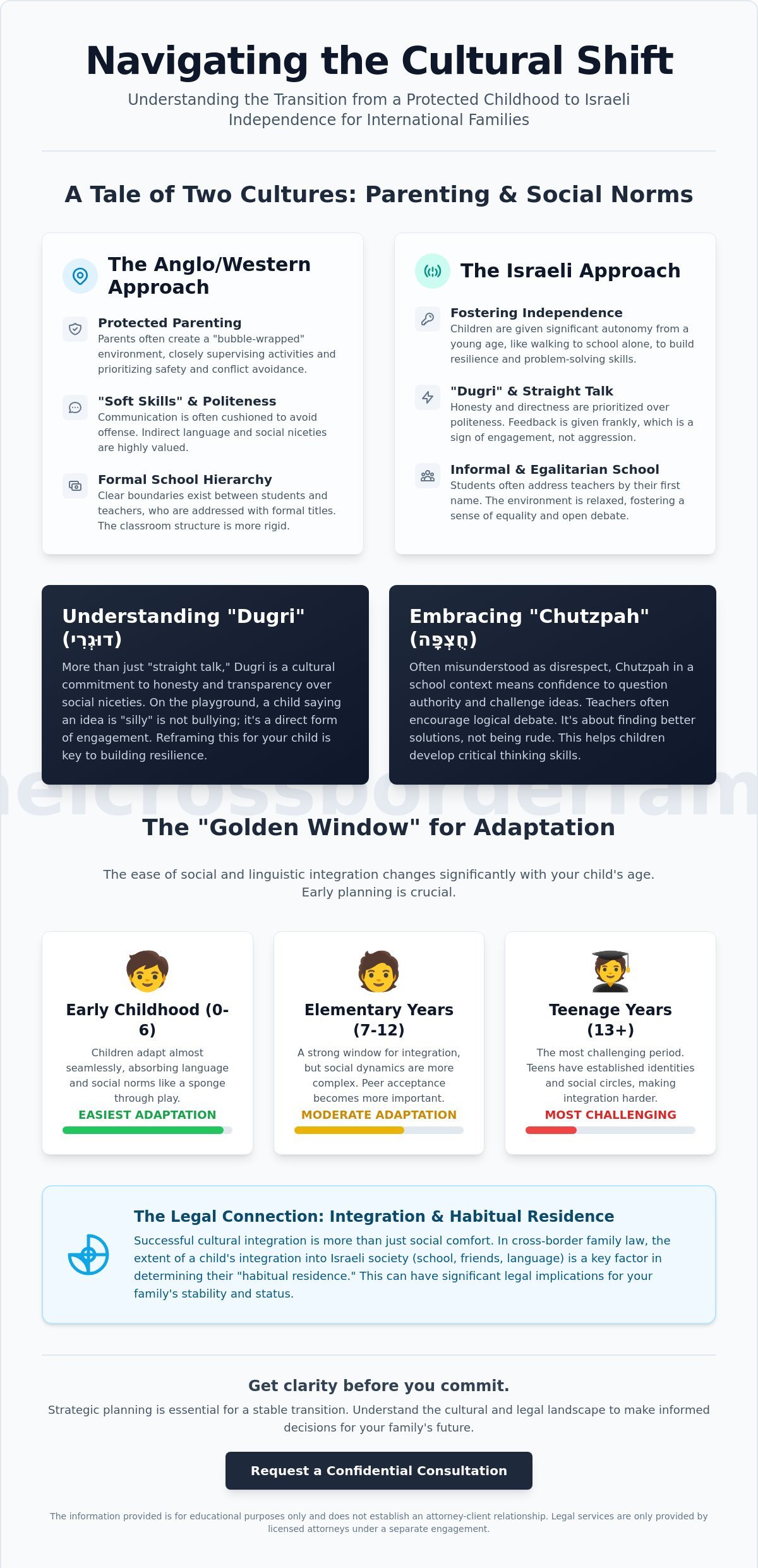
Dugri is a term that defines the social fabric of the state. It translates to “straight talk,” but it represents a profound commitment to honesty over politeness. For many, the cultural adjustment for children relocating to israel begins on the playground, where this directness can feel jarring. While Western social norms often prioritize “soft skills” and conflict avoidance, Israeli interaction is built on a foundation of transparency. This transparency is a key element of Israeli Culture, where clarity is valued more than social niceties.
Anglo children often mistake this directness for aggression or bullying. In a local classroom, a peer might tell your child their idea is “wrong” or “silly” without the cushioning common in North American or British schools. It isn’t meant to be cruel; it’s simply the local way of engaging with ideas. Understanding this shift is vital for parents who want to help their children build resilience rather than feeling isolated. By reframing these interactions as “direct” rather than “mean,” you provide your child with the tools to respond in kind, which is the first step toward social integration.
To better understand the nuances of this transition, watch this helpful video:
The neighborhood structure also reflects a sense of communal responsibility. In many Israeli towns, the “village” still exists. Neighbors often watch out for all children in the area, which facilitates a shift away from “bubble-wrapped” parenting. This collective oversight allows for a level of freedom that many international families find both terrifying and liberating. It’s a system where the community assumes children are capable of managing themselves, provided they stay within the shared social boundaries of the neighborhood.
The Concept of “Chutzpah” vs. Confidence
In the Israeli education system, questioning authority isn’t just tolerated; it’s often encouraged. This “chutzpah” is frequently a misunderstood trait. It isn’t about being disrespectful. Instead, it’s about the cultural norm of “thinking outside the box” and challenging the status quo to find better solutions. Teachers often appreciate a student who argues a point logically. Parents should explain to their children that while they can be assertive at school, home manners may still follow different family traditions. Bridging this gap helps children navigate two different worlds without losing their sense of identity.
Independence and Personal Autonomy
One of the most visible differences in IL is the “unsupervised” culture. It’s common to see elementary-aged children walking to school or visiting local parks alone. For parents coming from “helicopter” parenting backgrounds, this creates significant anxiety. However, this local autonomy is a primary driver of resilience. By allowing children to navigate their physical environment independently, they develop problem-solving skills and a sense of personal agency that is central to the Israeli childhood experience. This autonomy is often a cornerstone of a successful cultural adjustment for children relocating to israel, turning a foreign environment into a home they truly own.
Navigating the Israeli Education System (Mamlachti)
The Israeli education system is primarily divided into Mamlachti (state secular) and Mamlachti-Dati (state religious) streams. While the curriculum is standardized, the social atmosphere is often a surprise for those accustomed to formal Western hierarchies. Students typically address teachers by their first names, and the classroom environment is notably informal. This lack of distance is designed to foster a sense of equality, yet it requires a significant cultural adjustment for children relocating to israel who are used to more rigid boundaries. For example, public school fees for grades 1-6 range from 500 ₪ to 900 ₪ per year, reflecting a system that is accessible but relies on parental involvement for extras.
For new arrivals, schools provide “Ulpan” hours to facilitate Hebrew acquisition. Beyond the classroom, the social hierarchy is often dictated by participation in Tnuot Noar (youth movements) like the Tzofim (Scouts). These organizations are the primary venue for developing leadership and peer bonds outside the home. Understanding these Israeli Parenting Styles is helpful for parents trying to decode why their children’s social life seems to revolve around these movements. It’s a shift from scheduled “playdates” to a more organic, communal way of growing up.
Choosing Between International and Local Schools
Selecting a school involves a strategic trade-off between academic continuity and deep cultural immersion. International schools offer an English-speaking environment but come with significant costs. For instance, the Anglican International School in Jerusalem requires a 1,000 ₪ application fee and annual tuition that can reach 94,500 ₪. From a legal perspective, the choice of school is a primary factor in determining a child’s “Habitual Residence.” Enrolling a child in a local Mamlachti school often signals a permanent intent to reside in Israel, which can have significant implications in international custody and relocation matters. It’s an early decision that carries long-term weight.
The Role of Extracurriculars in Integration
In the Israeli system, the “Chug” (after-school activity) is where much of the social integration occurs. Whether it is sports, art, or technology, these activities provide a structured environment for forming friendship circles. Parents must also master the “WhatsApp group” culture, which serves as the unofficial communication hub for every class and activity. Advocacy in this system is direct. If your child needs support, the expectation is that you will speak up clearly and persistently. If you are unsure how these schooling decisions might impact your family’s legal standing, it is wise to request a confidential review of your situation.
Age-Specific Adjustment Challenges: From Toddlers to Teens
The impact of relocation varies significantly by developmental stage. While younger children often absorb a new environment through osmosis, older children require a more deliberate strategic approach. Navigating The Family Challenge of Aliyah requires understanding that cultural adjustment for children relocating to israel is not a uniform process. For instance, elementary students aged 6 to 12 often find themselves in a “golden window” where they are old enough to form deep local friendship circles but young enough to acquire Hebrew before the academic pressure of high school intensifies.
Toddlers and the “Gan” Experience
Daycare in IL, known as the “Gan,” is characterized by a level of warmth and perceived “chaos” that differs from the highly structured centers found in many Western countries. Israeli caregivers often adopt an “everyone is family” approach, which can be surprising for parents used to formal professional boundaries. However, this early immersion typically leads to native-level fluency within 12 to 18 months. The lack of rigid structure allows toddlers to adapt naturally to the local rhythm, though parents must adjust to the informal communication style of the staff.
The Teenager Transition and Social Identity
Relocating as a teenager presents the most complex hurdle. There is a high risk of retreating into “expat bubbles” if a teen refuses to engage with the Hebrew language. This social isolation can lead to long-term integration issues and identity conflicts. In Israel, the prospect of military service serves as a massive social milestone that defines the high school experience. Teens who don’t integrate early may feel excluded from these critical peer conversations. It’s vital to encourage local participation while allowing them space to maintain a connection to their home culture through English-language media or international peer groups.
For children with special educational needs, the transition requires early and persistent advocacy. The Israeli system provides support, but the bureaucracy is dense and requires a nuanced understanding of local regulations. Similarly, the pressure of the “Bagrut” (matriculation exams) in the final years of school can be overwhelming for those still mastering the language. Families should consider how these educational hurdles intersect with their long-term residency goals. Decisions made during these years often carry weight in international custody and relocation matters, as the child’s level of integration is a primary factor in legal determinations of habitual residence.
Managing the Anglo-Israeli Parenting Gap
The transition to Israeli life often exposes a stark contrast between Western “helicopter” parenting and the local “free-range” approach. In many English-speaking cultures, parents are conditioned to supervise every interaction and mitigate every risk. In Israel, independence is fostered early. This can lead to friction when Anglo parents perceive local methods as neglectful or overly lax. Successfully navigating the cultural adjustment for children relocating to israel requires parents to reconcile these differences while maintaining their own family values. This isn’t just a social challenge; it’s a strategic shift in how you manage your household’s daily operations.
Discipline and politeness also carry different weights in public spaces. Where an Anglo parent might expect a quiet “please” and “thank you,” Israeli society often prioritizes efficiency and assertiveness. Conflict with other parents is common, especially in a culture that values direct confrontation over polite avoidance. If another parent corrects your child in a park, it’s often intended as communal care rather than a personal slight. Building a local support network of both expats and veteran Israelis is essential. This network helps you decode these social cues and provides a buffer against the isolation that often accompanies cross-border moves. Given that the monthly cost of living for a family of four in Tel Aviv is estimated at 22,743 ₪ as of June 2026, the financial and social pressures make having a steady support system even more critical.
Communication Styles: Direct vs. Diplomatic
Israeli parents and administrators may seem intrusive or overly opinionated by Western standards. They often offer unsolicited advice on everything from your child’s clothing to their diet. Setting boundaries is necessary, but it must be done with an understanding of the communal nature of the society. When communicating with teachers, be direct. Vague or overly diplomatic requests are often ignored or misunderstood. Clear, assertive communication is the most effective way to ensure your child’s needs are met in a busy school environment. If you find that these cultural differences are creating significant friction in your family’s legal or residential stability, it’s important to seek professional guidance on your options.
Addressing Safety and Security Concerns
Helping children understand security protocols without instilling fear is a delicate balance. In Israel, security is “normalized” into daily life through drills and visible presence. Most children adapt quickly to these routines, viewing them as standard procedures rather than threats. During periods of national tension, resources for emotional support are available through local municipalities and schools. Open dialogue is key. Explain the situation in age-appropriate terms and emphasize the protective measures in place. This approach helps children feel secure while they integrate into a society that manages complex realities with remarkable resilience.
This article is published on an independent advisory platform and is not a law firm. The information provided is for educational purposes only and does not establish an attorney-client relationship.
Strategic Planning: Legal and Long-Term Considerations
Cultural adjustment for children relocating to israel is often viewed through a social or psychological lens, but in the context of international law, it serves as a critical evidentiary benchmark. The degree to which a child has integrated into Israeli society directly influences the legal determination of “Habitual Residence” in multi-jurisdictional disputes. Habitual residence is simply the place where a child’s life is centered. When a child begins attending a local school, masters the language, and builds a social network, they are considered legally “settled.” This status is not merely a milestone; it is a permanent legal shift that can define which country has jurisdiction over your family’s future.
Many families arrive in IL on a “trial” basis to determine if the relocation is sustainable. However, trial periods carry significant risks without a formal, written agreement signed by both parents before departure. If a parent decides to return to their country of origin after a child has spent a year in an Israeli school, they may find that the court views the child as legally settled here. Early decisions about schooling and extracurricular activities are not just social choices. They are strategic decisions that carry immense weight in any future cross-border disputes. Seeking clarity before the first flight is booked is the only way to prevent complex legal entanglements later.
The Hague Convention and Relocation Law
The Hague Convention is the international treaty that governs child abduction and relocation cases. If a child is deemed to be successfully integrated into the local culture, a court may refuse to order their return to a previous country. This makes the process of international custody and relocation planning vital for any expat family. Once a child has adapted to the Israeli classroom and neighborhood, the legal “status quo” shifts in favor of staying in Israel. Consulting with legal experts, such as Israel Cross Border Law Firm, before the move ensures that both parents understand how these integration milestones affect their rights under international law.
Seeking Professional Guidance
Israel Cross Border Law Firm offers the strategic legal guidance international families need for a comprehensive risk assessment, going beyond simple advice. Their process involves looking at the global scale of your relocation and identifying potential friction points before they escalate. A proactive approach allows you to make informed choices based on strategy and risk-based decision-making. You should never assume that the legal systems of your home country and Israel will align seamlessly. Get clarity before you commit. Request a confidential consultation with Israel Cross Border Law Firm.
Securing Your Family’s Future in a New Cultural Landscape
Successful cultural adjustment for children relocating to israel requires more than just language skills; it demands a strategic understanding of social and legal boundaries. By mastering the “Dugri” ethos and recognizing how local schooling decisions define your child’s legal status, you protect your family from the risks of cross-border complexity. The shift from a protected childhood to one of radical independence is a significant transition that impacts everything from daily parenting to long-term residency rights under international law.
Our independent advisory platform provides specialized expertise in US-Israel cross-border family law. We offer strategic risk management rooted in a deep understanding of both Anglo and Israeli legal cultures. We focus on helping families make informed decisions before commitments are made, ensuring that early choices don’t lead to unintended legal consequences later. Get clarity before you commit. Request a confidential consultation to discuss your family’s unique situation. With the right strategy, your relocation can become a foundation for growth and resilience.
This article is published on an independent advisory platform and is not a law firm. The information provided is for educational purposes only and does not establish an attorney-client relationship.
Frequently Asked Questions
How long does it typically take for a child to become fluent in Hebrew after moving to Israel?
Children typically achieve functional Hebrew fluency within 12 to 18 months of full immersion in the local system. Younger children in the “Gan” often acquire the language faster through daily social interaction. Older children may require more formal support and “Ulpan” hours. Success depends heavily on the child’s age and their willingness to engage in local social circles outside of school hours.
Is the Israeli school system safe for children who do not speak Hebrew?
The Israeli school system is generally safe and very accustomed to children who arrive without Hebrew skills. Most public schools provide dedicated “Ulpan” hours for new immigrants to help them bridge the communication gap. Teachers prioritize social integration alongside academic progress during the initial cultural adjustment for children relocating to israel, ensuring students feel supported while they learn.
Can I move my child back to the US if they do not adjust well to life in Israel?
You cannot unilaterally move your child back to the US without the other parent’s written consent or a court order once the child is settled. Doing so could be viewed as international parental child abduction under international law. It’s essential to have a clear, written agreement regarding “trial” periods before the initial move to prevent complex legal disputes if the adjustment fails.
What is the role of the Hague Convention in child relocation to Israel?
The Hague Convention acts as a legal framework to ensure that children who are wrongfully removed from their country of “habitual residence” are returned. If a child becomes settled in Israel, a court may determine that Israel is now their habitual residence. This status makes it legally difficult for one parent to return the child to their previous home country without mutual parental agreement.
Are there English-speaking schools in Israel, and should I consider them?
English-speaking international schools exist in areas like Tel Aviv and Jerusalem, but they are expensive and can slow down local integration. For example, private primary years in Tel Aviv can cost between 60,000 ₪ and 140,000 ₪ per year. These schools are often a strategic choice for families on short-term corporate relocations who plan to return abroad within a few years.
How do I explain the security situation in Israel to my children without scaring them?
You should explain the security situation using age-appropriate facts while emphasizing the protective measures, like sirens and shelters, that keep everyone safe. Schools conduct regular drills that children often view as routine procedures. Normalizing these protocols helps reduce anxiety, allowing children to focus on their cultural adjustment for children relocating to israel without living in a state of constant fear.
What happens if one parent wants to stay in Israel and the other wants to return with the children?
This situation constitutes a significant legal conflict that usually requires mediation or a court decision to resolve. Neither parent should remove the child from the country without a formal, legally binding agreement. Such disputes are governed by relocation laws and require a careful assessment of the child’s best interests and their established habitual residence in Israel.
How can I ensure my child maintains their US cultural identity while living in Israel?
Maintaining a US cultural identity is best achieved by keeping English as the primary language at home and continuing to celebrate American holidays. You can also utilize English-language books, movies, and expat community events to provide a sense of continuity. Balancing these traditions with local Israeli customs helps children develop a healthy, bicultural identity rather than feeling forced to choose one culture over the other.

Article by
Gabriel Lior
A Personal Journey That Became a Mission
The advisory was founded by an American father Gabriel Lior, LLB, MBA , global entrepreneur, and cross-border advisor who spent more than a decade navigating the Israeli family court system firsthand and now lives in Singapore with his son.
As a divorced parent in a cross-border family, Gabriel faced nearly every legal challenge a foreign parent can encounter in Israel — including child custody disputes, child support proceedings, property matters in Israel and abroad, false accusations, and complex immigration and relocation proceedings.
Over the years, he learned the hard way how difficult it is for non-Israeli parents to understand the system, identify the right legal strategy, and choose the right legal representation — especially when language, culture, and jurisdictional differences are involved. He also witnessed how foreign parents and new immigrants are often disadvantaged or taken advantage of by service providers and institutions simply because they lack local knowledge or fluency.
From Client to Advisor
To truly understand — and survive — the system, Gabriel pursued formal legal education in Israel, completing two Israeli law degrees, alongside a BA and MBA earned in the United States. This was never about becoming a practicing attorney, but about gaining a deep, structural understanding of how the system works — and where it breaks down for foreign parents.
This rare combination of:
Firsthand client experience
Israeli legal and US business education
International business and negotiation training
Decades of commercial execution
created a unique perspective – one that understands both sides of the table.
After years of litigation, persistence, and at times self-representation, he ultimately succeeded in securing custody of his son and relocating abroad through a rare legal victory in the Israeli Supreme Court — becoming one of the first fathers in Israel to do so under these circumstances.
Disclaimer
Important Disclaimer:
The information provided on this website and in its content is for general informational and educational purposes only and does not constitute legal advice, legal opinion, or legal representation.
Gabriel Lior is not licensed to practice law in Israel (nor is he interested in doing so) and does not provide legal services, despite having completed 2 Law Degrees. The services offered are advisory in nature and are intended to provide general guidance, strategic insight, and information regarding cross-border family law considerations.
No attorney-client relationship is formed by accessing this website, reading its content, or communicating with us.
Any decisions made based on this information are at your own discretion and risk. For legal advice specific to your situation, you should consult a licensed attorney in the relevant jurisdiction.
Where appropriate, we may refer clients to independent, licensed attorneys or professionals. Such referrals do not constitute legal representation and no liability is assumed for services provided by third parties.