This article is published on an independent advisory platform and is not a law firm. The information provided is for educational purposes only and does not imply or create an attorney-client relationship.
The most critical decision in an Israeli divorce isn’t just when to file, but who you choose to navigate the complex intersection of civil and religious law. You’re likely concerned about how language barriers or the dual jurisdiction of Family and Rabbinical courts might impact your international custody or asset division. This guide provides an objective profile of Asi Segal attorney and explains how to evaluate legal representation within the Israeli system. We’ll help you gain a clear understanding of what’s required to manage a cross-border case with confidence.
We’ll walk through the specific expertise needed for transnational family law and the strategic importance of early decisions. You’ll discover how a structured approach to risk-based decision-making can protect your interests when the stakes are high. This overview is designed to help you move from confusion to a position of informed strategy before you commit to a legal path. By understanding the nuances of the Israeli legal landscape, you can approach your case with the steady guidance needed for a complex international matter.
Key Takeaways
- Understand the professional profile of Asi Segal attorney and how his firm supports English-speaking clients through the complexities of the Israeli legal landscape.
- Learn why specialized knowledge of the Hague Convention and international treaties is essential for managing cross-border custody and child abduction cases.
- Gain clarity on the dual jurisdiction of Israel’s Family and Rabbinical courts and how this unique system impacts international divorce proceedings.
- Discover a practical checklist for evaluating legal representation, focusing on an attorney’s ability to explain risks without making unrealistic guarantees.
- Recognize the strategic importance of early decision-making in family law to avoid irreversible consequences in cross-border asset division or custody matters.
Who is Adv. Asi Segal? Founding Partner of Segal & Co.
Adv. Asi Segal has established himself as a prominent figure within the Israeli legal community. As the founding partner of Segal, Simchauve & Partners, he has developed a practice that specifically addresses the needs of the international community. For many expats, finding an Asi Segal attorney means seeking someone who understands the friction between different legal cultures. His firm manages a high volume of multi-jurisdictional family disputes. These cases often range from complex asset division to sensitive custody arrangements involving The Hague Convention.
To gain more perspective on the legal environment and attorney roles, watch this video:
Professional Background and Firm Leadership
Segal & Co was established with a clear objective: to bridge the gap for those who find the Israeli court system opaque. The firm’s leadership has focused on building a reputation for handling cases that cross borders and involve diverse legal systems. Their standing in professional directories like Duns 100 reflects their position in the Israeli market and their commitment to excellence. This recognition helps international families verify the firm’s stability and professional reach before they commit to a strategy. It isn’t just about the number of hearings an attorney has attended. It’s about their ability to operate within the specific hierarchies of both the Israeli Rabbinical and Family Courts. Understanding this background is a vital step for any expat trying to gauge if a firm has the institutional knowledge required for their case.
The Focus on International Families in Israel
The firm’s focus on expats and foreign nationals is a response to the unique challenges these groups face in IL. There’s a profound cultural gap in Israeli legal proceedings that often leaves English speakers feeling sidelined or confused by the pace of the process. An attorney who is truly bilingual doesn’t just translate words. They interpret the unspoken expectations of the local court system and the strategic nuances of opposing counsel. This bridge-building is essential for clients who aren’t familiar with the lack of a jury or the assertive, inquisitorial role a judge takes in Israel. By prioritizing the English-speaking community, the firm provides a level of clarity that is often missing in standard domestic practices. This approach allows families to move through the system with a better understanding of the risks involved. It helps them prepare for the reality of court appearances where the atmosphere may feel significantly different from what they expect in their home countries.
Key Legal Specialties: Hague Convention and Cross-Border Custody
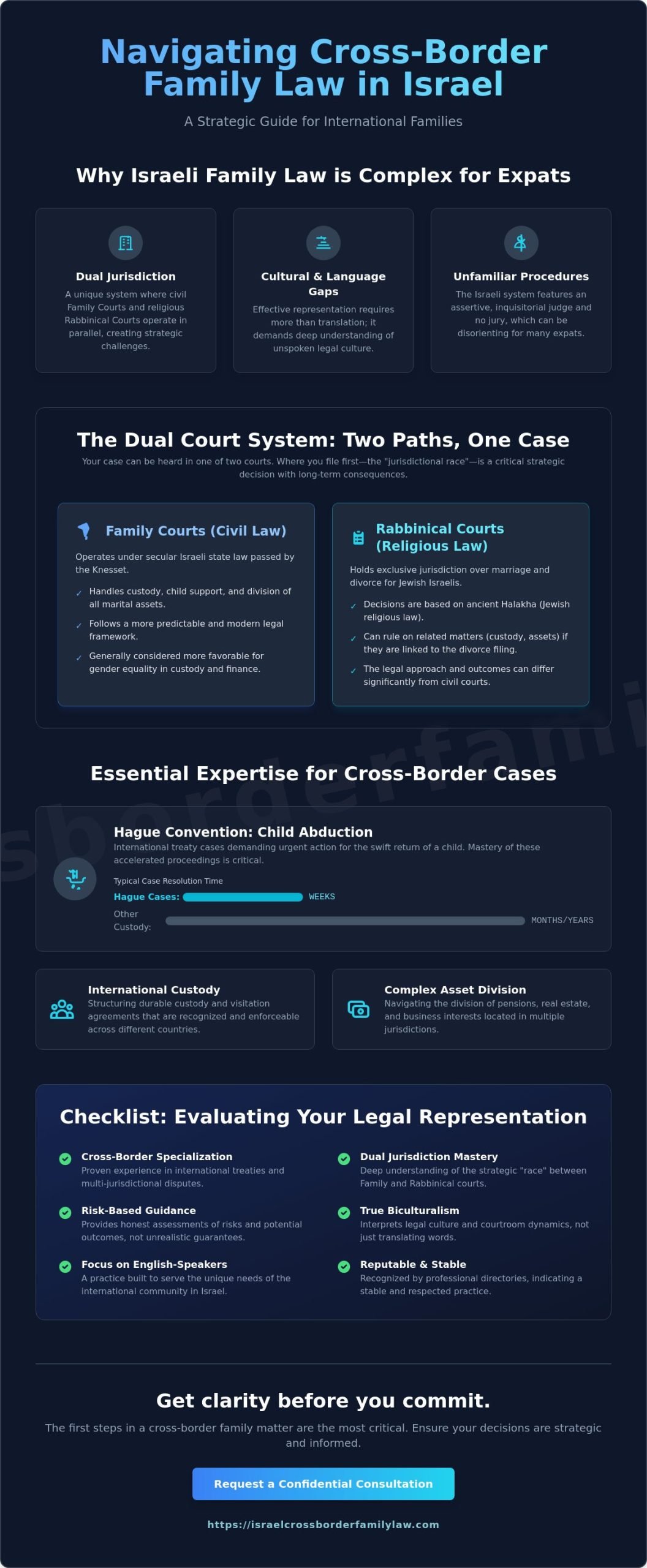
International child abduction cases represent some of the most time-sensitive matters in family law. Under the Hague Convention, the primary goal is the swift return of a child to their habitual residence following a wrongful removal. In IL, these proceedings move through the court system with remarkable speed, often reaching a conclusion in weeks rather than months. An Asi Segal attorney prioritizes these high-stakes scenarios, where jurisdictional knowledge and immediate action are the deciding factors for a family’s future.
Understanding the Hague Convention in IL
The Hague Convention is an international treaty designed to protect children from the harmful effects of abduction across international boundaries. Israel is a signatory to this treaty, which means its courts are legally bound by specific protocols to ensure a prompt return. Within the Israeli Legal System, these cases bypass many of the standard procedural delays seen in domestic litigation. Specialized legal representation is non-negotiable because the legal arguments are highly technical. You must be prepared to prove habitual residence while defending against specific exceptions, such as a grave risk to the child. The Family Court works in tandem with international law enforcement and central authorities, making a clear legal strategy essential from day one.
Managing Cross-Border Custody and Relocation
There is a profound legal distinction between a planned relocation and what the law classifies as abduction. Many parents mistakenly believe that a valid personal reason to move justifies leaving the country without formal approval. Under Israeli law, removing a child without the other parent’s explicit consent or a court order can trigger a Hague petition almost immediately. When an Asi Segal attorney manages international custody and relocation, they focus on the “best interests of the child” standard. This standard is the cornerstone of Israeli custody law, but it’s often interpreted through local cultural and legal lenses that might differ from your home country’s expectations.
Success in these matters depends on understanding that the court’s priority is maintaining the status quo until a formal decision is reached. Early decisions, such as where a child is enrolled in school or how visitation is documented, can have long-term consequences on the final outcome. To avoid the risks of an unplanned legal crisis, it is helpful to request a confidential review of your case strategy. Seeking clarity before taking action is the most effective way to protect your parental rights in a cross-border environment.
This article is published on an independent advisory platform and is not a law firm. The information provided is for educational purposes only and does not imply or create an attorney-client relationship.
Navigating the Israeli Legal System as an English Speaker
The Israeli legal system operates as a dual system. This means that both civil Family Courts and religious courts, such as the Rabbinical Court, have the authority to hear cases. For expats, this setup is often the most confusing aspect of their divorce. Unlike systems in many Western countries, Israel doesn’t use a jury. Instead, a single judge or a panel of three judges handles everything. They take an active role in questioning witnesses and reviewing evidence. An Asi Segal attorney helps clients understand that the judge is the central figure in their case. This shift in perspective is necessary for building an effective legal strategy. It’s not just about what you say, but how the judge perceives your narrative within the local legal framework.
Civil vs. Religious Courts: The Race for Jurisdiction
In Israel, the concept of “merutz hamsamchuyot,” or the race for jurisdiction, is a defining feature of divorce law. This means that the court where the first valid petition is filed usually gains the authority to decide on related matters like alimony and property division. The choice between a civil court and a religious court can lead to very different outcomes. The Rabbinical Court might view certain property rights or support obligations differently than the Family Court. Early decisions made by your legal team will dictate which court hears your case. This is especially critical for international couples with assets in multiple countries. A delay of even a few hours in filing can change the entire trajectory of your legal proceedings. Seeking clarity before these deadlines pass is essential for protecting your interests.
The Importance of Bilingual Legal Support
Language barriers are more than just a struggle to understand the judge. In the Israeli system, court protocols are recorded in Hebrew. If your testimony is translated poorly, or if the written record doesn’t capture your nuances, it can damage your case. Literal translation often fails to convey the true intent of a witness. You need more than a translator; you need cultural interpretation. When working with an Asi Segal attorney, you ensure that your voice isn’t lost in translation. They act as a bridge between your expectations and the reality of the Israeli courtroom. Understanding divorce and separation for international families requires a deep dive into how these two systems interact. A lawyer’s ability to simplify these complex legal concepts is vital. It allows you to make strategic choices based on risks rather than fear. Get clarity before you commit. Request a confidential consultation.
This article is published on an independent advisory platform and is not a law firm. The information provided is for educational purposes only and does not imply or create an attorney-client relationship.
Checklist: Evaluating High-Profile Legal Representation in Israel
Evaluating an Asi Segal attorney or any top-tier practitioner requires an objective framework. High visibility in the Israeli legal market suggests deep experience, but you must ensure that this experience matches your specific cross-border needs. International cases involve layers of complexity that standard domestic disputes do not. Use the following checklist to determine if a firm’s expertise aligns with your situation:
- Cross-border track record: Ask for specific examples of outcomes in Hague Convention cases or international asset divisions involving foreign entities.
- Risk communication: A reliable attorney explains what could go wrong. Avoid any professional who offers absolute guarantees, as the Israeli court system is inherently unpredictable.
- Strategic alignment: Ensure the lawyer understands your long-term goals, such as future relocation or the protection of foreign-based pensions and trusts.
- Fee transparency: High-stakes litigation often involves multiple stages and potential appeals. Ensure these costs are discussed and outlined before you sign an engagement agreement.
- Direct availability: Clarify if you will be working with the founding partner or if your case will be managed primarily by a junior associate.
Questions to Ask During a Consultation
Your initial meeting is a critical opportunity to test the attorney’s grasp of transnational issues. Ask about their specific experience with the US-Israel tax treaty or how they manage the division of assets when property is located in multiple jurisdictions. If one party currently lives outside of IL, inquire about the logistical challenges of providing testimony and the court’s view on remote evidence. A vital question to ask is: “What are the risks of my current legal position that I might be overlooking?” Their answer will reveal if they are a strategic advisor or simply a legal technician.
Understanding Legal Fees and Engagement
In high-stakes family law, you will encounter different pricing and engagement models. Some firms utilize hourly rates, while others propose global fees for specific stages of the litigation process. It is a common mistake for expats to choose representation based solely on the lowest initial price. In cross-border law, an early error in jurisdictional filing can lead to years of expensive corrective litigation. Choosing a lawyer who lacks specific multi-jurisdictional expertise is often the most expensive mistake a client can make. You deserve a clear, written outline of costs and the scope of work before you commit to a legal path. To ensure your strategy is built on a solid foundation, you can reach out for a professional case review.
This article is published on an independent advisory platform and is not a law firm. The information provided is for educational purposes only and does not imply or create an attorney-client relationship.
Strategic Decision-Making in Cross-Border Family Matters
Early decisions in an Israeli family law case often carry irreversible consequences. In a system where the race for jurisdiction is a daily reality, the choice of where and when to file can dictate the outcome of property division or child support for years to come. Strategy must always precede the filing of any legal documents. If you move too quickly without a comprehensive plan, you risk losing leverage in negotiations or ending up in a court that doesn’t recognize your foreign assets appropriately. When you are considering the services of an Asi Segal attorney, your focus should be on how their specific experience with international families will protect your long-term goals.
Cross-border cases are inherently more complex than domestic ones because they involve competing legal frameworks and cultural expectations. A decision that seems logical in your home country might trigger a negative response in the Israeli Family Court. It’s essential to understand these nuances before you take any action that could be interpreted as a change in the status quo. Strategy is not just about winning a single hearing. It is about managing the entire trajectory of your case to ensure the best possible outcome for your family and your financial future.
The Role of an Independent Advisor
An independent advisory platform provides a neutral environment to explore your legal options. While a law firm is designed for advocacy and litigation, an advisor helps you step back and look at the broader picture. You can weigh the risks of a high-conflict court case against the potential benefits of mediation or a structured settlement. Understanding how the advisory process works allows you to evaluate different legal paths before you enter a formal attorney-client relationship. This phase is about gathering facts and assessing the landscape of the Israeli legal system. It ensures that if you choose to move forward with an Asi Segal attorney, you are doing so from a position of knowledge rather than urgency.
Getting Clarity Before You Commit
The most effective way to manage a cross-border case is through a confidential case review. This process maps out a jurisdictional strategy that accounts for the differences between legal cultures. For example, the way an Israeli judge views a prenuptial agreement or a trust may differ significantly from a court in your home country. Incorporating educational resources, such as those found on the Israel Family Law YouTube channel, helps you become a more informed participant in your own case. Strategy remains the most powerful tool in cross-border family law. It allows you to anticipate challenges instead of merely reacting to them. By seeking clarity early, you protect your rights and your family’s future. Get clarity before you commit. Request a confidential consultation.
This article is published on an independent advisory platform and is not a law firm. The information provided is for educational purposes only and does not imply or create an attorney-client relationship.
Building a Strategy for Your International Family Case
Managing a cross-border legal matter in Israel requires a shift from reactive decisions to a proactive strategy. We’ve discussed the nuances of the dual court system and the strategic importance of early filings in jurisdictional races. Whether you’re considering an Asi Segal attorney or evaluating other legal options, the key is to prioritize clear communication and a deep understanding of international treaties like the Hague Convention.
Our independent advisory platform offers specialized guidance for US-Israel family law matters. We focus on providing a calm, risk-based perspective that helps you weigh litigation against alternative paths like mediation. By seeking clarity before you commit to a specific firm, you ensure that your legal strategy aligns with your long-term family and financial goals. You don’t have to face these complex systems without a map.
Get clarity before you commit. Request a confidential consultation.
This article is published on an independent advisory platform and is not a law firm. The information provided is for educational purposes only and does not imply or create an attorney-client relationship.
Frequently Asked Questions
Who is Asi Segal and what is his specialty in Israeli law?
Adv. Asi Segal is a prominent legal practitioner and the founding partner of Segal & Co. He specializes in complex family law matters, specifically focusing on cases with an international or multi-jurisdictional component. His expertise includes managing high-stakes disputes within both the civil Family Courts and the religious Rabbinical Courts. He is frequently recognized for his work in asset division and sensitive custody arrangements involving international families.
Is Asi Segal an English-speaking lawyer in Israel?
Yes, an Asi Segal attorney provides comprehensive support for the English-speaking community, including expats and foreign nationals. The firm’s focus is on bridging the cultural and linguistic gap that often exists for Anglos in the Israeli legal system. This bilingual approach ensures that clients fully understand court protocols and that their testimony is accurately represented in Hebrew-language legal documents.
What should I look for when hiring an international divorce lawyer in Israel?
You should prioritize a lawyer with documented experience in cross-border jurisdictional “races” and international asset valuation. It is essential to find a professional who explains legal risks clearly without offering unrealistic guarantees. Look for a firm that understands the nuances of foreign pensions, trusts, and the US-Israel tax treaty. A strategic approach that accounts for your long-term goals outside of IL is vital.
Can a US-based lawyer represent me in an Israeli Family Court?
No, only attorneys licensed by the Israel Bar Association are permitted to represent clients or file motions in Israeli courts. While a US-based lawyer can act as a consultant regarding foreign assets or laws, they have no standing in an Israeli courtroom. Most international families find success by hiring local Israeli counsel who can coordinate effectively with their legal teams in other jurisdictions.
How does the Hague Convention work in Israel for child abduction cases?
The Hague Convention is a treaty designed to return children to their country of habitual residence after a wrongful removal. In Israel, these cases are treated with extreme urgency and are heard in the Family Court under an expedited schedule. The court’s primary focus is on the legality of the removal rather than long-term custody. Strategic action within the first few days is often the most critical factor.
What is the difference between a law firm and a legal advisory platform in Israel?
A law firm provides direct advocacy, court representation, and legal filings for its clients. An independent advisory platform offers a neutral environment to evaluate your strategy and weigh different legal paths before you hire an Asi Segal attorney. Advisory services help you compare the risks of litigation against mediation, allowing you to make an informed choice through risk-based decision-making.
Are Israeli Family Court proceedings conducted in English?
No, all official proceedings, judge’s rulings, and court protocols in Israel are conducted and recorded in Hebrew. While you may be permitted to testify in English with the help of a translator, the official record remains in Hebrew. This makes bilingual legal support essential, as any errors in how your testimony is recorded can have a significant impact on the final judicial decision.
How much does it typically cost to hire a high-profile family lawyer in Israel?
Costs for high-profile representation depend on the complexity of the case and the seniority of the practitioners involved. Most firms use either hourly rates or global fees for specific stages of litigation, such as the initial filing or an appeal. You should always request a clear, written fee structure during your consultation. Choosing representation based on strategy and experience is often more cost-effective than correcting early jurisdictional mistakes.

Article by
Gabriel Lior
A Personal Journey That Became a Mission
The advisory was founded by an American father Gabriel Lior, LLB, MBA , global entrepreneur, and cross-border advisor who spent more than a decade navigating the Israeli family court system firsthand and now lives in Singapore with his son.
As a divorced parent in a cross-border family, Gabriel faced nearly every legal challenge a foreign parent can encounter in Israel — including child custody disputes, child support proceedings, property matters in Israel and abroad, false accusations, and complex immigration and relocation proceedings.
Over the years, he learned the hard way how difficult it is for non-Israeli parents to understand the system, identify the right legal strategy, and choose the right legal representation — especially when language, culture, and jurisdictional differences are involved. He also witnessed how foreign parents and new immigrants are often disadvantaged or taken advantage of by service providers and institutions simply because they lack local knowledge or fluency.
From Client to Advisor
To truly understand — and survive — the system, Gabriel pursued formal legal education in Israel, completing two Israeli law degrees, alongside a BA and MBA earned in the United States. This was never about becoming a practicing attorney, but about gaining a deep, structural understanding of how the system works — and where it breaks down for foreign parents.
This rare combination of:
Firsthand client experience
Israeli legal and US business education
International business and negotiation training
Decades of commercial execution
created a unique perspective – one that understands both sides of the table.
After years of litigation, persistence, and at times self-representation, he ultimately succeeded in securing custody of his son and relocating abroad through a rare legal victory in the Israeli Supreme Court — becoming one of the first fathers in Israel to do so under these circumstances.
Disclaimer
Important Disclaimer:
The information provided on this website and in its content is for general informational and educational purposes only and does not constitute legal advice, legal opinion, or legal representation.
Gabriel Lior is not licensed to practice law in Israel (nor is he interested in doing so) and does not provide legal services, despite having completed 2 Law Degrees. The services offered are advisory in nature and are intended to provide general guidance, strategic insight, and information regarding cross-border family law considerations.
No attorney-client relationship is formed by accessing this website, reading its content, or communicating with us.
Any decisions made based on this information are at your own discretion and risk. For legal advice specific to your situation, you should consult a licensed attorney in the relevant jurisdiction.
Where appropriate, we may refer clients to independent, licensed attorneys or professionals. Such referrals do not constitute legal representation and no liability is assumed for services provided by third parties.