This article is published on an independent advisory platform and does not constitute an attorney-client relationship. Legal services are provided only by licensed attorneys under a separate engagement.
Imagine discovering that your divorce or custody case is being decided in a Rabbinical court rather than a civil one, simply because your spouse filed a few hours earlier. For many Americans living in Israel, the “Race of Jurisdiction” isn’t just a legal concept; it’s a source of profound anxiety. It’s understandable to feel confused when the familiar legal protections you expected from home are replaced by a dual court system that operates under entirely different rules. Working with a dedicated us israel family law attorney provides the necessary bridge to help you navigate these cultural and legal divides with confidence.
You deserve to gain clarity on the complexities of the Israeli legal system through a strategic, Anglo-focused approach to cross-border family law. It’s vital to recognize that early decisions in Israel often dictate the final outcome of your case. This article, presented by Israel Cross Border Law Firm, explores how a proactive strategy can help you mitigate risks to your assets and parental rights. We will look at the differences between the family and religious courts, the impact of jurisdictional timing, and how to find peace of mind through expert advisory. Get clarity before you commit. Request a confidential consultation.
Key Takeaways
- Understand the “Race of Jurisdiction” and how the overlapping authority of Israel’s Rabbinical and Civil courts can fundamentally change your legal outcome.
- Learn why consulting a dual-licensed us israel family law attorney is necessary to align your legal strategy with the specific cultural and regulatory realities of Israel.
- Discover the critical differences between US and Israeli relocation laws and how the Hague Convention governs international custody disputes.
- Identify how to protect multi-jurisdictional assets through comprehensive estate planning that addresses the unique requirements of the Israeli legal system.
- Gain clarity on why a strategic, confidential case review is the essential first step to preventing irreversible errors in cross-border family matters.
Who is Jay Hait? A Legacy of Cross-Border Legal Expertise
This article is published on an independent advisory platform (not a law firm) and does not imply an attorney-client relationship. Legal services are only provided by licensed attorneys under a separate engagement.
Jay Hait is an English-speaking lawyer licensed to practice in both the United States and Israel. For over twenty years, he’s dedicated his career to helping international families manage the friction that arises when two different legal systems collide. His mission is simple: to provide clarity to those who feel lost in a system they don’t yet understand. Dealing with family law is stressful enough without the added weight of a language barrier or unfamiliar court procedures.
Success in these matters depends on a core philosophy that prioritizes strategy and risk-based decision-making. Instead of falling into the trap of reactive, emotional litigation, Jay focuses on the long-term impact of every legal move. As a seasoned us israel family law attorney, he understands that the first step taken in a cross-border case often determines the final outcome for assets and family dynamics. This advisory focuses on guiding you toward an informed choice before any irreversible commitments are made.
To better understand how these legal concepts apply to daily life, watch this helpful video regarding visiting rights in Israel:
The Bridge Between Two Legal Cultures
Managing assets or family ties across borders requires more than just legal knowledge; it requires multi-jurisdictional licensing. When you have property in the US and a home in Tel Aviv, a lawyer who only understands one system can’t see the full picture. Jay’s personal experience as an ‘Oleh’ (immigrant) allows him to view the Israeli system through the eyes of his clients. He knows what it’s like to move your life to a new country and then face the complexities of Israeli marriage and divorce laws.
This cultural competency is vital for demystifying the ‘Anglo’ experience in Israeli courts. Many expats expect the legal process to mirror what they’ve seen in the US, but the reality is often quite different. Having an advisor who can translate these concepts into plain English while understanding the underlying Hebrew legal framework is a critical advantage. This bridge between cultures ensures that your intent is clearly communicated and your rights are protected in both jurisdictions.
A Focus on the International Community
Identifying the unique legal needs of foreign nationals and expats living in Israel is the cornerstone of this practice. In a Hebrew-dominant legal environment, important details can easily be lost in translation. This advisory serves as a primary resource for those who need clear explanations of local legal norms without the dense jargon. It’s about more than just translating words; it’s about translating the entire legal culture.
By offering a dedicated advisory approach, Jay ensures that clients aren’t just reacting to crises. Instead, they are making informed choices based on a comprehensive risk assessment. This focus on the international community allows a us israel family law attorney to provide more nuanced handling of cases involving foreign assets, international relocation, and cross-border inheritance. Get clarity before you commit. Request a confidential consultation.
The Complexity of the Israeli Family Law System for Foreigners
Expats often arrive in Israel with the assumption that legal systems are fundamentally similar across Western democracies. This misunderstanding can lead to significant risks. In Israel, the family law landscape is uniquely shaped by a combination of religious and civil frameworks. What might be a standard procedure in New York or California could be entirely inapplicable here. Working with a us israel family law attorney is often the only way to bridge this gap and avoid the cultural shock that many Anglos face when entering the local court system.
Early decisions in these cases carry immense weight. A choice that seems minor at the start can dictate the long-term legal outcome of your entire case. It’s vital to recognize that what is considered “legally safe” or even standard practice in the United States may be viewed as high-risk in Israel. The differences aren’t just in the language, but in the very philosophy of how family disputes are resolved.
The Dual Court System: Rabbinical vs. Civil
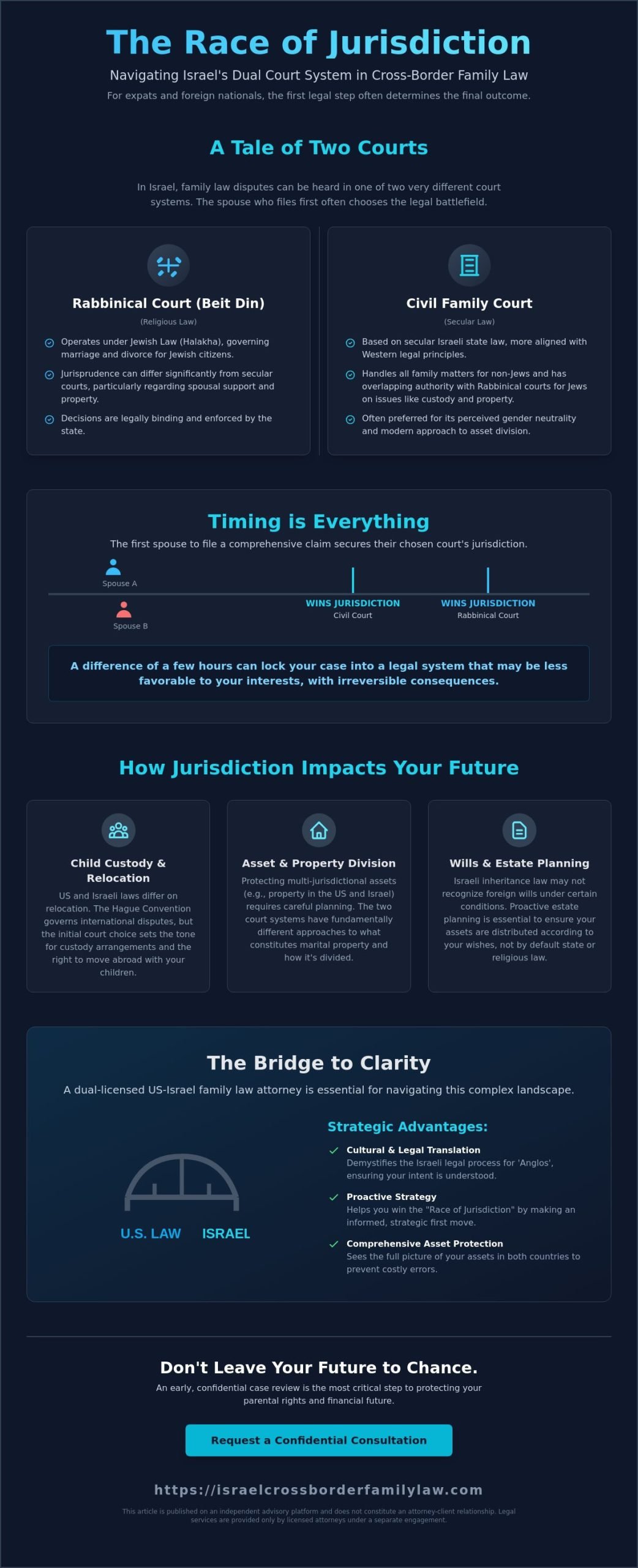
One of the most confusing aspects for foreigners is the concurrent jurisdiction between Rabbinical and Civil family courts. This creates what is known as the “Race of Jurisdiction.” Essentially, the court where a case is filed first often gains the authority to decide various aspects of the divorce or custody dispute. While civil courts handle matters based on modern legal statutes, Rabbinical courts apply religious law. Organizations like The Rackman Center at Bar-Ilan University provide extensive research on how these parallel powers affect family dynamics and rights in Israel.
The “first to file” rule isn’t just a technicality; it dictates the entire legal framework of your case. Decisions made in the first 48 hours can have permanent consequences for your financial future and your relationship with your children. Understanding the intersection of religious law and civil rights is vital for anyone navigating this system.
Common Pitfalls for English Speakers
It’s tempting to seek advice from friends or Facebook groups, but this is often disastrous. Every family situation is unique, and “crowdsourced” legal advice rarely accounts for the multi-jurisdictional complexity of expat lives. Relying on a lawyer in the US who doesn’t understand Israeli law is equally risky. Aggressive US-style litigation tactics often backfire in the Israeli judicial culture, which tends to favor a different rhythm of negotiation and evidence presentation.
Misinterpreting Hebrew legal documents is another frequent error. Even a high-quality professional translation can miss the nuanced legal intent behind specific Hebrew phrasing. Early, strategic decisions are the only way to prevent irreversible errors. If you’re feeling overwhelmed by the process, it’s helpful to speak with someone who understands both systems before taking action. Get clarity before you commit. Request a confidential consultation.
Navigating Cross-Border Divorce and Child Custody
When your life is built across two continents, a separation is never a simple legal procedure. It’s a complex logistical challenge that requires a deep understanding of how different jurisdictions interact. For those seeking a us israel family law attorney, the primary concern is often protecting family assets while ensuring the stability of the children. This is particularly true in cases of divorce and separation for international families, where the legal rules of one country may not be recognized by the other without specific intervention.
A common question involves the enforcement of foreign orders. Many expats wonder if a US child support order can be effectively enforced in Israel. While Israel is a signatory to international treaties regarding child support, an American order isn’t automatically active. It must first be recognized by an Israeli court. This process requires a strategic approach to ensure the Israeli Enforcement and Collection Authority can take action. Without this step, a parent may find themselves without the financial support they were granted by a US judge.
International Child Abduction and the Hague Convention
Wrongful removal occurs when a parent takes a child across an international border without the legal consent of the other parent or a valid court order. In the context of families with dual US-Israel ties, these situations often trigger the Hague Convention and international child abduction protocols. These cases are highly sensitive and move rapidly through the judicial system.
Preventing these disputes before they escalate is always the preferred strategy. For families considering international custody and relocation, it’s vital to have clear, court-approved agreements in place. These documents should explicitly detail travel rights and residency intentions. This proactive measure provides peace of mind and mitigates the risk of a parent being unfairly accused of abduction during a standard holiday or visit to family abroad.
Asset Division Across Jurisdictions
Israeli courts generally have the authority to value and divide property located outside of the country’s borders if they have jurisdiction over the divorce proceedings. This includes US real estate, business interests, and investment portfolios. However, the way these assets are valued can differ significantly from US standards. International financial agreements are a powerful tool for protecting these cross-border investments and ensuring that both parties have a clear understanding of how property will be split.
Managing US-based retirement accounts, such as a 401k or IRA, presents a unique challenge during an Israeli divorce. Because these accounts are governed by US federal law and tax regulations, an Israeli court order might not be sufficient to divide the funds without triggering penalties. A us israel family law attorney can help coordinate the legal requirements of both countries. This ensures that retirement savings are handled correctly, preserving their value for the future while satisfying the requirements of the Israeli settlement. Get clarity before you commit. Request a confidential consultation.
Future Planning: Wills, Estates, and Elder Law for Expats
Planning for the future is a different endeavor when your legacy spans two countries. For many Anglo families in Israel, the focus often shifts from daily life to the long-term protection of multi-jurisdictional assets. Without a coordinated strategy, families often fall into the “probate trap,” where a lack of clarity leads to years of legal delays and unexpected costs. Engaging a us israel family law attorney is a critical step in ensuring that your estate plan is enforceable in both the United States and Israel.
It is essential to understand that while Israel abolished inheritance tax in 1981, other financial implications remain. For instance, when an inherited property is eventually sold, it is subject to a 25% capital gains tax, known locally as Mas Shevach. This tax is calculated based on the original purchase price paid by the deceased, not the value at the time of inheritance. Navigating these nuances requires specialized legal services for expats and foreign nationals who understand the intersection of both tax systems.
Drafting Dual-Country Wills
A standard US will is often insufficient for transferring Israeli real estate or liquidating local bank accounts. Israeli courts require a formal legal opinion to validate a foreign will, a process that in 2026 typically costs between 3,000 and 7,000 ILS. Furthermore, the probate timeline for foreign heirs can stretch between 8 and 12 months. A dual-country approach helps minimize these delays by ensuring the documents meet the specific registration requirements of the Israeli Land Registry.
Coordinating your estate plan also helps prevent the mandatory digital portal challenges. As of 2026, the Israeli Registrar of Inheritance Affairs requires all petitions involving foreign residents to be submitted through a Hebrew-only digital system. Having a us israel family law attorney manage this process ensures that your intentions aren’t lost in a bureaucratic system designed for local residents. This strategic advisory approach provides the necessary framework to minimize tax friction for your heirs.
Elder Law and the Aliyah Experience
The Aliyah journey often involves aging parents relocating to Israel to be near their children and grandchildren. This move introduces complex questions regarding end-of-life planning and medical decision-making. The “sandwich generation,” those managing the affairs of both their children and their parents in two countries, faces unique pressures. A Durable Power of Attorney, or Yipui Koach Mitmashech, is a vital tool within the Israeli legal framework to protect a parent’s autonomy and interests.
Strategic planning for relocated parents ensures that their US-based healthcare directives are translated into a format recognized by Israeli hospitals and financial institutions. This proactive management prevents the need for a court-appointed guardian, which can be a costly and emotionally taxing process. To secure your family’s future and avoid cross-border complications, it is best to consult with a specialist regarding your estate planning needs. Get clarity before you commit. Request a confidential consultation.
The Strategic Advisory Approach: Getting Clarity Before You Commit
In the high-stakes environment of cross-border family law, jumping into litigation without a comprehensive plan is often a recipe for financial and emotional exhaustion. The most effective way to protect your interests is to ensure that strategy precedes any legal action. By engaging in a confidential case review, you can identify hidden jurisdictional risks that are often invisible to those who only understand one side of the US-Israel divide. This proactive approach allows you to see the full board before making a move that could have permanent consequences.
Understanding how the advisory process works is the first step toward regaining control. Unlike traditional models that focus on immediate conflict, this strategic advisory model prioritizes risk assessment and long-term stability. It’s about translating complex legal realities into actionable choices. When you work with a us israel family law attorney, you aren’t just hiring a representative; you’re gaining a partner who understands the multi-jurisdictional complexity of your life and assets.
Strategy vs. Litigation
A risk-based approach can potentially save you thousands of shekels in unnecessary legal fees and court costs. Litigation is often the most expensive way to resolve a dispute, and in the Israeli system, it can be particularly unpredictable for those who don’t understand the local judicial culture. The goal of informed decision-making is to replace the constant anxiety of the unknown with a clear, step-by-step plan of action. This shift from a reactive to a proactive stance is what ultimately provides peace of mind.
To support this educational journey, families are encouraged to utilize resources like the Israel Family Law YouTube channel. Watching these videos helps you understand the system’s mechanics before you commit to a specific path. Knowledge is a powerful tool for de-escalating conflict. When both parties understand the likely legal outcomes, they’re often more willing to pursue strategic settlements rather than endless court battles.
Next Steps for International Families
Preparing for a consultation with a cross-border legal advisor requires a focused effort to gather relevant information. To make the most of your time, you should begin organizing documentation for all assets and legal statuses in both Israel and the United States. This includes:
- Proof of citizenship, residency status, and any relevant visas for both countries.
- Detailed records of real estate holdings, bank accounts, and retirement funds in both jurisdictions.
- Existing legal documents such as prenuptial agreements, foreign wills, or prior court orders.
- A clear timeline of residency and the “habitual residence” of any minor children.
Having these details ready allows a us israel family law attorney to provide a more accurate risk assessment from the very first meeting. It ensures that no detail is overlooked when determining which jurisdiction is most favorable for your specific needs. Get clarity before you commit. Request a confidential consultation.
Securing Your Family’s Future Across Borders
Successfully managing a life that spans two nations requires a steady hand and a clear roadmap. We’ve explored how the “Race of Jurisdiction” and the dual court system in Israel can create unexpected hurdles for those used to American legal norms. Whether you’re dealing with a complex divorce or planning for the next generation’s inheritance, the decisions you make today will resonate for years. Relying on a us israel family law attorney who understands the intricate details of both legal cultures is the most effective way to protect what matters most.
With over 20 years of cross-border experience and professional licensing in both US and IL jurisdictions, Jay Hait provides the specialized focus that Anglo and expat communities require. This advisory approach replaces the anxiety of the unknown with a strategic, risk-based plan tailored to your international reality. You don’t have to navigate these complexities alone. Get clarity before you commit. Request a confidential consultation. You can move forward with confidence when you have a clear strategy in place.
This article is published on an independent advisory platform (not a law firm) and does not imply an attorney-client relationship. Legal services are only provided by licensed attorneys under a separate engagement.
Frequently Asked Questions
Is Jay Hait a licensed lawyer in both the US and Israel?
Jay Hait is fully licensed to practice law in both the United States and Israel. This dual qualification is a critical asset for international families who need to navigate two different legal systems simultaneously. As a us israel family law attorney, he uses his 20 years of experience to ensure that legal strategies are enforceable and effective in both jurisdictions.
Can Jay Hait help with a divorce if I live in the US but my spouse is in Israel?
Yes, managing divorce cases where spouses are located in different countries is a primary focus of this advisory. These situations require a deep understanding of international service of process and jurisdictional rules. The goal is to determine the most favorable venue for your case, whether that is in an Israeli court or a US jurisdiction, to protect your assets and parental rights.
How does the Israeli ‘Race of Jurisdiction’ affect my family law case?
The “Race of Jurisdiction” determines whether your case will be heard in a religious Rabbinical court or a civil Family Court. In Israel, the court where the initial claim is filed generally gains the authority to decide on related issues like property division and alimony. Because these courts operate under different legal philosophies, being the first to file can significantly impact the final outcome of your divorce.
Does Jay Hait provide advice on US-Israel tax treaty implications for families?
The advisory focuses on how international financial realities impact family law, divorce, and estate planning. While Israel has no inheritance or estate tax, selling inherited property is subject to a 25% capital gains tax, known as Mas Shevach. We help families understand these implications within their legal strategy, though we always recommend coordinating with a tax professional for specific filings and treaty applications.
What is the difference between a law firm and an independent advisory platform?
This independent advisory platform prioritizes strategy and education over immediate litigation. It provides a space for international families to gain clarity and conduct risk assessments before committing to a formal legal path. While Jay Hait is a licensed us israel family law attorney, this platform is designed to help you make informed decisions through a strategic lens before entering a traditional attorney-client relationship.
How can I access Jay Hait’s educational videos on Israeli family law?
You can find a comprehensive library of educational resources on the Israel Family Law YouTube channel. These videos are specifically created for the Anglo and expat community to explain complex topics like child support, custody, and the “Utah Model” for marriage. Utilizing these resources allows you to understand the mechanics of the Israeli system at your own pace before seeking a confidential consultation.
What should I do if my child has been taken to Israel without my consent?
If a child has been wrongfully removed to Israel, you must act immediately under the Hague Convention protocols. This international treaty provides a legal framework for the return of children to their country of habitual residence. Speed is essential in these cases, as Israeli courts follow expedited procedures to resolve international parental abduction disputes and ensure the child’s safety and return.
Are prenuptial agreements signed in the US enforceable in Israeli courts?
Prenuptial agreements signed in the US are generally recognized in Israel, but they often require a formal approval process to be fully enforceable. In 2026, the court fee for the approval of an agreement between spouses where no claim is pending is ₪536. It’s vital to have these documents reviewed to ensure they meet Israeli legal standards and won’t be invalidated by local “Public Policy” requirements.

Article by
Gabriel Lior
A Personal Journey That Became a Mission
The advisory was founded by an American father Gabriel Lior, LLB, MBA , global entrepreneur, and cross-border advisor who spent more than a decade navigating the Israeli family court system firsthand and now lives in Singapore with his son.
As a divorced parent in a cross-border family, Gabriel faced nearly every legal challenge a foreign parent can encounter in Israel — including child custody disputes, child support proceedings, property matters in Israel and abroad, false accusations, and complex immigration and relocation proceedings.
Over the years, he learned the hard way how difficult it is for non-Israeli parents to understand the system, identify the right legal strategy, and choose the right legal representation — especially when language, culture, and jurisdictional differences are involved. He also witnessed how foreign parents and new immigrants are often disadvantaged or taken advantage of by service providers and institutions simply because they lack local knowledge or fluency.
From Client to Advisor
To truly understand — and survive — the system, Gabriel pursued formal legal education in Israel, completing two Israeli law degrees, alongside a BA and MBA earned in the United States. This was never about becoming a practicing attorney, but about gaining a deep, structural understanding of how the system works — and where it breaks down for foreign parents.
This rare combination of:
Firsthand client experience
Israeli legal and US business education
International business and negotiation training
Decades of commercial execution
created a unique perspective – one that understands both sides of the table.
After years of litigation, persistence, and at times self-representation, he ultimately succeeded in securing custody of his son and relocating abroad through a rare legal victory in the Israeli Supreme Court — becoming one of the first fathers in Israel to do so under these circumstances.
Disclaimer
Important Disclaimer:
The information provided on this website and in its content is for general informational and educational purposes only and does not constitute legal advice, legal opinion, or legal representation.
Gabriel Lior is not licensed to practice law in Israel (nor is he interested in doing so) and does not provide legal services, despite having completed 2 Law Degrees. The services offered are advisory in nature and are intended to provide general guidance, strategic insight, and information regarding cross-border family law considerations.
No attorney-client relationship is formed by accessing this website, reading its content, or communicating with us.
Any decisions made based on this information are at your own discretion and risk. For legal advice specific to your situation, you should consult a licensed attorney in the relevant jurisdiction.
Where appropriate, we may refer clients to independent, licensed attorneys or professionals. Such referrals do not constitute legal representation and no liability is assumed for services provided by third parties.