This article is published on an independent advisory platform and is not a law firm. The information provided is for educational purposes only and does not establish an attorney-client relationship.
Did you know that between 35% and 40% of Jewish marriages in Israel end in divorce, yet the legal process often feels entirely foreign to those raised in Western systems? If you’re an expat or part of an international family, the anxiety of facing unfamiliar courts is a significant burden. For many, consulting with a Shai Simchauve lawyer is the first step in bridging the cultural and procedural gaps between the US and Israeli legal landscapes. It’s natural to feel concerned about how cross-border custody or asset division will be handled when the fundamental rules of the system have changed.
We agree that the complexity of the Israeli “race to the court” and the dual jurisdiction of Rabbinical and Family courts can be daunting. This article provides a clear, educational overview of the primary practice areas involved in Israeli family law. You’ll gain a strategic framework for understanding your legal situation, from the Hague Convention’s role in custody to the specifics of property division. This guide aims to help you make informed choices through a calm, risk-based approach to your family’s future.
Key Takeaways
- Understand how a Shai Simchauve lawyer bridges the gap between international legal standards and the specific procedural requirements of the Israeli court system.
- Learn the strategic importance of the Hague Convention and why timing is often the most critical factor in cross-border custody and relocation matters.
- Gain clarity on the “Race to the Court” and how the choice between Rabbinical and Civil jurisdictions significantly impacts asset division and alimony.
- Discover a framework for managing complex, multi-jurisdictional estates while identifying potential legal pitfalls before they become permanent commitments.
- Explore how specialized cross-border counsel provides a steady guide through the cultural and linguistic barriers inherent in the Israeli legal landscape.
This article is published on an independent advisory platform and is not a law firm. The information provided is for educational purposes only and does not establish an attorney-client relationship. Legal services are only provided by licensed attorneys under a separate engagement.
Who is Shai Simchauve? An Overview of His Practice in Israel
Adv. Shai Simchauve is a founding partner at Segal, Simchauve & Partners, where his practice focuses on the intersection of family law, international law, and criminal defense within the IL system. For many expats and international families, working with a Shai Simchauve lawyer provides a necessary bridge between their Western legal expectations and the procedural realities of Israeli courts. His firm has established itself as a steady guide for those facing high-stakes disputes that cross national borders.
To better understand the perspective of a legal professional in family matters, watch this helpful video:
His experience is particularly vital when cases involve the Hague Convention on the Civil Aspects of International Child Abduction. This international treaty governs cases where a child is removed from their country of habitual residence. In these sensitive situations, the strategy must be immediate and precise. Shai Simchauve’s work often involves representing English-speaking clients who need to understand the risks and procedural steps of these complex international custody matters. Engaging a Shai Simchauve lawyer allows families to approach the Israeli system with a clear framework rather than reacting to events as they unfold.
Professional Background and Legal Philosophy
Shai Simchauve is a member of the Israel Bar Association and has built his reputation on a strategy-based approach to complex litigation. Industry rankings often highlight his “Client at the Center” philosophy. This means he doesn’t just look at the law in isolation. He considers the client’s commercial and personal goals, especially in cases involving divorce and separation for international families. He focuses on identifying potential pitfalls early, ensuring that initial decisions don’t lead to long-term legal complications.
The Role of an English-Speaking Lawyer in Israel
Language and cultural nuances are critical in the IL family court system. A direct translation of legal terms often fails to capture the underlying cultural context that Israeli judges expect. For Anglos and expats, the gap between their home country’s system and the Israeli dual-court structure can be disorienting. Shai Simchauve acts as a translator not just of language, but of legal culture. Based in the international hub of Tel Aviv, his firm serves as a central point for managing multi-jurisdictional issues. He helps clients understand the strategy and risk involved in their specific situation.
This article is published on an independent advisory platform and is not a law firm. The information provided is for educational purposes only and does not establish an attorney-client relationship. Legal services are only provided by licensed attorneys under a separate engagement.
Specialized Expertise in the Hague Convention and International Custody
The Hague Convention isn’t a law that determines who should have custody of a child. Instead, it’s a procedural framework designed to return a child to their “habitual residence” after an unauthorized removal. For international families in IL, this distinction is vital. When a parent moves a child across borders without consent, the legal clock starts ticking immediately. Consulting a Shai Simchauve lawyer allows you to move past the emotional turmoil and focus on the specific strategic requirements needed to file or defend a Hague petition.
The “habitual residence” test is the most critical hurdle in these disputes. It’s not merely about where a child is physically located. Courts look at the child’s degree of integration into their social and family environment. This includes school enrollment, medical records, and even the intent of the parents when they first moved. A Shai Simchauve lawyer understands how the Israeli Family Courts interpret these factors within the local context, which often differs from how US or European courts might view the same facts. Without a clear strategy, families risk a legal deadlock that can last for months or even years.
Navigating Parental Child Abduction Cases
International custody disputes are layered with emotional and legal complexity. In IL, the procedural requirements for a Hague petition are strict and demand immediate intervention. If you are facing a potential abduction or are being accused of one, you must understand your rights under the Hague Convention child abduction protocols. These cases are heard in specialized courts that prioritize the prompt return of the child, often bypassing the standard custody litigation process to focus solely on the legality of the child’s presence in the country.
Relocation and Cross-Border Custody Agreements
Preventing a crisis is always more effective than managing one. When a parent wishes to relocate, crafting a detailed, enforceable agreement is the only way to ensure long-term stability. This involves creating visitation schedules that account for different time zones and school holidays in both countries. Ensuring that custody orders are recognized in both IL and the US requires a specific “mirror order” strategy. You can learn more about managing these transitions by reviewing the framework for International Custody & Relocation. Proper planning today prevents the risk of future litigation.
Get clarity before you commit. Request a confidential consultation.
This article is published on an independent advisory platform and is not a law firm. The information provided is for educational purposes only and does not establish an attorney-client relationship. Legal services are only provided by licensed attorneys under a separate engagement.
Strategic Approach to Divorce and Asset Division for International Families
The “Race to the Court” is a defining feature of the Israeli legal system that often catches international families off guard. For Jewish spouses in Israel, jurisdiction is split between the civil Family Courts and the religious Rabbinical Courts. The court where a divorce petition is first filed generally gains the authority to rule on related matters, including property division and alimony. Consulting a Shai Simchauve lawyer early is vital because the legal principles applied in a Rabbinical Court may differ from those in a civil Family Court. This initial choice of venue can dictate the strategic direction of your entire case.
Early decision-making is particularly important regarding spousal support and property. As of 2026, the Israeli legal system continues to see a trend where alimony calculations are increasingly integrated with property division to create long-term financial stability. A government-backed bill passed in late 2025 also temporarily expanded the authority of Rabbinical Courts to rule on child support for a two-year period, provided both parties consent. These shifting regulations mean that a reactive approach is risky. You need a clear understanding of the current landscape before any papers are filed.
Asset Protection and Multi-Jurisdictional Property
International families often hold significant assets outside of Israel, such as US-based 401ks, stock options, or real estate. Israeli courts generally have the authority to include these global assets in the division of property, but the process of valuation and enforcement is technically demanding. Financial agreements or prenuptial contracts are essential tools for simplifying this complexity. They provide a roadmap that prevents the court from having to interpret foreign financial structures. You can find more detailed information on managing these high-stakes situations in our overview of Divorce for International Families.
Cross-Border Enforcement of Child Support
Enforcing support orders when one parent lives abroad is a common challenge for the expat community. Israel has established mechanisms for the recognition of foreign support orders, but the procedural path is often narrow. If a payor resides in the US, for example, specific treaties and local laws govern how those funds are collected and transferred. Understanding the risks of non-compliance and the tools available for Child Support Cross-Border Enforcement is necessary for maintaining the financial security of the children involved. Strategy must always precede commitment in these multi-jurisdictional matters.
This article is published on an independent advisory platform and is not a law firm. The information provided is for educational purposes only and does not establish an attorney-client relationship. Legal services are only provided by licensed attorneys under a separate engagement.
What to Expect When Working with a Cross-Border Specialist
Families often arrive in the Israeli system feeling unheard or confused by the language. Working with a Shai Simchauve lawyer ensures that communication remains in plain English. The focus isn’t just on filing papers; it’s on identifying risks before they become legal crises. This collaborative approach aligns your family’s needs with a realistic legal strategy. You won’t find unnecessary legal jargon here. Instead, you’ll receive clear explanations of how the IL system operates and how it differs from what you might expect in the US or UK.
Transparency is a cornerstone of this process. There are significant differences between IL and foreign legal procedures that can impact your case’s outcome. For example, the discovery process in Israel is often less expansive than in the US. Understanding these nuances helps you avoid common pitfalls. Engaging a Shai Simchauve lawyer provides a framework for managing these differences through a strategy-first lens. It’s about knowing the rules of the game before you start playing.
The Initial Consultation and Case Review
A thorough case review requires specific documentation. You’ll need to gather records of all assets, including those held abroad. This often includes foreign tax returns, bank statements, and business valuations. Full disclosure is non-negotiable. If you omit information about cross-border assets, your legal strategy will be fundamentally flawed. Setting realistic expectations for the timeline of IL court proceedings is also a priority. Israeli courts don’t always follow the same schedules as Western jurisdictions. You can learn more about how this process is structured by reviewing our guide on how the advisory works.
Navigating the Israeli Court Culture
The Israeli court system is inherently adversarial. While US trends often favor mediation-heavy resolutions, Israeli litigation can be intense and fast-paced. Judges rely heavily on court-appointed experts to guide their decisions. These experts, ranging from social workers to financial appraisers, play a decisive role in custody and property cases. Their reports often form the basis of the final ruling. Maintaining a calm and authoritative presence during high-stress hearings is essential. It’s about presenting a clear, risk-based argument rather than relying on emotional appeals. For those living abroad, understanding legal considerations for expats is the first step toward a successful resolution.
Get clarity before you commit. Request a confidential case review.
This article is published on an independent advisory platform and is not a law firm. The information provided is for educational purposes only and does not establish an attorney-client relationship. Legal services are only provided by licensed attorneys under a separate engagement.
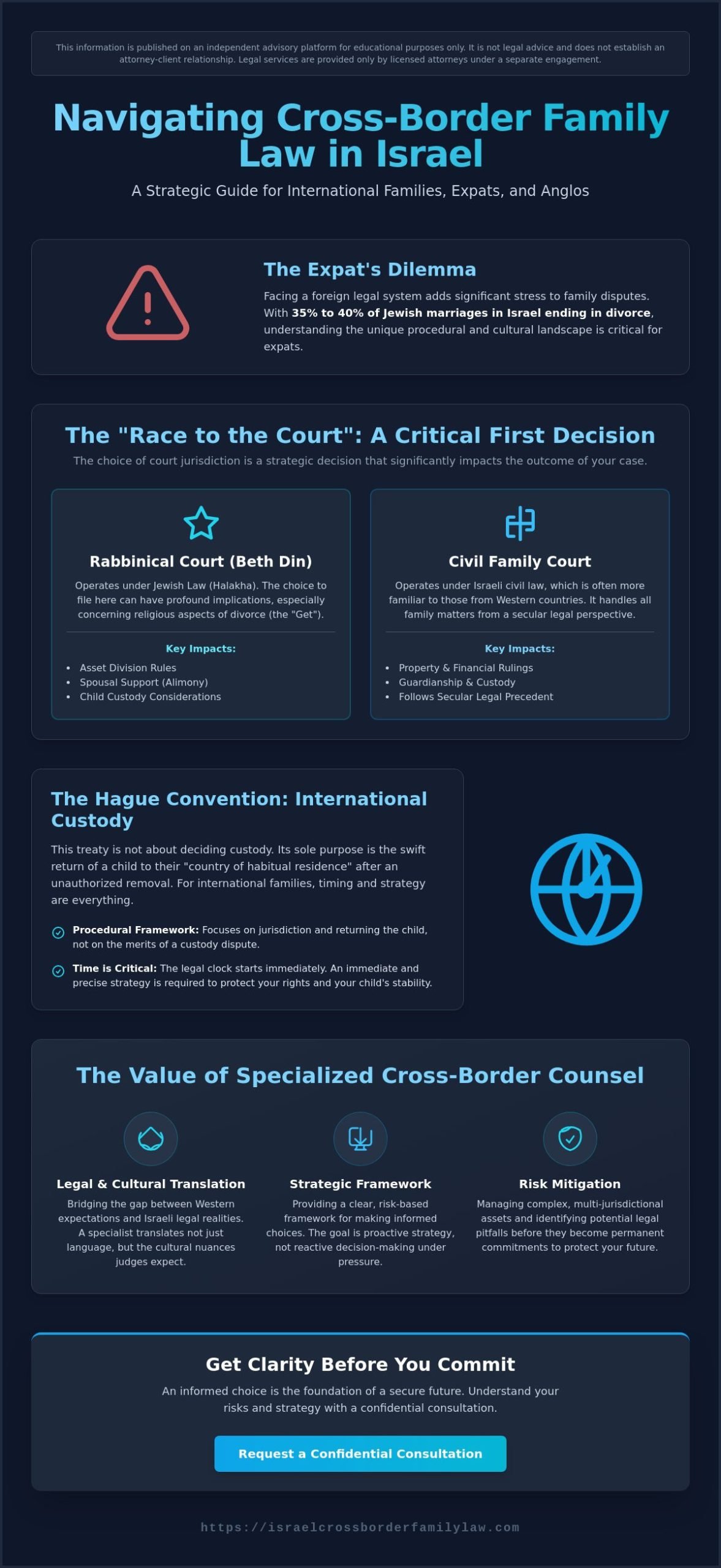
Gaining Clarity: Strategy and Risk in Israeli Family Law
The Israeli legal system is unique, particularly in how it balances civil and religious authority. For Anglos living in IL, this isn’t just a matter of law; it’s a matter of cultural adaptation. Engaging a Shai Simchauve lawyer helps international families move from a state of reactive anxiety to one of strategic clarity. The goal is to ensure that your specific history and global context aren’t lost in translation when they reach the judge’s desk. Specialized counsel acts as a necessary bridge between the expectations of Western legal tradition and the procedural realities of Israeli courts.
Early decisions carry a heavy weight in this jurisdiction. In a system where the first filing can determine which laws apply to your assets or your children, a single day can change the trajectory of your case for years. Whether you’re navigating the 2026 updates to family court fees or the March 2026 expansion of rabbinical arbitration powers, you need to understand the risks before you take action. A reactive approach often leads to legal deadlock, while a strategy-first approach allows for more predictable outcomes.
Making Informed Choices
A strategy-based approach is always superior to an emotion-driven one. Divorce and custody disputes are inherently stressful, but allowing that stress to drive your legal decisions often leads to long-term regret. You should evaluate whether your counsel has specific experience in multi-jurisdictional matters. If your assets are in the US but your life is in IL, you need a professional who understands both sides of that equation. This ensures that your legal goals are aligned with your long-term family needs rather than just short-term court victories.
Next Steps for International Families
Preparation is your most effective tool. Before seeking a Confidential Case Review, ensure your documentation is organized. This includes financial records, residency history, and any existing prenuptial or financial agreements. Having these facts ready allows for a more accurate assessment of your risks and opportunities within the IL system. Local expertise is not optional for international families. The intersection of treaties and local family law requires a nuanced, steady hand to manage the inherent complexity.
Get clarity before you commit. Request a confidential consultation.
This article is published on an independent advisory platform and is not a law firm. The information provided is for educational purposes only and does not establish an attorney-client relationship.
Securing Your Family’s Future Through Strategic Planning
Adv. Shai Simchauve’s practice at Segal, Simchauve & Partners serves as a vital bridge for international families facing the complexities of the Israeli legal system. Throughout this overview, we’ve highlighted the importance of addressing cross-border jurisdiction and the specific procedural requirements of the Hague Convention early in the process. Working with a Shai Simchauve lawyer ensures that your international context is understood and that your legal strategy is built on a foundation of risk management rather than emotional reaction.
Decisions made in the initial stages of a divorce or custody dispute in IL have lasting consequences. By gaining a clear understanding of how the dual-court system impacts asset division and parental rights, you can make informed choices that provide long-term stability. It’s essential to recognize the significant differences between legal cultures before making any permanent commitments.
Get clarity before you commit. Request a confidential consultation.
Establishing a strategic framework today is the most reliable way to navigate the challenges of international family law and secure your family’s future in Israel. You don’t have to face these multi-jurisdictional complexities without a clear plan.
This article is published on an independent advisory platform and is not a law firm. The information provided is for educational purposes only and does not establish an attorney-client relationship. Legal services are only provided by licensed attorneys under a separate engagement.
Frequently Asked Questions
What is Shai Simchauve’s primary area of legal expertise?
Shai Simchauve specializes in complex family law with a specific focus on international and cross-border litigation. His practice covers divorce, child custody, and the division of global assets within the Israeli legal system. As a founding partner at Segal, Simchauve & Partners, he frequently manages high-stakes cases involving the Hague Convention. His work centers on providing strategic clarity for families navigating multi-jurisdictional disputes.
Does Shai Simchauve represent English-speaking expats in Israeli family court?
Yes, he specifically represents the Anglo and expat community living in or dealing with the Israeli legal system. A Shai Simchauve lawyer serves as a cultural and linguistic bridge for clients who are unfamiliar with local court procedures. This expertise ensures that Western legal expectations are effectively translated into the specific requirements of IL family courts, helping international families feel understood and represented throughout their proceedings.
How does the Hague Convention apply to child custody cases in Israel?
The Hague Convention applies when a child is removed from their country of habitual residence without the consent of both parents. In Israel, these cases are heard in specialized Family Courts that prioritize the prompt return of the child. The focus remains on the legality of the removal rather than a long-term custody determination. Immediate strategic intervention is required to manage the strict procedural timelines inherent in these international treaties.
Can Shai Simchauve assist with enforcing US court orders in Israel?
He assists with the formal recognition and enforcement of foreign court orders, including those related to child support and custody. This process involves navigating specific treaties and Israeli laws that allow for the implementation of US-based rulings within the IL system. Success in these matters depends on ensuring that the original order meets the requirements for cross-border enforcement, preventing legal deadlock when one party resides abroad.
What should I bring to a consultation for a cross-border divorce case?
You should bring comprehensive records of all assets held both in Israel and abroad, including bank statements, tax returns, and business valuations. It is also essential to provide copies of any existing prenuptial agreements or previous court orders. Full disclosure of your global financial footprint allows a Shai Simchauve lawyer to identify potential risks early. This preparation forms the basis of a strategy-first approach to property division and alimony.
How does the “Race to the Court” affect divorce strategy in Israel?
The “Race to the Court” refers to the jurisdictional competition between Rabbinical and Civil courts for authority over a divorce. The venue where a petition is first filed generally gains the power to rule on related issues like property and support. Because these two court systems apply different legal principles, the first filing often dictates the strategic direction of the entire case. This makes early decision-making a critical factor in the final outcome.
What is the difference between Rabbinical and Civil courts in family law?
Rabbinical courts operate according to Jewish religious law, while Family Courts are civil institutions governed by Israeli secular law. While both have the authority to grant a divorce, their approaches to matters like alimony and asset division can vary. For international families, understanding these differences is vital because the choice of court can significantly impact financial settlements. A strategic framework is necessary to navigate this dual-court reality safely.
Does the firm handle criminal defense matters related to family law?
Yes, the practice includes handling criminal defense matters that arise within the context of family law disputes. This is particularly relevant in high-conflict situations where domestic allegations or other legal violations may impact custody or divorce proceedings. Providing a comprehensive approach that covers both family and criminal law ensures that clients are protected across all facets of the IL legal system. This integrated strategy helps maintain a calm and authoritative presence in court.

Article by
Gabriel Lior
A Personal Journey That Became a Mission
The advisory was founded by an American father Gabriel Lior, LLB, MBA , global entrepreneur, and cross-border advisor who spent more than a decade navigating the Israeli family court system firsthand and now lives in Singapore with his son.
As a divorced parent in a cross-border family, Gabriel faced nearly every legal challenge a foreign parent can encounter in Israel — including child custody disputes, child support proceedings, property matters in Israel and abroad, false accusations, and complex immigration and relocation proceedings.
Over the years, he learned the hard way how difficult it is for non-Israeli parents to understand the system, identify the right legal strategy, and choose the right legal representation — especially when language, culture, and jurisdictional differences are involved. He also witnessed how foreign parents and new immigrants are often disadvantaged or taken advantage of by service providers and institutions simply because they lack local knowledge or fluency.
From Client to Advisor
To truly understand — and survive — the system, Gabriel pursued formal legal education in Israel, completing two Israeli law degrees, alongside a BA and MBA earned in the United States. This was never about becoming a practicing attorney, but about gaining a deep, structural understanding of how the system works — and where it breaks down for foreign parents.
This rare combination of:
Firsthand client experience
Israeli legal and US business education
International business and negotiation training
Decades of commercial execution
created a unique perspective – one that understands both sides of the table.
After years of litigation, persistence, and at times self-representation, he ultimately succeeded in securing custody of his son and relocating abroad through a rare legal victory in the Israeli Supreme Court — becoming one of the first fathers in Israel to do so under these circumstances.
Disclaimer
Important Disclaimer:
The information provided on this website and in its content is for general informational and educational purposes only and does not constitute legal advice, legal opinion, or legal representation.
Gabriel Lior is not licensed to practice law in Israel (nor is he interested in doing so) and does not provide legal services, despite having completed 2 Law Degrees. The services offered are advisory in nature and are intended to provide general guidance, strategic insight, and information regarding cross-border family law considerations.
No attorney-client relationship is formed by accessing this website, reading its content, or communicating with us.
Any decisions made based on this information are at your own discretion and risk. For legal advice specific to your situation, you should consult a licensed attorney in the relevant jurisdiction.
Where appropriate, we may refer clients to independent, licensed attorneys or professionals. Such referrals do not constitute legal representation and no liability is assumed for services provided by third parties.