This article is published on an independent advisory platform and does not constitute an attorney-client relationship or legal advice. Legal services are provided only by licensed attorneys under a separate engagement.
Why does a legal bill in Tel Aviv often look nothing like one from New York or London? If you’re managing a family matter across borders, you might feel that legal billing in a foreign country is unpredictable or lacks transparency. It’s frustrating when you’re trying to budget for a major life transition but can’t get a straight answer on how much does an israeli lawyer cost? or why the standards seem so different from what you’re used to back home.
We agree that financial clarity is the foundation of a sound legal strategy. Our goal is to help you understand the structures, regulations, and market factors that determine legal fees in IL so you can plan your approach with confidence. We’ll explore the choice between hourly and flat fees, explain the Israel Bar Association’s recommended minimums, and show you how to evaluate a fee proposal without the stress of hidden costs. By understanding these multi-jurisdictional complexities, you can move forward with the reassurance that your professional team is operating with full transparency.
Key Takeaways
- Understand the distinction between the Israel Bar Association’s recommended minimum fees and the market-driven rates charged by experienced cross-border firms.
- Identify how professional seniority and geographic location in IL directly influence how much does an israeli lawyer cost? for complex international matters.
- Learn to navigate the unique “per-stage” billing model commonly used in Israeli divorce proceedings to better forecast your long-term legal budget.
- Gain the tools to evaluate an Israeli engagement letter to ensure all fee structures are transparent and clearly defined before you commit to representation.
The Framework of Legal Fees in Israel: Regulated vs. Market Rates
Understanding the financial landscape of The Israeli Legal System is the first step in managing your expectations during a family law matter. Unlike some jurisdictions where fees are entirely opaque until the first bill arrives, IL has a specific framework that combines historical regulations with modern market demands. One of the most common questions for families managing a cross-border transition is: how much does an israeli lawyer cost? The answer depends largely on whether you are looking at the regulated minimums or the rates required for complex, private representation.
To better understand this concept, watch this helpful video:
In the Israeli system, a written fee agreement is not just a best practice; it’s a professional requirement. This document, known as a Schar Tircha, serves as the primary contract between you and your legal team. It must outline the scope of work and the billing method to ensure there are no surprises. You can learn more about how these structures are evaluated on our pricing overview page.
The IBA Recommended Minimum Fee Schedule
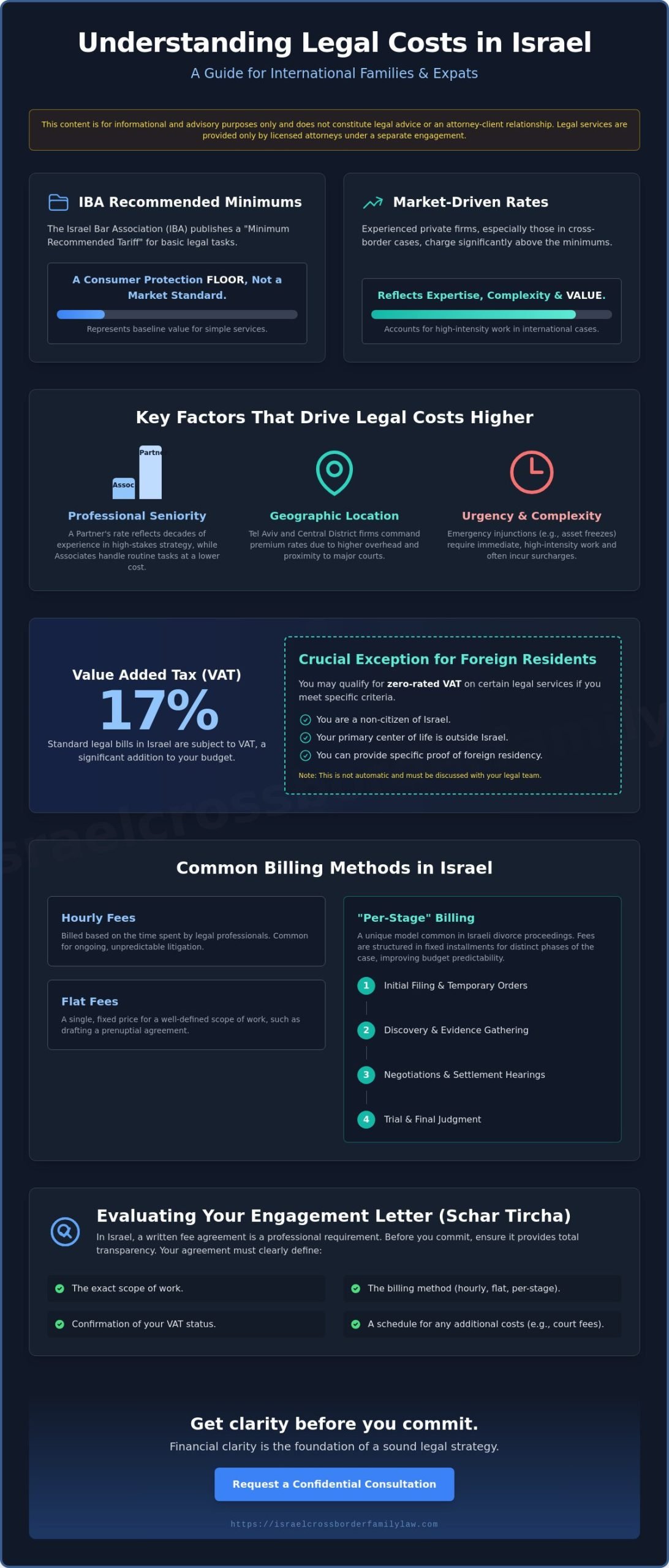
The Israel Bar Association (IBA) publishes a “Minimum Recommended Tariff” for various legal tasks. This list covers common actions such as filing a standard motion or drafting a basic contract. While this schedule exists, it’s vital to recognize that most experienced private firms, especially those handling multi-jurisdictional cases, charge significantly above these minimums. The IBA tariff acts more like a consumer protection floor than a market standard. It ensures that even the most basic services have a baseline value, but it doesn’t account for the high-intensity work required in contested international divorces or complex estate planning.
VAT and the Foreign Resident Exception
Standard legal bills in IL are subject to a 17% Value Added Tax (VAT). This is a significant addition to your budget that many expats overlook. However, there is a crucial exception for “foreign residents.” If you are a non-citizen and your primary center of life is outside of IL, you may qualify for a zero-rated VAT status on certain legal services. This is not automatic. You’ll need to provide specific proof of residency, such as a foreign passport and evidence that you aren’t physically present in the country while the work is being performed. Securing this status can save you thousands of shekels, making it a critical point of discussion during your initial strategy session.
Key Factors That Drive Israeli Legal Costs Higher
The base rate for legal services is rarely the final number on a bill. Several variables influence the total investment required for a family law matter. Professional seniority is a primary factor. A partner’s rate reflects decades of experience in high-stakes litigation and complex negotiations. Associates handle more routine tasks at a lower cost, but high-level strategy usually remains the partner’s domain. When you are calculating how much does an israeli lawyer cost?, you must consider the balance of expertise versus administrative drafting within the firm’s hierarchy.
Geographic location also dictates the market rate. Tel Aviv and the Central District serve as the primary hubs for international legal practice in IL. Firms in these areas face higher overhead costs and command a premium for their proximity to the major courts and commercial centers. While you might find lower rates in peripheral cities, those firms may lack the specific experience needed to handle legal matters for expats and foreign nationals. Choosing a firm based on location alone can be a risk if the case involves assets or custody issues spanning multiple countries.
Urgency and timing can further impact your budget. Emergency injunctions, such as stay-of-exit orders or immediate asset freezes, require a legal team to prioritize your case over all others. These “rush” filings often incur surcharges because they demand high-intensity work outside of standard hours. Planning your strategy early is the most effective way to avoid these sudden spikes in cost.
The Value of Cross-Border Expertise
There is often an “Anglo premium” for lawyers who are multi-qualified or licensed to practice in both the US and IL. This specialized knowledge is a significant cost driver because it prevents expensive procedural errors. A lawyer who understands both systems can ensure that a settlement reached in an Israeli court doesn’t inadvertently trigger negative tax consequences or enforcement issues in the US. Avoiding these multi-jurisdictional pitfalls often results in long-term savings that far outweigh the higher initial hourly rate. You can review our pricing framework to see how these strategic factors apply to your specific situation.
Administrative and Side Costs
Beyond professional fees, you must budget for administrative expenses that are unique to the Israeli system. Court filing fees, known as Agrot, are mandatory and often calculated based on the type of claim or the financial value involved in the case. International cases also require a significant budget for the following:
- Professional Translations: All foreign documents must be translated into Hebrew by certified professionals to be admissible in court.
- Apostille Certifications: This international standard of notarization is required to make foreign birth certificates, marriage licenses, or property deeds legally valid in IL.
- Expert Witnesses: Complex family law cases often require forensic accountants to value foreign business interests or psychologists for custody evaluations.
If you need clarity on how these factors might influence your specific case, you can request a confidential consultation to discuss your strategy.
Common Billing Methods in the Israeli Market
Selecting the appropriate billing structure is as vital as choosing the right practitioner. The Israeli legal market utilizes several distinct models to bill for professional services. Many clients focus solely on the question of how much does an israeli lawyer cost? without realizing that the billing method itself can significantly influence the final investment. Understanding these frameworks allows you to select a structure that aligns with your financial strategy and the specific complexity of your cross-border matter.
Hourly rates are the prevailing standard for litigation and complex advisory work. This model ensures that you pay for the precise amount of professional time dedicated to your file. It’s particularly effective for unpredictable disputes where the scope of work may shift as the case progresses. For standardized tasks, such as drafting a simple will or a mutual consent agreement, many firms offer a flat fee, often referred to in IL as a global fee. This provides immediate cost certainty. High-net-worth families or those with ongoing transnational interests may instead opt for retainer agreements, which provide consistent access to legal counsel for a fixed periodic fee.
Hourly vs. Flat Fee: Which is Better for You?
Hourly billing provides a high level of transparency but can lead to budget uncertainty if a dispute unexpectedly escalates. Many expats prefer flat fees for the “peace of mind” they offer, as they eliminate the stress of an accumulating bill. However, a flat fee may include a premium to account for the lawyer’s risk in a complex matter. If you decide on an hourly model, it’s wise to inquire about “caps” or “milestones.” These allow you to establish a maximum budget for specific phases of the case, ensuring you maintain strategic control over your legal spend. You can learn more about these structures in our advisory process guide.
Success Fees in Israel
Success fees, where the practitioner receives a percentage of the financial outcome, are common in Israeli commercial litigation or labor disputes. However, family law operates under different ethical constraints. The Israel Bar Association strictly limits or prohibits pure success fees in matters involving divorce or child custody. This regulation ensures that legal counsel remains focused on the best interests of the family rather than the financial size of a settlement. Most family law matters instead utilize a “per-stage” billing model to balance risk and predictability. For a deeper look at these specific costs, visit our pricing framework.
Typical Fee Structures for Cross-Border Family Law and Estates
Navigating family law in IL often involves a “per-stage” billing model that differs from the standard hourly approach found in many Western jurisdictions. This structure divides the legal process into distinct phases, such as the initial filing of claims, the interim hearings for temporary relief, and the final evidentiary stage. For families managing a separation across borders, this model provides a degree of predictability. It allows you to understand the financial commitment required for each specific step of the litigation. When assessing how much does an israeli lawyer cost? for a divorce, you’ll likely see these stages clearly delineated in your engagement letter. Prenuptial agreements also follow this logic, where the cost of drafting is often separate from the fee for court validation, which is a mandatory step in the Israeli system.
International child custody and relocation matters typically deviate from flat-fee models. These cases are inherently unpredictable and require high-intensity hourly work to manage the multi-jurisdictional evidence and expert evaluations involved. The complexity increases significantly in Hague Convention child abduction cases, where rapid response times and specialized knowledge of international treaties are mandatory. While the hourly investment for these matters is higher, a strategic approach from the outset can prevent the case from spiraling into years of expensive litigation.
International Divorce and Custody Costs
The dual court system in IL, where both the Family Court and the Rabbinical Court may have jurisdiction, can influence your total legal spend. Litigating in two different systems simultaneously increases administrative costs and professional time. However, mediation remains a powerful tool for international families to reduce these expenses. A mediated settlement agreement can often be drafted for a flat fee, bypassing the high costs associated with contested court hearings and providing a more amicable resolution for the children involved.
Estate Planning and Probate
Estate planning for those with assets in multiple countries requires a specialized framework. While a simple Israeli will might be handled for a fixed fee, US-Israel estate planning involving foreign trusts and complex tax considerations usually requires a more tailored hourly or hybrid structure. This ensures that your Israeli “Order of Succession” aligns perfectly with your foreign probate requirements. Probate costs for foreign-held assets often involve additional fees for obtaining “Orders of Inheritance” from the Israeli Registrar of Inheritance Affairs. Understanding how much does an israeli lawyer cost? for these services is essential for protecting your global legacy. If you’re ready to secure your family’s future, you can reach out to our advisory team to discuss a customized strategy.
This article is published on an independent advisory platform and does not constitute an attorney-client relationship or legal advice. Legal services are provided only by licensed attorneys under a separate engagement.
Managing Your Legal Budget: How to Evaluate Value
Managing a legal budget in a foreign jurisdiction requires more than just looking at a bottom-line number. It’s about evaluating the strategic value of the representation. The initial consultation is the most critical moment for this evaluation. It’s during this meeting that you set the strategy and define the budget parameters. A well-prepared practitioner will help you understand the likely trajectory of your case, allowing you to anticipate costs before they arise. When you ask how much does an israeli lawyer cost?, you are really asking about the value of the expertise required to navigate the specific risks of your international situation.
The engagement letter, or Schar Tircha, is your primary tool for financial control. This document must be transparent. It should clearly define the scope of work and the billing method, whether it is hourly or per-stage. You should also ensure that the agreement covers “out-of-pocket” expenses. In cross-border cases, these often include professional translations, international courier fees, and travel costs. If these aren’t mentioned, ask for them to be added. Clear communication from the start prevents the frustration of unexpected line items later on.
You can also reduce your legal spend through simple organization. Providing your legal team with well-organized documentation and clear, concise summaries of events reduces the time they spend on administrative sorting. This allows the firm to focus on high-level strategy rather than clerical work. In the Israeli system, an advisory approach is often more cost-effective. By focusing on the impact of early decisions, you can avoid the high costs of correcting procedural errors later.
Evaluating the Fee Proposal
A thorough fee proposal should include a phased budget. This breaks the case down into manageable financial milestones. It helps you avoid large financial surprises and allows you to adjust your strategy based on the results of each stage. When comparing quotes, remember that the cheapest option isn’t always the most efficient. A practitioner who lacks cross-border experience might offer a lower rate but could overlook critical multi-jurisdictional complexities. This can lead to expensive delays or the need for secondary legal counsel in another country.
The First Step Toward Clarity
An independent advisory platform serves as a bridge between you and the complexities of the Israeli system. It provides a neutral space to evaluate your options before you commit to a specific firm. Starting with a confidential case review is an effective way to define the scope of your matter and establish a realistic budget. This strategic overview ensures that you are hiring the right level of expertise for your specific needs in IL.
Get clarity before you commit. Request a confidential consultation.
Strategic Planning for Your Cross-Border Future
Navigating the financial aspects of family law in IL requires a shift from viewing legal fees as a static expense to seeing them as a strategic investment. By understanding the distinction between regulated minimums and market-driven premiums, you can better evaluate how much does an israeli lawyer cost? for your specific needs. The most effective way to manage your budget is through a transparent engagement model that prioritizes clarity before any commitment is made. This approach ensures that your cross-border strategy is built on a foundation of trust and mutual understanding.
Our advisory platform is authored by specialists in international family law who focus on the unique complexities of US-Israel multi-jurisdictional cases. We emphasize transparent pricing and established engagement models to help you avoid the pitfalls of unpredictable billing. Focusing on high-level strategy rather than just billable hours allows you to achieve your personal and commercial goals with greater security. You can take the first step toward a well-planned resolution today.
Get clarity before you commit. Request a confidential consultation.
This article is published on an independent advisory platform and does not constitute an attorney-client relationship or legal advice. Legal services are provided only by licensed attorneys under a separate engagement.
Frequently Asked Questions
Do Israeli lawyers charge for the initial consultation?
Most established family lawyers in IL charge a professional fee for an initial consultation. This meeting is far more than a simple introduction; it’s a comprehensive strategy session where the practitioner reviews your specific circumstances and provides a preliminary roadmap for your case. Paying for this time ensures you receive objective, high-level guidance from the outset.
Is it cheaper to hire a lawyer in Israel or the US for a cross-border case?
Hourly rates for practitioners in IL are generally lower than those in major US metropolitan hubs like New York or Los Angeles. While the base rate may be lower, the overall investment depends on which jurisdiction serves as the primary venue for your litigation. Utilizing a specialist who understands both systems can often reduce total costs by eliminating the need for two separate, full-time legal teams.
What is the average hourly rate for a family lawyer in Tel Aviv?
Market rates for experienced family lawyers in Tel Aviv typically range from 800 NIS to 1,800 NIS per hour plus VAT. When evaluating how much does an israeli lawyer cost?, it’s important to recognize that these rates reflect the specialized expertise required for the Central District’s courts. Senior partners at top-tier firms often command rates at the higher end of this scale due to their decades of multi-jurisdictional experience.
Can I pay my Israeli legal fees in US Dollars?
Many firms that cater to international clients and expats accept payment in US Dollars. While the official invoice must be calculated in NIS to satisfy Israeli tax regulations, the firm will typically use the representative exchange rate on the day of the transaction. This flexibility is a standard feature for firms managing transnational operations and multi-currency billing.
Are legal fees in Israel tax-deductible for US citizens?
Legal fees related to personal family law matters, such as divorce or child custody, are generally not tax-deductible for US citizens. There are specific exceptions if a portion of the fee is directly related to tax advice or the management of income-producing property. You should always consult with a qualified cross-border tax advisor to determine if any part of your legal spend qualifies for a deduction.
What happens if I have a dispute with my Israeli lawyer over fees?
Disputes regarding professional fees can be referred to the Israel Bar Association’s fee dispute committee for resolution. Most formal engagement letters in IL also include a clause specifying arbitration or mediation as the preferred path for resolving disagreements. This structured process provides a reliable mechanism for clients to seek clarity and fairness without entering into protracted litigation.
Does the losing party have to pay the other side’s legal fees in Israel?
Israeli courts operate under the “English Rule,” which means the judge has the discretion to order the losing party to pay the winner’s legal costs. However, you shouldn’t assume this will cover your entire bill. The court typically awards a “reasonable” amount based on standardized tariffs, which often only represents a fraction of the actual fees paid to a private, high-end firm.

Article by
Gabriel Lior
A Personal Journey That Became a Mission
The advisory was founded by an American father Gabriel Lior, LLB, MBA , global entrepreneur, and cross-border advisor who spent more than a decade navigating the Israeli family court system firsthand and now lives in Singapore with his son.
As a divorced parent in a cross-border family, Gabriel faced nearly every legal challenge a foreign parent can encounter in Israel — including child custody disputes, child support proceedings, property matters in Israel and abroad, false accusations, and complex immigration and relocation proceedings.
Over the years, he learned the hard way how difficult it is for non-Israeli parents to understand the system, identify the right legal strategy, and choose the right legal representation — especially when language, culture, and jurisdictional differences are involved. He also witnessed how foreign parents and new immigrants are often disadvantaged or taken advantage of by service providers and institutions simply because they lack local knowledge or fluency.
From Client to Advisor
To truly understand — and survive — the system, Gabriel pursued formal legal education in Israel, completing two Israeli law degrees, alongside a BA and MBA earned in the United States. This was never about becoming a practicing attorney, but about gaining a deep, structural understanding of how the system works — and where it breaks down for foreign parents.
This rare combination of:
Firsthand client experience
Israeli legal and US business education
International business and negotiation training
Decades of commercial execution
created a unique perspective – one that understands both sides of the table.
After years of litigation, persistence, and at times self-representation, he ultimately succeeded in securing custody of his son and relocating abroad through a rare legal victory in the Israeli Supreme Court — becoming one of the first fathers in Israel to do so under these circumstances.
Disclaimer
Important Disclaimer:
The information provided on this website and in its content is for general informational and educational purposes only and does not constitute legal advice, legal opinion, or legal representation.
Gabriel Lior is not licensed to practice law in Israel (nor is he interested in doing so) and does not provide legal services, despite having completed 2 Law Degrees. The services offered are advisory in nature and are intended to provide general guidance, strategic insight, and information regarding cross-border family law considerations.
No attorney-client relationship is formed by accessing this website, reading its content, or communicating with us.
Any decisions made based on this information are at your own discretion and risk. For legal advice specific to your situation, you should consult a licensed attorney in the relevant jurisdiction.
Where appropriate, we may refer clients to independent, licensed attorneys or professionals. Such referrals do not constitute legal representation and no liability is assumed for services provided by third parties.