This article is published on an independent advisory platform (not a law firm) and does not constitute an attorney-client relationship. The content provided is for informational and advisory purposes only and does not constitute legal representation or legal advice.
In the Israeli legal landscape, the specific court where you file first often dictates the rules for your entire family’s future. It’s a high-stakes environment where a single procedural choice can change the outcome of property division or spousal support. Most expats and international families feel a justified sense of unease when faced with Hebrew documents and the unfamiliar authority of religious courts. You likely realize that a simple translation isn’t enough to protect your interests when your life and assets span multiple borders.
This guide provides the clarity you need to manage these complexities with confidence. By engaging an english speaking family lawyer israel, you gain more than a translator; you secure a strategist who can bridge the gap between two distinct legal cultures. We will explore how the dual court system functions, the impact of recent 2026 legislative shifts regarding Rabbinical court authority, and the critical steps required to protect your children and global assets during a legal transition. Understanding these systemic differences is the first step toward a secure and predictable outcome.
Key Takeaways
- Learn how the “Race to Court” determines whether your case is heard in a civil Family Court or a religious Rabbinical Court, which fundamentally impacts the division of your assets.
- Understand the strategic considerations for managing US-based interests and how Israeli courts approach multi-jurisdictional financial protections.
- Identify the critical documents and early decisions that minimize risk and ensure you maintain a strategic advantage before any formal filing occurs.
- Discover why engaging an english speaking family lawyer israel is essential for bridging the gap between foreign legal expectations and the local regulatory environment.
- Explore the benefits of an advisory-first model that helps you gain clarity on your options and choose the right local counsel before committing to a specific legal path.
The Strategic Role of an English-Speaking Family Lawyer in Israel
This article is published on an independent advisory platform (not a law firm) and does not imply an attorney-client relationship. The content provided is for informational and advisory purposes only and does not constitute legal representation or legal advice.
For families moving between the US and Israel, legal expectations often clash with local realities. An english speaking family lawyer israel serves as more than a simple translator; they act as a strategic bridge. While you might understand the literal words on a legal document, the underlying weight of those words is often rooted in Israel’s dual court system. This system requires a nuanced approach that accounts for both civil and religious authorities, where a single filing can dictate the trajectory of your family’s future.
To better understand the perspective of international legal practitioners when dealing with complex multi-jurisdictional challenges, watch this discussion on cross-border legal dynamics:
Literal translation often fails to capture strategic nuance. A document might translate “balancing of resources” into English, but it won’t explain the practical differences from “equitable distribution” found in many US states. Without an advocate who understands both systems, you risk becoming a spectator in your own life. Effective counsel ensures you are an active participant. They help you understand how Israeli Bar Association standards apply to your specific international context, ensuring you aren’t blindsided by procedural norms that differ from your home country.
Beyond Language: Cultural and Legal Nuance
Israeli courts operate with a communication style that can feel direct or even aggressive to those accustomed to US proceedings. A cross-border professional understands the “Anglo” mindset and translates the expectations of negotiation accordingly. For instance, the concept of “balancing of resources” in Israel involves a specific mathematical formula for marital assets. This formula may not align with your prior understanding of divorce law, especially regarding pension funds or property held outside of Israel. Having a lawyer who can explain these differences in plain English prevents costly assumptions and ensures your strategy is grounded in reality.
The Importance of Seeking Clarity Before Commitment
You should never sign a representation agreement until you understand the long-term trajectory of your case. Hiring a lawyer based solely on their ability to speak English is a common mistake. If they lack cross-border expertise, they may overlook how a decision in an Israeli court affects your assets or custody rights abroad. Early decisions carry significant weight; once a case is filed in a specific court, it’s very difficult to change the jurisdiction. We recommend learning how our advisory process works to gain a clear view of your situation. This allows you to choose local counsel based on strategic fit rather than just a shared language.
Get clarity before you commit. Request a confidential advisory call or message us via WhatsApp to discuss your situation.
This article is published on an independent advisory platform (not a law firm) and does not imply an attorney-client relationship. The content provided is for informational and advisory purposes only and does not constitute legal representation or legal advice.
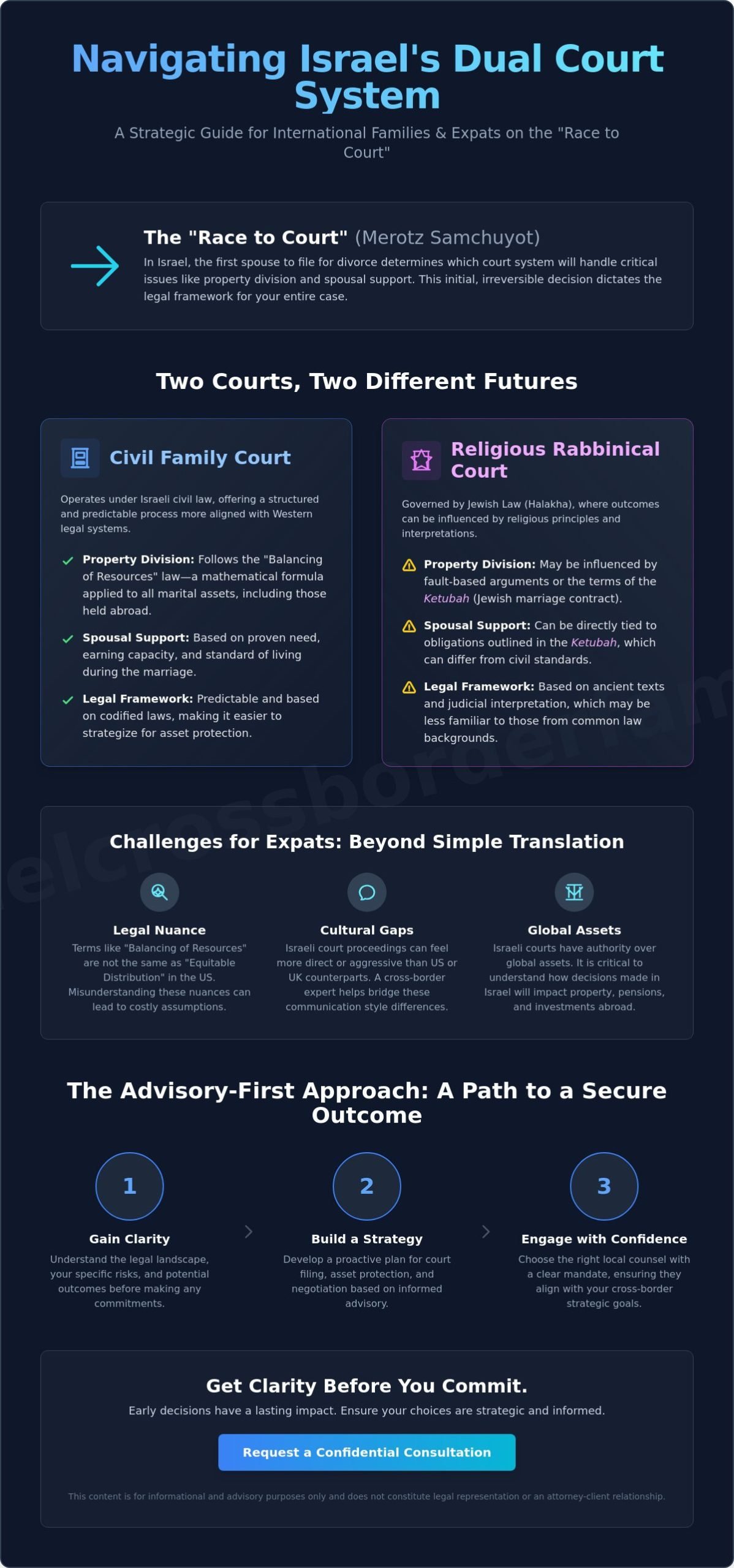
The Israeli legal system features a unique dual-court structure that often surprises families from common-law backgrounds. In Israel (IL), jurisdiction over family matters is shared between civil Family Courts and religious Rabbinical Courts. This overlap creates what is known locally as the “Race to Court,” or Merotz Samchuyot. Under this rule, the court where a case is first filed generally retains the authority to decide on specific issues like property division and spousal support. For international families, this means that the timing and location of your initial filing are not just procedural steps; they are foundational strategic decisions.
An english speaking family lawyer israel is vital in this early stage to help you evaluate which venue aligns best with your objectives. The choice of court can fundamentally change the financial outcome of a divorce. While both courts must consider the “best interests of the child” in custody matters, they may apply different standards to alimony or the division of global assets. Many English speakers assume that because they aren’t religious, the Rabbinical court won’t affect them. However, if your spouse files there first and “binds” secular issues to the divorce claim, you may find yourself litigating financial matters under religious law.
The Family Court (Civil Jurisdiction)
The civil Family Court is a secular institution designed to handle the modern complexities of family life. It manages a broad range of issues including child custody, visitation rights, and the “balancing of resources” for marital assets. Proceedings here are generally more predictable for those used to Western legal standards. The court focuses on civil statutes and precedent, providing a framework that many expats find more familiar and transparent when discussing international financial interests.
The Rabbinical Court (Religious Jurisdiction)
The Rabbinical Court has exclusive authority over the “Get,” which is the religious divorce decree required for Jewish citizens in Israel. Even if you don’t consider yourself observant, this court will likely be involved in the final dissolution of the marriage. Recent legislative changes in March 2026 have expanded the authority of these religious courts to arbitrate certain civil disputes with the consent of both parties, though child custody for married couples remains excluded from this expansion. The risk for many families lies in the “binding” of secular issues. A spouse can include claims for property or alimony within the religious divorce filing. This moves those issues away from the civil court’s jurisdiction. Understanding these risks before any papers are served is the only way to maintain control over your legal trajectory. If you are unsure how these jurisdictions overlap in your specific case, request a confidential advisory call to gain clarity on your options.
This article is published on an independent advisory platform (not a law firm) and does not imply an attorney-client relationship. The content provided is for informational and advisory purposes only and does not constitute legal representation or legal advice.
Managing a life across two continents requires a high level of strategic planning, especially when legal systems collide. Jurisdictional competition defines the situation where US and Israeli legal systems both hold authority over a family’s affairs, creating a strategic need to determine which court offers the most equitable protections. An english speaking family lawyer israel is essential for navigating these competing interests, as the decision of where to file can determine how your retirement accounts, real estate, and custody rights are handled. While Israeli courts can recognize foreign judgments, the process is never automatic. A foreign support order or divorce decree must undergo a formal recognition process to be enforceable within Israel (IL).
Asset Protection and Property Division
Israel’s “Balancing of Resources” law generally mandates an equal split of assets acquired during the marriage. However, applying this to US-based assets like 401k plans or IRAs is complex. Israeli courts often lack the direct authority to divide a US pension plan, which may require a strategy of offsetting the value against other local assets like Israeli real estate. For expats and foreign nationals, this means that a simple split is rarely straightforward. You must account for tax implications in both jurisdictions and ensure that any Israeli court order is drafted in a way that US financial institutions will actually honor. Failure to do this can leave you with an unenforceable judgment and significant financial loss.
International Child Custody and Relocation
The legal standard of “the best interests of the child” is the guiding principle in the Israeli system, yet its application often differs from US expectations. In the context of international custody and relocation, Israeli courts are typically cautious about allowing a child to move abroad permanently if it significantly disrupts the relationship with the other parent. The Hague Convention on the Civil Aspects of International Child Abduction provides a critical framework for preventing the wrongful removal of children across borders. It’s vital to understand that unilateral relocation without a formal court order or written consent carries severe legal risks. These risks include potential mandatory return orders and, in some cases, criminal allegations. Gaining clarity on these rules before making any travel plans is the only way to protect your parental rights and your child’s stability.
Get clarity before you commit. Request a confidential advisory call or message us via WhatsApp to discuss your cross-border situation.
This article is published on an independent advisory platform (not a law firm) and does not imply an attorney-client relationship. The content provided is for informational and advisory purposes only and does not constitute legal representation or legal advice.
Successful outcomes in Israeli family law are rarely the result of luck; they are the result of meticulous preparation before the first document is ever filed. The initial phase of a family matter in Israel (IL) is often the most critical. Decisions made during these early weeks can dictate the long-term trajectory of your case, particularly regarding jurisdiction and asset protection. Engaging an english speaking family lawyer israel during this pre-filing stage ensures that your preparation is based on established legal frameworks rather than anecdotes. Informal advice from social media groups or well-meaning friends is often dangerous, as it frequently overlooks the specific procedural requirements that apply to international families.
Before taking any formal steps, you should organize a comprehensive file of your global interests. This checklist includes:
- Original marriage certificates and any prenuptial or postnuptial agreements.
- Last three years of tax returns from both Israel and the US.
- Recent statements for all bank accounts, retirement funds (401k, IRA), and investment portfolios.
- Property deeds or lease agreements for real estate held in any jurisdiction.
- Passports and birth certificates for all family members.
The Mandatory Dispute Resolution Process
Israel requires most family law cases to begin with a mandatory “Settlement of Dispute” process, known locally as Sichsuh. This regulation creates a 45-day “cooling off” period where neither party can file a formal lawsuit. During this time, you will meet with social workers at the court’s Assistance Center to explore mediation or settlement options. It is vital to handle these meetings with a clear strategy. While the goal is resolution, anything you say or agree to can influence the future of your case if the matter proceeds to litigation. Having professional guidance helps you participate in these meetings without inadvertently compromising your legal position.
Risk Assessment and Strategy Mapping
A thorough risk assessment is the foundation of a sound strategy. You must identify potential jurisdictional conflicts before they become active crises. This includes analyzing where your spouse might file and how that choice would impact your rights. Transparency is essential when discussing divorce and separation for international families, as hidden assets or undisclosed travel plans can lead to severe penalties in both civil and religious courts. Early mapping allows you to anticipate challenges such as the enforcement of child support across borders or the division of foreign business interests. To begin mapping your specific strategy, request a confidential advisory call.
This article is published on an independent advisory platform (not a law firm) and does not imply an attorney-client relationship. The content provided is for informational and advisory purposes only and does not constitute legal representation or legal advice.
The Advisory Model: Gaining Clarity Before You Commit
The traditional path to legal resolution often begins with immediate litigation, yet for international families, this reactive approach can lead to irreversible strategic errors. An advisory-first model prioritizes decision-making and risk management before any formal action is taken. When you are looking for an english speaking family lawyer israel, you aren’t just seeking someone who can translate your words; you need a professional who can translate the strategic implications of the Hebrew-speaking legal environment. This model acts as a bridge, ensuring you understand the cultural and systemic nuances of the Israeli (IL) system before you sign a representation agreement with local counsel.
By focusing on clarity first, you gain a comprehensive view of how Israeli laws interact with your home country’s regulations. This is particularly important given the 2026 legislative expansions of religious court authority and the evolving standards for cross-border property division. To support your education during this process, you can access a range of detailed guides and explanations on our YouTube channel. These resources are designed to help you move from a place of uncertainty to one of informed leadership in your own case.
How Independent Advisory Protects Your Interests
There is a fundamental difference between general legal information and a customized strategic plan. Independent advisory provides a neutral assessment of your situation, identifying potential jurisdictional conflicts that a litigation-focused firm might overlook. This approach often reduces overall legal costs by preventing the need to correct early procedural mistakes. During high-stress transitions, having a calm and authoritative guide allows you to evaluate your options without the pressure of an impending court date. We focus on helping you choose the right local practitioners for your specific needs, whether those needs involve complex financial portfolios or sensitive relocation issues.
Next Steps for International Families
The goal of our advisory model is to ensure that every choice you make is backed by strategic clarity. If you are managing assets in multiple countries or navigating a custody dispute, the impact of your next move cannot be overstated. We invite you to begin this process with a confidential advisory call or a message via WhatsApp to discuss your specific circumstances. This initial step allows you to map out a path that protects your family’s future across all borders.
Get clarity before you commit. Request a confidential consultation.
Securing Your Family’s Global Future
Managing the intersection of US and Israeli law requires a proactive approach that prioritizes strategy over immediate litigation. The choices you make regarding the jurisdictional race between civil and religious courts will define your financial stability and parental rights for years to come. By focusing on meticulous preparation and understanding the 2026 legislative shifts in the Rabbinical court system, you can mitigate the risks inherent in transnational family life. It’s essential to recognize that early procedural steps often dictate the final outcome of property division and child support.
Engaging an english speaking family lawyer israel provides the cultural and legal bridge necessary to manage complex assets and international child custody matters with precision. Specialized advisory services offer a clear path through the Hebrew-speaking legal environment, ensuring your decisions are informed and your global interests are protected under the Hague Convention and local statutes. Informed choices are the foundation of a secure transition for your family. You don’t have to face these complexities without a clear, strategic roadmap.
Get clarity before you commit. Request a confidential consultation.
This article is published on an independent advisory platform (not a law firm) and does not imply an attorney-client relationship. The content provided is for informational and advisory purposes only and does not constitute legal representation or legal advice.
Frequently Asked Questions
Is a US divorce decree enforceable in Israel?
A US divorce decree is enforceable in Israel, but the process is not automatic. You must petition the Israeli Family Court for formal recognition or enforcement. Status issues like the divorce itself are handled differently than financial obligations like child support. Because legal frameworks vary, a decree must align with local IL regulations to be valid. This ensures that all cross-border protections are legally binding within the Israeli system.
Do I need an English-speaking lawyer if I speak basic Hebrew?
Conversational Hebrew is rarely sufficient to navigate the highly specialized terminology used in the Israeli legal system. An english speaking family lawyer israel ensures that every strategic nuance in a court transcript or financial agreement is fully understood. This prevents costly errors in Hebrew-drafted documents that could impact your rights for years. Professional clarity is essential to ensure your intentions are accurately translated into legal results within the local courts.
What is the ‘Race to Court’ in Israeli family law?
The ‘Race to Court’ describes the jurisdictional competition between the Civil Family Court and the Rabbinical Court. The court that first receives a valid filing generally retains authority over related matters like alimony and property division. Since these two systems apply different legal principles, the venue can significantly alter the case outcome. Managing this ‘race’ is a vital strategic consideration for international families before any legal action begins.
How does the Hague Convention affect international custody in Israel?
Israel is a signatory to the Hague Convention, which mandates the immediate return of children who are wrongfully removed from their country of habitual residence. If a child is moved to or from Israel without proper consent, the court can intervene. For expats, understanding the legal definition of “habitual residence” is a critical step. This knowledge is necessary before planning any long-term international relocation to avoid allegations of child abduction.
Can I handle an Israeli family law case from the US?
It is often possible to manage an Israeli family law case while residing in the US. Modern Israeli courts allow remote appearances through video links under specific conditions, and many tasks can be performed via power of attorney. However, engaging an english speaking family lawyer israel is essential for managing ground-level strategy. This ensures your interests are protected within the IL jurisdiction even when you cannot be physically present in the country.
Are US prenuptial agreements valid in Israel?
US prenuptial agreements are generally enforceable in Israel, provided they meet the criteria of the Israeli Financial Relations Law. To be fully recognized, an agreement often requires validation by an Israeli court or a notary, particularly if it was signed before the marriage took place. A cross-border expert should review your US document to ensure it offers the expected protections within the Israeli legal landscape and accounts for local property division rules.

Article by
Gabriel Lior
A Personal Journey That Became a Mission
The advisory was founded by an American father Gabriel Lior, LLB, MBA , global entrepreneur, and cross-border advisor who spent more than a decade navigating the Israeli family court system firsthand and now lives in Singapore with his son.
As a divorced parent in a cross-border family, Gabriel faced nearly every legal challenge a foreign parent can encounter in Israel — including child custody disputes, child support proceedings, property matters in Israel and abroad, false accusations, and complex immigration and relocation proceedings.
Over the years, he learned the hard way how difficult it is for non-Israeli parents to understand the system, identify the right legal strategy, and choose the right legal representation — especially when language, culture, and jurisdictional differences are involved. He also witnessed how foreign parents and new immigrants are often disadvantaged or taken advantage of by service providers and institutions simply because they lack local knowledge or fluency.
From Client to Advisor
To truly understand — and survive — the system, Gabriel pursued formal legal education in Israel, completing two Israeli law degrees, alongside a BA and MBA earned in the United States. This was never about becoming a practicing attorney, but about gaining a deep, structural understanding of how the system works — and where it breaks down for foreign parents.
This rare combination of:
Firsthand client experience
Israeli legal and US business education
International business and negotiation training
Decades of commercial execution
created a unique perspective – one that understands both sides of the table.
After years of litigation, persistence, and at times self-representation, he ultimately succeeded in securing custody of his son and relocating abroad through a rare legal victory in the Israeli Supreme Court — becoming one of the first fathers in Israel to do so under these circumstances.
Disclaimer
Important Disclaimer:
The information provided on this website and in its content is for general informational and educational purposes only and does not constitute legal advice, legal opinion, or legal representation.
Gabriel Lior is not licensed to practice law in Israel (nor is he interested in doing so) and does not provide legal services, despite having completed 2 Law Degrees. The services offered are advisory in nature and are intended to provide general guidance, strategic insight, and information regarding cross-border family law considerations.
No attorney-client relationship is formed by accessing this website, reading its content, or communicating with us.
Any decisions made based on this information are at your own discretion and risk. For legal advice specific to your situation, you should consult a licensed attorney in the relevant jurisdiction.
Where appropriate, we may refer clients to independent, licensed attorneys or professionals. Such referrals do not constitute legal representation and no liability is assumed for services provided by third parties.