This content is published on an independent advisory platform (not a law firm). The information provided focuses on strategy, risks, and decision-making guidance rather than an attorney-client relationship. Imagine the sudden, cold realization that your child’s passport is missing from its usual spot just as a difficult custody dispute begins to escalate. For many families living between the United States and Israel, this isn’t just a nightmare; it’s a legitimate risk that requires immediate, calculated action.
Preventing International Child Abduction starts with understanding that the border between these two nations is more than just a physical distance; it’s a complex intersection of two very different legal systems. You’re likely feeling a deep sense of anxiety about the jurisdictional maze between US family courts and the Israeli Rabbinical or civil systems. We understand the weight of these early decisions and the need for absolute clarity before a conflict peaks.
This guide provides the essential legal strategies and proactive measures you need to protect your children and prevent unauthorized removal. We’ll walk you through a clear checklist of prevention steps, explain how “Stay of Exit” orders function within the IL court system, and discuss the critical role of the Hague Convention. For more visual guidance, you can also explore the resources on the @IsraelFamilyLaw YouTube channel.
Key Takeaways
- Identify the common risks of unauthorized retention, which frequently occurs when a temporary family visit is used to keep a child abroad indefinitely.
- Learn the specific steps to secure the United States side of the border through custody orders that explicitly restrict international movement.
- Understand the essential process for Preventing International Child Abduction within the Israeli legal system by utilizing “Stay of Exit” orders.
- Explore how the Hague Convention provides a reliable and established legal framework for the return of children between the US and Israel.
- Recognize which essential documents and records you must keep secure to maintain a strong strategic position in high-conflict cross-border situations.
What is International Parental Child Abduction (IPCA)?
To understand the legal strategies for Preventing International Child Abduction, one must first grasp how the law defines the act itself. In a cross-border context, What is International Parental Child Abduction (IPCA)? involves the unauthorized removal or retention of a child outside their country of habitual residence. This definition is often broader than parents realize. It doesn’t just apply to a parent taking a child in secret; it also covers “wrongful retention.” This occurs when a child is taken on a pre-approved vacation to Israel or the United States but isn’t returned on the agreed date, effectively turning a temporary visit into a permanent stay without consent.
For families with dual citizenship, the risks are particularly nuanced and require careful navigation. A parent might mistakenly believe that because they hold an Israeli or American passport, they have an inherent right to keep their child in that country indefinitely. However, legal “abduction” applies even if a parent has partial custody or shared parental responsibility. If the relocation violates the other parent’s rights of custody under the law of the child’s home country, it’s a violation that can trigger serious international legal remedies. While the emotional toll of a high-conflict separation is significant, the strategic weight of early decisions regarding a child’s residence cannot be overstated, as these choices often dictate which nation’s courts will ultimately hold jurisdiction.
Identifying Early Warning Signs of Abduction Risk
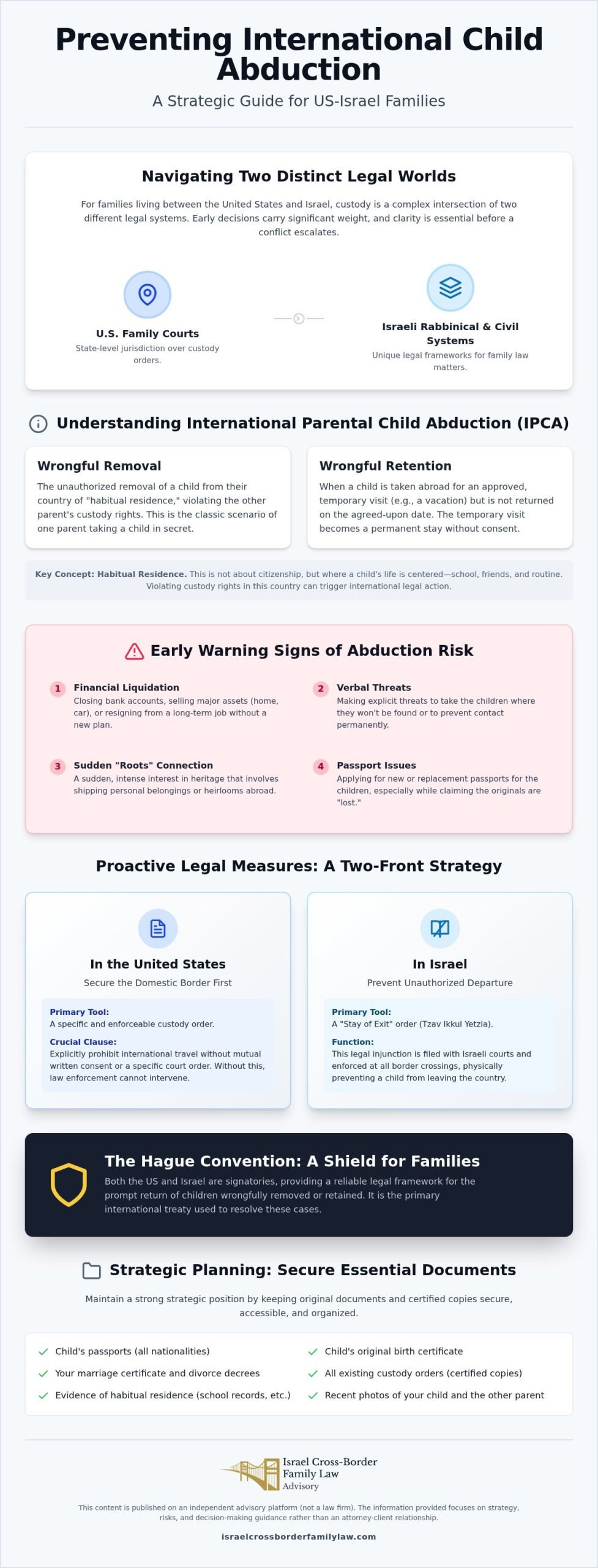
Recognizing behavioral red flags early is a critical step in Preventing International Child Abduction. High-conflict divorces often produce emotional outbursts, but certain shifts in behavior suggest a calculated plan to relocate. These indicators include:
- Liquidating personal assets, closing local bank accounts, or suddenly resigning from a long-term job without a clear alternative.
- Making explicit threats to “never let you see the children again” or “take them where you’ll never find them” during custody disputes.
- A sudden, intense interest in “reconnecting with roots” or religious heritage in Israel or the US that involves shipping personal belongings or heirlooms abroad.
- Applying for new or replacement passports for the children while claiming the original documents were lost or stolen.
The US-Israel Cross-Border Context
The concept of “habitual residence” is the cornerstone of cross-border custody cases. It isn’t simply about where a child was born, but where their life is centered through schooling, social connections, and a settled routine. Dual nationality complicates this because a child can legally enter both countries, making border crossings appear routine to authorities even when they violate a custody arrangement. Understanding these complexities is vital for expats and international families who may be unfamiliar with how the Israeli Rabbinical or civil courts interact with US state laws. For those seeking a deeper visual explanation of these dynamics, the Israel Family Law YouTube channel offers educational resources on international custody and relocation issues. Gaining this clarity early helps parents make informed decisions before a conflict escalates beyond their control.
Securing the domestic side of the border is the first logical step for parents concerned with Preventing International Child Abduction. While local police are often the first point of contact, it’s vital to understand that US law enforcement cannot intervene in a potential removal without a specific, valid court order. Without a clear directive from a family or federal court, officers may view a parent taking a child abroad as a simple exercise of parental rights. Therefore, the foundation of any prevention strategy is an enforceable custody order that explicitly prohibits international travel without written consent or further court intervention.
The US Department of State’s Office of Children’s Issues serves as the central authority for cases involving The Hague Convention: A Shield for US-Israel Families. They provide guidance on using federal resources to monitor travel, but they cannot provide legal representation. Strategy must be built through the court system to ensure that these federal agencies have the necessary authority to act. Early decisions regarding the wording of your custody agreement can significantly impact the speed at which authorities can respond if a child is moved without permission.
The Children’s Passport Issuance Alert Program (CPIAP)
One of the most effective administrative tools available is the Children’s Passport Issuance Alert Program. This allows the State Department to notify a parent if a passport application is submitted for their child, providing a critical window for legal intervention. You can enroll a child in CPIAP regardless of their current passport status; however, the program’s primary function is to alert you to new applications rather than canceling existing documents. It serves as an early warning system, giving you time to seek a court order to stop the issuance or seize a child’s travel documents before they’re used.
Obtaining Enforceable ‘No-Exit’ Provisions in US Courts
Drafting a custody agreement requires more than just standard templates when cross-border risks exist. Effective prevention language should include specific prohibitions against removing the child from the state or country. If a flight risk is established, courts can mandate supervised visitation or require the non-custodial parent to post a financial bond. This bond acts as a deterrent; if a parent violates the order, the funds can be used to help cover the costs of recovering the child. If you are unsure how these provisions apply to your specific situation, you can get clarity on your options before the situation escalates. These measures, combined with the proper legal framework, create a multi-layered defense for Preventing International Child Abduction.
Protective Actions Within the Israeli Legal System
While securing the US border is vital, the strategy for Preventing International Child Abduction must also be reinforced within Israel if the child is present in the country. The Israeli legal system offers robust tools to prevent unauthorized removal, but these require swift action and a clear understanding of local procedures. In Israel, a parent cannot unilaterally move a child abroad without explicit, written consent or a formal court order. If there is a credible risk of removal, the primary defensive mechanism is the ‘Stay of Exit’ order, known locally as a Ne Eretz order.
These orders are registered immediately with the Israeli Border Police and the Ministry of Interior (Misrad HaPnim). Once active, the order ensures the child is physically stopped at Ben Gurion Airport or any other exit point. Because speed is essential in high-conflict situations, parents often seek these orders through an urgent, one-sided application. It’s important to act before a conflict reaches its peak; the weight of early decisions often determines the child’s habitual residence and the court’s future jurisdiction.
Understanding the ‘Stay of Exit’ Order (Ne Eretz)
A Ne Eretz order acts as a legal lock on the child’s ability to leave the country. An ex parte order, which is issued by a judge without the other parent’s presence, can be obtained within hours if the risk is imminent. This temporary measure remains in place until a full hearing occurs where both sides can present their case. To issue such an order, Israeli courts typically require the applicant to provide a financial guarantee or deposit. This money serves as security in case the order is later found to be unjustified, covering potential damages to the other parent. In 2026, courts remain vigilant about these requirements to balance child safety with the freedom of movement.
Civil Family Court vs. Rabbinical Court Jurisdiction
Israel maintains a dual court system where both Civil Family Courts and Rabbinical Courts have jurisdiction over family matters. This creates a phenomenon known as the ‘Race to the Court’ (Merotz Samchuyot). The parent who files first in one system generally secures jurisdiction for that court to handle the case. This choice of forum is a critical part of International Custody and Relocation strategy. Rabbinical courts and civil courts may differ in their speed or the strictness of travel restrictions they impose. Understanding these nuances is essential for Preventing International Child Abduction, as procedural differences can significantly impact the outcome of a dispute. For instance, the mandatory “Settlement of Dispute” application fee in 2026 is 119 NIS, a small but necessary step in initiating these protective proceedings.
The Hague Convention: A Shield for US-Israel Families
While the goal is always Preventing International Child Abduction through proactive measures, a formal safety net exists when those safeguards fail. The Hague Convention on the Civil Aspects of International Child Abduction is a multilateral treaty designed to ensure the prompt return of children wrongfully removed or retained away from their country of habitual residence. It’s vital to recognize that both the United States and Israel are active signatories to this treaty and maintain a consistent history of cooperation. In fact, as of August 2026, the U.S. Department of State continues to recognize Israel as a compliant partner in these matters.
A common misconception is that a Hague proceeding decides which parent should have custody. In reality, the Convention’s scope is strictly jurisdictional. It focuses on returning the child to their home country so that the local courts there can resolve the underlying custody dispute. The law presumes that the child’s home country is the most appropriate forum to evaluate their best interests. Because these cases are intended to move quickly, Israeli courts often aim to conclude Hague proceedings within six to eight weeks, though complex litigation can extend this window.
How the Convention Operates Between the US and Israel
The treaty functions through “Central Authorities” in each nation. In the US, this is the Office of Children’s Issues; in Israel, it’s the Ministry of Justice. These entities coordinate the search for the child and facilitate the legal process. Timing is critical, as applications should ideally be filed within one year of the wrongful removal to avoid a “settled” defense, where a court might refuse return if the child has already integrated into their new environment. For a deeper look at the procedural requirements, you can review our guide on Hague Convention Child Abduction filings.
Common Defenses and Limitations in Hague Cases
Israeli courts take specific defenses very seriously, particularly the “Grave Risk of Harm” exception. This allows a court to refuse a return if it’s proven that returning the child would expose them to physical or psychological danger. Another common limitation is the “Child’s Objection,” where a court may consider the views of an older, mature child who refuses to return. While the Hague Convention provides a path for recovery, it’s often a long and expensive litigation process involving significant legal costs and emotional strain. This reality makes Preventing International Child Abduction through early strategic planning far superior to seeking a return after the fact. If you’re concerned about a potential removal, it’s best to request a confidential consultation to discuss your specific risks.
Strategic Planning for High-Conflict Cross-Border Situations
Effective strategies for Preventing International Child Abduction often rely on quiet, logistical preparation before a crisis occurs. If you’re in a high-conflict relationship, it’s vital to keep certified copies of your children’s birth certificates and passports in a secure, off-site location. Having these documents readily available can save precious hours if you need to file for emergency orders. Additionally, maintaining a detailed log of your child’s daily habits, school attendance, and medical history is essential. This record serves as concrete evidence of the child’s “habitual residence,” which is the primary factor in determining which country has jurisdiction over custody.
The first 24 hours after a suspected abduction are the most critical. If a parent fails to return a child at the agreed time, immediate contact with both local law enforcement and international legal advisors is necessary. Waiting even a few days can allow the other parent to cross a border or go into hiding, making recovery significantly more difficult. In some cases, a well-drafted cross-border financial agreement or prenuptial agreement can settle jurisdictional issues long before a conflict arises, providing a clear roadmap for where disputes should be heard.
Creating a Multi-Jurisdictional Safety Plan
A comprehensive safety plan requires coordination between legal professionals in both the United States and Israel. This ensures that a custody order issued in one country is recognized and enforceable in the other. A key tool in this process is the “Mirror Order.” This is a court order obtained in the destination country that reflects the terms of the original custody agreement. It provides an extra layer of security, as local authorities are more likely to act on an order issued by their own courts. When discussing travel with the other parent, try to establish clear protocols in a calm manner, such as requiring daily video calls and specific return dates in writing.
Seeking Professional Guidance Before Conflict Escalates
For Anglo parents living in Israel, the intersection of two legal cultures can be confusing. It’s common to feel lost between the US state court system and the Israeli family or Rabbinical courts. Seeking guidance during the strategic phase, rather than waiting for a full-blown emergency, allows for more measured decision-making. You can learn more about how the advisory works to understand how early planning provides clarity. Ultimately, prevention is always more effective and far less traumatic for the children involved than a multi-year recovery process through the Hague Convention. Get clarity before you commit. Request a confidential consultation.
Securing Your Family’s Future Across Borders
The complexities of dual-jurisdiction family life require a proactive mindset rather than a reactive one. Effective Preventing International Child Abduction depends on a synchronized strategy that addresses legal vulnerabilities in both the United States and Israel simultaneously. By establishing clear custody provisions in the US and utilizing tools like the “Stay of Exit” order in Israel, you create a robust perimeter for your children’s safety. While the Hague Convention remains a critical international safeguard, the emotional and financial costs of recovery underscore why early strategic planning is the superior choice.
This independent advisory platform provides the specialized US-Israel legal expertise needed for such sensitive matters. We offer a calm, strategic environment to help you navigate these high-conflict issues with deep experience in Hague Convention cases. Gaining this clarity before a conflict reaches its peak is the most significant step you can take to protect your family’s stability. Get clarity before you commit. Request a confidential case review today. You don’t have to navigate these cross-border challenges alone.
Frequently Asked Questions
Can I stop my child’s other parent from getting a passport for them?
You can enroll your child in the Children’s Passport Issuance Alert Program (CPIAP) to receive notifications regarding any US passport applications. For Israeli passports, you can seek a court order to prevent issuance if you can establish a credible flight risk. While these measures don’t cancel existing passports, they provide a vital alert system to stop new documents from being processed without your knowledge.
What should I do if my child has already been taken to Israel without my consent?
You should immediately contact the US Department of State’s Office of Children’s Issues to report the unauthorized removal. Since both nations are Hague Convention signatories, you can file a formal petition for the child’s prompt return to their habitual residence. Acting within the first year is vital to ensure the legal process for Preventing International Child Abduction remains effective before the child becomes settled.
Does a US custody order automatically work in Israel?
A US custody order isn’t automatically enforceable in Israel without a formal recognition process. To ensure the terms are respected, you must apply to an Israeli Family Court for the recognition and enforcement of the foreign judgment. This process bridges the two legal systems and ensures that local Israeli authorities have the necessary jurisdiction to act on the US court’s specific directives.
How long does a ‘Stay of Exit’ order last in Israel?
The duration of a ‘Stay of Exit’ (Ne Eretz) order depends on whether it’s a temporary or permanent measure. A temporary order is often issued for a short window until a full hearing, while a permanent order can remain in effect until the child reaches age 18. Courts frequently review these orders during custody proceedings to determine if the flight risk still exists over time.
Is it considered abduction if I take my child to the US for a holiday and decide to stay?
Yes, deciding to stay in the US after a permitted holiday from Israel is legally classified as “wrongful retention.” Even if the initial departure was consensual, failing to return the child on the agreed date violates the other parent’s rights of custody. This act allows the parent in Israel to initiate Hague Convention proceedings to secure the child’s immediate return to their home country.
Can the Israeli Rabbinical court issue a travel ban for my child?
Yes, the Rabbinical court has the authority to issue a ‘Stay of Exit’ order if they have jurisdiction over the family case. Because Israel uses a dual court system, either the Rabbinical court or the Civil Family Court can implement these travel bans. The choice of court often depends on which parent filed for jurisdiction first, a process known as the “Race to the Court.”
How much does it cost to file a Hague Convention application?
There are no court filing fees for Hague Convention applications in Israel as of 2026. However, parents should plan for associated costs such as legal representation, professional document translations, and service of process fees. While the US Department of State assists with the administrative coordination, the actual litigation in either country involves significant professional expenses that are the responsibility of the parents.
What is a ‘Mirror Order’ and do I need one for US-Israel travel?
A ‘Mirror Order’ is a court order obtained in a destination country that replicates the terms of a custody order from the home country. It’s highly recommended for US-Israel travel because it provides local authorities with a clear, enforceable directive in their own language and jurisdiction. This proactive step is a cornerstone of Preventing International Child Abduction by ensuring consistent legal protection across borders.

Article by
Gabriel Lior
A Personal Journey That Became a Mission
The advisory was founded by an American father Gabriel Lior, LLB, MBA , global entrepreneur, and cross-border advisor who spent more than a decade navigating the Israeli family court system firsthand and now lives in Singapore with his son.
As a divorced parent in a cross-border family, Gabriel faced nearly every legal challenge a foreign parent can encounter in Israel — including child custody disputes, child support proceedings, property matters in Israel and abroad, false accusations, and complex immigration and relocation proceedings.
Over the years, he learned the hard way how difficult it is for non-Israeli parents to understand the system, identify the right legal strategy, and choose the right legal representation — especially when language, culture, and jurisdictional differences are involved. He also witnessed how foreign parents and new immigrants are often disadvantaged or taken advantage of by service providers and institutions simply because they lack local knowledge or fluency.
From Client to Advisor
To truly understand — and survive — the system, Gabriel pursued formal legal education in Israel, completing two Israeli law degrees, alongside a BA and MBA earned in the United States. This was never about becoming a practicing attorney, but about gaining a deep, structural understanding of how the system works — and where it breaks down for foreign parents.
This rare combination of:
Firsthand client experience
Israeli legal and US business education
International business and negotiation training
Decades of commercial execution
created a unique perspective – one that understands both sides of the table.
After years of litigation, persistence, and at times self-representation, he ultimately succeeded in securing custody of his son and relocating abroad through a rare legal victory in the Israeli Supreme Court — becoming one of the first fathers in Israel to do so under these circumstances.
Disclaimer
Important Disclaimer:
The information provided on this website and in its content is for general informational and educational purposes only and does not constitute legal advice, legal opinion, or legal representation.
Gabriel Lior is not licensed to practice law in Israel (nor is he interested in doing so) and does not provide legal services, despite having completed 2 Law Degrees. The services offered are advisory in nature and are intended to provide general guidance, strategic insight, and information regarding cross-border family law considerations.
No attorney-client relationship is formed by accessing this website, reading its content, or communicating with us.
Any decisions made based on this information are at your own discretion and risk. For legal advice specific to your situation, you should consult a licensed attorney in the relevant jurisdiction.
Where appropriate, we may refer clients to independent, licensed attorneys or professionals. Such referrals do not constitute legal representation and no liability is assumed for services provided by third parties.