This article is published on an independent advisory platform and does not constitute an attorney-client relationship. The information provided is for educational purposes and does not replace specific legal counsel from a licensed attorney.
What if the child support order you fought for in your home country is treated as nothing more than a suggestion once it crosses the Israeli border? For many expats and international families, the discovery that a foreign judgment isn’t automatically binding can lead to significant financial strain and legal anxiety. Successfully enforcing foreign child support order in Israel is not a simple administrative task. It’s a strategic two-step process that requires navigating the specific requirements of the Israeli judicial system.
You’ve likely already navigated one legal system and feel overwhelmed by the prospect of starting again in a second language. It’s a common concern, but clarity is the best tool for managing this transition. This guide outlines exactly how to recognize and execute international orders within the 2026 legal framework. We’ll examine the difference between judicial recognition and actual collection, the realistic 6 to 18-month timeframe for enforcement, and the strategic risks you need to understand to secure your child’s financial future.
Key Takeaways
- Understand why foreign support judgments aren’t self-executing and how the Recognition of Foreign Judgments Law acts as the primary gatekeeper in the Israeli system.
- Identify the necessary legal requirements for recognition, including the need for a final court order from a competent jurisdiction that is no longer subject to appeal.
- Compare the strategic benefits of different enforcement paths, such as utilizing the 2007 Hague Convention versus pursuing private legal counsel for enforcing foreign child support order in Israel.
- Follow a clear roadmap for the enforcement process, starting with professional document authentication and ending with judicial recognition in the Israeli Family Court.
- Learn to manage strategic risks by assessing the debtor’s financial assets and preparing for potential counter-claims for support reduction before you commit to the process.
This article is published on an independent advisory platform and does not constitute an attorney-client relationship. The information provided is for educational purposes and does not replace specific legal counsel from a licensed attorney.
Understanding the Framework: Is a Foreign Order Automatic in Israel?
A common misconception among international families is the belief that a child support order issued by a foreign court is immediately enforceable in Israel. This is not the case. Foreign judgments are not “self-executing”. You cannot simply present a California or London court order to an Israeli bank or employer and expect them to garnish wages or freeze assets. Before any collection can occur, the Israeli legal system must formally “domesticate” the order through a specific judicial process.
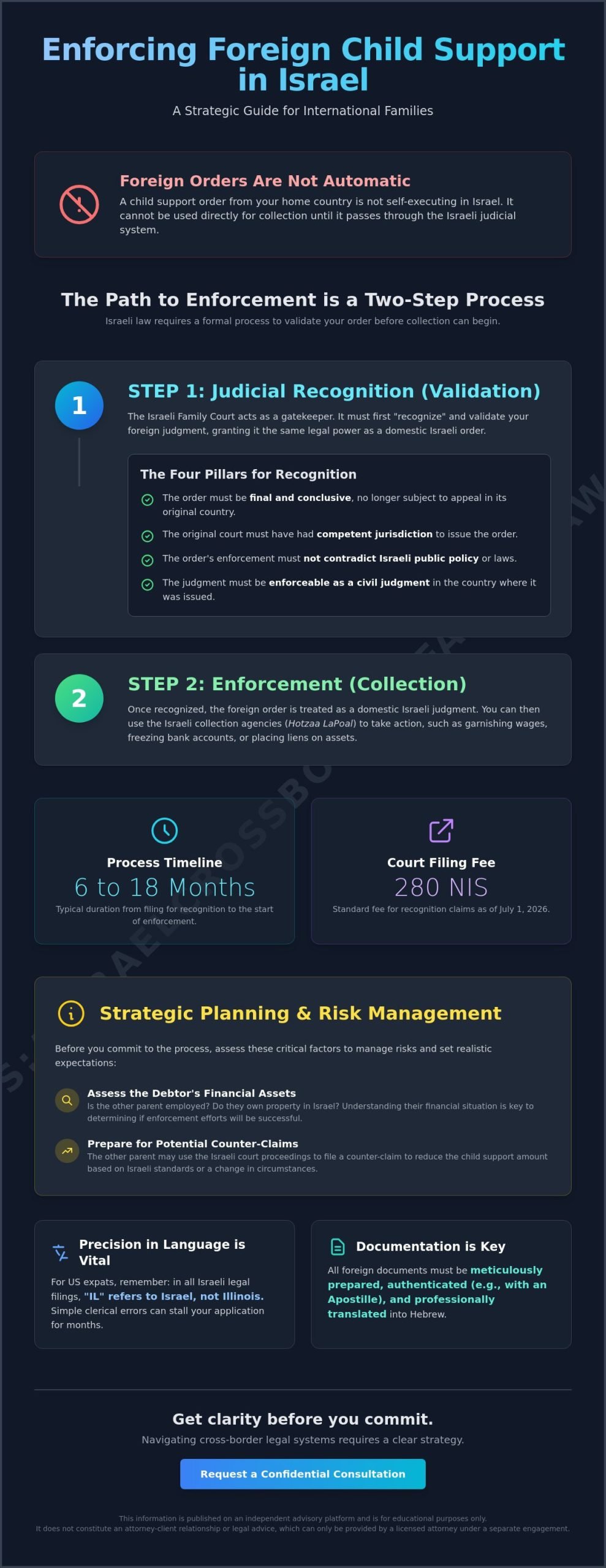
The process of enforcing foreign child support order in Israel begins with a petition for recognition. This validation phase is handled by the Israeli Family Court, which acts as a gatekeeper. The court ensures that the foreign order meets specific legal standards before it is granted the same status as a domestic ruling. Seeking clarity on these requirements before you commit to litigation can prevent costly delays and administrative rejections. As of July 1, 2026, the court filing fee for these claims is set at 280 NIS, reflecting a standardized approach to international support matters.
To better understand the mechanics of this process, watch this helpful video:
The Role of the Foreign Judgments Law (1958)
The primary piece of legislation governing this process is the Recognition of Foreign Judgments Law (1958). Under this framework, an Israeli court must declare a judgment enforceable before any administrative action can be taken. The court evaluates whether the original judgment was given by a court with competent jurisdiction and if it respects Israeli public policy. For many cases, the Hague Convention on the International Recovery of Child Support provides a streamlined path for member states. However, the 1958 Law remains the fallback for countries without reciprocal treaties. It also manages the distinction between civil support and matters that might fall under religious jurisdiction, ensuring the secular Family Court remains the primary venue for these international claims. This legal filter is designed to protect the integrity of the Israeli system while honoring international obligations.
Why “IL” Refers to Israel, Not Illinois
Precision in language is vital for cross-border filings. For US expats, remember that in this context, “IL” always refers to the State of Israel, not the state of Illinois. Jurisdictional terminology often carries different weights across borders. Clerical errors in identifying the correct sovereign entity or failing to properly translate “Family Court” into its Hebrew equivalent, Beit Mishpat Le’Inyaney Mishpacha, can stall your application for months. Documentation must be meticulously prepared, authenticated, and translated to reflect the specific requirements of the Israeli system. Understanding these cultural and systemic differences early on helps in building a realistic strategy for child support cross-border enforcement. Early decisions regarding how you present your foreign order will dictate the speed of the recognition process, which typically takes between 6 to 18 months.
This article is published on an independent advisory platform and does not constitute an attorney-client relationship. The information provided is for educational purposes and does not replace specific legal counsel from a licensed attorney.
Legal Requirements for Recognition: The Four Pillars
To succeed in enforcing foreign child support order in Israel, your judgment must pass a rigorous four-part test established by Israeli law. The Israeli Family Court does not simply rubber-stamp external rulings; it validates them against domestic standards to ensure they are compatible with the local legal environment. These pillars act as the foundation for any successful domestication petition.
The first requirement is competent jurisdiction. The court that issued the order must have had the legal authority to do so under its own laws and in a way that Israel recognizes. Second, the order must be “final”. This means it is no longer subject to appeal in its home country. Third, there must be reciprocity; Israel generally recognizes orders from nations that would, in turn, recognize an Israeli support order. Finally, the judgment must not contradict Israeli “Public Policy” or fundamental rights. This includes ensuring the support amount isn’t so excessive it violates basic fairness or so low it fails to meet the child’s essential needs. Understanding these cross-border complexities is the first step toward achieving strategic clarity.
The Finality and Competency Tests
Proving finality is often the most technical hurdle. While Israeli courts prioritize the child’s welfare, they are hesitant to domesticate temporary or interim orders that could be modified next month in London or New York. A key component of competency is verifying that the defendant was given a fair opportunity to be heard. In many US cases, “Default Judgments” occur when a parent fails to appear. While these are enforceable in Israel, you must provide documented proof that the parent was properly served and chose not to participate. This is where a strategic approach to cross-border enforcement becomes essential to avoid administrative rejection.
The Reciprocity Principle for US-Israel Cases
For American expats, reciprocity is anchored in a 2009 Memorandum of Understanding (MOU) between the United States and Israel. This agreement establishes a reciprocal framework for the recovery of maintenance between the two nations. Even though child support is managed at the state level in the US, the Israeli Ministry of Justice typically views most US jurisdictions as meeting the reciprocity standard because of this federal-level agreement. The process of enforcing foreign child support order in Israel for US citizens is significantly aided by this long-standing legal cooperation. These protocols are further detailed in the Guide to Processing Cases with Israel, which serves as a vital resource for professionals managing these complex matters. If you are unsure if your specific state’s order qualifies, it is wise to request a confidential review of your situation before initiating formal proceedings.
This article is published on an independent advisory platform and does not constitute an attorney-client relationship. The information provided is for educational purposes and does not replace specific legal counsel from a licensed attorney.
Mechanisms of Enforcement: Hague Convention vs. Private Action
When you decide to proceed with enforcing foreign child support order in Israel, you must choose between two distinct legal paths: the administrative route via the Hague Convention or a private judicial action. Each method offers different levels of control, speed, and cost. Understanding these trade-offs is essential for parents who need a reliable timeline for financial support. While both paths aim for the same result, the experience of the process varies significantly depending on your specific jurisdictional needs and the debtor’s location. It’s a trade-off between cost and speed.
The choice often depends on whether you prefer a government-led process or a more hands-on, strategic approach. For families already dealing with the complexities of living abroad, clarity on these mechanisms helps manage expectations. For example, parents classified as expats or foreign nationals often find that their residency status influences which path is more efficient for their specific circumstances.
The Hague Convention Route
Israel is a signatory to the 2007 Hague Convention on the International Recovery of Child Support. Under this treaty, the Israeli Ministry of Justice serves as the Central Authority, coordinating directly with the corresponding agency in your home country. This is primarily a “no-cost” government-to-government service designed to assist parents in recovering maintenance across borders. It provides a formal structure for cooperation, which is particularly helpful when the debtor’s address is unknown.
However, this administrative route often involves significant communication gaps. Because you are relying on two separate government bureaucracies to exchange information, the process can be slow. Timelines are frequently unpredictable, and you have limited direct influence over the speed of the case. For a detailed overview of how these international protocols work between the U.S. and Israel, you can consult the U.S. government guide on child support enforcement in Israel. This resource explains the formal channels that government agencies use to process these claims.
Private Enforcement Strategy
In contrast, a private enforcement strategy involves filing a direct petition for recognition in the Israeli Family Court. This path allows for greater tactical control and typically yields faster results. By bypassing the administrative queues of the Central Authority, you can move directly to the judicial validation phase. This is often the preferred route for international families who require proactive management of their case and direct communication with their legal team. Enforcing foreign child support order in Israel through private action ensures that your specific priorities remain the focus of the proceedings.
While private action involves professional fees, many find the investment worthwhile for the time saved. Managing these costs is easier when you have access to pricing transparency, allowing you to budget for the 6 to 18-month timeframe typical of these cases. Private enforcement also allows for more aggressive discovery and collection efforts once the order is recognized. This provides a level of agility that government agencies often cannot match. This approach is particularly effective when the debtor has known assets or income sources within Israel.
This article is published on an independent advisory platform and does not constitute an attorney-client relationship. The information provided is for educational purposes and does not replace specific legal counsel from a licensed attorney.
The Step-by-Step Enforcement Process in Israel
Successfully enforcing foreign child support order in Israel requires a clear understanding of the transition from a judicial ruling to administrative collection. Many parents mistakenly believe that obtaining a court judgment is the final step. In reality, the process is divided into two distinct phases: the Recognition Phase and the Execution Phase. The first phase takes place in the Family Court to validate the order, while the second phase moves to the Enforcement and Collection Authority to actually recover the funds. This distinction is critical for managing your timeline and expectations.
The journey typically follows five structured steps:
- Step 1: Preparation. Gather authenticated court documents and obtain professional Hebrew translations.
- Step 2: Filing. Submit a Petition for Recognition in the Israeli Family Court. As of mid-2026, the standard filing fee for this application is 280 NIS.
- Step 3: Judicial Declaration. Attend a hearing where the judge issues a “Declaration of Enforceability,” effectively domesticating the foreign order.
- Step 4: Activation. Open a formal execution file at the Hotza’a Le-Poal (Execution Office) using the domesticated judgment.
- Step 5: Collection. Utilize administrative tools to secure payment, including wage garnishments or bank account liens.
This entire progression generally takes between 6 to 18 months to complete. Because early procedural choices impact the eventual success of collection, it is vital to discuss your specific enforcement goals before filing your initial petition.
Navigating the Hotza’a Le-Poal (Execution Office)
Once the Family Court domesticates your order, the Hotza’a Le-Poal becomes your primary point of contact for collection. This administrative body possesses significant power to compel payment from a debtor residing in Israel. They can garnish monthly wages directly from an employer or freeze liquid assets in Israeli bank accounts. One of the most effective measures is the “Stay of Exit” order. This prevents the debtor from leaving the country until the debt is settled or a sufficient guarantee is provided. These measures ensure that the support remains a priority even if the debtor is uncooperative.
Authentication and Translation Requirements
The Israeli legal system is strict regarding the format of foreign evidence. To be accepted, your original court documents must carry an Apostille, which is an international certification of authenticity. Furthermore, every document must be accompanied by a notarized Hebrew translation. Many international families face significant systemic delays because of minor clerical errors or unofficial translations. Ensuring your paperwork is meticulously prepared before submission is the best way to avoid having your case returned for corrections. This technical precision is the bedrock of a successful strategy for child support cross-border enforcement.
This article is published on an independent advisory platform and does not constitute an attorney-client relationship. The information provided is for educational purposes and does not replace specific legal counsel from a licensed attorney.
Strategic Planning and Risk Management
Before initiating the process of enforcing foreign child support order in Israel, a thorough assessment of the debtor’s “collectability” is essential. Legal victories in the Family Court are only valuable if they result in actual financial recovery. Because the cost of living in Israel is estimated to be 30 to 40 percent higher than in the United States, understanding the debtor’s local financial footprint is a critical first step. You must determine if the individual has garnishable wages, real estate, or liquid assets within the jurisdiction. Without this strategic clarity, you risk investing time and resources into a domestication process that may yield limited practical results.
Another factor to consider is the potential for a “counter-claim”. When you petition to recognize a foreign order, you bring the matter into the Israeli judicial sphere. This occasionally prompts the debtor to file for a reduction of support based on Israeli legal standards or a “material change in circumstances”. While the threshold for modification is high, the risk exists and should be factored into your decision-making framework. Seeking a confidential case review allows you to weigh these risks against the potential benefits of enforcement before you commit to a specific path.
Can the Israeli Court Lower the Support Amount?
There is a specific risk that the Israeli court may “re-open” support calculations if the debtor can prove that local laws should apply. Since the landmark 2017 Supreme Court ruling (HCJ 919/15), the Israeli legal landscape has moved toward shared financial responsibility for children aged 6 to 18. If the parents share physical custody in Israel and have similar income levels, the court might apply a gender-neutral formula that differs significantly from the original foreign order. Protecting your original judgment requires a filing strategy that emphasizes the finality of the foreign ruling and the specific protections of the 1958 Recognition Law. Understanding how these local precedents interact with international orders is vital for maintaining the financial stability you’ve already secured abroad.
Seeking Clarity Before Commitment
Engaging in cross-border litigation is a significant commitment that requires a clear roadmap. A strategy call is often the most efficient way to distinguish between general advisory information and formal legal representation. This distinction ensures you understand the systemic differences of the Israeli landscape without the pressure of immediate litigation. For those unfamiliar with the local system, educational resources can provide a helpful foundation. You can find more information on the nuances of this process by visiting the advisory’s YouTube channel, Enforcing Support Orders. These resources are designed to guide international families toward informed choices regarding their global legal obligations. Get clarity before you commit. Request a confidential consultation.
Securing Financial Stability in the Israeli System
This article is published on an independent advisory platform and does not constitute an attorney-client relationship. The information provided is for educational purposes and does not replace specific legal counsel from a licensed attorney.
Successfully enforcing foreign child support order in Israel requires more than just administrative filing; it demands a sophisticated understanding of how the 1958 Foreign Judgments Law interacts with the practical powers of the Execution Office. By prioritizing technical precision in your documentation and assessing the debtor’s local assets early, you can navigate the 6 to 18-month enforcement timeline with confidence. You now have a roadmap that distinguishes between judicial recognition and administrative collection, ensuring you aren’t caught off guard by systemic differences.
While the Hague Convention offers a standard route, private action often provides the strategic control needed to manage complex international cases effectively. This authoritative advisory platform focuses specifically on the nuances of Anglo-Israeli family law, helping you bridge the gap between divergent legal cultures. Early decisions regarding your filing strategy will dictate your success in the Family Court and beyond. Get clarity before you commit. Request a confidential consultation to discuss your specific cross-border needs. Taking the right steps now ensures a more predictable path for your family’s financial future.
This article is published on an independent advisory platform and does not constitute an attorney-client relationship. The information provided is for educational purposes and does not replace specific legal counsel from a licensed attorney.
Frequently Asked Questions
Is a US child support order automatically valid in Israel?
No, a US child support order isn’t automatically valid or enforceable in the Israeli system. It must first undergo a formal domestication process under the Recognition of Foreign Judgments Law (1958). The process of enforcing foreign child support order in Israel requires a judicial declaration from an Israeli Family Court to make the order legally binding and collectible within IL borders.
How long does it take to recognize a foreign judgment in the Israeli Family Court?
The timeframe for recognition and enforcement typically ranges from 6 to 18 months. This duration depends on several factors, including whether the debtor contests the petition and whether you choose a private legal action or the administrative Hague Convention route. Accurate documentation and specialized strategy can help manage these timelines more predictably.
Can I prevent the other parent from leaving Israel if they owe child support?
Yes, you can request a “Stay of Exit” order once the foreign judgment is domesticated. This is a powerful tool used by the Israeli Execution Office to prevent a debtor from departing the country until the debt is settled or sufficient financial guarantees are provided. It’s often one of the most effective ways to ensure compliance from a parent residing in IL.
Do I need to travel to Israel to enforce my child support order?
You generally don’t need to be physically present in Israel to initiate or complete the enforcement process. Most procedural steps, including the filing of the petition and judicial hearings, can be managed by your legal representative. This allows international families to seek financial recovery without the added expense and logistical burden of international travel.
What is the “Hotza’a Le-Poal” and how does it help with collection?
The Hotza’a Le-Poal is the Israeli Enforcement and Collection Authority, which acts as the administrative arm for recovering debt. Once the Family Court recognizes your order, this body has the power to garnish wages, freeze bank accounts, and seize assets. It’s the primary mechanism for enforcing foreign child support order in Israel after the judicial validation phase is complete.
Will the Israeli court change the amount of support ordered by the US court?
The court won’t typically change the amount unless a party proves a “Material Change in Circumstances” has occurred since the original order. However, you should be aware that the debtor may attempt to apply local precedents, such as the 2017 shared responsibility ruling (HCJ 919/15), which could impact calculations. Minimum essential needs in Israel are currently verified between ₪1,400 and ₪1,600 per month per child.
What documents do I need to start the enforcement process in Israel?
You’ll need a certified copy of the original foreign court order with an Apostille and a notarized Hebrew translation. Additionally, you must provide proof that the order is final and no longer subject to appeal in its home jurisdiction. Early documentation errors are a primary cause of systemic delays, so ensuring these files are meticulously prepared is essential.
Can I enforce a foreign order if the other parent is not an Israeli citizen?
Yes, citizenship status doesn’t determine the court’s ability to enforce an order. If the debtor parent is a resident of Israel or holds garnishable assets within the country, the Israeli legal system has jurisdiction to domesticate and execute the foreign support order. The focus of the court is on the child’s right to support and the presence of assets within the IL jurisdiction.

Article by
Gabriel Lior
A Personal Journey That Became a Mission
The advisory was founded by an American father Gabriel Lior, LLB, MBA , global entrepreneur, and cross-border advisor who spent more than a decade navigating the Israeli family court system firsthand and now lives in Singapore with his son.
As a divorced parent in a cross-border family, Gabriel faced nearly every legal challenge a foreign parent can encounter in Israel — including child custody disputes, child support proceedings, property matters in Israel and abroad, false accusations, and complex immigration and relocation proceedings.
Over the years, he learned the hard way how difficult it is for non-Israeli parents to understand the system, identify the right legal strategy, and choose the right legal representation — especially when language, culture, and jurisdictional differences are involved. He also witnessed how foreign parents and new immigrants are often disadvantaged or taken advantage of by service providers and institutions simply because they lack local knowledge or fluency.
From Client to Advisor
To truly understand — and survive — the system, Gabriel pursued formal legal education in Israel, completing two Israeli law degrees, alongside a BA and MBA earned in the United States. This was never about becoming a practicing attorney, but about gaining a deep, structural understanding of how the system works — and where it breaks down for foreign parents.
This rare combination of:
Firsthand client experience
Israeli legal and US business education
International business and negotiation training
Decades of commercial execution
created a unique perspective – one that understands both sides of the table.
After years of litigation, persistence, and at times self-representation, he ultimately succeeded in securing custody of his son and relocating abroad through a rare legal victory in the Israeli Supreme Court — becoming one of the first fathers in Israel to do so under these circumstances.
Disclaimer
Important Disclaimer:
The information provided on this website and in its content is for general informational and educational purposes only and does not constitute legal advice, legal opinion, or legal representation.
Gabriel Lior is not licensed to practice law in Israel (nor is he interested in doing so) and does not provide legal services, despite having completed 2 Law Degrees. The services offered are advisory in nature and are intended to provide general guidance, strategic insight, and information regarding cross-border family law considerations.
No attorney-client relationship is formed by accessing this website, reading its content, or communicating with us.
Any decisions made based on this information are at your own discretion and risk. For legal advice specific to your situation, you should consult a licensed attorney in the relevant jurisdiction.
Where appropriate, we may refer clients to independent, licensed attorneys or professionals. Such referrals do not constitute legal representation and no liability is assumed for services provided by third parties.