This article is published on an independent advisory platform and is not a law firm. The information provided is for informational and advisory purposes only and does not constitute legal representation or an attorney-client relationship. Legal services are only provided by licensed attorneys under a separate engagement.
The most expensive part of an international divorce in Israel isn’t usually the lawyer’s hourly rate; it’s the cost of a poorly chosen legal strategy. When you begin researching the Israel Family Lawyer Price, you’ll quickly realize that the market doesn’t follow a single, standardized rulebook. For families with assets or ties in multiple countries, the financial stakes are often higher due to the unique jurisdictional overlaps between Israeli and foreign courts.
We understand the fear of hidden legal costs and the confusion that arises when comparing Israeli Bar Association recommendations with actual market rates. You deserve a clear, transparent framework for evaluating how legal professionals structure their fees. This guide explains the differences between hourly and flat-fee arrangements and offers strategies to manage costs in complex cross-border disputes. You’ll gain the clarity needed to make informed decisions before committing to a legal path.
Key Takeaways
- Distinguish between the Israeli Bar Association’s recommended minimum fees and the market rates typically charged by experienced private attorneys.
- Learn how to navigate common billing models and the critical role of a written fee agreement in protecting your financial interests.
- Understand the factors that influence the Israel Family Lawyer Price, especially the “complexity premium” required for multi-jurisdictional cases involving US and IL law.
- Explore how the mandatory mediation process in Israel serves as a strategic tool to manage costs and avoid the expenses of prolonged litigation.
- Discover the benefits of seeking a strategic case review to gain clarity on your situation before committing to a long-term legal engagement.
The Baseline: How Legal Fees are Regulated in Israel
Understanding the Israel Family Lawyer Price requires a shift in perspective for those used to the legal systems in the US or the UK. In Israel, legal fees aren’t strictly capped by government legislation. Instead, the cost of representation is shaped by a combination of professional guidelines and competitive market forces. This flexibility allows for a wide range of pricing. It’s often unsettling for families who need predictable costs during a stressful life transition.
To better understand how these costs are structured and what you might expect when hiring a professional, watch this helpful video:
The Role of the Israeli Bar Association
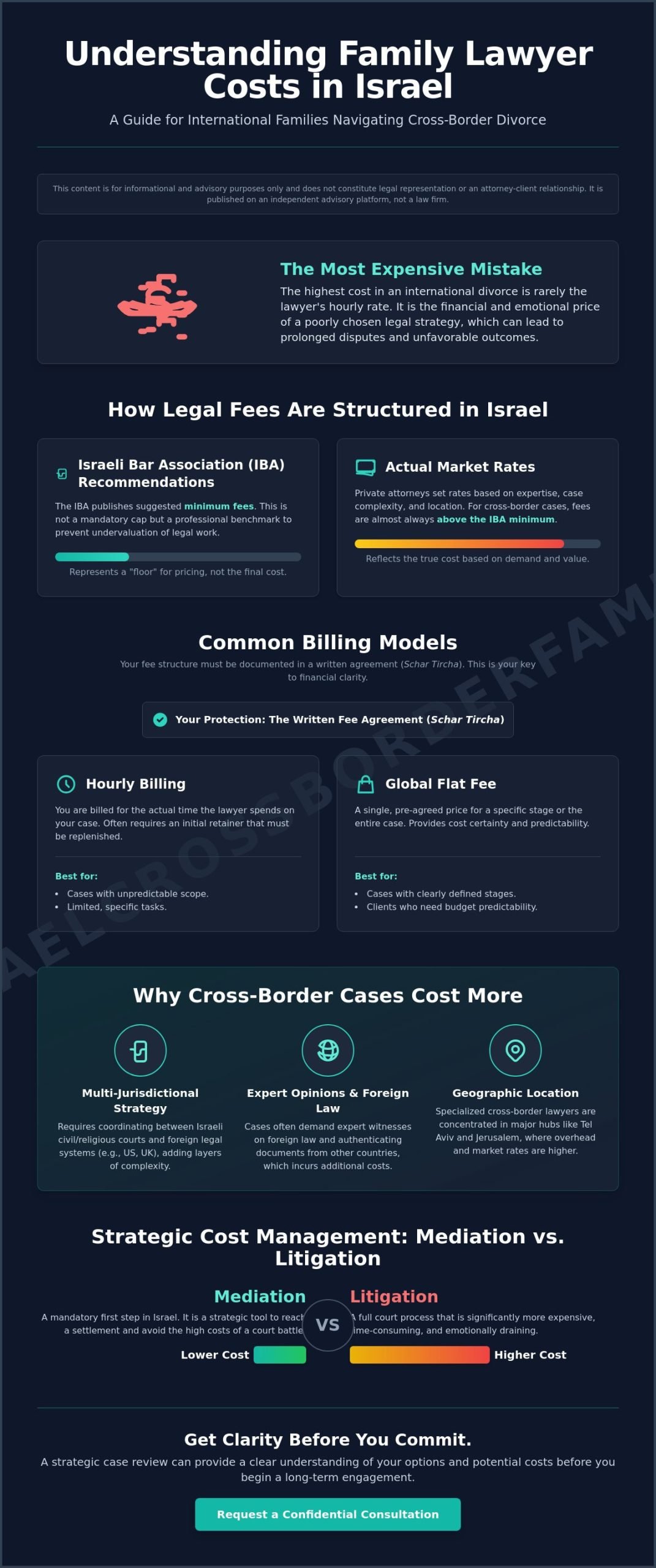
The Israeli Bar Association (IBA) publishes a list of suggested minimum fees for various legal services. This list acts as a professional benchmark. It ensures that practitioners don’t devalue legal work to the point where quality is compromised. Think of it as a “floor” for pricing. It isn’t a mandatory cap. Private attorneys are free to set their rates based on their expertise, the complexity of the case, and the specific needs of the client.
For international families, these IBA minimums are rarely a realistic reflection of the work required. Cases involving assets in multiple countries or disputes over international relocation require specialized knowledge. When you’re dealing with the Judiciary of Israel, which includes both civil family courts and religious rabbinical courts, the strategic complexity increases. This complexity often justifies a price point above the basic recommendations found in the IBA schedule.
Market Forces and Geographic Variations
Geographic location significantly impacts the market price for legal services within IL. It’s a primary driver of the total Israel Family Lawyer Price you’ll encounter. Firms located in major commercial centers like Tel Aviv or Jerusalem typically have higher overhead costs. These hub cities are where you’ll find the highest concentration of lawyers who specialize in English-speaking clients and cross-border litigation. These practitioners bridge the gap between different legal cultures, which is a vital service for expats.
Choosing a lawyer based solely on the lowest quote is a risky strategy. In cross-border family law, the cheapest option often lacks the necessary experience to handle foreign document authentication or expert opinions on foreign law. An error in these areas can lead to significant financial loss, far outweighing any initial savings on legal fees. You can find more details on how these factors influence overall costs on our pricing page.
The IL legal landscape also differs from the US in how it approaches retainers and billing cycles. Many US firms rely heavily on high hourly retainers that must be replenished frequently. Israeli practitioners often offer more varied structures, including global flat fees for specific milestones. Gaining clarity on these differences early in the process helps you manage your budget and avoid the “bill shock” that often accompanies international litigation.
Common Billing Models for Family Law in Israel
The Israel Family Lawyer Price is often determined by the specific billing model you choose at the start of your engagement. In Israel, legal fee structures are flexible, but they must be documented in a written agreement known as a Schar Tircha. This contract is your primary protection against financial uncertainty. It outlines exactly what services are included, how you’ll be billed, and the circumstances under which fees might change. Without this written clarity, families often find themselves facing unexpected costs during an already stressful period.
Beyond the lawyer’s professional fees, you should account for external costs that are standard in the Israeli system. These include court filing fees, known as Agrot, and the cost of certified translations or notarizations. In the Israeli Family Courts, these administrative expenses are mandatory and separate from your attorney’s bill. For international families, translation costs can be significant. Foreign marriage certificates, bank statements, or prenuptial agreements must be professionally translated into Hebrew to be admissible as evidence.
Hourly Rates vs. Global (Flat) Fees
Hourly billing is common for complex cases where the total amount of work is difficult to predict. This model is often used during intense negotiations or detailed legal research involving the laws of multiple countries. While it offers flexibility, it can lead to higher total costs if a dispute becomes protracted. Many practitioners who specialize in cross-border matters charge higher hourly rates due to their specialized knowledge of both Israeli and foreign legal systems.
Many international clients prefer a global or flat fee structure for its predictability. This model provides cost certainty for defined tasks, such as drafting a will, a prenuptial agreement, or a mutual divorce settlement. It’s an attractive option for those who want to avoid the unpredictability of the billable hour. You can review more about these structures on our pricing overview to see which might fit your needs.
The Retainer and Step-by-Step Billing
A retainer in the Israeli system usually acts as a down payment against future work. Israeli lawyers often use a “phased” billing approach rather than a single massive upfront payment. This means you pay for specific stages of your case as they occur. For example, you might pay one fee for the initial filing and another for the evidentiary hearings. This model helps manage your cash flow and ensures you aren’t paying for trial preparation that may never happen if you reach a settlement early.
Clear milestones in your Schar Tircha protect you from unexpected bills. They allow for strategic pauses or exits if the case resolves sooner than expected. If you’re unsure which billing model is most appropriate for your cross-border situation, you can reach out for a brief clarification. Understanding these financial structures is the first step toward maintaining control over your legal journey in Israel.
This article is published on an independent advisory platform and is not a law firm. The information provided is for informational and advisory purposes only and does not constitute legal representation or an attorney-client relationship. Legal services are only provided by licensed attorneys under a separate engagement.
Why Cross-Border Cases Command Different Pricing
International families often notice a gap between the standard rates they see online and the quotes they receive for their specific situation. This difference is largely due to the “Complexity Premium.” When a case involves both the United States and Israel, your legal team isn’t just managing a local dispute. They’re navigating two distinct legal cultures, languages, and procedural requirements. This multi-layered approach is the primary driver of the Israel Family Lawyer Price for expats and foreign nationals who require a high level of technical expertise.
Bilingual representation is an investment in risk mitigation. A lawyer who understands the nuances of English legal terminology and Hebrew court procedures can prevent costly misunderstandings that lead to long-term financial damage. These professional standards are reinforced by Israel Bar Association regulations, which emphasize the importance of clear, written fee agreements before substantive work begins. By investing in a team that understands both systems, you reduce the risk of a judgment that’s unenforceable in your home country.
Multi-Jurisdictional Legal Research
A significant portion of the work involves analyzing how an IL court ruling might impact assets held in the US. For instance, a divorce decree issued in Israel must be carefully drafted to ensure it’s enforceable in a US state court. This often requires the coordination of “mirror orders,” which are twin legal documents that satisfy the requirements of both jurisdictions. Because Israel uses a unique split between civil family courts and religious rabbinical courts, the strategy must account for how each system views international assets. This level of cross-border coordination prevents future litigation, but it requires more billable hours than a standard domestic filing. You can learn more about these complexities in our guide for expats and foreign nationals.
Translation and Foreign Evidence
The administrative hurdles in these cases add to the overall billable time. Every document from abroad, such as a US prenuptial agreement or bank statements, must undergo notarized translation. You also need an Apostille, which is an international certification that makes a document valid in Israel. In many instances, the court requires an expert opinion on foreign law. This involves hiring a specialist to testify in the Israeli court about how US state laws apply to your specific marriage or property. These experts are an additional cost, but they’re essential for ensuring the Israeli judge has the correct context for your case. Managing these foreign elements requires a lawyer who is experienced in divorce for international families.
This article is published on an independent advisory platform and is not a law firm. The information provided is for informational and advisory purposes only and does not constitute legal representation or an attorney-client relationship. Legal services are only provided by licensed attorneys under a separate engagement.
Strategic Cost Management: Mediation vs. Litigation
The most effective way to control the Israel Family Lawyer Price is through early strategic intervention. In Israel, the law mandates an initial “Settlement of Dispute” process known as Mahut. This involves several meetings with court-appointed social workers to explore mediation before any litigation can proceed. These mandatory sessions are designed to lower the temperature of the conflict and reduce the burden on the court system. For international families, this stage is a critical opportunity to resolve jurisdictional questions before they turn into expensive legal battles.
The financial toll of a “Race to Jurisdiction” can be immense. This occurs when one spouse files in the US and the other in Israel, leading to parallel proceedings. You end up paying for two sets of lawyers, two sets of court fees, and the added stress of conflicting rulings. An advisory-first approach focuses on making a calculated decision about where to file. This early clarity prevents the reactive litigation that often doubles or triples legal expenses. You can learn more about managing these transitions in our guide on Divorce & Separation for International Families.
The Financial Impact of Mediation
Professional mediators in Israel charge for their time, but their fees are typically shared between the parties. This is significantly more cost-effective than hiring two separate litigating lawyers for a full courtroom battle. A successful mediation can save you tens of thousands in court fees and the high costs of expert witnesses. However, it’s vital to ensure your mediator understands the cross-border implications of your agreement. A poorly drafted settlement that isn’t enforceable in the US can lead to even higher costs later. We recommend seeking clarity on fee structures before starting the mediation process.
The Hidden Costs of Litigation
Litigation in Israel involves several expenses that go beyond your lawyer’s hourly rate. The court often appoints its own experts, such as child psychologists or real estate appraisers, and the parties are usually required to split these fees. There is also the risk of “Costs Orders.” In the Israeli system, the judge has the authority to order the losing party to pay a portion of the other side’s legal fees. This makes the financial risk of an aggressive courtroom strategy much higher than in many US jurisdictions. If you are facing a potential courtroom dispute, you can request a confidential consultation to evaluate your risks and options. Early strategic decisions are the biggest factor in your long-term cost control.
This article is published on an independent advisory platform and is not a law firm. The information provided is for informational and advisory purposes only and does not constitute legal representation or an attorney-client relationship. Legal services are only provided by licensed attorneys under a separate engagement.
Beyond the Billable Hour: Seeking Strategic Clarity
When evaluating the Israel Family Lawyer Price, it is easy to focus solely on the bottom line of a retainer. However, for international families, the real value lies in strategic guidance that precedes formal representation. Many families find themselves rushing into a full legal engagement before they fully understand the systemic differences of the Israeli landscape. Choosing an advisory model allows you to gain a high-level view of your risks and opportunities without the immediate pressure of a long-term commitment. This approach prioritizes informed decision-making over reactive litigation.
The Israeli legal system requires a specific cultural and systemic fluency. For an expat or foreign national, the way a judge in a civil family court views assets might differ significantly from a US court’s perspective. Understanding these nuances before you sign a contract is essential. It ensures that your resources are allocated toward a strategy that actually achieves your long-term goals rather than simply paying for administrative motions.
Choosing Strategy Over Representation
A one-time Confidential Case Review can often prevent a multi-year legal battle. During this stage, the focus is entirely on risk assessment and identifying the most efficient path forward. It provides a roadmap that helps you determine if you even need a full-scale litigator or if a more collaborative approach is possible. By separating the advisory phase from the representation phase, you maintain control over your budget and your future. This method ensures that when you do move forward, you are doing so with a clear understanding of the potential costs and outcomes.
Final Checklist for Evaluating Legal Fees
Before you commit to a specific firm or attorney, use this checklist to ensure complete pricing transparency. Israeli law requires certain disclosures, but you should be proactive in asking for details. You can also review our pricing philosophy to see how we frame these considerations for international clients.
- VAT (Ma’am): Does the quoted fee include the mandatory 17% Value Added Tax? In Israel, prices are often quoted without VAT, which can lead to a significant surprise on your first invoice.
- Out-of-Pocket Expenses: Are administrative costs like travel, international courier fees for Apostilles, and court filing fees clearly defined and capped?
- Bilingual Surcharge: Does the firm charge extra for drafting documents in both Hebrew and English, or is this included in the base rate?
- Success Fees: While rare in pure family law litigation, ensure your agreement clearly states that there are no hidden “success” or “result” fees that haven’t been discussed.
Managing your legal journey in Israel starts with seeking clarity before you commit. If you need assistance navigating these strategic choices, you are welcome to reach out for an advisory call or a brief WhatsApp message to discuss your situation.
Get clarity before you commit. Request a confidential consultation.
Securing Clarity in Your International Legal Journey
Navigating the financial aspects of family law in Israel requires more than just comparing hourly rates. The total Israel Family Lawyer Price is ultimately a reflection of the strategic path you choose at the beginning of your journey. By prioritizing mediation and seeking a comprehensive case review, you can mitigate the risks of parallel proceedings and conflicting court orders. Our expertise in multi-jurisdictional US-Israel family law allows us to offer a calm, advisory-first approach focused on long-term risk management.
Clear fee agreements and a deep cross-cultural understanding are the foundations of a successful legal strategy. Licensed practitioners who understand both systems can help you avoid the hidden costs of administrative errors and unenforceable judgments. You deserve a partner who values transparency and strategic foresight over aggressive litigation. Making informed choices today protects your financial stability and your family’s future in the years ahead.
Get clarity before you commit. Request a confidential consultation to get clarity on your case. You have the power to protect your interests through deliberate, well-researched action.
This article is published on an independent advisory platform and is not a law firm. The information provided is for informational and advisory purposes only and does not constitute legal representation or an attorney-client relationship. Legal services are only provided by licensed attorneys under a separate engagement.
Frequently Asked Questions
Is the first consultation with an Israeli family lawyer usually free?
Most experienced family lawyers in Israel charge a professional fee for the initial consultation. This session is designed to be a substantive strategy meeting rather than a simple introductory call. It provides an opportunity to review the jurisdictional risks of your case and identify the most efficient legal path forward. Paying for this time ensures you receive focused, high-level guidance tailored to your specific cross-border situation.
What is the “Israeli Bar Association Minimum Fee” and does it apply to me?
The Israeli Bar Association publishes a recommended minimum fee schedule that serves as a professional baseline for legal services within IL. These rates are recommendations designed to prevent the devaluation of legal work, but they are not mandatory caps for private attorneys. Most practitioners who specialize in complex international matters charge rates that reflect their specialized expertise and the multi-jurisdictional nature of the work.
How much are the court filing fees (Agrot) for a divorce in Israel?
As of January 2026, the mandatory filing fee for the initial “Settlement of Dispute” application is 119 NIS. Opening a standard divorce file in the Family Court generally costs 568 NIS, while filing a specific claim for child custody is 417 NIS. These administrative costs are separate from the Israel Family Lawyer Price and must be paid directly to the court system at the time of filing.
Can I recover my legal fees if I win my family law case in Israel?
You may be able to recover a portion of your expenses if the judge issues a “Costs Order” in your favor. Unlike some jurisdictions where each party always pays their own way, Israeli judges have the discretion to order the losing party to contribute to the winner’s legal costs. However, these court-ordered awards are often based on standard scales and rarely cover the total cost of private representation.
Do Israeli family lawyers charge more for English-speaking services?
While there is rarely a specific “English-speaking surcharge,” the Israel Family Lawyer Price often reflects the specialized skills required for bilingual representation. Practitioners who can navigate both the Hebrew-speaking court system and the English-speaking needs of international families typically operate in major commercial hubs like Tel Aviv. These lawyers provide essential risk mitigation by ensuring all documents and strategies translate accurately across different legal cultures.
What happens if I cannot afford to pay my lawyer mid-way through the case?
If a client cannot meet their financial obligations, the lawyer may seek the court’s permission to withdraw from the representation. It’s critical to maintain open communication regarding your budget and to review your fee agreement for clauses related to payment delays. Utilizing a phased billing approach or clear milestones can help you manage your cash flow and prevent sudden interruptions in your legal strategy.
Are there hidden costs in US-Israel cross-border child custody cases?
Cross-border custody disputes often involve administrative expenses that are not always apparent at the start. You should account for the cost of Apostille certifications, notarized translations of foreign evidence, and potential fees for expert witnesses who can testify on US law. These requirements are essential for making foreign documents admissible in Israeli courts, but they do add to the overall billable time and project budget.
How do I know if a flat fee or an hourly rate is better for my situation?
A flat fee is generally most appropriate for defined, non-adversarial tasks such as drafting a prenuptial agreement or a mutual divorce settlement. Hourly rates are often the standard for contested litigation where the total amount of work is difficult to predict. Choosing the right model depends on your need for cost certainty versus the flexibility required to handle an unpredictable courtroom battle.

Article by
Gabriel Lior
A Personal Journey That Became a Mission
The advisory was founded by an American father Gabriel Lior, LLB, MBA , global entrepreneur, and cross-border advisor who spent more than a decade navigating the Israeli family court system firsthand and now lives in Singapore with his son.
As a divorced parent in a cross-border family, Gabriel faced nearly every legal challenge a foreign parent can encounter in Israel — including child custody disputes, child support proceedings, property matters in Israel and abroad, false accusations, and complex immigration and relocation proceedings.
Over the years, he learned the hard way how difficult it is for non-Israeli parents to understand the system, identify the right legal strategy, and choose the right legal representation — especially when language, culture, and jurisdictional differences are involved. He also witnessed how foreign parents and new immigrants are often disadvantaged or taken advantage of by service providers and institutions simply because they lack local knowledge or fluency.
From Client to Advisor
To truly understand — and survive — the system, Gabriel pursued formal legal education in Israel, completing two Israeli law degrees, alongside a BA and MBA earned in the United States. This was never about becoming a practicing attorney, but about gaining a deep, structural understanding of how the system works — and where it breaks down for foreign parents.
This rare combination of:
Firsthand client experience
Israeli legal and US business education
International business and negotiation training
Decades of commercial execution
created a unique perspective – one that understands both sides of the table.
After years of litigation, persistence, and at times self-representation, he ultimately succeeded in securing custody of his son and relocating abroad through a rare legal victory in the Israeli Supreme Court — becoming one of the first fathers in Israel to do so under these circumstances.
Disclaimer
Important Disclaimer:
The information provided on this website and in its content is for general informational and educational purposes only and does not constitute legal advice, legal opinion, or legal representation.
Gabriel Lior is not licensed to practice law in Israel (nor is he interested in doing so) and does not provide legal services, despite having completed 2 Law Degrees. The services offered are advisory in nature and are intended to provide general guidance, strategic insight, and information regarding cross-border family law considerations.
No attorney-client relationship is formed by accessing this website, reading its content, or communicating with us.
Any decisions made based on this information are at your own discretion and risk. For legal advice specific to your situation, you should consult a licensed attorney in the relevant jurisdiction.
Where appropriate, we may refer clients to independent, licensed attorneys or professionals. Such referrals do not constitute legal representation and no liability is assumed for services provided by third parties.