What if the most significant factor in your divorce expenses isn’t the attorney’s seniority, but the specific court where your case begins? Many expats and international families feel overwhelmed when trying to estimate the divorce lawyer cost israel requires, especially when faced with a legal system that operates in a second language. It’s natural to worry that hidden fees or complex jurisdictional rules will lead to unpredictable costs. Gaining a clear understanding of the financial landscape is the first step toward regaining a sense of security during a difficult transition.
This guide provides a structured framework for understanding how legal fees are organized in Israel, specifically for those managing assets or family ties across multiple borders. You’ll learn the practical differences between hourly and flat-fee billing, and how the choice between Rabbinical and Family courts can impact your total expenditure. We’ll also explore how a strategic approach can help you maintain a predictable budget and minimize unnecessary costs. This information is published on an independent advisory platform to provide strategic guidance rather than formal legal representation.
Key Takeaways
- Understand the three primary billing structures used in Israel to determine which model offers the most financial predictability for your specific circumstances.
- Discover how coordinating with international counsel and tracking foreign assets influences the overall divorce lawyer cost israel expats face during cross-border proceedings.
- Learn why the “Race of Authorities” between Rabbinical and Family courts is a critical strategic decision that dictates the long-term complexity and cost of your case.
- Identify how the mandatory Mahut meetings and mediation can serve as a more cost-effective alternative to high-conflict litigation.
- Gain a list of specific transparency questions to ask during your initial consultation to help you avoid hidden fees in dual-jurisdiction cases.
The Landscape of Legal Fees in Israel: Structures and Standards
Understanding the financial requirements of a family law case in Israel requires looking beyond simple price tags. The legal market operates under specific structures that may differ significantly from what international clients expect in their home jurisdictions. When evaluating the divorce lawyer cost israel families should anticipate, it’s essential to recognize that fees are influenced by the Legal Framework of Divorce in Israel, which balances civil family courts with religious rabbinical courts. This dual system creates unique procedural demands that directly impact billing.
Experienced practitioners often structure their engagements to reflect the multi-jurisdictional complexity of expat cases. While the Israeli Bar Association (IBA) publishes a list of recommended minimum fees, these are merely guidelines. Most established attorneys set rates that align with their specialized expertise rather than these baseline recommendations. This is particularly true for those handling assets in multiple countries or complex custody arrangements. This content is published on an independent advisory platform to help you build a strategic framework before committing to a specific firm.
To better understand the financial landscape of these proceedings, watch this helpful video:
Common Billing Models in Israeli Family Law
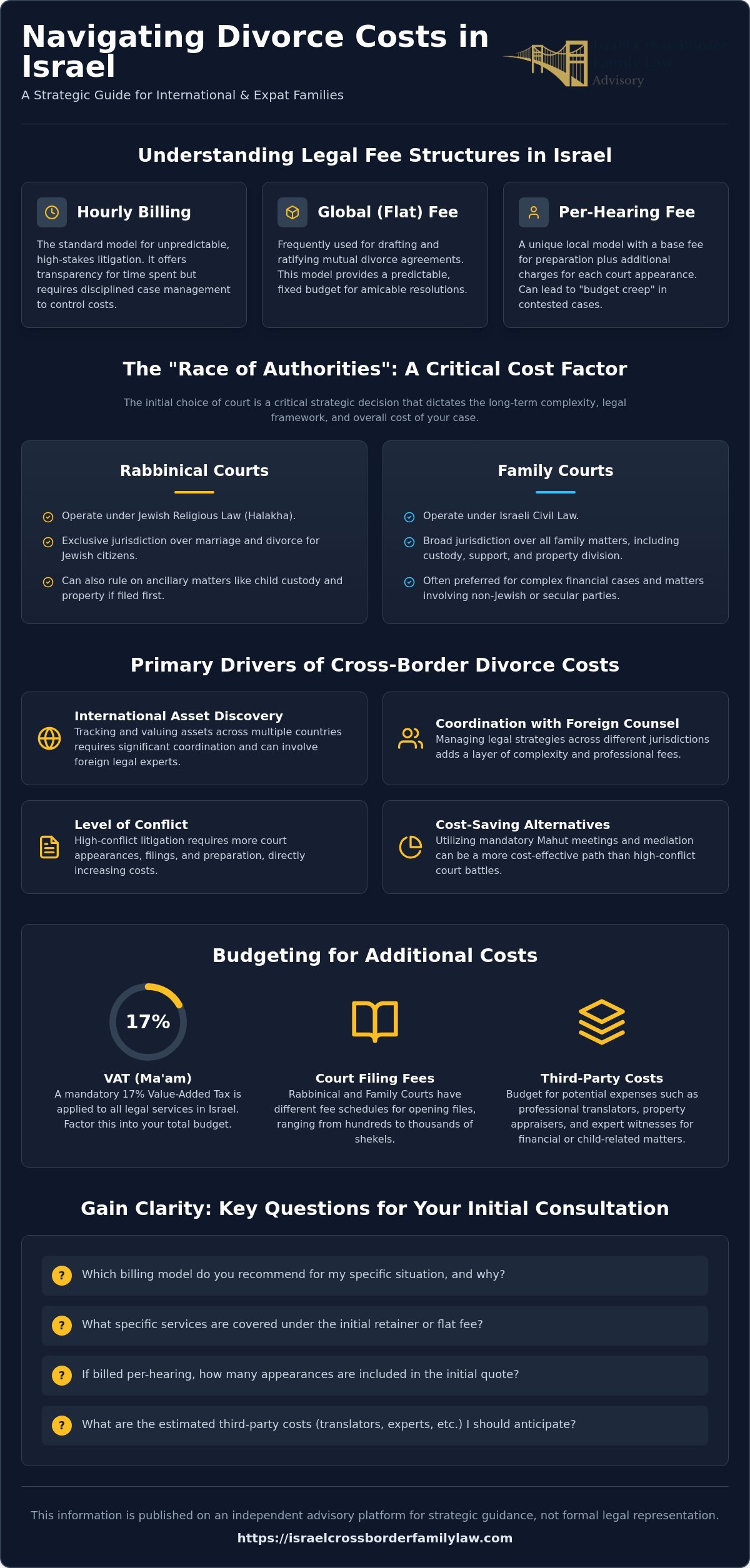
Hourly billing remains the standard for high-stakes litigation where timelines are unpredictable. This model offers transparency for every minute spent on your file, though it requires a disciplined approach to case management to avoid surprises. Global fees, or flat fees, are frequently applied to drafting and ratifying a mutual divorce agreement. This provides a predictable budget for families seeking an amicable resolution without the volatility of a courtroom battle.
The per-hearing model is a distinct feature of the local market. Under this structure, a base fee covers the initial filings and preparation, while additional charges apply for every physical court appearance. This can lead to budget creep if a case becomes highly contested and involves numerous sessions. It’s vital to clarify how many hearings are included in an initial quote to maintain financial control.
Value-Added Tax (VAT) and Third-Party Costs
In Israel, all legal services are subject to a 17% Value-Added Tax, known locally as Ma’am. This is a mandatory addition to the quoted fee and should be factored into your total budget calculations from the outset. Filing fees also vary between jurisdictions. The Rabbinical Court and the Family Court have different fee schedules for opening files, which can range from a few hundred to several thousand shekels depending on the nature of the claim.
Professional transparency is essential during the vetting process. For more information on how these variables are managed, you can review our pricing framework. Initial consultations in the specialist market are rarely free, as they involve a high-level strategic review of your cross-border situation. Paying for this early clarity often prevents costly mistakes later in the process. Seeking a clear understanding of your retainer is also crucial. In Israel, a retainer is often an upfront payment that secures the attorney’s availability and is applied against the total cost of the agreed-upon representation.
Factors Influencing Cross-Border Divorce Costs
The financial trajectory of a cross-border divorce is rarely determined by court fees alone. Instead, the complexity of the evidentiary requirements and the geographic distribution of marital assets dictate the final investment. When calculating the divorce lawyer cost israel families must consider, one must account for the high level of coordination required between legal systems. This information is provided by an independent advisory platform to assist in strategic planning; formal legal representation is only established through a separate engagement with a licensed attorney.
The Financial Weight of International Discovery
Tracing foreign assets introduces significant procedural hurdles that go beyond standard local filings. For expats with interests in the United States, identifying the current and future value of 401(k) plans, IRAs, or restricted stock units (RSUs) requires specialized actuarial reports. These reports are essential because Israeli courts must understand how to balance these assets against local holdings. While Official Family Court Fees are relatively transparent, the cost of obtaining international evidence is more variable.
Forensic accountants often play a critical role in cross-border business valuations, especially when one spouse holds ownership in a foreign entity. Beyond expert analysis, the legal process of “Letters Rogatory” or international subpoenas adds layers of administrative work. These formal requests from an Israeli court to a foreign judicial authority are time consuming and require precise drafting to be enforceable. Managing these moving parts across time zones naturally increases the hours dedicated to a case, emphasizing the need for a well structured budget from the outset.
Language and Cultural Translation Costs
The Israeli judicial system operates exclusively in Hebrew, meaning every piece of English language evidence must be translated and certified. This includes bank statements, text messages, emails, and employment contracts. For international families, the sheer volume of documentation can make translation a significant line item in the overall budget. Engaging a practitioner with a deep understanding of the needs of expats and foreign nationals can provide a strategic advantage in this area.
Hiring a bilingual lawyer often results in long term savings because it eliminates the need for “translation as a service” during the strategic phases of the case. However, in the courtroom, the use of court approved interpreters is often mandatory for non Hebrew speakers. These professionals ensure that testimony is accurately recorded, but their fees are an additional expense that clients must anticipate. Expert witnesses, such as child psychologists for relocation cases or foreign law experts, also contribute to the total divorce lawyer cost israel residents face. To ensure you are making informed decisions, you may wish to request a confidential review of your specific circumstances.
The ‘Race of Authorities’ and Its Financial Impact
The “Race of Authorities” is a procedural reality unique to the Israeli legal system. It refers to the competition between the secular Family Court and the religious Rabbinical Court (Beit Din) to gain jurisdiction over civil matters like property division and alimony. Because these two systems operate under different legal philosophies, the forum that hears your case fundamentally shifts its complexity. Making a strategic decision in the earliest stages is the primary driver of the total divorce lawyer cost israel families will eventually incur. This content is published on an independent advisory platform to provide strategic guidance; formal legal representation is only established through a separate engagement with a licensed attorney.
Family Court vs. Rabbinical Court: A Cost Comparison
Filing fees in the secular Family Court are standardized and vary based on the type of claim being filed. Financial claims and property division often carry higher initial filing fees compared to the Rabbinical Court. However, the Rabbinical Court has its own unique fee structure for opening files related to the “Get” (the religious divorce bill) and related civil matters. While the Rabbinical Court may appear less expensive at the outset, the specialized nature of its proceedings can lead to additional legal hours.
The “Race” often necessitates emergency filings to secure a specific jurisdiction before the other spouse takes action. While these rapid filings increase initial legal expenditure, they are often a defensive necessity. Securing the preferred court early prevents the “Double Litigation” trap, where cases proceed in both court systems simultaneously. Litigating jurisdiction for months is a significant financial drain that provides no progress toward a final resolution.
Managing the Financial Risks of High-Conflict Litigation
High-conflict cases in Israel often involve a flurry of motions, some of which may be perceived as frivolous. Defending against these motions requires dedicated time and resources, which can quickly escalate your budget. It’s also vital to understand how the Israeli system handles the awarding of legal fees. Unlike some jurisdictions, Israeli courts rarely award 100% of legal costs to the prevailing party. Judges typically award only a fraction of actual expenditures, meaning you’ll likely remain out of pocket even after a successful hearing.
Strategic foresight is your best tool for cost control. Decisions made in the first 48 hours of a case often dictate the financial trajectory for the next several years. For those managing assets across borders, the stakes are even higher. You can learn about our approach to complex international divorce to see how early planning helps avoid the most common financial pitfalls of the Israeli dual-court system. Maintaining a focus on strategy rather than emotion is the most effective way to ensure a predictable budget during a difficult transition.
Estimating Your Budget: Mediation vs. Litigation
The choice between a collaborative settlement and a contested trial is the most significant variable in your financial planning. In Israel, the legal process officially begins with a “Sichsuh” (Settlement of Dispute) application, which triggers the mandatory “Mahut” meetings. These meetings serve as an informational gateway, designed to introduce couples to alternative dispute resolution before they enter the courtroom. For international families, these initial steps are critical because they offer a chance to resolve complex issues without the escalating divorce lawyer cost israel litigation typically requires. This content is published on an independent advisory platform to provide strategic guidance; formal legal representation is only provided by licensed attorneys under a separate engagement.
The Economics of Mediation
Mediation is almost always the most cost effective path for expats. When you choose mediation, you generally share the cost of a single professional rather than paying for two separate trial lawyers to engage in adversarial discovery. This process culminates in a “Heskem Mamon” (Financial Agreement), which is a comprehensive document that outlines property division, support, and custody. Once ratified by the court, this agreement has the force of a legal judgment. It provides a level of finality that prevents future litigation costs. While Israel offers a Legal Aid system, it’s often unavailable to expats due to strict income and asset thresholds. Most international families find that private mediation, though requiring an upfront investment, saves tens of thousands of shekels in the long term.
When Litigation is Unavoidable: Budgeting for the Long Haul
If mediation fails, you must prepare for the financial realities of a full scale trial. Budgeting for litigation requires setting clear milestones. The first phase usually involves securing temporary orders for child support or custody, which are essential for maintaining stability while the case proceeds. These early stages often require a significant portion of the total budget. As the case moves toward a final judgment, costs continue to accumulate through witness preparation and evidence submission. You can view our general pricing framework to understand how these phases are typically structured.
It’s also vital to consider the possibility of appeals. If a decision from the Family Court or Rabbinical Court is contested, the case may move to the District Court or even the Supreme Court. Each level of appeal introduces new filing fees and additional legal hours. Because the Israeli system rarely awards full legal costs to the winner, you must ensure your strategy accounts for these risks. To build a predictable budget for your specific situation, you may wish to request a consultation to discuss your strategy. Understanding these financial milestones early allows you to make decisions based on logic rather than the pressure of mounting expenses.
Vetting a Cross-Border Lawyer: Beyond the Hourly Rate
Selecting the right legal representative is the most significant decision you’ll make in the early stages of your case. While many families focus on the hourly rate as the primary metric, the total divorce lawyer cost israel residents face is often determined by the practitioner’s efficiency and cross-border expertise. A lower hourly rate from a local lawyer who lacks experience with international assets can result in higher long term costs due to procedural errors or missed financial opportunities. This content is published on an independent advisory platform to provide strategic guidance; formal legal representation is only provided by licensed attorneys under a separate engagement.
Strategic Questions for Your First Meeting
Transparency during your initial consultation is vital for maintaining a predictable budget. You should feel confident asking direct questions about how the firm manages complex, multi-jurisdictional matters. Consider including these specific inquiries in your vetting process:
- “How many US-Israel cases have you handled in the last year?” This confirms their current familiarity with the interplay between these two specific legal systems.
- “What is your estimate for third-party costs like translations and experts?” As discussed in previous sections, these “hidden” costs can significantly impact your total spend.
- “How do you handle communication with my US-based advisors?” Collaborative efficiency between your Israeli and foreign teams prevents the duplication of billable hours.
A clear Engagement Letter, known in Israel as a “Schar Tircha,” is your most important tool for financial clarity. This document should explicitly outline the billing model, the frequency of invoices, and how the retainer is applied. If the letter is vague, it’s a signal to seek further clarification before making a commitment. You can also reduce your own legal bill by remaining organized. Providing your legal team with well-indexed documents and clear, concise summaries of your financial history reduces the time they spend on basic administrative discovery.
The Strategy-First Engagement: Clarity Before Commitment
Many international families find value in a “Confidential Case Review” to map out their strategy before any formal filings occur. This approach treats strategy mapping as a separate professional service from litigation. By investing in a high-level review of your risks and opportunities, you can avoid the “Double Litigation” trap and other common financial pitfalls of the Israeli dual-court system. This early clarity allows you to set a realistic budget based on the specific complexities of your assets and family dynamics.
Making informed decisions early is the only way to maintain control over the process. Whether you choose mediation or find that litigation is unavoidable, your strategy should always prioritize long term financial stability over short term tactical wins. To better understand how these variables apply to your specific situation, you can learn more about our advisory process. Gaining an objective view of the landscape before you commit to a specific path is the most effective way to manage your investment.
Get clarity before you commit. Request a confidential consultation.
Securing Financial Predictability in Your Cross-Border Case
Navigating the complexities of the Israeli legal system requires more than just an understanding of hourly rates. The total divorce lawyer cost israel families encounter is heavily influenced by early strategic decisions, such as the “Race of Authorities,” and the specific requirements of international asset discovery. By prioritizing mediation when possible and seeking absolute transparency on billing structures like the “Schar Tircha,” you can maintain a predictable budget during a significant life transition. This content is published on an independent advisory platform to provide strategic guidance; formal legal representation is only established through a separate engagement with a licensed attorney.
Our authoritative guidance is specifically designed for the Anglo and expat community, leveraging deep expertise in US-Israel cross-border jurisdictions to provide clarity. For additional perspective on these topics, you can view featured insights on the Israel Family Law YouTube channel. Establishing a clear roadmap before you file is the most effective way to protect your financial interests and ensure a stable future for your family.
Get clarity before you commit. Request a confidential consultation.
Frequently Asked Questions
How much does a divorce lawyer in Israel cost on average?
The total divorce lawyer cost israel families experience depends heavily on whether the case is resolved through a mutual agreement or contested litigation. An uncontested divorce involving a single agreement is significantly more predictable than a multi-year courtroom battle involving international assets. This information is published on an independent advisory platform to provide strategic guidance; formal legal representation is only provided by licensed attorneys under a separate engagement.
Do I have to pay my spouse’s legal fees in an Israeli divorce?
Each party is generally responsible for their own legal expenses throughout the proceedings. However, Israeli courts have the authority to award legal costs to the prevailing party at the end of a case or after specific motions. It’s important to realize that these awards rarely cover the full amount of actual legal expenditures, often leaving the winner with out-of-pocket costs.
Why are filing fees different in the Rabbinical Court vs. Family Court?
Filing fees differ because the two court systems operate under separate administrative regulations and fee schedules. The secular Family Court fees are often based on the type of claim, such as property division or child support, while the Rabbinical Court has its own specific costs for opening a divorce file. These procedural costs are separate from the fees you pay for professional legal representation.
Can I use a US-based lawyer for my divorce in Israel?
A US-based lawyer cannot appear in an Israeli court or file local legal documents unless they are also licensed to practice in Israel. However, for cross-border cases, your Israeli team may coordinate with your US counsel to ensure that decisions made in Israel don’t negatively impact your foreign assets or tax status. This collaborative approach is common for expats managing dual-jurisdiction interests.
What is the ‘Recommended Minimum Fee’ set by the Israeli Bar Association?
The Israeli Bar Association (IBA) publishes a list of recommended minimum fees for various legal services to provide a baseline for the market. These are guidelines rather than mandatory requirements, and most practitioners specializing in complex international family law charge rates that reflect their specific expertise. You should view these minimums as a starting point for understanding the local legal landscape.
How can I reduce the cost of my cross-border divorce?
The most effective strategy for reducing costs is reaching a comprehensive settlement through mediation rather than litigating every issue in court. You can also minimize billable hours by keeping your financial documentation organized and providing clear, concise instructions to your team. Early strategic planning helps you avoid the “Double Litigation” trap, which is one of the most expensive pitfalls in the Israeli system.
Do Israeli lawyers charge for initial consultations?
Most experienced practitioners in the specialist market charge a fee for an initial consultation. This meeting is not a simple sales pitch; it’s a high-level strategic review of your specific circumstances, risks, and jurisdictional options. Paying for this early clarity often prevents much larger expenses that can result from making uninformed decisions at the start of a case.
What happens if I cannot afford a divorce lawyer in Israel?
Individuals who meet specific income and asset criteria may be eligible for state-funded legal aid through the Ministry of Justice. However, these services are strictly means-tested, and many expats or international families find they don’t qualify due to their foreign assets or income levels. If you don’t qualify for legal aid, mediation remains the most accessible and affordable path to a legal resolution.

Article by
Gabriel Lior
A Personal Journey That Became a Mission
The advisory was founded by an American father Gabriel Lior, LLB, MBA , global entrepreneur, and cross-border advisor who spent more than a decade navigating the Israeli family court system firsthand and now lives in Singapore with his son.
As a divorced parent in a cross-border family, Gabriel faced nearly every legal challenge a foreign parent can encounter in Israel — including child custody disputes, child support proceedings, property matters in Israel and abroad, false accusations, and complex immigration and relocation proceedings.
Over the years, he learned the hard way how difficult it is for non-Israeli parents to understand the system, identify the right legal strategy, and choose the right legal representation — especially when language, culture, and jurisdictional differences are involved. He also witnessed how foreign parents and new immigrants are often disadvantaged or taken advantage of by service providers and institutions simply because they lack local knowledge or fluency.
From Client to Advisor
To truly understand — and survive — the system, Gabriel pursued formal legal education in Israel, completing two Israeli law degrees, alongside a BA and MBA earned in the United States. This was never about becoming a practicing attorney, but about gaining a deep, structural understanding of how the system works — and where it breaks down for foreign parents.
This rare combination of:
Firsthand client experience
Israeli legal and US business education
International business and negotiation training
Decades of commercial execution
created a unique perspective – one that understands both sides of the table.
After years of litigation, persistence, and at times self-representation, he ultimately succeeded in securing custody of his son and relocating abroad through a rare legal victory in the Israeli Supreme Court — becoming one of the first fathers in Israel to do so under these circumstances.
Disclaimer
Important Disclaimer:
The information provided on this website and in its content is for general informational and educational purposes only and does not constitute legal advice, legal opinion, or legal representation.
Gabriel Lior is not licensed to practice law in Israel (nor is he interested in doing so) and does not provide legal services, despite having completed 2 Law Degrees. The services offered are advisory in nature and are intended to provide general guidance, strategic insight, and information regarding cross-border family law considerations.
No attorney-client relationship is formed by accessing this website, reading its content, or communicating with us.
Any decisions made based on this information are at your own discretion and risk. For legal advice specific to your situation, you should consult a licensed attorney in the relevant jurisdiction.
Where appropriate, we may refer clients to independent, licensed attorneys or professionals. Such referrals do not constitute legal representation and no liability is assumed for services provided by third parties.