This article is published on an independent advisory platform (not a law firm) and does not imply an attorney-client relationship.
The belief that simply being the first to file for divorce secures your future is a common misconception in cross-border cases. While timing matters, speed without a clear strategy often leads to jurisdictional traps that can haunt families for years. If you’re an expat or an Anglo living in Israel, you’re likely worried about how the Rabbinical courts might impact your rights or how a US court order will be treated in IL. It’s natural to feel confused when facing two different legal systems at once.
This article provides a strategic framework designed to help you navigate these complexities with confidence. By working with an international family lawyer Israel, you can gain a clear understanding of which country has jurisdiction and how to avoid the high costs of dual-country legal battles. We will examine the specific steps needed to protect your assets and your children while ensuring you have a guide who understands both the legal and cultural landscape of both nations.
Key Takeaways
- Identify when your case requires the specialized expertise of an international family lawyer Israel to navigate the complex overlap between US and Israeli legal systems.
- Learn how the “race to jurisdiction” between Rabbinical and Civil courts works in IL and why your first filing decision is often the most critical factor in your case.
- Discover the legal frameworks used to enforce US child support and custody orders in Israel, ensuring your family’s financial security and physical safety.
- Understand how to evaluate a cross-border advisor’s ability to coordinate effectively with legal teams in your home US state for a seamless, unified strategy.
- Gain a strategic framework that prioritizes clarity and risk assessment, helping you make informed choices before committing to a formal legal path.
This article is published on an independent advisory platform (not a law firm) and does not imply an attorney-client relationship.
What is an International Family Lawyer in Israel?
An international family lawyer Israel is more than a legal representative in a local courtroom. This professional acts as a strategic architect for families whose lives are split between two nations. They specialize in the unique friction that occurs when the laws of Israel meet the laws of another country, most often the United States. While a standard lawyer focuses on the rules of a single jurisdiction, a cross-border advisor looks at the interplay between them.
The Israeli legal system is a complex blend of religious and civil law. For an expat or an Anglo family, this creates risks that a domestic practitioner might overlook. A cross-border advisor prioritizes risk assessment long before any papers are filed. They help you understand which court has the authority to hear your case and what that means for your future financial and parental rights. This approach focuses on making informed choices before committing to a specific legal path.
To better understand how these legal complexities affect your children, watch this helpful video:
The Scope of Cross-Border Family Law
Managing a divorce or separation for international families involves more than just ending a marriage. It requires a deep dive into assets held in multiple currencies and jurisdictions. You might have a home in Israel but retirement accounts or business interests in the US. An international advisor ensures that these assets are handled according to the correct legal framework. They also address the critical issue of child support and how orders from a foreign court are enforced within IL. This scope includes managing international child custody and addressing the risks of parental abduction through established international treaties.
Why “Speaking English” is Not Enough
Linguistic fluency is not the same as legal fluency. Many lawyers in Israel speak excellent English, but they may not understand the nuances of US legal concepts like “equitable distribution” or “no-fault divorce.” Conversely, a US lawyer will likely be unfamiliar with the “Get” requirement or the parallel authority of the Rabbinical courts. An effective advisor for expats and foreign nationals must be cross-culturally competent. This means they can translate complex Israeli legal procedures into terms that make sense within your native legal culture. They often work as a bridge, coordinating with co-counsel in your home state to ensure a unified strategy that avoids jurisdictional traps.
This article is published on an independent advisory platform (not a law firm) and does not imply an attorney-client relationship.
Understanding the Israeli Dual Court System: Rabbinical vs. Civil
Israel operates under a unique dual-court system that often surprises expats. Two separate judicial bodies have authority to hear family law cases: the Israeli Family Courts and the Rabbinical courts. While the Family Court is a civil system, the Rabbinical court operates based on religious law. This overlap creates “parallel jurisdiction” over matters like child custody and property division. For Jewish residents, the Rabbinical court holds exclusive power over the actual act of divorce, or the “Get.” However, the civil courts handle the broader financial aspects unless the religious court intervenes first.
This creates the “Race to Jurisdiction.” In IL, the court where a claim is filed first typically gains the authority to decide all related issues. If one spouse files in the Rabbinical court and “binds” property issues to that claim, that court takes control. If the other spouse files in the Family Court first, the civil system retains authority. You can learn more about how this process works in practice. An international family lawyer Israel will emphasize that your first filing is the most significant decision you’ll make. This choice alters the legal standards applied to your case, making a pre-filing strategy essential.
Choosing the right path requires a deep understanding of how these systems interact with international treaties and foreign orders. Getting a clear overview of these options is the first step toward a stable resolution. You can reach out for a confidential review of your situation to see which system aligns with your needs.
The Family Court (Civil System)
The civil system is often preferred by international families. It operates based on statutes and a focus on the “best interests of the child.” Assets are usually divided through equitable distribution. The Family Court is also the primary venue for cases involving the Ministry of Justice and the Hague Convention. Because it mirrors Western legal structures, it provides procedural clarity for those from the US or UK who are used to a secular legal framework.
The Rabbinical Court (Religious System)
Expats often mistakenly believe the Rabbinical court only matters to the religious. In reality, all Jewish residents are subject to its jurisdiction for divorce. As of March 2026, a new law allows these courts to arbitrate broader civil disputes if both parties agree, though this is currently facing a constitutional challenge. They can also acquire jurisdiction over support and assets if linked to the divorce filing. Since June 2026, they also have new powers to sanction parental alienation. An international family lawyer Israel helps families navigate these religious nuances alongside civil requirements.
This article is published on an independent advisory platform (not a law firm) and does not imply an attorney-client relationship.
Key Cross-Border Challenges: Custody, Support, and Assets
Managing family matters across borders introduces layers of complexity that domestic cases never face. When your life is split between two nations, a simple disagreement can quickly spiral into a multi-jurisdictional dispute. One of the most pressing concerns for expats is the division of global assets. For instance, dividing a residence in Tel Aviv alongside a 401k or IRA in the United States requires a nuanced understanding of both systems. An international family lawyer Israel ensures that these assets are valued and divided without triggering unnecessary tax penalties or legal deadlocks.
Financial stability often hinges on the Child Support Cross-Border Enforcement framework. Under a 2009 Memorandum of Understanding between the US and Israel, child support orders can be enforced across borders. This is vital because the cost of living in Israel is estimated to be 30% to 40% higher than in many parts of the United States. In IL, the minimum essential needs for a child are typically estimated at 1,400 to 1,600 NIS per month, excluding housing. The US-Israel Tax Treaty also plays a role, as it influences how divorce settlements and support payments are treated by tax authorities in both countries.
International Custody and Relocation
Determining where a child will live is often the most sensitive part of a cross-border case. Israeli courts apply the “best interests of the child” standard, but this takes on a different meaning when one parent wishes to move to another country. Relocation requires explicit consent or a court order. Historical practices like the “Tender Years Doctrine” still influence some decisions for children under six, though the trend is moving toward shared responsibility. For more details on these requirements, see our guide on International Custody & Relocation.
The Hague Convention and Child Abduction
The risk of a parent taking a child across borders without consent is a reality in high-conflict cases. Israel and the United States are both signatories to the Hague Convention on the Civil Aspects of International Child Abduction. This treaty provides a mechanism for the prompt return of children wrongfully removed from their country of habitual residence. Each country maintains a “Central Authority” to handle these requests. Understanding these protections is essential for any parent in an international marriage. You can read more about the Hague Convention & Child Abduction to understand the defensive strategies available.
This article is published on an independent advisory platform (not a law firm) and does not imply an attorney-client relationship.
How to Choose the Right International Family Lawyer
Selecting an international family lawyer Israel is one of the most consequential decisions you’ll make for your family’s future. It isn’t enough to find a practitioner who simply speaks English. You need an advisor who understands the structural differences between the US and Israeli legal systems. Because laws vary significantly between US states, your representative should have experience relevant to your specific home jurisdiction, whether that is New York, California, or Florida. This ensures they can anticipate how a US judge might react to an Israeli ruling.
A “strategy-first” approach is essential in cross-border cases. Before any papers are filed, your lawyer should be able to map out the potential outcomes in both the Family Court and the Rabbinical court. They must also coordinate with co-counsel in the United States to ensure a unified front. This collaborative effort prevents contradictory orders that can lead to years of expensive litigation. If you’re unsure where to begin, you can request a strategic review to clarify your options before you commit to a specific path.
Your advisor must also have a firm grasp of the nuances of divorce and separation for international families. This includes understanding how Israeli “Get” requirements intersect with US civil divorce decrees. They should prioritize your long-term stability rather than pushing for immediate, aggressive court battles that may not serve your interests in the long run.
Vetting Checklist for Expats
When interviewing a potential international family lawyer Israel, use this checklist to assess their suitability for your case:
- Tax and Asset Knowledge: Do they understand the tax implications of US-based assets like 401ks, IRAs, or Social Security?
- Communication Style: Can they explain complex Israeli legal procedures in plain English without relying on confusing jargon?
- Licensing: Are they licensed to practice in IL, and do they have a deep network or co-counsel relationships in the US?
- Jurisdictional Strategy: Can they explain the “Race to Jurisdiction” and how it applies specifically to your filing timeline?
Red Flags to Avoid
Be cautious of practitioners who make absolute promises. No lawyer can guarantee a specific outcome in the Rabbinical court, especially given the evolving nature of religious judicial authority. Another red flag is a firm that ignores jurisdictional risks until after the first filing. In cross-border law, an early mistake is often impossible to correct. Finally, avoid practitioners who lack a physical presence or a verified professional network in both the Israeli and US markets, as they may lack the local insight needed to navigate these systems effectively.
This article is published on an independent advisory platform (not a law firm) and does not imply an attorney-client relationship.
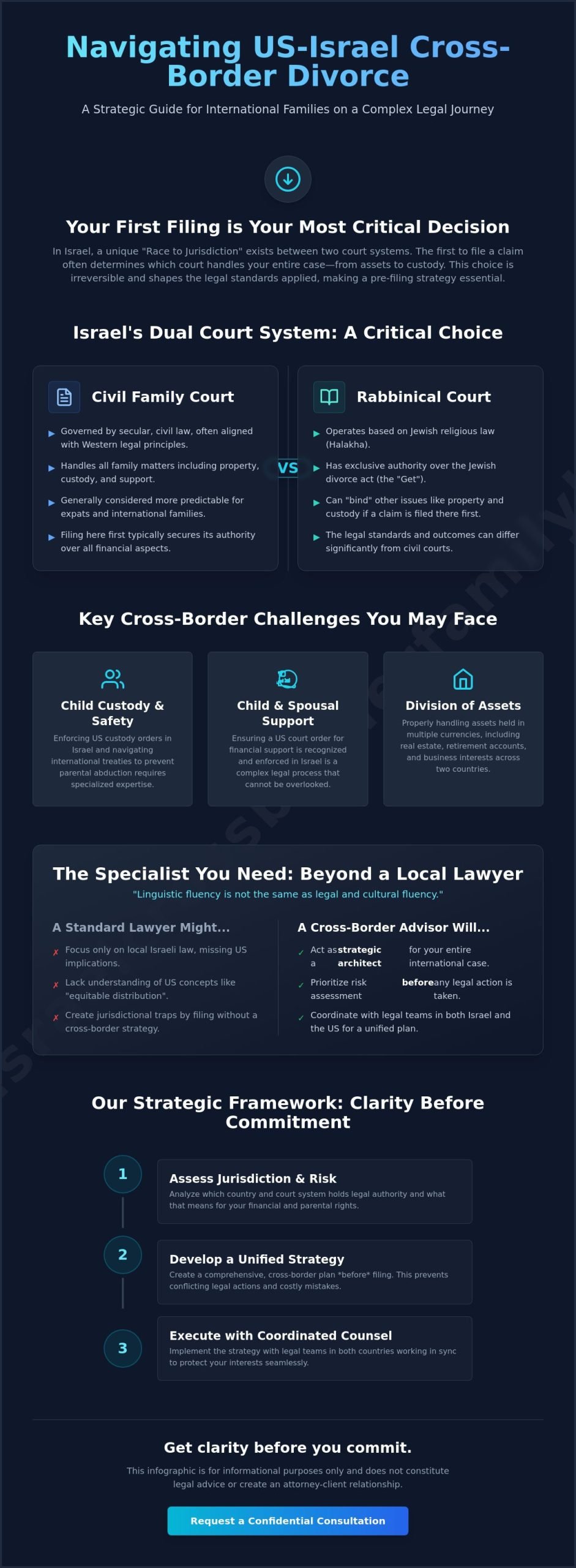
The Strategic Advisory Approach: Clarity Before Commitment
In the high-stakes environment of cross-border family law, acting without a comprehensive plan is the most significant risk an expat can take. Many families feel a sense of urgency to file papers immediately, often driven by fear of the “Race to Jurisdiction.” However, a strategic consultation is the most critical step in any case involving both Israeli and US interests. It provides a necessary pause to evaluate the legal landscape before you commit to a specific court or attorney. This phase focuses on education and risk assessment, ensuring that your first move is your best move.
An independent advisory platform offers a distinct advantage over a traditional law firm. While a law firm is typically structured for immediate litigation and representation, an advisor helps you map out risks, costs, and timelines from a neutral perspective. By working with an international family lawyer Israel as a strategic consultant, you gain a panoramic view of how decisions made in IL will echo in the United States. This approach empowers you to make choices based on logic and long-term objectives rather than immediate emotional pressure. It bridges the gap between two divergent legal cultures, providing a steady hand through a complex process.
How the Advisory Process Works
The advisory process begins with a rigorous assessment of your jurisdictional strengths and weaknesses. We analyze where your children are habitually resident and where your global assets are held. You can learn more about how it works to understand the specific stages of our strategic guidance. We help you build a “Legal Roadmap” that accounts for the unique US-Israel dynamics, such as the enforcement of support orders or the impact of the Rabbinical court’s expanding authority. This roadmap identifies potential systemic traps and provides a clear, actionable path forward.
Getting Started Safely
Early-stage planning requires absolute discretion and a safe environment for open discussion. Confidentiality is the foundation of the advisory process, allowing you to explore your options without the risk of escalating a situation prematurely. Understanding the potential costs is also vital; for example, a claim for property in IL carries a court fee of 3,447 NIS as of January 2026. You can start this process with a confidential case review to begin your journey toward clarity. Strategy is the essential bridge between two legal systems, turning a confusing transnational struggle into a manageable and predictable transition.
Get clarity before you commit. Request a confidential consultation.
This article is published on an independent advisory platform (not a law firm) and does not imply an attorney-client relationship.
Securing Your Family’s Future Across Borders
Navigating the intersection of US and Israeli law requires more than just local representation; it demands a unified strategy that accounts for global assets and international treaties. By prioritizing clarity before commitment, you can avoid the systemic traps of the “Race to Jurisdiction” and ensure your financial and parental rights are protected in both nations. The complexities of the dual court system in IL don’t have to be overwhelming when you have a clear roadmap to follow.
Working with an international family lawyer Israel who provides specialized US-Israel cross-border expertise ensures you receive plain English guidance tailored to your specific needs. This advisory focus helps you move from a state of uncertainty to a position of informed decision-making. Whether you are managing global property division or enforcing child support orders, a strategy-first approach is the bridge to a stable resolution. You have the power to protect your family’s interests by making informed choices today.
Get clarity before you commit. Request a confidential consultation.
This article is published on an independent advisory platform (not a law firm) and does not imply an attorney-client relationship.
Frequently Asked Questions
Does an Israeli divorce decree work in the US?
Yes, US courts generally recognize divorce decrees from Israel based on the principle of comity. For the decree to be valid, both parties must have received proper notice and a fair opportunity to be heard. It is important to remember that Jewish couples often require a religious “Get” in addition to a civil decree to ensure the divorce is recognized by both legal and religious authorities in both countries.
What is the “Race to Jurisdiction” in Israeli family law?
The “Race to Jurisdiction” is a situation where the first spouse to file a claim determines which court system handles the case. In IL, the Family Court and the Rabbinical court have parallel authority over matters like property and support. The court where the first valid claim is filed typically gains the power to decide those issues. Consulting an international family lawyer Israel before filing is essential to ensure you choose the system that best protects your interests.
Can I enforce a US child support order if the parent lives in Israel?
Yes, you can enforce a US child support order in Israel through a bilateral agreement between the two nations. A 2009 Memorandum of Understanding allows for the reciprocal enforcement of support obligations. The Israeli Ministry of Justice acts as the Central Authority to process these requests. This system ensures that children receive necessary support regardless of which country the paying parent resides in.
How long does an international divorce between the US and Israel take?
The timeline for an international divorce varies significantly based on how much the parties agree. An amicable divorce with a pre-negotiated settlement can often be finalized within three to six months. However, contested cases involving complex global assets or international custody disputes can take two years or more. Early strategic planning is the most effective way to prevent a case from dragging on in multiple jurisdictions.
Do I need two lawyers if I have assets in both countries?
You often need legal expertise in both jurisdictions to handle a cross-border estate properly. While an Israeli advisor manages the local proceedings, a US-based attorney may be needed to handle state-specific assets like 401k accounts or real estate. The most effective approach is to have a lead advisor who coordinates with co-counsel in the US. This ensures a unified strategy and prevents the issuance of conflicting court orders.
Is a US prenuptial agreement valid in Israel?
A US prenuptial agreement is generally enforceable in Israel, but it must meet specific procedural requirements. To ensure the agreement is recognized by Israeli courts, it often needs to be validated or approved by a judge or a notary, depending on the timing of the signing. If the agreement contradicts Israeli public policy or was signed under duress, its enforceability may be challenged during the divorce process.
What happens if my spouse takes our child to Israel without my permission?
This is treated as a potential case of international child abduction under the Hague Convention. Both Israel and the US are signatories to this treaty, which requires the prompt return of a child wrongfully removed from their home country. You must file a petition with the Central Authority immediately. Speed is critical because the court will look at the child’s “habitual residence” to determine if they should be returned.
How much does an international family lawyer in Israel cost?
The cost of legal services depends on the complexity of the international assets and the level of conflict between the parties. In addition to professional fees, you must account for government filing fees. For instance, as of January 2026, filing a property claim in the Family Court costs 3,447 NIS. Finding an international family lawyer Israel who focuses on a strategy-first approach can often reduce total expenses by avoiding long, drawn-out litigation.
Get clarity before you commit. Request a confidential consultation.

Article by
Gabriel Lior
A Personal Journey That Became a Mission
The advisory was founded by an American father Gabriel Lior, LLB, MBA , global entrepreneur, and cross-border advisor who spent more than a decade navigating the Israeli family court system firsthand and now lives in Singapore with his son.
As a divorced parent in a cross-border family, Gabriel faced nearly every legal challenge a foreign parent can encounter in Israel — including child custody disputes, child support proceedings, property matters in Israel and abroad, false accusations, and complex immigration and relocation proceedings.
Over the years, he learned the hard way how difficult it is for non-Israeli parents to understand the system, identify the right legal strategy, and choose the right legal representation — especially when language, culture, and jurisdictional differences are involved. He also witnessed how foreign parents and new immigrants are often disadvantaged or taken advantage of by service providers and institutions simply because they lack local knowledge or fluency.
From Client to Advisor
To truly understand — and survive — the system, Gabriel pursued formal legal education in Israel, completing two Israeli law degrees, alongside a BA and MBA earned in the United States. This was never about becoming a practicing attorney, but about gaining a deep, structural understanding of how the system works — and where it breaks down for foreign parents.
This rare combination of:
Firsthand client experience
Israeli legal and US business education
International business and negotiation training
Decades of commercial execution
created a unique perspective – one that understands both sides of the table.
After years of litigation, persistence, and at times self-representation, he ultimately succeeded in securing custody of his son and relocating abroad through a rare legal victory in the Israeli Supreme Court — becoming one of the first fathers in Israel to do so under these circumstances.
Disclaimer
Important Disclaimer:
The information provided on this website and in its content is for general informational and educational purposes only and does not constitute legal advice, legal opinion, or legal representation.
Gabriel Lior is not licensed to practice law in Israel (nor is he interested in doing so) and does not provide legal services, despite having completed 2 Law Degrees. The services offered are advisory in nature and are intended to provide general guidance, strategic insight, and information regarding cross-border family law considerations.
No attorney-client relationship is formed by accessing this website, reading its content, or communicating with us.
Any decisions made based on this information are at your own discretion and risk. For legal advice specific to your situation, you should consult a licensed attorney in the relevant jurisdiction.
Where appropriate, we may refer clients to independent, licensed attorneys or professionals. Such referrals do not constitute legal representation and no liability is assumed for services provided by third parties.