This article is published on an independent advisory platform and does not constitute legal representation or legal advice. It is for informational purposes only; legal services are provided solely by licensed attorneys under a separate engagement.
Winning an International Relocation Case isn’t actually about your rights as a parent. Instead, success depends on your ability to prove a superior “life plan” that prioritizes your child’s welfare above all else. When you’re dealing with the legal systems of both the United States and Israel (IL), the complexity can feel paralyzing. You might worry about being unfairly accused of child abduction or feel anxious about how conflicting laws will impact your relationship with your child.
It’s completely normal to feel this way. These cases involve high stakes and deep emotional stress. This guide will show you the critical legal criteria and strategic preparation you need to navigate these transitions safely. We’ll walk through how to build a persuasive argument centered on child welfare, helping you minimize legal risks while creating a clear roadmap for your family’s future.
Key Takeaways
- Learn the critical distinction between a legal relocation application and the risks of a Hague Convention abduction claim.
- Understand the specific criteria judges use to evaluate a child’s emotional and social needs in a new country.
- Discover why a comprehensive “Life Plan” is the foundation for Winning an International Relocation Case.
- Identify the tactical steps for gathering objective evidence to support your relocation request in Israeli or US courts.
- Recognize how cultural nuances in Israeli Family Courts can affect your case strategy and the importance of cross-border advisory.
This article is published on an independent advisory platform (not a law firm) and must not imply an attorney-client relationship. Legal services are only provided by licensed attorneys under a separate engagement.
Understanding the Legal Framework for US-Israel Relocation
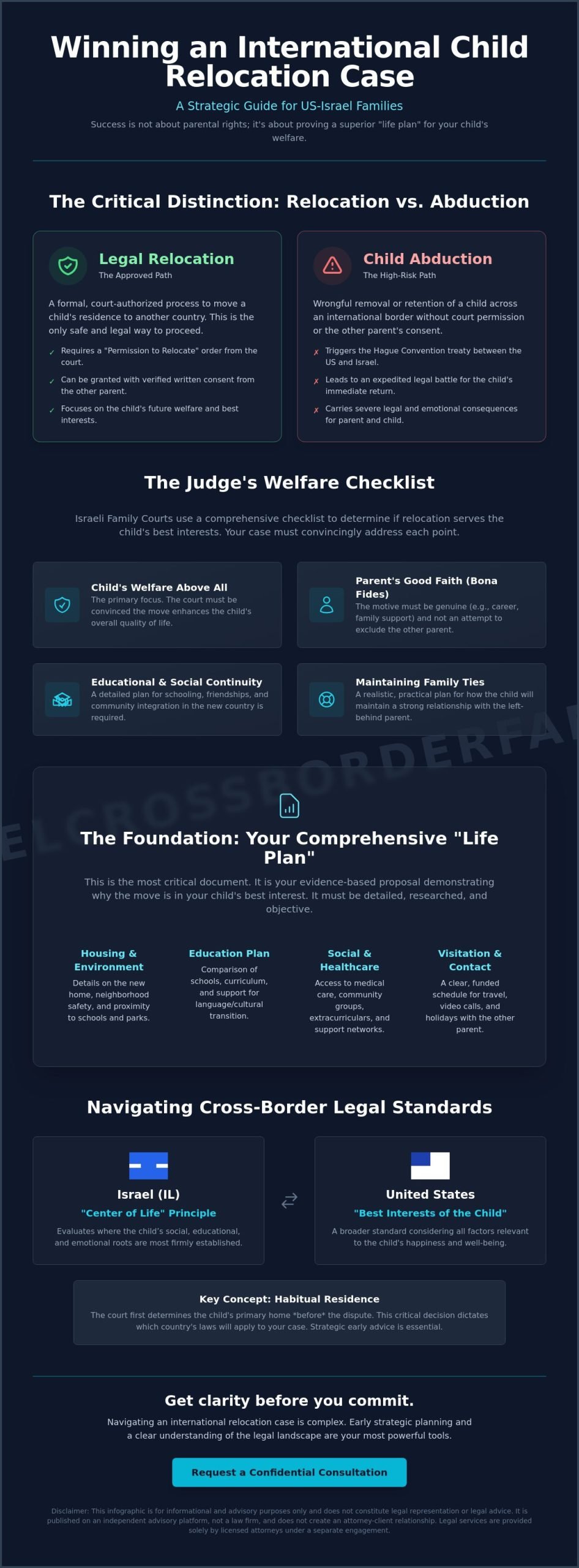
International relocation between the United States and Israel (IL) involves a formal legal transition that requires authorization from the court holding jurisdiction over the child. In Israel, the Family Court serves as the primary authority for granting “Permission to Relocate.” Without this explicit judicial approval or the verified written consent of the other parent, moving a child across international borders is often classified as a wrongful removal. This distinction is vital because the legal consequences of an unauthorized move can be immediate and severe.
Winning an International Relocation Case requires a nuanced understanding of how Israeli and American legal standards intersect. While US courts generally apply the broad “Best Interests of the Child” standard, Israeli courts place significant weight on the “Center of Life” principle. This test evaluates where the child’s social, educational, and emotional roots are most firmly established. Decisions made early in the process, such as where you choose to file initial motions, can lock you into a specific legal system. You can find more detailed insights on these transitions by exploring our International Family Law channel.
Relocation vs. Abduction: Knowing the Difference
There’s a definitive legal boundary between a planned relocation and international child abduction. The Hague Convention on International Child Abduction is a treaty signed by both the US and IL. It’s designed to ensure the prompt return of children wrongfully removed from their home country. If you move without a court order, the other parent can file a Hague petition. This usually leads to an expedited legal battle where the court’s primary focus is returning the child to their original jurisdiction. Seeking clarity through an international custody relocation application is the only safe way to proceed.
Jurisdictional Challenges between the US and Israel
Determining which country has the authority to hear a case is often the first major hurdle for international families. Courts look for the child’s “Habitual Residence,” which is the place they lived immediately before the dispute began. Establishing habitual residence is often complex for families who split their time between the US and IL. Early strategic decisions are critical because they define which court will ultimately rule on your life plan. Understanding these cross-border complexities early helps prevent jurisdictional conflicts that can delay your family’s plans for months or even years.
This article is published on an independent advisory platform (not a law firm) and must not imply an attorney-client relationship.
The Welfare Checklist: What Judges Actually Look For
When an Israeli Family Court evaluates a request to move a child abroad, it relies on a specific set of criteria often referred to as the “Welfare Checklist.” This is not a simple administrative hurdle. It is a comprehensive assessment of how the move will impact every facet of the child’s life. Winning an International Relocation Case depends on your ability to demonstrate that the proposed move is not just a personal preference but a strategic decision that serves the child’s long-term interests. Judges look for evidence that the moving parent is acting in good faith (bona fides) rather than attempting to cut ties with the other parent.
A critical component of this process is the “Mirror Order.” Since Israel (IL) and the US have different legal systems, an Israeli judge may require that a court in the destination state issues an identical order. This ensures that visitation rights and custody terms are legally enforceable in both jurisdictions. Without such protections, courts are often hesitant to allow a child to leave the country. Understanding these global standards is essential; you can find more context in this Global guide to child relocation laws, which outlines how different nations approach these sensitive transitions.
Educational and Social Continuity
Judges prioritize stability. If you are moving from Israel to the US, you must provide a detailed comparison of the school systems, medical facilities, and social environments. For Anglo families in IL, maintaining linguistic and cultural ties is often a point of concern. You should be prepared to show how the child will keep their Hebrew skills or stay connected to their Israeli heritage. Highlighting the presence of extended family in the destination country can also provide the court with the reassurance that the child will have a strong support network immediately upon arrival.
The Left-Behind Parent’s Relationship
The most significant obstacle in relocation cases is the potential damage to the child’s relationship with the parent staying behind. To succeed, you must propose a visitation schedule that is both generous and logistically sound. This includes specific dates for summer vacations, holidays, and a consistent schedule for digital contact through video calls. Courts are highly sensitive to “gatekeeping” behavior. If a judge senses that the moving parent will not actively encourage a bond with the other parent, the application is likely to fail. Proving your commitment to this relationship is just as important as proving the benefits of the new location. If you are unsure how to structure these proposals, it may be helpful to speak with an advisor about the cultural expectations of the Israeli court system.
This article is published on an independent advisory platform (not a law firm) and must not imply an attorney-client relationship.
Strategic Preparation: Building a Robust Relocation Plan
Winning an International Relocation Case requires moving beyond the emotional desire to leave and creating a concrete “Life Plan.” Israeli courts often view relocation through the lens of risk. They want to see that the child’s standard of living and stability will improve, or at least remain consistent. Early strategic decisions are vital. If you wait until a conflict reaches its peak to start planning, you may find that the court favors the current status quo in IL. The longer a child is settled in a specific school or social circle in Israel, the harder it becomes to justify a move. Success depends on presenting a future that is clearly defined rather than a vague hope for a better life.
Timing your application is just as critical as the content of the plan itself. Filing for relocation while a child is in a transition period, such as between elementary and middle school, can sometimes be more persuasive than trying to move them mid year. You must also address the common objection that the child will lose their Israeli heritage or Hebrew language skills. By proactively including solutions for these concerns in your initial proposal, you demonstrate a commitment to the child’s identity that judges value. This level of preparation shows that you are focused on the child’s welfare rather than your own convenience.
Developing the ‘Life Plan’ Document
A robust Life Plan is a detailed document that leaves no question unanswered. When preparing to move to the US, you should research and present specific data points to the court. This evidence should include:
- Specific schools and extracurricular programs that match the child’s current interests.
- Identified healthcare providers and proof of insurance coverage.
- Secure housing arrangements, including proximity to extended family support.
- Evidence of employment or a clear financial support structure in the new location.
- A proposed schedule for holidays and summer vacations that ensures consistent contact with the other parent.
Addressing Objections Before They Reach Court
You can often neutralize the “loss of contact” argument by showing how technology will bridge the gap. Propose a schedule for video calls that accounts for time zone differences between IL and the US. Using expert opinions from psychologists or social workers can also provide objective evidence that the move is in the child’s best interest. These professionals can evaluate the child’s adaptability and the strength of their bond with both parents. For more detailed guidance on these transitions, explore strategies for international custody and relocation. By addressing objections early, you present yourself as a collaborative parent who prioritizes the child’s emotional health.
This article is published on an independent advisory platform (not a law firm) and must not imply an attorney-client relationship.
5 Essential Steps to Winning Your Relocation Case
Moving from a strategic plan to a legal reality involves a specific tactical sequence. In Israel (IL), the process typically begins with filing a formal relocation application in the Family Court. This is a separate legal action from a standard custody claim. Winning an International Relocation Case is not a single event; it’s the cumulative result of building layers of credibility through objective evidence and professional evaluations. Success requires you to remain focused on the child’s welfare while managing the procedural requirements of both the US and Israeli legal systems.
The tactical sequence often starts with a mandatory attempt at dispute resolution. Israeli courts prioritize mediation through the “Unit for the Assistance of the Family Courts” before a judge hears the case. If a consensual agreement isn’t reached, the case moves into a more formal litigation phase. During this time, the court will rely heavily on expert reports and documented facts rather than emotional pleas. To understand how these tactical steps apply to your specific situation, you may wish to schedule a strategy call.
Gathering Objective Evidence
Courts don’t make decisions based on parental desires; they rely on objective data. You must compile a comprehensive file that includes school reports, medical histories, and expert testimonies from the destination country. If your child is old enough, the court may also consider their expressed wishes. It’s helpful to create a side-by-side comparison of the child’s current life in IL versus their proposed life in the US. Documenting specific extracurricular opportunities or specialized medical care available in the new location adds a layer of credibility that personal testimony cannot provide.
Managing Court-Appointed Evaluations
In most IL relocation cases, the judge will appoint a social worker or a psychologist to conduct an evaluation. This professional, often called a “Sia’id,” meets with both parents and the children to assess the family dynamic. It’s vital to present your case calmly and focus on the child’s needs. A common mistake is using the evaluation to vent frustrations about the other parent. This can be interpreted as “parental alienation,” which is a significant red flag for judges. The expert’s recommendation often serves as the blueprint for the final decision, so your interactions with them must be strategic and transparent.
Finally, ensure that any final judgment is enforceable in both jurisdictions. This often involves obtaining a “Mirror Order” in the US to confirm the terms set by the Israeli court. This step protects you from future claims of wrongful removal and ensures that visitation schedules are respected across borders. Without international coordination, even a winning judgment in one country can lead to legal complications in another.
This article is published on an independent advisory platform (not a law firm) and must not imply an attorney-client relationship. Legal services are only provided by licensed attorneys under a separate engagement.
Seeking Advisory: Clarity Before the Courtroom
Winning an International Relocation Case is a multi-layered challenge that extends far beyond the borders of a single country. While local attorneys in the US or Israel (IL) are essential for courtroom representation, they often lack the bird’s-eye view required for a cross-border transition. A specialized advisory approach focuses on the intersection of two different legal cultures. It prioritizes long-term strategy and risk mitigation over short-term litigation wins. Understanding the cultural nuances of the Israeli Family Court is just as important as knowing the law itself. These courts operate with a specific rhythm and set of expectations that can catch international families off guard.
The primary goal of seeking advisory early is to gain a clear understanding of your options before you commit to a specific legal path. Decisions made in the first few weeks of a dispute often dictate the jurisdictional outcome of the case. By focusing on strategy first, you can identify potential obstacles and address them before they become permanent legal barriers. To see how this process unfolds, you can learn more about how the advisory works for international families.
The Value of a Cross-Border Strategy
Success in a US-Israel relocation depends on seamless coordination between your legal teams in both countries. An advisory role acts as a bridge, ensuring that the arguments made in an Israeli court don’t inadvertently create a “Hague trigger” in the United States. Wrongful removal claims under the Hague Convention are often the result of poor early communication or a lack of cross-border foresight. By identifying these risks early, you can structure your relocation application to be transparent and legally sound in both jurisdictions. This proactive approach minimizes the chance of emergency motions or “Stay of Exit” orders that can freeze your plans for months.
Next Steps for Expats and International Families
For expats and Anglo families, the complexity of the Israeli system can feel overwhelming. The impact of your early choices cannot be overstated. Whether you are just beginning to consider a move or are already facing an objection from the other parent, gaining clarity is your first priority. You can find additional perspectives and guidance by visiting our YouTube channel for International Family Law Insights. If you are ready to evaluate your specific situation, you may request a confidential case review to explore your strategic options.
Get clarity before you commit. We invite you to reach out for an advisory call or a brief conversation via WhatsApp to discuss your next steps.
This article is published on an independent advisory platform (not a law firm) and must not imply an attorney-client relationship.
Securing Your Family’s Future Across Borders
Winning an International Relocation Case is a journey that requires precision, patience, and a well-documented strategy. Throughout this guide, we’ve explored how a robust “Life Plan” serves as your strongest evidence in the Israeli Family Court. We’ve also highlighted the necessity of understanding the “Center of Life” principle and the importance of securing Mirror Orders to protect your parental rights in both the United States and Israel (IL). These steps ensure that your transition is legally sound and enforceable across jurisdictions.
Success isn’t found in aggressive litigation but in proactive risk mitigation and specialized US-Israel cross-border expertise. By focusing on the child’s welfare and coordinating your legal strategy between countries, you can navigate these complexities with confidence. Early decisions carry significant weight; seeking authoritative advisory for international families is a critical step in avoiding common legal pitfalls like Hague Convention triggers. Taking the time to understand the cultural nuances of the Israeli legal landscape will provide the steady guidance your family needs during this challenging time.
Get clarity before you commit. Request a confidential consultation to discuss your strategy and minimize your legal risks. You don’t have to navigate this transition alone.
This article is published on an independent advisory platform (not a law firm) and must not imply an attorney-client relationship. Legal services are only provided by licensed attorneys under a separate engagement.
Frequently Asked Questions
Can I move my child out of Israel without the other parent’s consent?
No, you cannot move a child out of Israel (IL) without the written consent of the other parent or a formal court order. Attempting to do so is legally classified as wrongful removal under international treaties. This action often triggers an immediate Hague Convention petition, which can lead to the child’s forced return and severely damage your chances of Winning an International Relocation Case in the future.
How long does a typical international relocation case take in Israel?
A standard relocation case in Israel typically takes between 6 and 18 months to reach a final judgment. While Hague Convention cases for child abduction aim for a six-week resolution, relocation applications require extensive evaluations. The court must wait for reports from social workers and psychologists, so it’s vital to start your strategic preparation well before your intended move date.
Does the child have a say in whether they want to relocate?
Israeli courts do consider the wishes of the child, particularly for those aged 6 and older. A court-appointed professional or a judge may meet with the child in a neutral setting to understand their feelings and maturity level. While the child’s preference is not the only factor, it carries more weight as the child approaches their teenage years and demonstrates an independent perspective.
What happens if I move the child and the court later orders their return?
If you relocate without permission and a court issues a return order, you must comply immediately to avoid severe legal consequences. Failure to return the child can lead to criminal charges, significant financial penalties, and “Stay of Exit” orders that prevent you from leaving Israel again. It often results in a loss of legal credibility that makes future relocation applications nearly impossible to win.
How do Israeli courts view a move to the US for a better job opportunity?
A superior job opportunity in the US is considered a legitimate motive, but it is only one part of the court’s evaluation. Judges focus on whether the move improves the child’s overall welfare rather than just the parent’s career or income. You must demonstrate that the relocation provides a better “Life Plan” for the child’s education, social life, and emotional health to be successful.
Is it possible to win a relocation case if the other parent has joint custody?
It is possible to win with joint custody, but the legal burden is significantly higher. You must prove that the move’s benefits are so substantial that they outweigh the child’s loss of daily contact with the other parent. Winning an International Relocation Case in these situations depends on proposing a very generous visitation schedule that utilizes both physical travel and digital communication.
What is a ‘Mirror Order’ and why is it necessary for US-Israel cases?
A Mirror Order is an identical court order issued by a judge in the destination country, such as a US state court. It ensures that the custody and visitation terms set by the Israeli court are legally recognized and enforceable in the United States. Israeli judges often require this as a condition of relocation to protect the “left-behind” parent’s rights and prevent future jurisdictional disputes.
Can I relocate if the other parent hasn’t paid child support?
No, a parent’s failure to pay child support does not grant you the right to relocate the child unilaterally. In the Israeli legal system, financial support and relocation rights are separate matters. Using non-payment as a justification for moving is viewed as a high-risk legal error that suggests you are not acting in the child’s best interests or respecting the court’s authority.

Article by
Gabriel Lior
A Personal Journey That Became a Mission
The advisory was founded by an American father Gabriel Lior, LLB, MBA , global entrepreneur, and cross-border advisor who spent more than a decade navigating the Israeli family court system firsthand and now lives in Singapore with his son.
As a divorced parent in a cross-border family, Gabriel faced nearly every legal challenge a foreign parent can encounter in Israel — including child custody disputes, child support proceedings, property matters in Israel and abroad, false accusations, and complex immigration and relocation proceedings.
Over the years, he learned the hard way how difficult it is for non-Israeli parents to understand the system, identify the right legal strategy, and choose the right legal representation — especially when language, culture, and jurisdictional differences are involved. He also witnessed how foreign parents and new immigrants are often disadvantaged or taken advantage of by service providers and institutions simply because they lack local knowledge or fluency.
From Client to Advisor
To truly understand — and survive — the system, Gabriel pursued formal legal education in Israel, completing two Israeli law degrees, alongside a BA and MBA earned in the United States. This was never about becoming a practicing attorney, but about gaining a deep, structural understanding of how the system works — and where it breaks down for foreign parents.
This rare combination of:
Firsthand client experience
Israeli legal and US business education
International business and negotiation training
Decades of commercial execution
created a unique perspective – one that understands both sides of the table.
After years of litigation, persistence, and at times self-representation, he ultimately succeeded in securing custody of his son and relocating abroad through a rare legal victory in the Israeli Supreme Court — becoming one of the first fathers in Israel to do so under these circumstances.
Disclaimer
Important Disclaimer:
The information provided on this website and in its content is for general informational and educational purposes only and does not constitute legal advice, legal opinion, or legal representation.
Gabriel Lior is not licensed to practice law in Israel (nor is he interested in doing so) and does not provide legal services, despite having completed 2 Law Degrees. The services offered are advisory in nature and are intended to provide general guidance, strategic insight, and information regarding cross-border family law considerations.
No attorney-client relationship is formed by accessing this website, reading its content, or communicating with us.
Any decisions made based on this information are at your own discretion and risk. For legal advice specific to your situation, you should consult a licensed attorney in the relevant jurisdiction.
Where appropriate, we may refer clients to independent, licensed attorneys or professionals. Such referrals do not constitute legal representation and no liability is assumed for services provided by third parties.