This article is published on an independent advisory platform and does not constitute an attorney-client relationship. The content is for informational and advisory purposes only and does not constitute legal representation or legal advice; legal services are only provided by licensed attorneys under a separate engagement.
The success of an international abduction case often rests on the clinical application of legal definitions rather than emotional testimony. When you’re facing the reality of Returning a Child Under the Hague Convention, the first six weeks are the most critical period for your legal strategy. It’s natural to feel a deep sense of anxiety regarding the speed of legal proceedings or confusion over whether Israel or the United States has jurisdiction over your family’s future.
You deserve clarity during this high-stakes transition. This guide explains the legal mechanisms, potential risks, and strategic considerations for parents navigating these complex cross-border cases. We’ll outline the specific criteria required for a return order, identify the narrow defenses permitted under the law, and walk you through the procedural steps within the Israeli Family Court system. By understanding how the system in Israel operates, you can move forward with a focus on strategy and informed decision-making.
Key Takeaways
- Understand the specific legal mechanisms and expedited timelines involved in Returning a Child Under the Hague Convention between Israel and the United States.
- Learn how the “Habitual Residence” test serves as the primary tool for determining a child’s legal home and whether a removal was wrongful.
- Identify the narrow exceptions, such as “Grave Risk” or the child’s own maturity, that Israeli courts consider when deciding whether to refuse a return order.
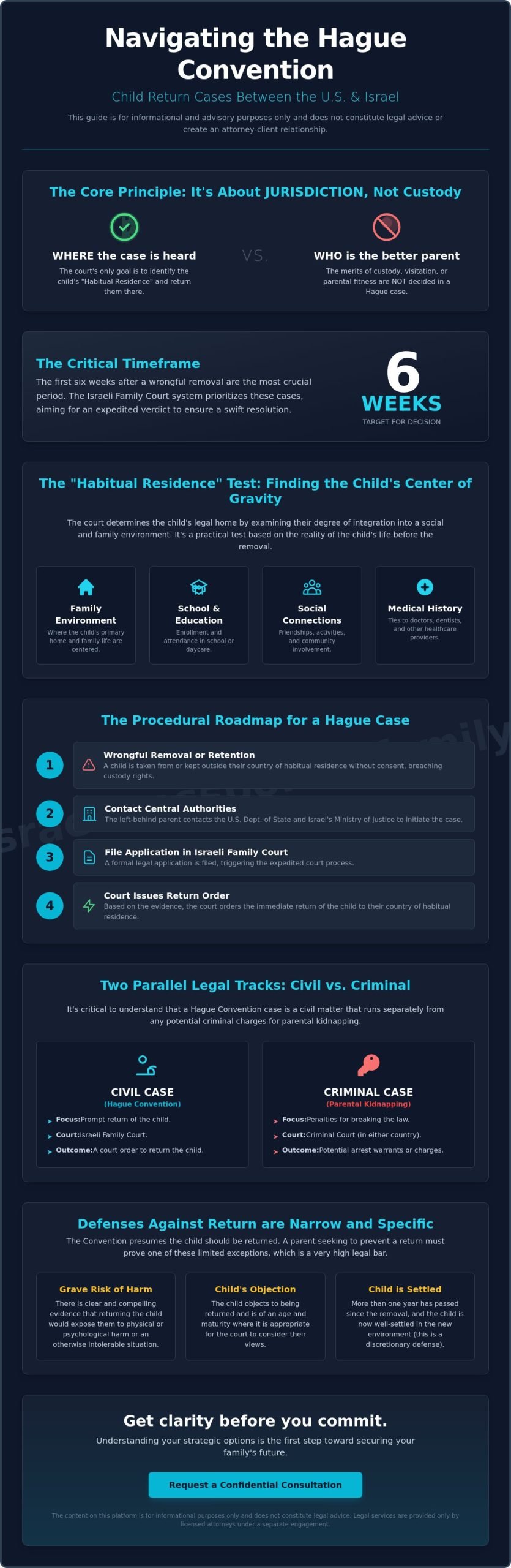
- Navigate the procedural steps in the Israeli Family Court system, which prioritizes speed to reach a verdict within a target of six weeks.
- Evaluate the long-term risks of uncoordinated legal actions and the importance of aligning your strategy between US and Israeli jurisdictions.
Understanding the Hague Convention Framework in Israel and the US
This article is published on an independent advisory platform and does not imply an attorney-client relationship. The primary instrument for Returning a Child Under the Hague Convention is the 1980 Hague Convention on the Civil Aspects of International Child Abduction. This international treaty establishes a shared legal framework between member nations, known as Contracting States. Both Israel and the United States are active signatories. This means they’ve committed to a reciprocal process for addressing cases where a child is taken across borders without the consent of both parents. This reciprocity is the foundation of cross-border enforcement between the two legal systems.
The treaty operates on a very specific logic that often surprises parents. It doesn’t ask which parent is more fit or who should have custody. Instead, it focuses entirely on jurisdiction. The goal is to determine which country’s courts have the right to decide the child’s long-term future. By prioritizing the prompt return of the child to their home country, the convention aims to restore the status quo that existed before the removal. It’s a procedural mechanism designed to discourage parents from “forum shopping” or searching for a more favorable legal system by moving the child without permission.
To better understand the complexities of these cases, watch this helpful video:
The Role of the Central Authority
Each country maintains a Central Authority to manage the administrative side of these cases. In Israel, this role is fulfilled by the Ministry of Justice. In the United States, the Department of State’s Office of Children’s Issues takes the lead. These offices don’t provide personal legal representation or advice; however, they facilitate communication between the two governments. Contacting the Central Authority is often a necessary first step for a parent. It initiates the formal administrative tracking of the case and helps ensure that the relevant documents are transmitted correctly between Israel and the US.
Civil vs. Criminal Aspects of Abduction
You must distinguish between the different legal paths available. Hague Convention proceedings are strictly civil matters. In Israel, these cases are heard in the Family Court, which focuses on the return of the child under the specific Israeli implementing law. However, parental kidnapping is also a criminal offense under Israel’s Penal Law. Similarly, in the US, it can trigger federal criminal charges. While a family court judge might order a child to be returned, that civil order doesn’t automatically resolve any concurrent criminal warrants. Parents should be aware that these two legal tracks often run at the same time. Decisions made in the civil case can sometimes impact the criminal situation, making it essential to coordinate your strategy across both areas of law.
This article is published on an independent advisory platform and does not imply an attorney-client relationship. To trigger the legal process of Returning a Child Under the Hague Convention, a court must first determine that a removal or retention was “wrongful.” Under Article 3, a removal is wrongful if it breaches the rights of custody granted to a parent under the laws of the state where the child was habitually resident. It’s vital to distinguish between removal, which is the act of taking the child away, and retention. Retention occurs when a child stays beyond a permitted period, such as an extended summer vacation in Israel that one parent refuses to end.
The “Habitual Residence” test is the most significant factor in these proceedings. Courts don’t rely on a single, rigid definition. Instead, they look for the child’s center of gravity by examining the degree of integration into a social and family environment. Evidence typically includes school enrollment, medical history, and the child’s social ties. If a child has spent most of their life in New York but is suddenly kept in Tel Aviv, the court will analyze whether the child’s life had truly shifted to Israel before the legal dispute began. Decision-making depends on clinical facts rather than emotional claims about which country is “better.”
The Habitual Residence Challenge for Expats
Expat families often face unique hurdles because their lives are inherently transborder. A temporary relocation to Israel for a job or a family emergency can blur the lines of residency. US and Israeli courts sometimes weigh “parental intent” differently. When parents disagree on where a child belongs, the process of Returning a Child Under the Hague Convention becomes a question of where the child was most recently settled. A planned three-month stay in Israel that turns into a permanent move without one parent’s consent can be classified as a wrongful retention if the child’s home base remained in the US.
Establishing Rights of Custody
A parent must prove they were actually exercising “rights of custody” when the child was taken. This is different from “rights of access,” which only covers visitation. Israeli Family Courts look closely at how custody was shared in practice. If you didn’t have a formal court order in the US, the court will look at the laws of your home state to see if you held “de facto” custody. Because Israeli law and US state laws often differ on the definition of joint custody, it’s helpful to clarify your legal standing before initiating a petition. Documenting your daily involvement in the child’s life is essential for a successful return application.
This article is published on an independent advisory platform and does not imply an attorney-client relationship. While the primary objective of the treaty is the prompt return of the child, Article 13 provides several narrow defenses that may be raised. These are not general arguments about which parent provides a better lifestyle. Instead, they are specific legal exceptions that require a high standard of proof. Understanding these defenses is a core part of the strategy for anyone involved in Returning a Child Under the Hague Convention.
The most common defenses include:
- Grave Risk: A court may refuse return if there’s a grave risk that returning the child would expose them to physical or psychological harm or an intolerable situation.
- Age and Maturity: If a child is of sufficient age and maturity, the court may consider their objection to being returned.
- Settled in the New Environment: If more than one year has passed since the removal before the petition was filed, a court might refuse return if the child is now settled in Israel.
- Consent or Acquiescence: If the left-behind parent agreed to the move or stayed silent for a significant period, the court may find they waived their right to a return order.
The High Bar for Article 13(b) in Israel
Israeli courts interpret the “grave risk” exception very restrictively. It’s not enough to show that the child’s life in Israel is more comfortable or that a move back to the US would be difficult. The court requires objective, professional evidence of an intolerable situation. This often involves psychological evaluations or reports from social services. Israeli judges generally operate on the principle that the home country’s courts are the proper place to resolve safety concerns once the child is returned. They distinguish between an “unpleasant relocation” and a situation that genuinely threatens the child’s well-being.
When the Child Objects to Returning
In Israel, there’s no fixed age at which a child’s view becomes decisive. However, courts often begin to weigh a child’s opinion more heavily around the age of 10 to 12. A court-appointed social worker, known as a Pakid Saad, usually interviews the child to determine if their objection is genuine. The court is particularly vigilant about “parental alienation,” where one parent has influenced the child to reject the other. If the objection seems coached or lacks independent reasoning, the court may prioritize the return order regardless of the child’s stated preference. The convention ceases to apply once the child reaches 16 years of age, making these objections moot for older teenagers.
The Procedural Roadmap for Hague Cases in the Israeli Family Courts
This article is published on an independent advisory platform and does not imply an attorney-client relationship. Israeli Family Courts treat cases involving Returning a Child Under the Hague Convention with extreme urgency. Unlike standard custody disputes that can last for months or years, these proceedings follow a condensed schedule. The court aims for a final verdict within six weeks of the initial filing. This rapid pace is designed to prevent the child from becoming too settled in Israel before a decision is reached. It also minimizes the period of uncertainty for both the parents and the child.
The process typically starts with a petition filed through the Central Authority. Once the administrative work is complete, the case moves to the Family Court. An urgent preliminary hearing is usually arranged within 15 days. Because the legal window is so narrow, early decisions regarding evidence are vital. If a parent misses deadlines or fails to provide necessary documentation at the start, it can be fatal to the petition’s success. The court focuses strictly on the legality of the child’s presence in Israel rather than long-term custody arrangements.
Timeline and Urgency in Israel
The “swift return” promise is a reality in the Israeli system. You should prepare for a marathon of hearings over a very short period. Judges often prioritize these cases on their dockets to meet international treaty obligations. If the case is appealed, it moves to the District Court. Even the appeal process is expedited to maintain the momentum of the initial ruling. Delays are rare and usually only granted under exceptional circumstances, as the system is built to discourage any tactical stalling by the taking parent.
Evidence and Witnesses in Hague Proceedings
Because the scope of the hearing is limited to jurisdiction, the evidentiary requirements are specific. Israeli courts rely heavily on written affidavits. However, live cross-examination still occurs. For parents or witnesses located in the United States, Israeli courts frequently allow testimony via video link. This is a critical nuance for international families who cannot travel to Israel on short notice. Expert witnesses, such as psychologists, have a more limited role here than in standard custody cases. Their testimony is usually restricted to proving specific defenses like “grave risk” rather than general parenting capability.
Navigating the intersection between Israeli Family Courts and US state courts requires a coordinated approach. If you are managing a case across these two jurisdictions, you can contact us for a confidential case review to understand the procedural requirements for Returning a Child Under the Hague Convention.
This article is published on an independent advisory platform and does not imply an attorney-client relationship. When you are navigating the process of Returning a Child Under the Hague Convention, your strategy must look beyond the immediate return. While the emotional urge to take immediate action is strong, you must avoid “self-help” measures. Attempting to physically take a child back without a court order is dangerous. It can lead to criminal abduction charges in both Israel and the United States, and it significantly weakens your standing in the Family Court. A clinical, legal approach is the only way to ensure your parental rights remain protected in the long term.
Coordinating your legal strategy between US and Israeli counsel is a necessity. These cases are not isolated events. A statement made in a US state court can be used as evidence in an Israeli Family Court, sometimes with unintended consequences. For example, if you claim in a US filing that you intended to move to Israel permanently, it could undermine your argument about “habitual residence” in a Hague petition. Success requires a unified narrative that respects the procedural nuances of both legal systems. This coordination ensures that your actions in one jurisdiction do not inadvertently sabotage your case in the other.
Mediation is often an overlooked alternative to a contested hearing. In Israel, mediation can be used to resolve access arrangements or even the return itself. Agreements reached through mediation can be recognized by the Israeli courts and hold the same legal weight as a judge’s decision. This path can sometimes be faster and less traumatic for the child than a full evidentiary trial. It allows parents to maintain some control over the outcome rather than leaving the decision entirely to a judge who must follow a rigid treaty framework.
Early Decisions and Long-Term Impact
The impact of your earliest decisions cannot be overstated. A “Return Order” is only the beginning of the journey; it simply moves the custody battle back to the child’s home country. If the initial filings are poorly worded, they can create hurdles for the subsequent custody litigation in the US. It is essential to seek clarity before you commit to a specific legal path. Understanding how a Hague ruling will influence your future custody rights is a vital part of the advisory process.
Navigating the US-Israel Corridor
There are distinct cultural nuances in how Israeli Family Courts view Anglo and expat families. The court’s focus is on the child’s integration and the legality of their residence. Families moving between these two cultures benefit from international custody and relocation advisory that accounts for these systemic differences. To understand the specific risks and strategic options for Returning a Child Under the Hague Convention in your situation, you may request a confidential case review. Get clarity before you commit. Request a confidential consultation.
Securing a Clear Path for Your Family’s Future
This article is published on an independent advisory platform and does not imply an attorney-client relationship. Successfully navigating the process of Returning a Child Under the Hague Convention requires more than just an understanding of the treaty; it demands a clinical focus on “Habitual Residence” and the expedited timelines of the Israeli Family Court. As we’ve explored, the six-week goal for these cases means that early, strategic decisions are the most significant factors in protecting your parental rights. Waiting too long or making uncoordinated filings in US and Israeli courts can create risks that are difficult to reverse.
Protecting your child’s future in a cross-border dispute involves managing deep jurisdictional conflicts with a calm, steady hand. Our specialized advisory services for international families provide the strategic guidance needed for these high-stakes cases. By focusing on the intersection of US and Israeli law, you can move forward with the confidence that your legal strategy is aligned across both borders. Don’t leave your family’s future to chance in a complex system.
Get clarity before you commit. Request a confidential consultation to discuss your specific situation. You can find the right path forward through informed choices and expert strategy.
This article is published on an independent advisory platform and does not imply an attorney-client relationship. The content is for informational and advisory purposes only and does not constitute legal representation or legal advice; legal services are only provided by licensed attorneys under a separate engagement.
Frequently Asked Questions
How long does a Hague Convention case typically take in Israel?
Hague Convention cases in Israel are designed for extreme speed. The Family Court aims to reach a final verdict within six to eight weeks from the initial filing of the petition. An urgent preliminary hearing usually occurs within fifteen days. This timeline is significantly faster than standard family law litigation, reflecting the treaty’s priority on restoring the child’s original status quo as quickly as possible.
Can I stop my child from being returned if I claim domestic violence?
Claims of domestic violence fall under the “Grave Risk” exception of Article 13(b). While this can be a defense, the evidentiary bar in Israel is exceptionally high. You must provide objective, professional evidence showing that the return would create an intolerable situation. Israeli courts often believe that the home country’s legal system is best equipped to handle safety concerns once the child is returned to their habitual residence.
What happens if the child is taken to a country that is not a Hague signatory?
If a child is taken to a non-signatory country, the Hague Convention does not apply. In these situations, you cannot rely on the treaty’s expedited return mechanisms. You must instead navigate the local laws of that specific nation. This often involves filing for custody or return under the principle of international comity, which is generally a much slower and more complex legal process than treaty-based returns.
Do I need a lawyer in both the US and Israel for a Hague case?
Coordinating legal strategy across borders is essential for a successful outcome. While you specifically need a licensed attorney in Israel to manage the Family Court proceedings, having a US lawyer is critical for handling concurrent filings in your home state. Aligning your narrative ensures that decisions made regarding Returning a Child Under the Hague Convention in Israel don’t negatively impact future custody hearings in the United States.
Will the Israeli court decide who gets permanent custody during a Hague hearing?
No, the Israeli Family Court does not determine long-term custody during a Hague hearing. The court’s only role is to decide which country has the jurisdiction to hear the custody case. If a return is ordered, the child goes back to their country of habitual residence. The courts in that home country will then handle the substantive issues of legal and physical custody after the child arrives.
Can a child be returned to the US if they have Israeli citizenship?
Israeli citizenship does not protect a parent from a return order. The Hague Convention focuses on the child’s “habitual residence” rather than their nationality. Even if a child holds an Israeli passport, they can be ordered back to the US if that was their primary home before the removal. Citizenship is generally considered irrelevant to the jurisdictional question of where the child actually lives and attends school.
What is the “one-year rule” in international child abduction cases?
The “one-year rule” refers to the timeframe for filing a petition. If you file within one year of the wrongful removal, the court must order the child’s return unless a specific exception applies. If more than twelve months have passed, the taking parent can argue that the child is now “settled” in their new environment in Israel. This defense makes Returning a Child Under the Hague Convention much more difficult to achieve because it shifts the focus to the child’s new life.

Article by
Gabriel Lior
A Personal Journey That Became a Mission
The advisory was founded by an American father Gabriel Lior, LLB, MBA , global entrepreneur, and cross-border advisor who spent more than a decade navigating the Israeli family court system firsthand and now lives in Singapore with his son.
As a divorced parent in a cross-border family, Gabriel faced nearly every legal challenge a foreign parent can encounter in Israel — including child custody disputes, child support proceedings, property matters in Israel and abroad, false accusations, and complex immigration and relocation proceedings.
Over the years, he learned the hard way how difficult it is for non-Israeli parents to understand the system, identify the right legal strategy, and choose the right legal representation — especially when language, culture, and jurisdictional differences are involved. He also witnessed how foreign parents and new immigrants are often disadvantaged or taken advantage of by service providers and institutions simply because they lack local knowledge or fluency.
From Client to Advisor
To truly understand — and survive — the system, Gabriel pursued formal legal education in Israel, completing two Israeli law degrees, alongside a BA and MBA earned in the United States. This was never about becoming a practicing attorney, but about gaining a deep, structural understanding of how the system works — and where it breaks down for foreign parents.
This rare combination of:
Firsthand client experience
Israeli legal and US business education
International business and negotiation training
Decades of commercial execution
created a unique perspective – one that understands both sides of the table.
After years of litigation, persistence, and at times self-representation, he ultimately succeeded in securing custody of his son and relocating abroad through a rare legal victory in the Israeli Supreme Court — becoming one of the first fathers in Israel to do so under these circumstances.
Disclaimer
Important Disclaimer:
The information provided on this website and in its content is for general informational and educational purposes only and does not constitute legal advice, legal opinion, or legal representation.
Gabriel Lior is not licensed to practice law in Israel (nor is he interested in doing so) and does not provide legal services, despite having completed 2 Law Degrees. The services offered are advisory in nature and are intended to provide general guidance, strategic insight, and information regarding cross-border family law considerations.
No attorney-client relationship is formed by accessing this website, reading its content, or communicating with us.
Any decisions made based on this information are at your own discretion and risk. For legal advice specific to your situation, you should consult a licensed attorney in the relevant jurisdiction.
Where appropriate, we may refer clients to independent, licensed attorneys or professionals. Such referrals do not constitute legal representation and no liability is assumed for services provided by third parties.