This article is published on an independent advisory platform (not a law firm) and must not imply an attorney-client relationship.
What if your ability to protect your family’s future in Israel depended less on your immediate bank balance and more on your long-term legal strategy? For many expats and international families, the financial barrier to entry for cross-border litigation feels insurmountable. You may be facing high upfront retainers for specialized experts while trying to manage the complexity of paying in both USD and ILS. It’s natural to feel a sense of unease about the possibility of running out of funds before your case reaches a resolution.
When these pressures mount, a common question arises: is legal fee financing an option? We agree that financial sustainability is just as important as the legal strategy itself. This guide will help you understand how legal fee financing works for international family law matters and how to evaluate your payment options. We will preview the differences between firm-led payment plans and third-party loans, providing the clarity you need to ensure your budget doesn’t compromise your legal goals in the Israeli system.
Key Takeaways
- Learn how third-party funding provides the immediate capital required to manage high upfront retainers and expert costs.
- Determine if is legal fee financing an option for your case by comparing external loans with internal firm-led payment plans.
- Evaluate the impact of currency exchange rates between USD and ILS on your long-term balance in cross-border litigation.
- See how securing early financial support can protect your legal strategy and prevent budget constraints from compromising your case.
- Gain insights into why a strategic advisory review is essential for calculating the total estimated costs of litigation in IL.
What is Legal Fee Financing and How Does It Work?
Legal fee financing is a specialized third-party funding arrangement designed to cover the costs of legal representation. Unlike a traditional personal loan, this credit product is specifically structured for the legal industry. It allows a client to secure the services of a high-level practitioner without needing to provide the entire retainer upfront. To understand the broader context of this industry, you can explore more about What is Legal Financing and how it has evolved to support litigants across various jurisdictions.
When an international family begins a case in IL, the financial requirements are often immediate and substantial. For many individuals facing a sudden litigation crisis, the primary question is whether is legal fee financing an option for their specific situation. This arrangement works by having a lender pay the law firm the full amount of the retainer or invoice immediately. The client then repays the lender in fixed monthly installments over a predetermined term, making the cost of high-stakes litigation more predictable and manageable.
To better understand this concept, watch this helpful video:
The Core Mechanism of Legal Funding
The process typically begins with an evaluation by the third-party lender. They may review the client’s credit profile or, in some instances, the merits of the case itself. Once approved, the funds are usually disbursed directly into the law firm’s trust or escrow account. This ensures that the legal team has the necessary resources to begin work immediately. It’s important to understand that the repayment schedule is established independently of the case’s progress; you’ll continue making your monthly payments regardless of whether the case is in active hearings or a waiting period.
Why It Is Used in US-Israel Family Law
Cross-border litigation between the US and IL involves unique financial pressures that standard domestic cases do not. The need for immediate funding is most critical in time-sensitive matters, such as those involving the Hague Convention or international custody disputes. These cases often require the simultaneous coordination of experts in multiple countries, which can quickly deplete available cash reserves.
Using financing helps preserve your liquidity for daily living expenses during a divorce. It ensures that your legal strategy is driven by your goals rather than your current cash flow. By securing funding early, families can act decisively before the other party gains a tactical or financial advantage in the Israeli court system.
Financing vs. Payment Plans: Key Differences for International Clients
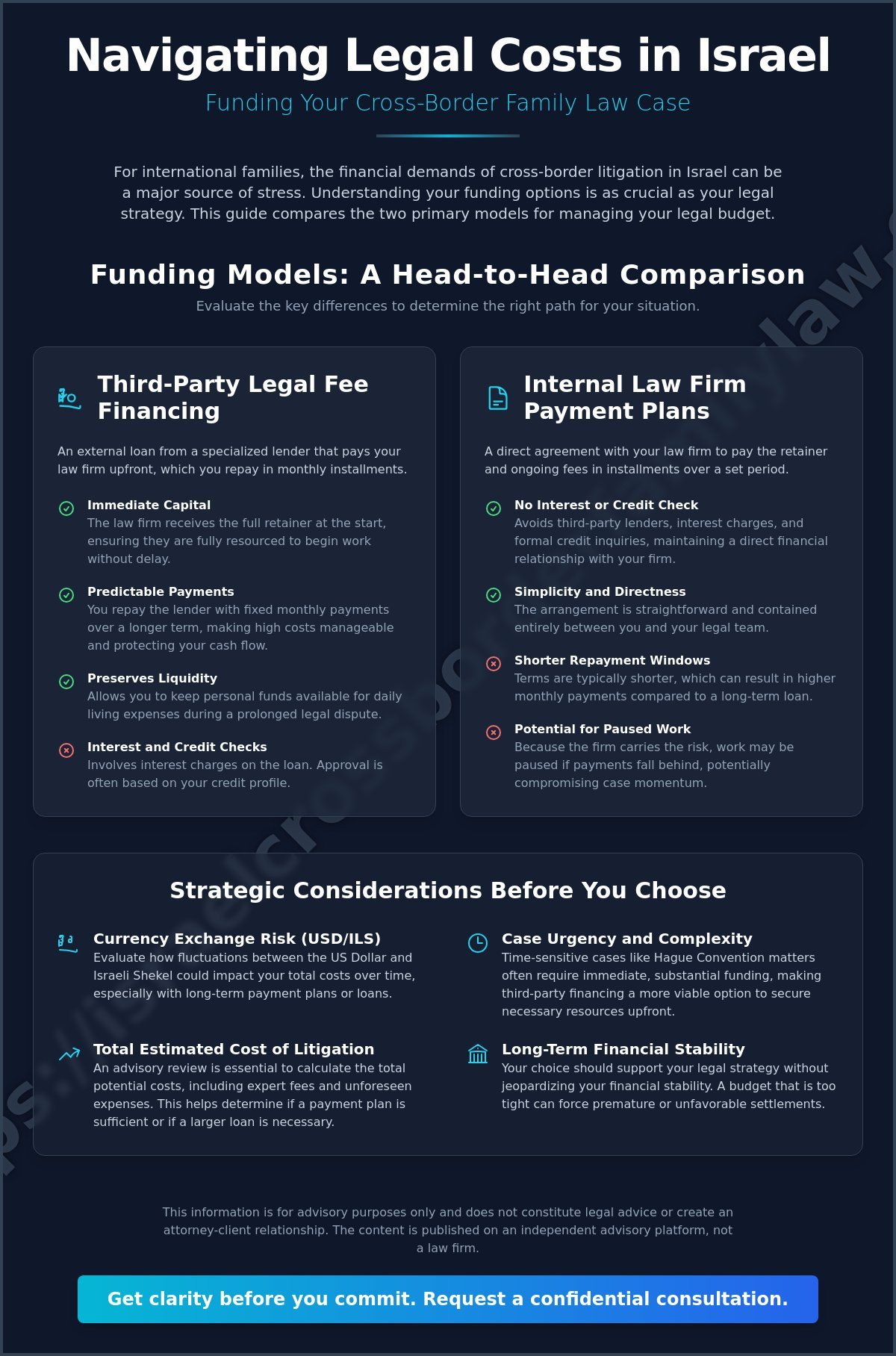
Deciding how to manage the costs of cross-border litigation requires a clear understanding of your available funding models. You will generally choose between an internal arrangement with your firm or an external financial product. Many international families ask, “is legal fee financing an option that provides better security than a private agreement?” The answer depends on whether you prefer the simplicity of an interest-free plan or the lower monthly burden of a long-term loan. Each path has distinct implications for your liquid capital and the pace of your case.
Internal Law Firm Payment Plans
Internal payment plans are agreements made directly between the client and the law firm. These are a common choice for divorce and separation for international families who wish to avoid third-party lenders. These plans offer the benefit of no interest charges and no formal credit checks, maintaining a direct relationship with your advisor. However, they typically feature shorter repayment windows. Because the firm is carrying the financial risk, they may require higher monthly payments or full settlement before the case concludes, which might not cover the full cost of a long trial.
Third-Party Legal Fee Loans
Third-party financing involves an external financial institution that pays the law firm the full retainer amount upfront. This provides the firm with immediate financial certainty, which often allows for more aggressive and focused representation. To better understand the landscape of these services, you can consult a guide to litigation funding that details how these entities operate in IL. “Retain Now, Pay Later” serves as a fintech bridge that provides immediate legal access for those who cannot liquidate assets quickly.
- Pros: These loans offer longer terms, often up to 60 months, which significantly reduces your monthly cash outlay and covers large retainers in full.
- Cons: Interest rates apply, and the process requires credit approval, which could impact your credit score.
For international clients, it’s vital to account for interest costs and currency fluctuations. As of May 25, 2026, the Bank of Israel benchmark interest rate was set at 3.75%. Most commercial legal loans are structured as the Prime rate plus a margin. A loan taken in one currency to pay for services in another can fluctuate in value over a multi-year term. You should discuss these financial nuances with a strategic advisor before committing to a specific funding path.
Evaluating Options for Cross-Border Legal Matters
Evaluating your financial path is a critical step in cross-border litigation. You must determine if a provider can bridge the gap between your assets in one country and legal needs in another. For an expat living in Tel Aviv with bank accounts in New York, the primary concern is whether is legal fee financing an option that works across these specific boundaries. You need a lender that understands the requirements of the Israeli legal system and can facilitate payments to local firms without bureaucratic delays.
One vital aspect is the ability to replenish retainers. Cross-border family law cases often evolve in ways that require additional funds for expert witnesses or unexpected hearings. A rigid loan that only covers the initial payment may leave you stranded mid-litigation. Look for flexible arrangements that allow you to increase your credit line as the case progresses. This ensures your strategy remains uninterrupted by temporary cash flow issues. Many families find that having this financial “safety net” provides the peace of mind needed to focus on the case itself.
You should also consider the total cost of credit against the risk of an underfunded case. In IL, court filing fees for monetary claims in Family Court are typically 1% of the amount sought. While interest on a loan adds to your expenses, the cost of losing a case because you couldn’t afford a critical expert or necessary filing can be far higher. Strategic financing allows you to maintain the quality of your representation from the first hearing to the final judgment. To understand how these costs are structured, you might review our pricing overview for a clearer picture of typical litigation expenses.
Currency and Jurisdictional Challenges
When your legal services are based in Tel Aviv but your loan is in USD, currency exchange rates become a significant factor. A USD-based loan balance will fluctuate when converted to ILS for disbursement to your legal team. You must also account for international wire transfer fees and the time it takes for funds to arrive in a firm’s trust account. Some lenders specialize in these transnational operations, streamlining the process to avoid delays. You should also consult with a tax professional regarding the implications of moving large sums across borders for legal purposes.
Assessing Lender Transparency
Transparency is paramount when selecting a third-party lender for sensitive family matters. You should prioritize providers that offer clear interest rate disclosures and a “no hidden fee” policy. Because cross-border cases are complex, having access to an intuitive web portal is essential for tracking your balance and payments from any time zone. Lenders who specialize in family law often provide more tailored support than general personal loan companies. They understand the emotional and strategic nuances of divorce or custody matters, which can make the process feel more supportive and less transactional.
Strategic Considerations Before Choosing a Financing Path
Choosing a funding route is a strategic decision that affects the very foundation of your legal position. Many clients focus on the immediate cost, but the real question is whether is legal fee financing an option that provides the necessary leverage to achieve a favorable outcome. Financial certainty allows you to secure high-level expert witnesses, such as forensic accountants for complex asset division or child psychologists for custody disputes, without hesitating over the expense. When you aren’t forced to cut corners, your representation can be as robust as the case requires.
Early decisions in cross-border cases often dictate the final outcome. If you have the funds to act immediately, you can prevent the other party from establishing a tactical advantage, such as filing first in a more favorable jurisdiction. However, there’s a subtle risk of over-litigating. When credit is readily available, it’s tempting to pursue every minor legal point, which can lead to unnecessary costs. A disciplined approach ensures that your funding is used to support your primary objectives rather than fueling endless procedural battles. You should also consider privacy; third-party lenders typically require a degree of information about your case to assess their risk. You must ensure that this disclosure doesn’t waive attorney-client privilege or expose sensitive details to unauthorized parties.
Financial Readiness and Legal Leverage
In time-sensitive matters like Hague Convention child abduction cases, the ability to launch a rapid response is paramount. Financing provides the liquidity needed for immediate filings and international coordination. It’s also about endurance. You need to ensure you can sustain a marathon case, as international litigation in IL can span several years. Be cautious of predatory lenders who target vulnerable individuals with exorbitant rates; instead, look for reputable institutions that specialize in legal credit. This ensures your strategy remains focused on the long term rather than immediate cash constraints.
Disclosing Financing in Cross-Border Litigation
One specific concern for expats is whether they must disclose their funding source to the court in IL. While third-party funding is generally permissible, courts may scrutinize these arrangements if they believe a conflict of interest exists. Financing can also impact the fee-shifting process. In IL, the court has the discretion to award legal costs to the winning party. Having a clear record of your financed expenses can simplify this recovery process. Before finalizing any agreement, consult with an advisor on the pricing and structure of your representation to ensure it aligns with your long-term budget. Speak with a strategic advisor to evaluate your funding options.
This article is published on an independent advisory platform (not a law firm) and must not imply an attorney-client relationship.
The Advisory Approach: Gaining Clarity on Your Legal Budget
A strategic advisory approach differs fundamentally from traditional legal representation. While a licensed attorney focuses on the specific legal arguments within a courtroom, an advisor helps you step back and look at the financial architecture of your entire case. Many international families struggle to see the full picture of their litigation expenses until they are already deep in the process. By seeking an advisory perspective, you can determine if is legal fee financing an option that aligns with your broader financial goals before you sign a formal engagement with a law firm.
Gaining clarity on your budget requires a thorough understanding of how it works when managing a case across two different legal systems. An advisor provides a neutral evaluation of your situation, helping you anticipate the costs of filing fees, expert witnesses, and multi-jurisdictional coordination. This process is focused on the return on investment of your legal spend. Protecting significant assets in both the US and IL requires a strategy that is financially sustainable. You shouldn’t have to choose between a strong legal position and your long-term financial stability.
Planning Your Financial Strategy
Developing a multi-stage budget is essential for complex matters like international custody or divorce. You need to know not just the initial retainer cost, but the estimated total spend through various phases of the litigation. This allows you to integrate financing into a larger asset protection plan, ensuring that you don’t exhaust your liquid cash during the most critical moments of the case. Early financial planning is the foundation of a stable legal outcome. By mapping out these costs early, you gain the leverage needed to negotiate from a position of strength rather than financial desperation.
Next Steps for International Families
If you are considering your funding options, your first step should be gathering all relevant financial documents for a preliminary assessment. This includes statements that reflect your assets and liabilities in both countries. It’s vital to remember the distinction between advisory services and licensed legal counsel. An advisor helps you build the strategy and budget, while a licensed attorney provides the actual representation in court. To begin this process, you can request a confidential case review to discuss your specific needs. This review will help you understand whether is legal fee financing an option that can provide the security you need to protect your family’s future.
Get clarity before you commit. Request a confidential consultation.
Securing Your Financial Foundation for International Litigation
Navigating the intersection of US and Israeli legal systems requires more than just legal expertise; it demands a sustainable financial strategy. We’ve explored how third-party funding provides the necessary capital to secure high-level expert witnesses and maintain robust representation throughout a lengthy trial. By comparing internal law firm payment plans with external loans, you can make an informed choice that preserves your liquidity and protects your family’s future. For many families facing these complex decisions, the central question remains: is legal fee financing an option that aligns with their specific asset protection goals?
Our authoritative advisory focus is on strategic risk management for international families. We bring specialized expertise in cross-border US-Israel family law to help you evaluate these paths with absolute clarity. Early decisions regarding your budget will serve as the anchor for your legal stability in IL. You don’t have to navigate these jurisdictional and financial complexities alone. Decisions made today will determine the strength of your position tomorrow.
Get clarity before you commit. Request a confidential consultation to discuss your funding and strategy options. We are here to help you move forward with confidence and strategic certainty.
This article is published on an independent advisory platform (not a law firm) and must not imply an attorney-client relationship.
Frequently Asked Questions
Is legal fee financing available for international divorce cases?
Yes, legal fee financing is widely accessible for international divorce and custody cases involving the Israeli courts. These arrangements are particularly effective for families who need to manage the high costs of dual-jurisdiction litigation and expert testimony. Lenders typically evaluate your financial profile to provide the capital necessary for immediate court filings and strategic representation in the Israeli legal system.
What are the typical interest rates for legal fee loans in 2026?
Interest rates in 2026 are closely tied to the Bank of Israel’s benchmark rate, which was set at 3.75% as of May 25, 2026. Most commercial legal loans are structured as the prime rate plus a specific margin determined by the lender. Your final rate will depend on your personal credit history and the lender’s specific assessment of the case’s financial requirements.
Can I use a US-based lender to pay a lawyer in Israel (IL)?
You can use a US-based lender if they have the established infrastructure to handle international wire transfers to IL. The lender usually pays the funds directly into the Israeli law firm’s trust or escrow account to ensure the money is used specifically for legal costs. This process requires careful coordination to account for currency exchange fluctuations and any associated international transfer fees.
Will applying for legal financing affect my credit score?
Applying for a legal fee loan generally involves a formal credit inquiry, which may cause a minor and temporary change in your credit score. Most lenders perform a standard credit check to determine your eligibility and set your interest rates. It is a standard financial transaction that functions similarly to applying for a personal loan or a new line of credit.
What happens if my case ends before the loan is fully spent?
If your case concludes before the full loan amount is utilized, any remaining funds held in the law firm’s trust account are typically returned to the lender. This refund is applied directly to your outstanding loan balance to reduce the total principal you owe. This mechanism ensures you only pay interest on the funds that were actually spent on your legal representation.
Are payment plans with the law firm better than third-party financing?
Choosing between a firm-led plan and third-party credit depends entirely on your monthly cash flow requirements. Firm plans are often interest-free but usually require larger payments over a much shorter period. If you need to lower your monthly expenses over several years, is legal fee financing an option that provides significantly greater flexibility for your long-term financial planning.
Can I finance a retainer for a child support enforcement case?
Yes, you can secure funding for retainers in child support enforcement or international relocation cases involving the Israeli Family Court. These matters often require immediate action to protect a child’s interests or secure financial support across borders. Determining if is legal fee financing an option for enforcement allows you to act decisively without waiting for liquid assets to become available.
Do I need to put up collateral for a legal fee loan?
Most legal fee financing products for family law are unsecured, meaning you don’t need to provide physical collateral like a home or vehicle. The lender’s decision is primarily based on your creditworthiness and your documented ability to make monthly repayments over the loan term. This makes it an accessible choice for expats who may not yet have significant physical assets within IL.

Article by
Gabriel Lior
A Personal Journey That Became a Mission
The advisory was founded by an American father Gabriel Lior, LLB, MBA , global entrepreneur, and cross-border advisor who spent more than a decade navigating the Israeli family court system firsthand and now lives in Singapore with his son.
As a divorced parent in a cross-border family, Gabriel faced nearly every legal challenge a foreign parent can encounter in Israel — including child custody disputes, child support proceedings, property matters in Israel and abroad, false accusations, and complex immigration and relocation proceedings.
Over the years, he learned the hard way how difficult it is for non-Israeli parents to understand the system, identify the right legal strategy, and choose the right legal representation — especially when language, culture, and jurisdictional differences are involved. He also witnessed how foreign parents and new immigrants are often disadvantaged or taken advantage of by service providers and institutions simply because they lack local knowledge or fluency.
From Client to Advisor
To truly understand — and survive — the system, Gabriel pursued formal legal education in Israel, completing two Israeli law degrees, alongside a BA and MBA earned in the United States. This was never about becoming a practicing attorney, but about gaining a deep, structural understanding of how the system works — and where it breaks down for foreign parents.
This rare combination of:
Firsthand client experience
Israeli legal and US business education
International business and negotiation training
Decades of commercial execution
created a unique perspective – one that understands both sides of the table.
After years of litigation, persistence, and at times self-representation, he ultimately succeeded in securing custody of his son and relocating abroad through a rare legal victory in the Israeli Supreme Court — becoming one of the first fathers in Israel to do so under these circumstances.
Disclaimer
Important Disclaimer:
The information provided on this website and in its content is for general informational and educational purposes only and does not constitute legal advice, legal opinion, or legal representation.
Gabriel Lior is not licensed to practice law in Israel (nor is he interested in doing so) and does not provide legal services, despite having completed 2 Law Degrees. The services offered are advisory in nature and are intended to provide general guidance, strategic insight, and information regarding cross-border family law considerations.
No attorney-client relationship is formed by accessing this website, reading its content, or communicating with us.
Any decisions made based on this information are at your own discretion and risk. For legal advice specific to your situation, you should consult a licensed attorney in the relevant jurisdiction.
Where appropriate, we may refer clients to independent, licensed attorneys or professionals. Such referrals do not constitute legal representation and no liability is assumed for services provided by third parties.