This article is published on an independent advisory platform (not a law firm) and does not constitute an attorney-client relationship.
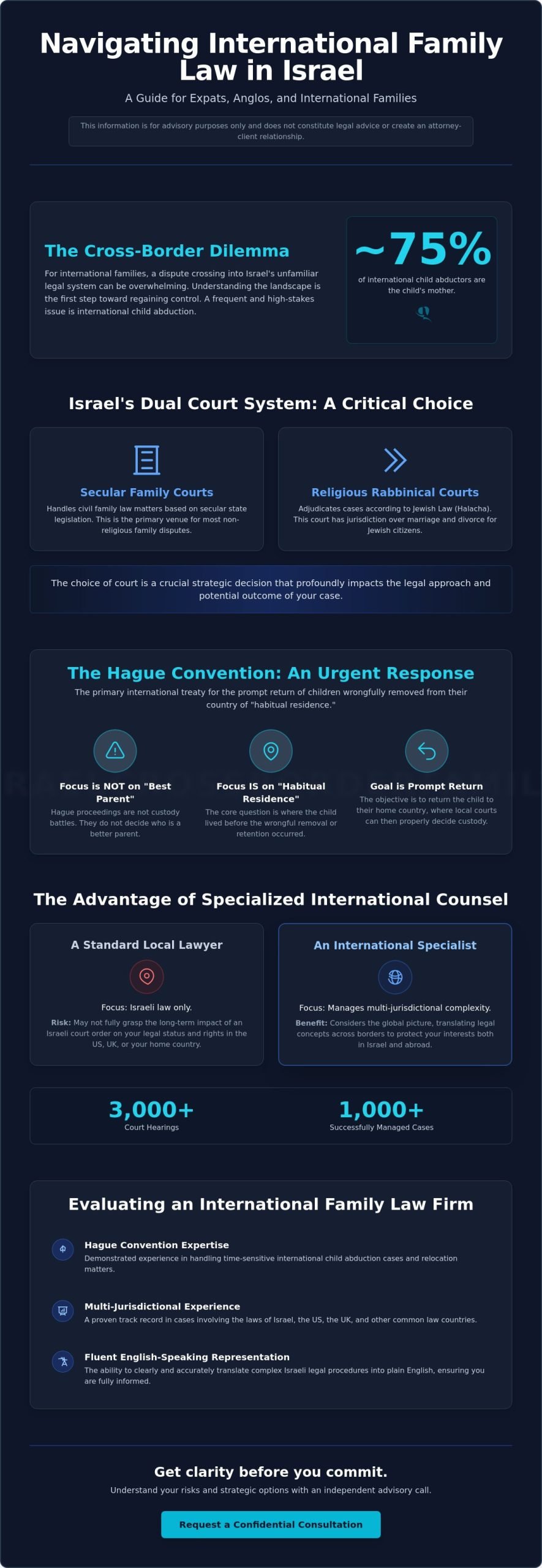
Did you know that in roughly 75% of international child abduction cases, the person taking the child is the mother? For many expats and international families, the realization that a family dispute has crossed borders into Israel (IL) brings an immediate sense of panic. It’s natural to feel overwhelmed by a legal system that operates in a different language and follows unfamiliar rules. Understanding the role of a firm like Segal Simchauve is a critical first step toward gaining control of your situation.
You likely want to know how to protect your family while navigating a system that feels foreign. This article provides an educational overview of the firm’s expertise and the strategic importance of choosing specialized international legal counsel in Israel. We’ll explore the criteria for evaluating international family lawyers and provide clarity on complex US-Israel legal disputes. You’ll learn about the impact of early decisions and how to manage risks without the confusion of legal jargon, ensuring you have the knowledge needed to move forward with confidence.
Key Takeaways
- Gain an educational overview of the international profile of Segal Simchauve and how their Tel Aviv-based practice supports families navigating the Israeli legal landscape.
- Learn why specialized knowledge of the Hague Convention is essential for managing cross-border child custody disputes and ensuring the safety of minors.
- Understand the strategic necessity of English-speaking representation to accurately translate complex legal concepts between the US and Israel.
- Discover the key benchmarks for evaluating international family law firms, focusing on multi-jurisdictional experience and proven success in relocation matters.
- Identify how independent advisory platforms provide clarity on risks and strategies before you commit to formal legal representation.
Introduction to Segal Simchauve & Partners: An International Legal Profile
PUBLICATION NOTE: This article is published on an independent advisory platform and does not imply an attorney-client relationship.
Segal Simchauve & Partners maintains a prominent position within the Tel Aviv legal sector as an international law firm dedicated to complex family and divorce matters. Founded by Adv. Asi Segal and Adv. Shay Simchauve, the firm focuses on the specific needs of English-speaking clients and international families who are navigating the Israeli (IL) legal system. Their practice is built on the understanding that cross-border disputes require more than just a knowledge of local law; they require a sophisticated grasp of how different legal cultures and jurisdictions interact.
To better understand the depth of professional experience required for these complex matters, watch this helpful video:
The Firm’s Role in the Israeli Legal Landscape
Israel presents a unique challenge for international families because of its dual court system. Cases can be heard in either secular Family Courts or religious Rabbinical Courts; the choice of venue often dictates the legal strategy and the eventual outcome. Segal Simchauve acts as a guide through this complex landscape, helping clients understand the implications of where their case is filed. Maintaining a physical presence in Tel Aviv is essential for this work. It allows the firm to engage directly with the central district courts where many international matters are litigated. With a history that includes over 3,000 court hearings and more than 1,000 successfully managed cases, the firm provides a steady hand for those facing the uncertainty of Israeli litigation. You can learn more about how this strategic guidance works on our about the advisory page.
Defining “International” in the Context of Israeli Law
Being an international practitioner in Israel involves much more than linguistic fluency. While speaking English is a vital prerequisite for serving Anglos and expats, the true value lies in the ability to translate legal concepts across borders. A standard local lawyer might not fully grasp the long-term implications of an Israeli court order on a client’s status in the US or the UK. In contrast, an international firm manages these multi-jurisdictional complexities by looking at the global picture. This is especially true in cases involving the Hague Convention on the Civil Aspects of International Child Abduction. These matters require an urgent, specialized response to ensure the prompt return of children wrongfully removed from their home country. By prioritizing clear communication and strategic planning, the firm helps families avoid the pitfalls that often arise when local decisions are made without considering international consequences.
Core Expertise: Hague Convention and Cross-Border Custody
International family law is defined by its high stakes and time-sensitive nature. When a child is moved across borders without consent, the legal response must be immediate and precise. The primary tool used in these situations is the Hague Convention on the Civil Aspects of International Child Abduction. This international treaty is designed to ensure the prompt return of children to their “habitual residence” so that custody can be decided by the appropriate court in the country where the child actually lives.
For families in Israel (IL), navigating these waters requires a firm like Segal Simchauve that understands both the local Family Court procedures and the global implications of the treaty. Specialized representation is critical because Hague cases are not traditional custody battles. They don’t focus on who is the better parent. Instead, they focus on where the child lived before the move and whether the removal was wrongful. This distinction is often misunderstood by parents, which can lead to costly strategic errors during the initial stages of a dispute.
Navigating International Child Abduction Cases
Speed is the most important factor in abduction cases. A “return order” is the primary goal of a Hague petition, and the window for filing is narrow. In fact, if a petition is filed within one year of the move, the court is strongly favored to order the child’s return. After that one-year threshold, the case becomes significantly more difficult as the other parent may argue the child is “settled” in their new environment. According to the U.S. State Department on International Child Abduction, approximately 10,000 cases of international parental child abduction occur annually. Parents facing these challenges should review our detailed guide on Hague Convention Child Abduction to understand the procedural requirements. Strategic planning at the outset determines whether a child is returned or remains in a new jurisdiction indefinitely.
Enforcing Support and Custody Across Borders
Beyond abduction, many families struggle with the cross-border enforcement of child support and visitation. An order issued in a US court isn’t automatically valid in Israel. It must be recognized through a specific legal process involving the Israeli court system. This often creates friction, especially in cases involving parental alienation or chronic visitation violations. Early decisions regarding how to present a US order to the Israeli system are vital. Without the right approach, a parent might find themselves unable to enforce financial support or maintain a relationship with their child. You can explore more about these mechanisms in our overview of child support cross-border enforcement. If you’re unsure about your current standing, it’s wise to discuss your situation to gain clarity on the risks involved.
The Importance of English-Speaking Legal Representation in Israel
For Anglos and expats living in Israel (IL), the legal system often feels like a maze of unfamiliar Hebrew terms and procedural hurdles. While many Israeli practitioners speak English, there’s a vast difference between basic linguistic fluency and the ability to translate nuanced legal concepts. In family law, a single misunderstood word or poorly explained clause can change the trajectory of a case for years. This is why clear communication is not just a convenience; it’s a strategic necessity.
Firms like Segal Simchauve act as a cultural bridge for international families. They understand that a client’s background in the US or UK shapes their expectations of how a court should function. It isn’t just about what is being said in a hearing, but why it’s being said and how it fits into a broader global strategy. Having a representative who can explain these complexities in plain English helps reduce the anxiety that naturally comes with cross-border litigation. This transparency ensures that you aren’t just a spectator in your own legal process but an informed decision-maker.
Bridging US and Israeli Legal Cultures
US citizens often enter the Israeli family court system expecting procedural norms like extensive pre-trial discovery or depositions. However, the Israeli system operates differently, often moving at a pace that can feel jarring to those from common law backgrounds. Court etiquette and the weight given to specific types of evidence also vary. A lawyer’s role is to manage these expectations and prevent clients from making tactical errors based on assumptions from their home country. By providing this cultural context, practitioners help clients avoid common pitfalls, such as failing to understand how an initial filing might impact their long-term rights.
Transparency and Advisory in International Divorce
One of the most confusing aspects for expats is the dual jurisdiction between Rabbinical courts and secular Family Courts. This “race of jurisdiction” means that the venue where a case is first filed can significantly influence outcomes regarding property division or alimony. Transparent, jargon-free explanations are essential for navigating this choice. You can find more detailed guidance on these specific challenges in our overview of Divorce & Separation for International Families.
Seeking advisory services early is often more valuable than reactive representation after a crisis has already begun. Early strategy allows you to consider the impact of your decisions on both sides of the border. In complex, multi-year divorce litigation, consistent and clear communication ensures that you remain in control of the strategy. This clarity is the foundation of any successful international legal approach.
Evaluating International Family Law Firms: Key Benchmarks
Selecting the right representation for a cross-border matter is a decision that fundamentally impacts your family’s future. It requires looking beyond general rankings or local reputations. An international case involves layers of complexity that a standard domestic firm may not be equipped to handle. When evaluating a firm like Segal Simchauve, you should focus on their specific ability to bridge the gap between the Israeli (IL) legal system and your home jurisdiction.
A primary benchmark is a proven track record in Hague Convention and international relocation cases. These matters are governed by strict timelines and specific evidentiary rules. You need a team that understands how to present evidence that meets the standards of both Israeli and foreign courts. Additionally, the firm must demonstrate a deep understanding of both religious Rabbinical courts and secular Family Courts in Israel. The ability to pivot between these two paths is often the difference between a successful outcome and a stalled case. Finally, ensure the firm maintains a physical presence and active engagement within Israel to manage the logistical demands of local litigation.
Checklist for Choosing Your Legal Team
- Verify Treaty Expertise: Confirm the firm has handled cases involving specific US-Israel treaty implications, such as the enforcement of foreign support orders.
- Strategic Alignment: Assess whether the firm prioritizes mediation or aggressive litigation. In international cases, a collaborative approach can sometimes prevent the long-term damage of a “scorched earth” court battle.
- Financial Clarity: Review the firm’s approach to Pricing and Fee Transparency. International litigation can be expensive; you deserve a clear understanding of costs before you commit.
- Communication Standards: Ensure the firm has dedicated English-speaking staff who can provide updates without the need for a translator.
Questions to Ask During a Case Review
When you sit down for an initial consultation, go beyond the basics. Ask how many cases similar to yours the firm has handled in the last 24 months. Volume matters because laws and court attitudes toward relocation can shift quickly. Inquire about their logistical setup: how do they manage communication across different time zones? If you are in New York and they are in Tel Aviv, a delay in response can be critical. Most importantly, ask for an honest assessment of the specific risks of your case within the Israeli system. A firm that only promises success without discussing potential pitfalls is not providing the advisory value you need. To begin evaluating your options, you can request a confidential review of your circumstances.
This article is published on an independent advisory platform (not a law firm) and does not constitute an attorney-client relationship.
Strategic Advisory for Complex US-Israel Legal Matters
Navigating a cross-border dispute requires a strategic layer that sits above the day-to-day litigation. While a courtroom battle focuses on immediate rulings, a strategic advisory approach looks at the long-term protection of your global interests. This is particularly important for professionals and families operating within innovation hubs like Tel Aviv, where complex financial assets and high-stakes careers are often part of the equation. Understanding how a firm like Segal Simchauve operates within this fast-paced environment helps you align your legal goals with your broader life objectives.
Proactive planning is the most effective way to protect family interests and assets when living abroad. In Israel (IL), the intersection of secular and religious law can create unexpected risks for the unprepared. By choosing a firm that understands both the US and Israeli legal frameworks, you ensure that decisions made in one country don’t inadvertently damage your standing in the other. This global perspective is essential for managing multi-jurisdictional complexity, especially when it involves transnational business interests or property holdings.
The Path to Informed Choices
The first step in any international dispute should be a thorough assessment of the landscape. A confidential case review allows you to map out potential risks and identify the most favorable path forward before you commit to a specific course of action. This process helps you understand how the advisory works to provide clarity in a confusing system. By working with multi-qualified practitioners who understand divergent legal cultures, you can build a collaborative strategy that integrates local Israeli representation with your existing global legal needs.
Final Strategic Recommendations
Successful outcomes in international family law are rarely the result of emotional reactions. Instead, they come from measured, logical decision-making based on a clear understanding of the law. You should prioritize firms that demonstrate a deep knowledge of the specific treaties and procedural differences discussed throughout this article. Seeking clarity early on prevents the common pitfalls that arise when families wait until a crisis occurs to seek guidance. The impact of your early decisions will likely be felt for years; it’s vital to move forward with a plan that accounts for all jurisdictions involved. Get clarity before you commit. Request a confidential consultation to discuss your strategy.
Securing Your Family’s Future Across Borders
Navigating the intersection of US and Israeli law requires more than just local knowledge; it demands a global perspective. We’ve explored how specialized representation in matters like the Hague Convention and cross-border custody ensures your rights are protected in both jurisdictions. Understanding the profile of Segal Simchauve helps you identify the benchmarks of quality required for successful international litigation. By prioritizing clear communication and a deep understanding of the IL legal landscape, you can move from a place of uncertainty to one of strategic clarity.
Success in these high-stakes cases depends on making informed choices before a crisis escalates. Whether you’re dealing with child support enforcement or complex divorce proceedings, your strategy should always account for the cultural and systemic differences between countries. Protecting your interests is possible when you have the right advisory support to guide you through each decision. Get clarity before you commit. Request a confidential consultation.
Moving forward with a well-defined strategy is the best way to ensure a stable and secure future for your family in Israel.
This article is published on an independent advisory platform (not a law firm) and does not constitute an attorney-client relationship.
Frequently Asked Questions
Who are the founding partners of Segal Simchauve & Partners?
The founding partners of the firm are Adv. Asi Segal and Adv. Shay Simchauve. They lead a professional team dedicated to guiding international families through the complexities of the Israeli legal system. Their combined decades of experience include managing over 1,000 cases, with a specific focus on the multi-jurisdictional challenges faced by Anglos and expats living in Israel (IL).
What are the primary specialties of the Segal Simchauve law firm?
The firm focuses exclusively on family law, divorce law, and the creation of wills and estates. Their practice is designed to handle high-stakes litigation and strategic planning for international clients. This includes navigating the dual jurisdiction of Israel’s secular Family Courts and religious Rabbinical Courts, ensuring that global interests are protected throughout the legal process.
Does the firm handle US-Israel international divorce cases?
Yes, the firm manages complex international divorce cases that involve both US and Israeli jurisdictions. They address critical issues such as property division, alimony, and the enforcement of foreign judgments. Their expertise helps ensure that legal decisions made in Israel are structured to be recognized and effective within the United States legal framework.
Is Segal Simchauve an English-speaking law firm in Israel?
Segal Simchauve is a prominent English-speaking firm that provides clear, jargon-free communication for the Anglo community in Israel. Their staff is fluent in English, which allows them to act as a cultural and linguistic bridge during court proceedings. This ensures that clients remain fully informed and in control of their legal strategy without the frustration of a language barrier.
What is the firm’s experience with the Hague Convention?
The firm has extensive experience litigating cases under the Hague Convention on the Civil Aspects of International Child Abduction. They have participated in numerous court hearings to secure the prompt return of children to their habitual residence. This specialized knowledge is vital because Hague cases follow unique international rules and very strict timelines that differ from standard custody battles.
Where is the Segal Simchauve law office located?
The firm’s primary office is located in Tel Aviv, Israel. Maintaining a physical presence in this central innovation hub allows the team to engage directly with the district courts where many international family law matters are heard. This local engagement is a key differentiator for clients who need active representation within the Israeli legal landscape.
Can this firm help with enforcing US child support in Israel?
The firm assists clients with the cross-border enforcement of US child support orders within the Israeli (IL) system. Since foreign orders aren’t automatically valid in Israel, they must go through a specific recognition process in the local courts. The firm guides parents through these procedural requirements to ensure that financial support obligations are legally recognized and enforced across borders.
How do I evaluate if an Israeli law firm is right for my international case?
You should evaluate a firm based on their specific experience with international treaties and their ability to manage cases across multiple jurisdictions. It’s important to look for transparency in pricing and a firm that provides an honest assessment of risks rather than guarantees. Ensure they have the linguistic skills to explain complex Israeli legal concepts in plain English before you commit.

Article by
Gabriel Lior
A Personal Journey That Became a Mission
The advisory was founded by an American father Gabriel Lior, LLB, MBA , global entrepreneur, and cross-border advisor who spent more than a decade navigating the Israeli family court system firsthand and now lives in Singapore with his son.
As a divorced parent in a cross-border family, Gabriel faced nearly every legal challenge a foreign parent can encounter in Israel — including child custody disputes, child support proceedings, property matters in Israel and abroad, false accusations, and complex immigration and relocation proceedings.
Over the years, he learned the hard way how difficult it is for non-Israeli parents to understand the system, identify the right legal strategy, and choose the right legal representation — especially when language, culture, and jurisdictional differences are involved. He also witnessed how foreign parents and new immigrants are often disadvantaged or taken advantage of by service providers and institutions simply because they lack local knowledge or fluency.
From Client to Advisor
To truly understand — and survive — the system, Gabriel pursued formal legal education in Israel, completing two Israeli law degrees, alongside a BA and MBA earned in the United States. This was never about becoming a practicing attorney, but about gaining a deep, structural understanding of how the system works — and where it breaks down for foreign parents.
This rare combination of:
Firsthand client experience
Israeli legal and US business education
International business and negotiation training
Decades of commercial execution
created a unique perspective – one that understands both sides of the table.
After years of litigation, persistence, and at times self-representation, he ultimately succeeded in securing custody of his son and relocating abroad through a rare legal victory in the Israeli Supreme Court — becoming one of the first fathers in Israel to do so under these circumstances.
Disclaimer
Important Disclaimer:
The information provided on this website and in its content is for general informational and educational purposes only and does not constitute legal advice, legal opinion, or legal representation.
Gabriel Lior is not licensed to practice law in Israel (nor is he interested in doing so) and does not provide legal services, despite having completed 2 Law Degrees. The services offered are advisory in nature and are intended to provide general guidance, strategic insight, and information regarding cross-border family law considerations.
No attorney-client relationship is formed by accessing this website, reading its content, or communicating with us.
Any decisions made based on this information are at your own discretion and risk. For legal advice specific to your situation, you should consult a licensed attorney in the relevant jurisdiction.
Where appropriate, we may refer clients to independent, licensed attorneys or professionals. Such referrals do not constitute legal representation and no liability is assumed for services provided by third parties.