This article is published on an independent advisory platform and does not constitute an attorney-client relationship. The content is for informational and advisory purposes only and does not constitute legal representation or legal advice.
What if the biggest threat to your Israeli divorce isn’t the legal argument itself, but a procedural error made during a delivery in the United States? When your spouse lives thousands of miles away, the simple act of providing notice becomes a complex exercise in international law. You likely feel the pressure of getting this right, knowing that a single mistake could lead to a court dismissal or allow a spouse to evade the proceedings entirely. Learning how to serve divorce papers from Israel to USA is a critical first step that requires more than just a standard courier; it demands a strategic alignment with both Israeli court rules and American due process.
In this guide, you’ll learn the essential legal steps and treaties required to properly serve divorce process from Israel to a spouse residing in the United States. We will examine the mandatory framework of the Hague Service Convention, the role of Central Authorities, and the specific timelines you should expect. By understanding these cross-border requirements early, you can ensure your service is legally valid in both jurisdictions and avoid unnecessary delays in your proceedings.
Key Takeaways
- Understand the mandatory role of the Hague Service Convention in ensuring your Israeli divorce filing remains valid and enforceable across international borders.
- Discover the essential procedural steps for how to serve divorce papers from Israel to USA, including obtaining necessary orders from IL family or rabbinical courts.
- Learn how American “due process” and diverse state regulations in the US can impact the timeline and legal validity of your notice.
- Identify strategic tools, such as skip tracing, to effectively manage spouses who are difficult to locate or are actively evading service.
- Explore why coordinating your service strategy before filing is critical for securing your preferred jurisdiction and avoiding a “race to the courthouse.”
This article is published on an independent advisory platform and does not constitute an attorney-client relationship. The content is for informational and advisory purposes only and does not constitute legal representation or legal advice.
The Legal Framework: The Hague Service Convention Between Israel and the US
The legal foundation for your cross-border case rests on a specific international treaty. The Hague Service Convention is the primary mechanism that ensures legal documents move safely between Israel and the United States. Since both nations are signatories, this treaty provides a standardized path for “service of process,” which is the formal delivery of legal documents. When you are determining how to serve divorce papers from Israel to USA, you aren’t just sending mail. You’re following a treaty designed to protect the rights of both parties and ensure that any resulting court order is enforceable in both countries.
There is a sharp distinction between simply notifying your spouse and legally serving them. Notification might happen through a phone call or a text, but service is a formal act that triggers the court’s jurisdiction over the respondent. Without valid service under the Convention, a US court may refuse to recognize an Israeli divorce decree. Similarly, an Israeli court might find it cannot proceed with certain financial or custodial claims if the respondent hasn’t been served according to these international standards. Mastering the mechanics of how to serve divorce papers from Israel to USA ensures that your case stands on solid ground from day one.
To better understand the practical side of serving papers within the American system, watch this helpful video:
The Role of the Israeli Central Authority
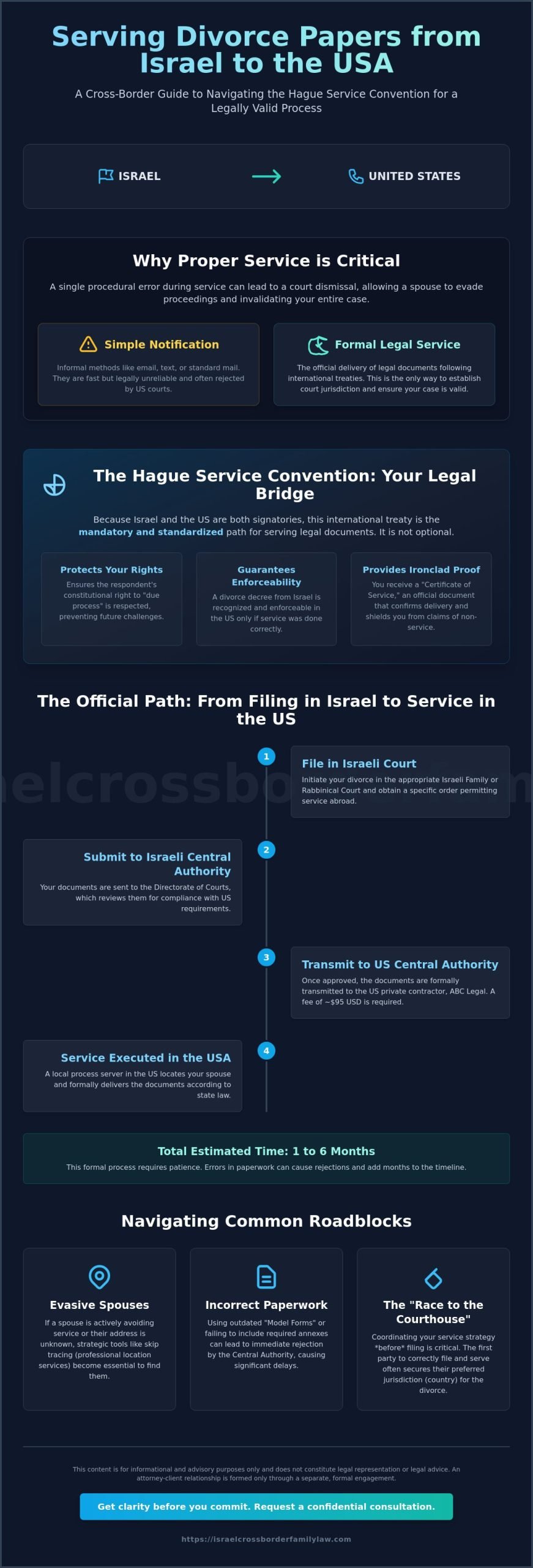
In Israel, the Directorate of Courts acts as the Central Authority. Their job is to review your request before it ever leaves the country. They ensure your documents meet the specific requirements set by the US Department of Justice. This administrative journey starts at the Israeli Family Court, moves to the Directorate of Courts, and eventually reaches the US Central Authority’s private contractor, ABC Legal. You should expect a fee of approximately $95.00 USD for the service within the United States. Errors at this stage, such as using outdated “Model Forms” or failing to provide the required annexes, can lead to immediate rejection. This adds months to a process that typically takes between one and six months to complete.
Hague Convention vs. Informal Notification
It’s tempting to use faster, informal methods like WhatsApp, email, or regular registered mail. While Israel doesn’t technically object to service by postal channels, this method is often unreliable and fraught with issues. US courts are highly protective of “due process,” a constitutional principle that requires clear proof that the respondent was properly notified. If you rely on informal methods, you risk having a “default judgment” overturned years later. This could reopen sensitive issues regarding asset division or child support at a time when you thought the case was closed. Using the formal Hague process provides a “Certificate of Service” that acts as an ironclad shield against future legal challenges. For more complex situations involving children, you can read more about divorce and separation for international families to understand how these early decisions impact your long-term strategy.
This article is published on an independent advisory platform and does not constitute an attorney-client relationship. The content is for informational and advisory purposes only and does not constitute legal representation or legal advice.
Step-by-Step Process: Delivering Papers from Israel to a US Address
The journey of a legal document from an Israeli court to a US doorstep is a multi-stage process that requires meticulous attention to detail. After you secure a court order from the Family or Rabbinical Court authorizing service abroad, you must prepare the “Model Form.” This standardized request serves as the official cover for your legal dossier. You’ll need to include the summons, the divorce petition, and any relevant interim orders. These documents are submitted to the Directorate of Courts in Jerusalem, which acts as the intermediary for all Hague Service Convention requirements for Israel. Once approved, the Directorate forwards the request to the US Department of Justice.
Understanding how to serve divorce papers from Israel to USA involves more than just handing over a folder. Once the papers reach the US, the Department of Justice utilizes a private contractor, ABC Legal, to execute the service. There is a standard fee of $95.00 USD for this service within the US. You’ll eventually receive a formal “Certificate of Service” once the delivery is successful. This certificate is your primary evidence for the Israeli court, proving the respondent has been legally notified under international standards. If you’re feeling overwhelmed by these procedural hurdles, it’s often helpful to get professional guidance early in the process.
Translation and Documentation Standards
Precision in legal translation is a mandatory requirement. Your Hebrew court documents must be translated into English by a professional who can provide a certificate of accuracy. US courts and authorities are strict about “due process,” meaning the respondent must be able to fully understand the claims against them. If the translation is poor or confusing, the service can be challenged or rejected. Additionally, when the proof of service returns from the US to IL, you may need an Apostille or a notarized translation back into Hebrew for the Israeli court to accept the filing. Accuracy at this stage prevents the case from stalling before it truly begins.
Timeline and Logistics of International Service
Patience is a necessity when learning how to serve divorce papers from Israel to USA. While some cases are resolved in 1 to 4 months, the process can easily extend to 6 months depending on the specifics of the US location. Geography plays a significant role; serving someone in a major hub like New York City is often faster than reaching a spouse in a remote rural area. Before you file, verify your spouse’s current residential address. If the address is incorrect, the US process server will return the documents to the Central Authority, forcing you to start the entire administrative cycle from the beginning. You can learn more about managing these variables by reviewing our guide on how the advisory process works for international families.
This article is published on an independent advisory platform and does not constitute an attorney-client relationship. The content is for informational and advisory purposes only and does not constitute legal representation or legal advice.
Navigating US Due Process and State-Specific Requirements
The American legal system operates under the strict principle of “due process.” This constitutional protection ensures that no individual is deprived of their rights or property without receiving fair and adequate notice. When you are researching how to serve divorce papers from Israel to USA, you must realize that what an Israeli judge considers sufficient may not satisfy an American court. If your spouse later claims they weren’t personally served, a US court could refuse to recognize your Israeli decree. This creates a significant risk for anyone with shared assets or family obligations in the United States.
Each state in the US maintains its own specific rules of civil procedure. A service method that is perfectly valid in California might face intense scrutiny in New York or Florida. While the Hague Convention provides a global framework, local US courts often look for proof of service that aligns with their own specific state laws. This multi-jurisdictional complexity is why a uniform approach rarely works in cross-border divorce. You must ensure that the method you choose satisfies both the Israeli court’s requirements and the specific standards of the state where your spouse resides.
Personal Service vs. Service by Mail
Article 10 of the Hague Convention allows for service by mail if the destination country doesn’t object. The US doesn’t object to this method, but most practitioners advise against it. Mail can be lost, signed for by a roommate, or simply ignored by the recipient. In contrast, personal service by a professional process server provides a sworn affidavit of delivery. This creates an undeniable record that the respondent received the papers. Choosing personal service is the most reliable way to fulfill your obligations when you need to know how to serve divorce papers from Israel to USA effectively.
The Risk of Non-Enforcement
US courts follow the principle of “comity,” which means they respect foreign judgments out of mutual courtesy. However, this respect is only granted if the foreign proceeding was fair and followed proper notice procedures. If a spouse in the US can prove they weren’t served according to local standards, the US court may choose to ignore the Israeli ruling. This is particularly dangerous for child support and alimony enforcement. Without valid, verifiable service, you may find it impossible to garnish wages or seize assets in the US to satisfy an Israeli judgment. Get clarity before you commit. Request a confidential advisory call or reach out via WhatsApp.
This article is published on an independent advisory platform and does not constitute an attorney-client relationship. The content is for informational and advisory purposes only and does not constitute legal representation or legal advice.
Overcoming Obstacles: Evasive Spouses and Unknown Addresses
Sometimes, a spouse in the US isn’t just living abroad; they’re actively hiding to avoid the legal consequences of a divorce. This creates a significant hurdle when you’re trying to figure out how to serve divorce papers from Israel to USA effectively. If the initial address you provided is no longer valid, you’ll likely need to employ “skip tracing.” This is a professional investigative service in the United States that uses vast databases, including credit headers, utility records, and public filings, to pinpoint a person’s current location. Without a confirmed physical address, the Hague Central Authority cannot initiate the service process, as they require a specific destination for their contracted servers.
When skip tracing fails to produce a result, you must move toward a higher legal threshold. You’ll need to prove to the Israeli court that you’ve exhausted every reasonable avenue to find your spouse. Israeli judges are cautious about allowing a case to proceed without proof of service because it jeopardizes the international enforceability of the final decree. If you can’t find them, your strategy must shift toward requesting “substituted service” or service by publication. This step requires a detailed affidavit of your search efforts to satisfy the court’s requirement for due diligence. If you’re facing these challenges, you can request a confidential consultation to discuss specific strategies for your case.
Substituted Service in Israel for US Recipients
To obtain an order for substituted service, you must demonstrate to an Israeli judge that the spouse’s whereabouts are truly unknown despite your best efforts. Israeli case law is gradually evolving to recognize digital methods, such as service via social media or email, but these aren’t always granted automatically. Often, the court will still require “service by publication.” This involves placing a legal notice in a newspaper that circulates in the area of the spouse’s last known US residence. While this method is slower, it provides the legal fiction of notice that allows your Israeli case to move forward even if the spouse remains missing.
Handling an Uncooperative US Spouse
In cases where the spouse’s location is known but they refuse to open the door, professional US process servers use specialized tactics. They might conduct “stakeouts” at a workplace or use “drop service” if local state laws allow it. Drop service occurs when the server identifies the person and places the papers at their feet or on their vehicle after they refuse to take them. It’s also vital to consider the religious implications. If you’re pursuing a Jewish divorce, an evasive spouse who avoids civil service may also be inclined to withhold the “Get.” Coordinating your civil service strategy with your religious requirements is essential for a clean break. You can explore how these factors influence the process by reading about how the advisory process works for international families.
This article is published on an independent advisory platform and does not constitute an attorney-client relationship. The content is for informational and advisory purposes only and does not constitute legal representation or legal advice.
Strategic Planning for Cross-Border Divorce Service
Effective service of process is not merely a logistical task; it’s a strategic maneuver that should be decided before you ever file your initial claim in an Israeli court. In the complex world of international law, the “Race to the Courthouse” is a very real phenomenon. The party that successfully files and serves papers first often secures the jurisdiction of their choice. By understanding how to serve divorce papers from Israel to USA early in the process, you prevent your spouse from filing a competing claim in a US state court that might offer less favorable terms for asset division or alimony.
Your choice of service method directly impacts the long-term stability of your case. While it’s tempting to look for the most cost-efficient route, you must balance those savings against the need for legal certainty. A failed attempt at service doesn’t just cost time; it can create a jurisdictional vacuum where neither the Israeli nor the American courts feel empowered to make final rulings. Integrating service of process into your broader strategy ensures that every step you take in Israel is recognized as valid by US authorities, protecting your interests across both borders.
The Importance of Early Advisory
Seeking clarity before you commit to a specific path prevents your case from falling into jurisdictional limbo. This is a state where a divorce is recognized in one country but not the other, creating significant complications for future remarriage or property sales. Working with professionals who understand both the Israeli Directorate of Courts and the US Department of Justice requirements is essential. This dual-system expertise allows you to navigate the cultural and systemic differences that often trip up unguided litigants. You can find more detailed guidance on these dynamics in our overview of Divorce and Separation for International Families.
Next Steps and Consultations
The next phase of your planning should involve a detailed evaluation of your specific case variables. The state where your spouse resides, the nature of your joint assets, and the presence of children all dictate the specific dossier requirements. You’ll need to prepare a package of documents that can withstand intense scrutiny from both the Israeli Family Court and the US process server network. For practical tips and a deeper look at the cross-border landscape, you can view more on our YouTube Channel. We provide regular updates on the evolving standards of international family law to help you make informed choices.
Get clarity before you commit. If you have questions about your specific situation, feel free to reach out for a confidential advisory call or send a message via WhatsApp.
This article is published on an independent advisory platform and does not constitute an attorney-client relationship. The content is for informational and advisory purposes only and does not constitute legal representation or legal advice.
Securing Your Cross-Border Legal Standing
Successfully managing an international divorce requires a commitment to procedural precision. You now understand that the Hague Service Convention isn’t just a set of rules. It’s the mandatory framework that ensures your Israeli court orders are respected by US authorities. By prioritizing formal personal service over informal methods, you protect your ability to enforce future claims for child support or asset division. Strategic planning before you file allows you to navigate the race to the courthouse with confidence. This ensures your case remains in the jurisdiction that best serves your family’s needs.
As an advisory platform specializing in the complexities of US-Israel cross-border law, we focus on providing international families with the clarity needed to handle Hague Service Convention protocols. Whether you’re dealing with an evasive spouse or navigating state-specific due process requirements, a well-prepared strategy is your best defense. Learning how to serve divorce papers from Israel to USA correctly is a vital component of this overarching plan. Taking the right steps today ensures a more stable and predictable path forward for your family.
Get clarity before you commit. Request a confidential consultation to discuss your specific cross-border strategy.
This article is published on an independent advisory platform and does not constitute an attorney-client relationship. The content is for informational and advisory purposes only and does not constitute legal representation or legal advice.
Frequently Asked Questions
Can I serve divorce papers via email from Israel to the US?
Service via email is generally not permitted under the standard Hague Convention protocols unless you obtain a specific order for substituted service from an Israeli court. While digital methods are becoming more common, you must first prove that traditional physical service was attempted or is impossible. Relying on email without a specific court order risks having your entire case dismissed for lack of proper notice under US due process rules.
How long does it take to serve a spouse in the USA through the Hague Convention?
The execution of a service request through the Hague Convention typically takes between 1 and 6 months. Several factors influence this timeline, including the administrative speed of the Israeli Directorate of Courts and the specific location of the respondent in the US. Major urban centers often move faster than rural areas. You should account for these potential delays when planning your overall legal strategy in IL family courts.
What happens if I cannot find my spouse’s address in the United States?
If you cannot find your spouse’s address, you must conduct skip tracing or seek an order for service by publication. The Hague process cannot begin without a confirmed physical location for the respondent. If professional investigators in the US cannot locate them, an Israeli judge may allow you to publish a notice in a local US newspaper. This fulfills the legal requirement for notice when a spouse is truly missing.
Does the Israeli Rabbinical Court handle service differently than the Family Court?
The Israeli Rabbinical Court and Family Court follow identical administrative procedures for serving documents to the United States. While the internal laws governing the divorce differ, the outbound path through the Directorate of Courts remains the same. Both courts require adherence to the Hague Service Convention to ensure that the final decree is enforceable and recognized by American authorities, particularly regarding financial obligations or custodial rights.
Do I need to translate all my divorce documents into English?
You must translate all primary legal documents, including the summons and the divorce petition, into English. US authorities and process servers require these translations to ensure the respondent understands the nature of the legal action. Failing to provide certified English translations will lead to the rejection of your dossier by the US Central Authority. This requirement is essential for satisfying the American principle of fair notice and due process.
Is service of process required if my spouse agrees to the divorce?
Formal service is not strictly required if your spouse is willing to sign a voluntary Waiver of Service or Acknowledgment of Receipt. This is often the most efficient way to handle how to serve divorce papers from Israel to USA in cooperative cases. By signing these documents before a notary, your spouse confirms they have received the papers and waive the need for a professional process server, saving significant time and expense.
What is the cost of serving papers internationally from Israel to the US?
The primary fee for serving divorce papers within the United States under the Hague Convention is $95.00 USD. This fee is paid to the Department of Justice’s contracted service provider. However, you should also budget for additional costs, such as professional legal translations and Israeli court fees. Understanding how to serve divorce papers from Israel to USA involves managing these varied costs to ensure your filing remains procedurally sound and valid.
Will a US court recognize an Israeli divorce if service was only done by mail?
While US courts may recognize service by mail, it is frequently challenged and offers much less legal security than personal service. Many US states have strict rules regarding proof of delivery that mail cannot always satisfy. If your spouse later claims they never received the documents, your Israeli judgment could be deemed unenforceable in the US. Personal service by a professional is the gold standard for cross-border cases.

Article by
Gabriel Lior
A Personal Journey That Became a Mission
The advisory was founded by an American father Gabriel Lior, LLB, MBA , global entrepreneur, and cross-border advisor who spent more than a decade navigating the Israeli family court system firsthand and now lives in Singapore with his son.
As a divorced parent in a cross-border family, Gabriel faced nearly every legal challenge a foreign parent can encounter in Israel — including child custody disputes, child support proceedings, property matters in Israel and abroad, false accusations, and complex immigration and relocation proceedings.
Over the years, he learned the hard way how difficult it is for non-Israeli parents to understand the system, identify the right legal strategy, and choose the right legal representation — especially when language, culture, and jurisdictional differences are involved. He also witnessed how foreign parents and new immigrants are often disadvantaged or taken advantage of by service providers and institutions simply because they lack local knowledge or fluency.
From Client to Advisor
To truly understand — and survive — the system, Gabriel pursued formal legal education in Israel, completing two Israeli law degrees, alongside a BA and MBA earned in the United States. This was never about becoming a practicing attorney, but about gaining a deep, structural understanding of how the system works — and where it breaks down for foreign parents.
This rare combination of:
Firsthand client experience
Israeli legal and US business education
International business and negotiation training
Decades of commercial execution
created a unique perspective – one that understands both sides of the table.
After years of litigation, persistence, and at times self-representation, he ultimately succeeded in securing custody of his son and relocating abroad through a rare legal victory in the Israeli Supreme Court — becoming one of the first fathers in Israel to do so under these circumstances.
Disclaimer
Important Disclaimer:
The information provided on this website and in its content is for general informational and educational purposes only and does not constitute legal advice, legal opinion, or legal representation.
Gabriel Lior is not licensed to practice law in Israel (nor is he interested in doing so) and does not provide legal services, despite having completed 2 Law Degrees. The services offered are advisory in nature and are intended to provide general guidance, strategic insight, and information regarding cross-border family law considerations.
No attorney-client relationship is formed by accessing this website, reading its content, or communicating with us.
Any decisions made based on this information are at your own discretion and risk. For legal advice specific to your situation, you should consult a licensed attorney in the relevant jurisdiction.
Where appropriate, we may refer clients to independent, licensed attorneys or professionals. Such referrals do not constitute legal representation and no liability is assumed for services provided by third parties.