This article is published on an independent advisory platform and does not constitute an attorney-client relationship. Legal services are provided only by licensed attorneys under a separate engagement.
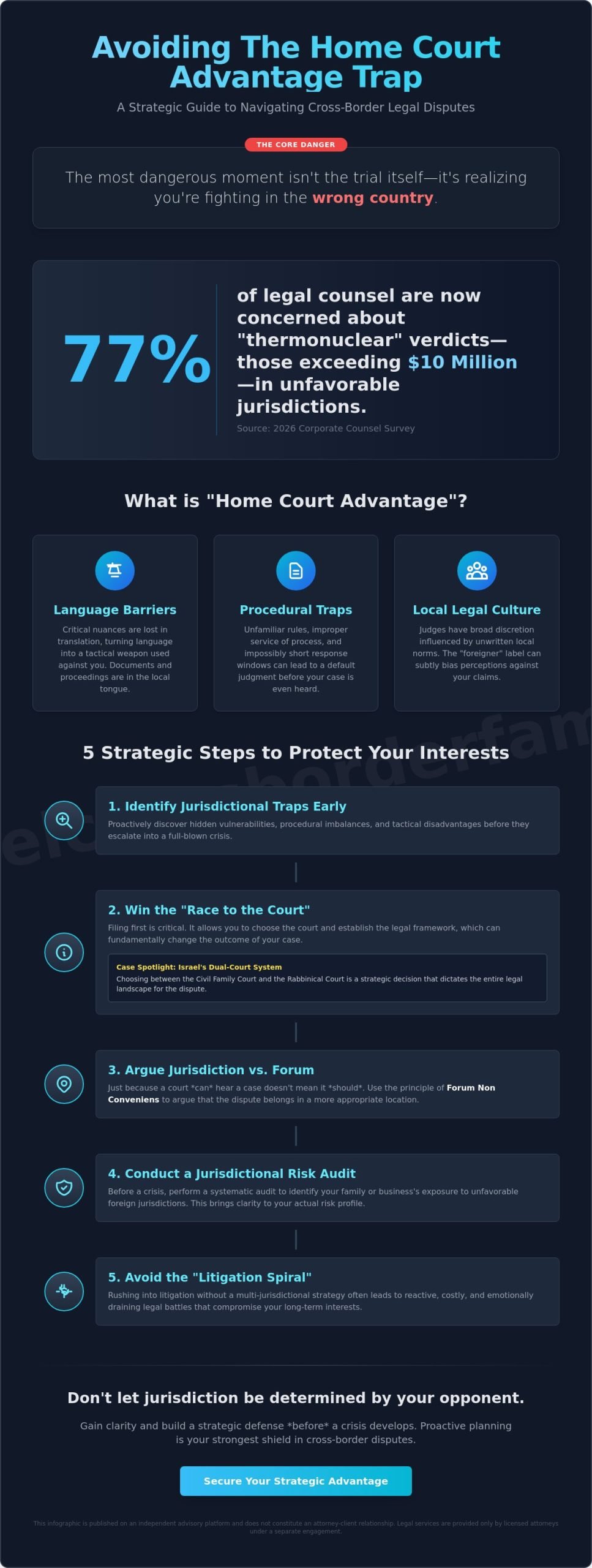
The most dangerous moment in a cross-border dispute isn’t the trial itself; it’s the moment you realize you’re fighting in the wrong country. Many international families and expats feel a deep sense of unease regarding the “home court advantage” an opposing party might enjoy in a foreign legal system. When you’re facing language barriers and unfamiliar court procedures, it’s easy to feel like the deck is stacked against you. Understanding how to avoid being taken advantage of in a foreign court starts with recognizing jurisdictional traps before they close. It’s a valid concern, as a 2026 survey found that 77% of counsel are now worried about “thermonuclear” verdicts exceeding $10 million in unfavorable jurisdictions.
You can protect your legal interests by making strategic decisions before a crisis develops. This guide will teach you how to block unfair jurisdictional moves and identify risks that could compromise your position. We’ll examine the current status of international agreements like the 2005 Hague Convention and provide a clear framework for securing a strategic advantage in complex, multi-jurisdictional disputes.
Key Takeaways
- Discover the strategic steps for how to avoid being taken advantage of in a foreign court by identifying jurisdictional traps and procedural imbalances before they escalate.
- Learn why the “Race to the Court” in IL is critical, as filing first in either the Civil Family Court or the Rabbinical Court can fundamentally change your legal framework.
- Understand the vital distinction between a court’s power to hear a case and the most appropriate location for it, including how to use the principle of Forum Non Conveniens.
- Identify how a jurisdictional risk audit helps you spot hidden vulnerabilities and language barriers that are often used as tactical weapons in cross-border disputes.
- Gain clarity on why rushing into litigation without a multi-jurisdictional strategy often leads to a “litigation spiral” that compromises your long-term interests.
This article is published on an independent advisory platform and does not constitute an attorney-client relationship. Legal services are provided only by licensed attorneys under a separate engagement.
What Is “Home Court Advantage” in International Litigation?
Home court advantage in a legal context is not a single rule or statute. It is the cumulative effect of being on familiar ground, both procedurally and culturally. In 2025, the International Chamber of Commerce (ICC) registered 894 new cases involving parties from 147 different countries, which illustrates the massive scale of multi-jurisdictional disputes. A local party understands the unwritten rules of their system, while an international party is often left guessing. Learning how to avoid being taken advantage of in a foreign court begins with identifying these subtle imbalances before they become insurmountable legal crises.
To better understand the dynamics of protecting yourself in high-stakes situations, watch this helpful video:
Language serves as one of the most effective tactical weapons in cross-border litigation. Documents are filed in the local language, and critical nuances are often lost in translation. This challenge isn’t limited to the words on the page; it extends to the “local legal culture.” Judges frequently have broad discretion, and their decisions can be influenced by local norms that aren’t explicitly written in any statute. Being the “responding party” in a foreign jurisdiction means you’re already operating from a defensive position. You’re forced to react to the other party’s choice of venue and legal framework. This is where the doctrine of Forum non conveniens becomes vital, as it provides a framework to argue that the case belongs in a more appropriate location.
The Psychological Impact of Foreign Litigation
Litigation is inherently stressful, but conducting it in a foreign system adds a layer of isolation. Expats and international families often struggle with the anxiety of not knowing the rules while the opposing party moves with confidence. The “foreigner” label can subtly influence how court staff or even judges perceive your claims. It’s essential to maintain a calm, strategic posture throughout the process. Emotional errors often lead to hasty concessions that damage your long-term interests. Seeking a neutral advisory perspective can help you stay focused on risk-based decision-making rather than fear.
Procedural Traps for the Unwary
Procedural traps are frequently where cases are lost before the actual merits are even discussed. Service of process is a common hurdle; if you aren’t properly notified according to international standards, you might face a default judgment without realizing a case was filed. Local parties also benefit from short response windows that are difficult for an international party to meet. The financial burden is another significant factor. Translating evidence and hiring bilingual expert witnesses can be incredibly expensive. In a 2026 survey, 77% of corporate counsel expressed concern about jury awards exceeding $10 million in unfavorable jurisdictions. This data highlights why understanding how to avoid being taken advantage of in a foreign court is a matter of financial survival. For those living abroad, reviewing specific resources for expats and foreign nationals can provide much-needed clarity before a dispute arises.
This article is published on an independent advisory platform and does not constitute an attorney-client relationship. Legal services are provided only by licensed attorneys under a separate engagement.
The Hidden Risks of the Israeli Dual-Court System
The Israeli legal landscape presents a unique challenge for international families due to its dual-court system. Unlike many Western jurisdictions, IL operates with two parallel authorities that have concurrent jurisdiction over family matters: the Civil Family Courts and the Rabbinical Courts. This structure creates a phenomenon known as the “Race to the Court.” In this system, the court where a case is first filed generally gains the authority to hear the entire matter. If one party files in the Rabbinical court while the other prefers the Civil system, the first to the filing desk often dictates the legal framework for the entire dispute.
Understanding this dynamic is a cornerstone of how to avoid being taken advantage of in a foreign court. For an expat or foreign national, being “captured” in a court system that doesn’t align with your cultural or legal expectations can be a significant risk. For instance, Rabbinical courts may interpret international agreements or foreign prenuptial contracts through the lens of religious law rather than civil statutes. This can lead to outcomes regarding asset division or spousal support that differ from what you’d expect in your home country.
Civil vs. Rabbinical: A Strategic Choice
Choosing between these two systems requires a sophisticated understanding of how each court views specific issues. Civil courts are generally more aligned with Western legal principles, especially concerning the division of property and the enforcement of US-style prenuptial agreements. Conversely, religious law governs the Rabbinical courts, which can impact how spousal support is calculated. International families must assess both systems before any legal action is taken to ensure their interests are protected. If you’re unsure which path fits your situation, you can request a confidential review to explore your options.
The Role of the “Get” and Extortion Risks
In the Israeli context, a religious divorce (the “Get”) is required to finalize the dissolution of a marriage between Jewish parties. This process can sometimes be used as a tool for financial leverage in civil disputes. One party might withhold the Get to demand concessions in alimony or child custody. Preventing this requires an early cross-border strategy that addresses both the civil and religious aspects of the case simultaneously. By identifying these risks before they become crises, you can navigate the divorce process for international families with greater security and confidence.
This article is published on an independent advisory platform and does not constitute an attorney-client relationship. Legal services are provided only by licensed attorneys under a separate engagement.
Jurisdiction vs. Forum: Choosing Where to Fight
Understanding the difference between jurisdiction and forum is a fundamental part of how to avoid being taken advantage of in a foreign court. Jurisdiction refers to the legal authority of a court to hear a case; it’s the power granted by law to rule on a specific matter. Forum, however, refers to the actual location or venue where the case is heard. Even if a court technically has the power to hear your case, it may not be the most appropriate place for the trial. This distinction allows you to challenge an unfavorable venue before the merits of the case are even discussed.
Strategic tools like “Anti-Suit Injunctions” can serve as a powerful defensive shield in cross-border disputes. These are orders issued by a court in one country that prohibit a party from initiating or continuing litigation in another country. Such moves are often necessary when one party attempts to exploit a foreign legal system to gain an unfair advantage. International treaties like the Hague Convention on Choice of Court Agreements aim to bring predictability to these situations, but their application is limited. As of March 1, 2026, while 38 states and the EU have ratified the convention, countries like the United States and Israel have signed but not yet ratified it, meaning it currently lacks legal force in those jurisdictions.
The principle of Forum Non Conveniens provides another vital layer of protection. This doctrine allows a court to decline to exercise its jurisdiction if it determines that a court in another country is significantly more appropriate or convenient for the parties involved. You might argue this if the majority of evidence, witnesses, or assets are located elsewhere. Successfully making this argument can shift the entire battlefield to a legal system where you feel more secure and better represented.
Analyzing Jurisdictional Risk
Determining if a court has the right to rule on your assets requires a specific audit of your “contacts” with that country. In US law, the “Minimum Contacts” rule ensures a person isn’t hauled into court unless they have a sufficient connection to that state. In contrast, IL residency requirements focus heavily on the “center of life” and physical presence. Winning the jurisdictional battle is often more important than the case itself, as it dictates the procedural rules and cultural norms that will govern your future.
Enforcement: The Ultimate Reality Check
A foreign court order is only effective if it can be enforced where your assets are actually located. If a judgment is obtained through procedural trickery or by taking advantage of your lack of local knowledge, you can often challenge its enforcement in your home country. This is a critical consideration for those managing Enforcing US Child Support Orders in Israel. Before you commit to a legal path, ensure you understand the enforcement realities of both systems. Get clarity before you commit. Request a confidential consultation.
This article is published on an independent advisory platform and does not constitute an attorney-client relationship. Legal services are provided only by licensed attorneys under a separate engagement.
5 Strategic Steps to Protect Your Interests Abroad
Protecting your family and assets in a multi-jurisdictional environment requires a shift from reactive defense to proactive strategy. While corporate entities often have established protocols for international disputes, families and expats frequently find themselves unprepared for the specific vulnerabilities of family law. Understanding how to avoid being taken advantage of in a foreign court involves more than just hiring a local lawyer; it requires a comprehensive approach that accounts for the differences between legal cultures. In 2025, a survey of international litigants showed that 65% of those who utilized expedited procedures did so primarily to minimize costs and prevent the “litigation spiral” that occurs when a case lacks clear direction.
- Step 1: Conduct a Jurisdictional Risk Audit. Identify where your marriage was registered, where your children hold citizenship, and where your primary assets are located before a dispute arises.
- Step 2: Secure a Cross-Border Advisor. You need a professional who understands the interplay between your home country’s laws and the IL legal system to ensure your strategy is cohesive.
- Step 3: Document Everything. While your original records may be in English, the courts in IL operate in Hebrew. Ensure all critical communications and agreements are professionally translated and documented in both languages.
- Step 4: Avoid “Self-Help” Measures. Taking unilateral actions, such as moving assets or relocating children without permission, can be viewed as bad faith. This often leads to severe penalties under international treaties.
- Step 5: Act Fast. In cross-border law, silence is often interpreted as consent. Delaying your response to a foreign summons can result in “attorning” to that court’s jurisdiction, making it nearly impossible to challenge the venue later.
The Importance of Early Decision-Making
The first 48 hours after being served with legal papers are the most critical. This is the window where you must decide whether to challenge the court’s authority or respond to the merits of the case. Many expats fall into the trap of making “informal” agreements with an opposing party, but these are rarely recognized by foreign courts and can even be used against you. For visual guidance on managing these early stages, you can watch Essential Steps for International Families to better understand your immediate priorities.
Choosing Your Legal Team Strategically
There’s a significant difference between a local litigator and a cross-border strategist. A local attorney focuses on winning a specific motion in a local court, whereas a strategist looks at how that motion affects your standing in other countries. You need a “bridge” between your US and Israeli legal representatives to prevent conflicting arguments that could jeopardize your assets. To see how this integrated approach protects your interests, learn more about how the cross-border advisory works. If you’re facing a potential dispute, don’t wait for the situation to escalate. Contact us today to secure your strategic position.
This article is published on an independent advisory platform and does not constitute an attorney-client relationship. Legal services are provided only by licensed attorneys under a separate engagement.
Gaining Clarity Before You Commit to Litigation
The decision to enter a courtroom in a foreign country is one of the most significant financial and personal commitments an expat or international family will ever make. Rushing into this process without a comprehensive strategy often leads to what professionals call the “litigation spiral,” where legal costs escalate while the primary objectives remain out of reach. According to a 2025 report, 70% of corporate counsel reported involvement in at least one regulatory proceeding in 2024, a statistic that underscores the increasing complexity of modern legal disputes. To understand how to avoid being taken advantage of in a foreign court, you must prioritize risk-based decision-making over emotional reactions that often cloud judgment during a crisis.
A neutral advisory perspective serves as a vital safeguard against the home-court advantages discussed in previous sections. By stepping back from the immediate pressure of a lawsuit, you can evaluate the long-term impact of your choices. This approach relies on a bicultural and bilingual legal bridge, ensuring that your expectations from your home country align with the realities of the IL legal system. Our role is to provide the steady, knowledgeable guidance needed to navigate these challenging landscapes without the immediate pressure of an adversarial proceeding.
The Advisory vs. Litigation Model
An advisory platform operates differently than a traditional law firm. It offers a safe space to explore your multi-jurisdictional options without the inherent pressure of an attorney-client relationship focused solely on active litigation. This model allows you to vet local litigators objectively and ensure they are following a strategy that protects your global interests rather than just a local motion. For those living abroad, specific resources for expats and foreign nationals provide a foundation for understanding these cultural and procedural differences. This strategic layer is the most effective way to ensure you don’t become a statistic in a foreign legal system.
Requesting a Confidential Review
Preparing for an international case review requires gathering documentation that spans multiple jurisdictions. During a strategy session, we examine the “center of life” factors in IL and how they might conflict with your residency status elsewhere. We focus on identifying risks before they become legal crises, allowing you to move forward with a clear map of the battlefield. This proactive approach is the definitive method for how to avoid being taken advantage of in a foreign court. It transforms you from a responding party into a strategic actor with a clear vision of the desired outcome.
Get clarity before you commit. Request a confidential consultation.
This article is published on an independent advisory platform and does not constitute an attorney-client relationship. Legal services are provided only by licensed attorneys under a separate engagement.
Securing Your Strategic Position in Cross-Border Disputes
Navigating the intersection of two distinct legal systems requires a shift from reactive defense to proactive strategy. You’ve learned that the “Race to the Court” within the Israeli dual-court system and the fundamental distinction between jurisdiction and forum are the primary battlegrounds for international families. Identifying these procedural traps early is the most effective way to protect your assets and parental rights. Understanding how to avoid being taken advantage of in a foreign court is ultimately about recognizing risks before they escalate into legal crises.
Our team on the ground in Tel Aviv and New York provides a seamless professional home for those managing complex international matters. We specialize in US-Israel cross-border family law, offering a bicultural and bilingual legal strategy that serves as a bridge between legal cultures. By prioritizing risk-based decision-making over emotional reactions, you can secure a strategic advantage that safeguards your long-term interests. This steady, knowledgeable guidance ensures you remain in control of your legal narrative across multiple jurisdictions.
Get clarity before you commit. Request a confidential consultation.
This article is published on an independent advisory platform and does not constitute an attorney-client relationship. Legal services are provided only by licensed attorneys under a separate engagement.
Frequently Asked Questions
Can I be sued in a foreign country if I don’t live there?
Yes, you can be sued in a foreign jurisdiction if the court determines it has the authority to hear the case based on your connections to that country. In IL, courts often apply the “center of life” test to establish jurisdiction over family matters, even if you are currently residing in the US. Reviewing these jurisdictional links early is a primary step in how to avoid being taken advantage of in a foreign court.
What should I do if I am served with legal papers from Israel while in the US?
You should seek a cross-border strategy review immediately without signing any documents or responding directly to the sender. The first 48 hours are vital for determining if the service of process complied with international standards. Making informal promises or “agreements” during this window can be interpreted by a judge as consenting to the foreign court’s authority, which limits your future options.
Is a US court order enforceable in Israel?
US court orders are enforceable in IL, but the process is not automatic and requires a formal “recognition” procedure through the Israeli civil court system. The court will examine whether the US court had proper jurisdiction and if the order aligns with local public policy. Reciprocal agreements often facilitate the enforcement of child support, yet the procedural requirements in IL remain strict and technical.
How do I prove that a foreign court is the wrong place for my case?
You prove this by invoking the doctrine of Forum Non Conveniens to show that another country is significantly more appropriate for the dispute. This involves presenting evidence that the majority of witnesses, relevant documents, and family assets are located outside the foreign jurisdiction. Successfully arguing this point can move the case to a legal system that is more familiar and accessible to you.
Do I need a lawyer in both countries for a cross-border dispute?
While you may only have one active case, having a bicultural and bilingual legal bridge between both systems is highly beneficial. A local litigator in IL focuses on domestic procedures, but they may not understand how their arguments affect your legal standing in the US. An integrated strategy ensures that your actions in one country don’t inadvertently damage your interests in another. This coordination is essential for how to avoid being taken advantage of in a foreign court.
What happens if I simply ignore a foreign court summons?
Ignoring a summons usually results in a default judgment, which grants the opposing party nearly everything they requested. This judgment can then be brought to your home country for enforcement against your domestic assets or bank accounts. It’s almost always more strategic to challenge the court’s jurisdiction at the start rather than trying to overturn a finalized default judgment later.
Can a foreign court take my assets located in the United States?
A foreign court cannot directly seize US property, but it can issue a judgment that the opposing party then asks a US court to recognize and enforce. If a US judge grants recognition, your domestic assets, including real estate and savings, could be subject to seizure. This reality makes it critical to identify and block unfair jurisdictional moves before a final judgment is ever issued.
How much does it typically cost to fight a jurisdictional battle?
The cost depends on the complexity of the multi-jurisdictional issues and the volume of evidence that requires professional translation. While we don’t provide specific fee estimates, the International Chamber of Commerce reported in February 2026 that expedited procedures can reduce certain legal fees by 20%. Investing in a jurisdictional challenge early is often more cost-effective than being drawn into a years-long litigation spiral in an unfavorable system.

Article by
Gabriel Lior
A Personal Journey That Became a Mission
The advisory was founded by an American father Gabriel Lior, LLB, MBA , global entrepreneur, and cross-border advisor who spent more than a decade navigating the Israeli family court system firsthand and now lives in Singapore with his son.
As a divorced parent in a cross-border family, Gabriel faced nearly every legal challenge a foreign parent can encounter in Israel — including child custody disputes, child support proceedings, property matters in Israel and abroad, false accusations, and complex immigration and relocation proceedings.
Over the years, he learned the hard way how difficult it is for non-Israeli parents to understand the system, identify the right legal strategy, and choose the right legal representation — especially when language, culture, and jurisdictional differences are involved. He also witnessed how foreign parents and new immigrants are often disadvantaged or taken advantage of by service providers and institutions simply because they lack local knowledge or fluency.
From Client to Advisor
To truly understand — and survive — the system, Gabriel pursued formal legal education in Israel, completing two Israeli law degrees, alongside a BA and MBA earned in the United States. This was never about becoming a practicing attorney, but about gaining a deep, structural understanding of how the system works — and where it breaks down for foreign parents.
This rare combination of:
Firsthand client experience
Israeli legal and US business education
International business and negotiation training
Decades of commercial execution
created a unique perspective – one that understands both sides of the table.
After years of litigation, persistence, and at times self-representation, he ultimately succeeded in securing custody of his son and relocating abroad through a rare legal victory in the Israeli Supreme Court — becoming one of the first fathers in Israel to do so under these circumstances.
Disclaimer
Important Disclaimer:
The information provided on this website and in its content is for general informational and educational purposes only and does not constitute legal advice, legal opinion, or legal representation.
Gabriel Lior is not licensed to practice law in Israel (nor is he interested in doing so) and does not provide legal services, despite having completed 2 Law Degrees. The services offered are advisory in nature and are intended to provide general guidance, strategic insight, and information regarding cross-border family law considerations.
No attorney-client relationship is formed by accessing this website, reading its content, or communicating with us.
Any decisions made based on this information are at your own discretion and risk. For legal advice specific to your situation, you should consult a licensed attorney in the relevant jurisdiction.
Where appropriate, we may refer clients to independent, licensed attorneys or professionals. Such referrals do not constitute legal representation and no liability is assumed for services provided by third parties.