This article is published on an independent advisory platform and does not constitute a law firm or an attorney-client relationship.
Imagine checking your bank app from London or New York only to find your Israeli funds are completely inaccessible. For many expats and international families, this is how they first encounter an Ikul עיקול. This legal seizure of assets often arrives without a clear explanation in English, triggered by debts you might not even know existed. It’s a stressful situation that can leave you feeling powerless against a system that feels foreign and complex.
It’s completely normal to feel overwhelmed by Hebrew legal notices and the fear of losing access to your property. We believe you deserve clarity before you make any major decisions. This guide provides a straightforward path through the technicalities of asset attachments in IL. You’ll learn how to identify active orders, understand your rights under the 2019 Insolvency and Financial Rehabilitation Law, and see the practical steps needed to release frozen assets and regain control of your financial life.
Key Takeaways
- Understand how an Ikul עיקול functions as a legal mechanism to freeze bank accounts and real estate to satisfy outstanding debts.
- Discover why expats and US citizens remain vulnerable to asset seizures even if they haven’t lived in Israel for several years.
- Learn the immediate steps to verify a seizure order and obtain the necessary case information from the Execution Office.
- Identify strategic pathways to resolve a freeze, such as negotiating a formal settlement or requesting a payment order.
This article is published on an independent advisory platform and does not constitute a law firm or an attorney-client relationship. Legal services are only provided by licensed attorneys under a separate engagement.
What is an Ikul (עיקול)? Defining Asset Attachment in Israel
In the legal landscape of IL, an Ikul עיקול is a procedural mechanism that serves as a “freeze” on a debtor’s assets. While the term might sound intimidating, it’s a standard tool used to ensure that financial obligations are met before assets are moved or hidden. To understand the broader context, it helps to look at What is Asset Attachment? in a global sense. Essentially, it’s a way for a creditor to secure their claim by legally preventing you from selling, transferring, or withdrawing your property until a debt is resolved or a court reaches a final decision.
These orders are typically issued by either a civil court or the Execution Office, known in Hebrew as Hotza’a LaPoal. This government body is responsible for enforcing judgments and collecting debts. For international families and expats, the Execution Office is often the primary entity they’ll interact with when trying to resolve a frozen bank account or a lien on a property. The goal isn’t necessarily to take the property immediately, but to “earmark” it so it remains available to satisfy a future judgment.
<p
This article is published on an independent advisory platform and does not constitute a law firm or an attorney-client relationship. Legal services are only provided by licensed attorneys under a separate engagement.
Types of Assets Subject to Seizure: From Bank Accounts to Real Estate
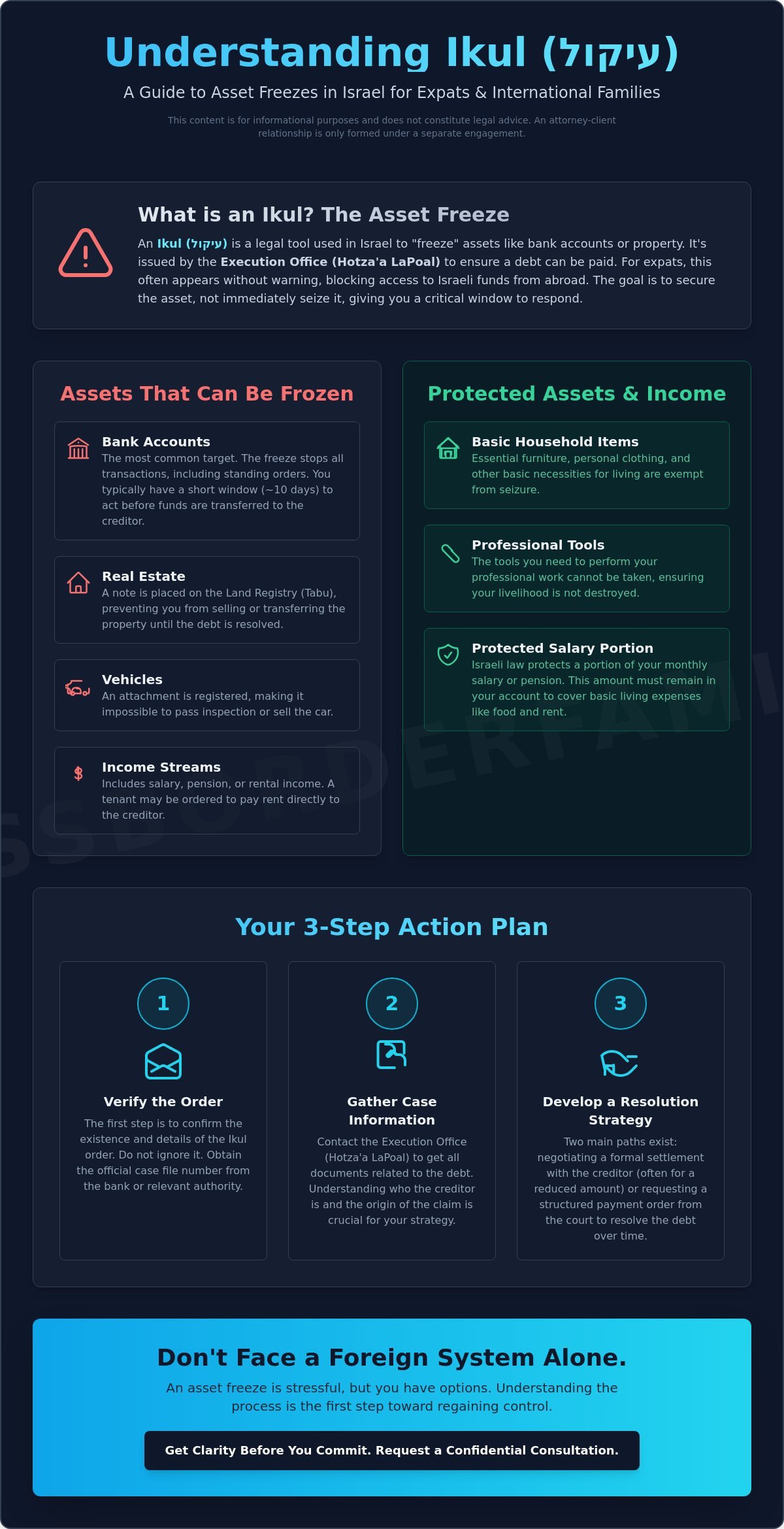
When an Ikul עיקול is issued, it doesn’t just sit in a legal file. It moves quickly through various government and private systems to secure assets. The process is overseen by Israel’s Enforcement and Collection Authority, which coordinates with banks, the Land Registry, and even the Ministry of Transport. While bank accounts are the most frequent target, the reach of these orders extends to real estate, vehicles, and even income streams like salary or rent.
Bank accounts, specifically current accounts, are typically the first to be affected. When a bank receives an attachment order, they’re legally obligated to freeze the specified amount immediately. This can be disruptive because it often stops standing orders and can cause checks to bounce, even if you have other funds available in the account. There’s usually a short window, often around ten days, before the bank actually transfers the money to the creditor. This period is your opportunity to take action before the funds are gone forever.
Real estate is another significant target for creditors. Instead of taking the house away immediately, the authorities record a note on the Land Registry, known as the Tabu. This note acts as a “stop” signal, preventing you from selling or transferring the property until the debt is cleared. Similarly, for vehicles, an attachment is registered with the Ministry of Transport, making it impossible to pass the annual inspection or sell the car to a new owner.
Exemptions: What Cannot Be Seized Under Israeli Law
Your income also has built-in protections. Only a portion of your monthly salary or pension can be seized. The law sets a protected amount that must remain in your account to cover basic needs like food and rent. If you find that a seizure is preventing you from paying for essentials, you can request a review of your specific circumstances to adjust the payment order. Third-party attachments can also affect rent payments or funds held by your employer. If you’re an expat managing an Israeli property from abroad, a tenant might be ordered to pay their rent directly to the Execution Office. For those facing issues related to child support enforcement, these attachments can be particularly aggressive and require a strategic response to protect your rights.
This article is published on an independent advisory platform and does not constitute a law firm or an attorney-client relationship. Legal services are only provided by licensed attorneys under a separate engagement.
The Cross-Border Risk: Why Expats and US Citizens are Vulnerable
Living abroad doesn’t provide immunity from the Israeli legal system. In fact, it often increases your risk. An Ikul עיקול can be issued against your Israeli assets even if you haven’t set foot in the country for a decade. This happens because the system relies on procedural assumptions that don’t always align with the reality of international life. For many US citizens and expats, the first sign of trouble isn’t a letter in the mail, but a declined transaction on an Israeli credit card or a frozen savings account.
The primary vulnerability for those outside IL is the “Service of Process.” Most legal notifications are sent to the address registered with the Ministry of Interior. If you moved to London or Los Angeles and didn’t update this record, the court might still consider you “served.” This is known as constructive service. It means a judge can authorize an attachment because they assume you ignored a notice you never actually saw. This “element of surprise” is often the most damaging part of the process for international families who lose the chance to defend themselves before the freeze occurs.
Notice and the ‘Registered Address’ Problem
The danger of the registered address cannot be overstated. When a creditor files a claim, the Execution Office sends notices to the last known IL address. If the mail isn’t returned, the law often treats the notification as successful. This creates a massive gap for expats who don’t have someone monitoring their old mailbox. Strategic planning for international families should always include maintaining a local legal contact or a reliable way to monitor official government notifications to avoid missing critical 30-day windows to challenge a claim.
Family Law and Cross-Border Support
Cross-border enforcement is particularly common in cases involving divorce or separation for international families. Under various international agreements, a US child support order can be enforced in Israel, leading to an immediate Ikul עיקול on any local assets. While an Israeli court order cannot directly freeze a bank account in New York or Chicago, the impact is still significant. It can prevent the sale of an Israeli apartment or freeze an inheritance intended for a beneficiary living abroad.
One of the most severe risks for travelers is the “Stay of Exit” order, or Tikuv Yetzia. If you have an active debt, you might be flagged at Ben Gurion Airport. This can prevent you from leaving the country until the debt is settled or a bond is posted. It’s a high-stakes scenario that can be avoided by checking your status before you travel. Get clarity before you commit to a trip. Request a confidential advisory call or WhatsApp message to understand your standing within the system.
This article is published on an independent advisory platform and does not constitute a law firm or an attorney-client relationship. Legal services are only provided by licensed attorneys under a separate engagement.
Immediate Steps: How to Check and Cancel an Ikul Order
Discovering an Ikul עיקול on your assets requires swift and methodical action. The first priority is verification. You can check the status of any enforcement proceedings by contacting the Execution Office’s national call center at *35592. While the operators generally speak Hebrew, they can confirm if there’s an open file against your Israeli ID number. This initial step is vital because it moves the situation from a vague fear to a documented legal reality with a specific case number.
Once you’ve confirmed the existence of an order, you must obtain a “Daf Meida,” which is a formal Request for Information. This document is the roadmap for your defense. It identifies the creditor who initiated the freeze, the total debt claimed, and the specific branch of the Execution Office handling the matter. Without this information, you can’t effectively evaluate whether the attachment is based on a legitimate debt or a procedural error that can be challenged.
How to Check for Orders from Abroad
Expats often face a significant hurdle when trying to use the Israeli government’s online “Personal Area” portal. The system frequently requires a local Israeli SIM card for two-factor authentication, which many people living in the US or Europe don’t possess. If you’re stuck behind this digital wall, the most effective strategy is to appoint a local representative via a Power of Attorney. This person can visit the Execution Office in person to pull your records and ensure you aren’t missing critical deadlines, such as the 30-day window typically allowed to challenge a claim.
Legal Grounds for Cancellation
Filing a “Bakasha LeBitul Ikul,” or a Request to Cancel, is the formal way to ask the court or the Execution Office to lift the freeze. Success often depends on proving a lack of proper service. If you can show that you never received notice of the debt because you were living abroad, the court may agree to cancel the order and allow you to defend the case on its merits. Another common strategy involves offering alternative security. Instead of having your main bank account frozen, you might offer a bank guarantee for the disputed amount, which allows you to maintain your daily financial operations while the litigation continues.
In some cases, an attachment is placed on an asset that doesn’t actually belong to the debtor. For example, a joint bank account might be frozen due to the debt of only one owner. If you’re facing this type of complexity, it’s essential to act before the bank transfers the funds. You can request a confidential consultation to discuss the specific procedural steps needed to protect your property and rights.
This article is published on an independent advisory platform and does not constitute a law firm or an attorney-client relationship. Legal services are only provided by licensed attorneys under a separate engagement.
Developing a Strategy for Long-Term Resolution
Resolving an asset freeze isn’t just about filing a single form. It requires a strategic approach that balances the cost of litigation against the speed of a settlement. Once you’ve identified the source of the Ikul עיקול, you have to decide whether to fight the underlying debt or negotiate a way out. For international families, the goal is usually to restore financial mobility as quickly as possible to avoid long-term damage to their credit or property rights in IL.
A formal settlement, known as a Hesder, is often the most pragmatic path for those living abroad. Creditors are frequently willing to discount the total debt or waive accumulated interest in exchange for a lump-sum payment. This is particularly effective when the creditor knows that collecting from someone in the US or Europe is a slow and expensive process. A successfully negotiated settlement leads to the immediate removal of the Ikul עיקול, allowing you to sell a property or access your bank account without further delay.
For individuals with ongoing income in Israel, a “Tzav Tashlumim” or payment order can be a vital tool. This mechanism allows you to pay the debt in monthly installments based on a formal assessment of your financial ability. Once the court approves this order and you make the initial payment, the Execution Office can lift the freeze on your monthly salary. This ensures you can meet your daily living expenses while gradually resolving the total debt. Early intervention is critical here. If you wait too long, the Execution Office may move from a simple freeze to the actual sale of your assets at a public auction.
Settlement vs. Litigation
Deciding between a settlement and litigation depends on the validity of the debt. If the debt is based on a clear error or a statute of limitations issue, challenging it in court may be the best route. However, being an “Anglo” in the Israeli system can influence these dynamics. Creditors sometimes assume that foreign residents have more liquid assets, which can lead to more aggressive enforcement. Strategic advisory helps level the playing field by presenting your financial reality accurately and navigating the cultural nuances of Israeli legal negotiations.
Protecting Your Assets Before a Dispute Arises
The most effective form of protection is prevention. You should ensure your address is always updated with the Ministry of Interior so that legal notices don’t go to an old mailbox. For those managing complex international interests, the strategic use of trusts or specific financial agreements can provide a significant layer of security. These tools are part of a broader strategy for expats and foreign nationals who want to secure their Israeli holdings against sudden legal actions.
Don’t wait until a temporary freeze becomes a permanent loss. Seeking clarity early allows you to make informed choices about your property and your future. Get clarity before you commit to a course of action. Request a confidential advisory call or WhatsApp message to discuss your strategy.
This article is published on an independent advisory platform and does not constitute a law firm or an attorney-client relationship. Legal services are only provided by licensed attorneys under a separate engagement.
Securing Your Financial Future Across Borders
Managing an Ikul עיקול requires a proactive strategy that accounts for the unique challenges of international residency. We’ve explored how these seizures can occur without your knowledge because of outdated addresses and the procedural assumptions of the Israeli legal system. By understanding the difference between temporary freezes and permanent foreclosures; you can take the necessary steps to verify your status and protect your property before a dispute escalates.
Our advisory is built on authoritative expertise in US-Israel cross-border family law and deep familiarity with Hotza’a LaPoal procedures for expats. We provide international families with the clarity needed to navigate complex multi-jurisdictional debts and enforcement actions. Whether you’re dealing with unpaid child support or a civil claim; early intervention is the most effective way to avoid a permanent loss of assets in IL.
Get clarity before you commit. Request a confidential consultation. You don’t have to face the Israeli legal landscape alone; we’re here to help you find a path forward.
This article is published on an independent advisory platform and does not constitute a law firm or an attorney-client relationship. Legal services are only provided by licensed attorneys under a separate engagement.
Frequently Asked Questions
Can my Israeli bank account be frozen without me knowing?
Yes, it’s possible for your account to be frozen before you receive any formal notice. Banks in IL are mandated to act on court or Execution Office orders immediately upon receipt. If you reside abroad, the notification sent to your registered address may never reach you. This often means you only discover the freeze when a credit card is declined or a standing order fails to process.
Does an Ikul on my car mean I can’t drive it?
An attachment on a vehicle primarily restricts your ability to transfer ownership rather than your ability to drive. It is registered with the Ministry of Transport, which prevents you from selling the car or renewing its annual registration. While you might still be able to drive the vehicle physically, you won’t be able to pass the mandatory annual roadworthiness test. This effectively grounds the car until the debt is cleared.
How long does it take to cancel an Ikul after the debt is paid?
The cancellation process is not instantaneous and can take several days to a few weeks. After you pay the debt, the creditor must report the settlement to the Execution Office. It then takes time for the office to process the request and send electronic cancellation notices to banks or the Land Registry. You should monitor the file to ensure these notices are sent; otherwise, your assets could remain frozen for weeks.
Can an Israeli court seize my assets in the United States?
An Israeli court cannot directly freeze funds held in a US bank. Jurisdictional limits prevent an Ikul עיקול from reaching beyond Israeli borders. However, a creditor can choose to domesticate an Israeli judgment in a US court. If they’re successful, they could then use American legal tools to seize assets located in the United States. Cross-border debt often requires a strategic defense in both jurisdictions.
What happens if an Ikul is placed on my apartment in Israel?
An attachment on an apartment typically involves a recorded note at the Land Registry, known as the Tabu. This note prevents any sale, transfer, or refinancing of the property. While you can usually continue living in the apartment, the property serves as a guarantee for the creditor. It remains “locked” until the legal dispute is resolved or the court orders a sale to satisfy the debt.
Is an Ikul the same as a ‘Stay of Exit’ (Tikuv Yetzia) order?
No, these are two distinct enforcement measures with different goals. An attachment targets your financial assets, such as bank accounts or property. A Stay of Exit, or Tikuv Yetzia, is a personal restriction that prevents you from leaving IL. While they often appear in the same case, paying a debt might lift the asset freeze while the travel ban remains in place until a separate request is filed.
Can child support arrears from the US cause an Ikul in Israel?
Yes, US child support orders are frequently enforced in Israel through international treaties and agreements. If you have arrears in the US, the recipient can open an enforcement file in IL. This process often triggers an Ikul עיקול on your Israeli bank accounts or any real estate you own. It’s a powerful tool used to ensure that cross-border financial obligations to family members are met promptly.
What should I do if I receive a Hebrew legal notice about an ‘Ikul’?
You should seek an English translation and professional verification of the document as your first priority. Hebrew legal notices often contain strict deadlines, such as a 30-day window to file a defense or a challenge. Once you understand the claim, you can verify the details with the Execution Office. Taking early action is the best way to prevent a temporary freeze from becoming a permanent loss.

Article by
Gabriel Lior
A Personal Journey That Became a Mission
The advisory was founded by an American father Gabriel Lior, LLB, MBA , global entrepreneur, and cross-border advisor who spent more than a decade navigating the Israeli family court system firsthand and now lives in Singapore with his son.
As a divorced parent in a cross-border family, Gabriel faced nearly every legal challenge a foreign parent can encounter in Israel — including child custody disputes, child support proceedings, property matters in Israel and abroad, false accusations, and complex immigration and relocation proceedings.
Over the years, he learned the hard way how difficult it is for non-Israeli parents to understand the system, identify the right legal strategy, and choose the right legal representation — especially when language, culture, and jurisdictional differences are involved. He also witnessed how foreign parents and new immigrants are often disadvantaged or taken advantage of by service providers and institutions simply because they lack local knowledge or fluency.
From Client to Advisor
To truly understand — and survive — the system, Gabriel pursued formal legal education in Israel, completing two Israeli law degrees, alongside a BA and MBA earned in the United States. This was never about becoming a practicing attorney, but about gaining a deep, structural understanding of how the system works — and where it breaks down for foreign parents.
This rare combination of:
Firsthand client experience
Israeli legal and US business education
International business and negotiation training
Decades of commercial execution
created a unique perspective – one that understands both sides of the table.
After years of litigation, persistence, and at times self-representation, he ultimately succeeded in securing custody of his son and relocating abroad through a rare legal victory in the Israeli Supreme Court — becoming one of the first fathers in Israel to do so under these circumstances.
Disclaimer
Important Disclaimer:
The information provided on this website and in its content is for general informational and educational purposes only and does not constitute legal advice, legal opinion, or legal representation.
Gabriel Lior is not licensed to practice law in Israel (nor is he interested in doing so) and does not provide legal services, despite having completed 2 Law Degrees. The services offered are advisory in nature and are intended to provide general guidance, strategic insight, and information regarding cross-border family law considerations.
No attorney-client relationship is formed by accessing this website, reading its content, or communicating with us.
Any decisions made based on this information are at your own discretion and risk. For legal advice specific to your situation, you should consult a licensed attorney in the relevant jurisdiction.
Where appropriate, we may refer clients to independent, licensed attorneys or professionals. Such referrals do not constitute legal representation and no liability is assumed for services provided by third parties.