The dissolution of a marriage is an inherently complex process; when that marriage bridges the United States and Israel, the legal and financial intricacies become profoundly more challenging. You are likely confronting the daunting task of completing a financial affidavit for international divorce while facing critical questions: How do you properly value US-based securities in Israeli Shekels? Which nation’s exacting disclosure requirements govern your case? And what are your strategic options if you suspect a spouse is concealing assets in a foreign jurisdiction? These are not minor procedural points but high-stakes issues with significant financial repercussions.
A misstep on this crucial document can lead to severe legal penalties. This comprehensive guide is designed to provide authoritative clarity, navigating you through the sophisticated requirements of multi-jurisdictional financial disclosure. Here, you will learn how to value diverse cross-border assets, from Tel Aviv real estate to US stock options, and receive a clear framework to avoid critical errors. Our goal is to empower you with the understanding needed to proceed with confidence and secure the expert counsel required to protect your financial future across both legal systems.
Key Takeaways
- Navigating a US-Israel divorce requires a deep understanding of how to report assets and income held in both USD and ILS across disparate financial systems.
- Completing an accurate financial affidavit for international divorce is the foundation for an equitable division of all marital property, including complex Israeli assets like a Keren Hishtalmut or pension funds.
- Discover the most common and costly errors, such as improperly valuing Israeli real estate or business interests, which can lead to significant financial loss and legal complications.
- Learn why standard domestic divorce counsel is often ill-equipped for these multi-jurisdictional cases and the critical questions to ask to ensure your legal team has the requisite cross-border expertise.
What Is a Financial Affidavit and Why Is It Critical in Divorce?
A financial affidavit is a comprehensive, sworn legal document that provides a complete and transparent overview of your financial situation. Its fundamental purpose in any dissolution of marriage, particularly a complex cross-border case, is to provide the court and both parties with the necessary data to ensure a fair and equitable division of all marital assets and debts. This document is signed under penalty of perjury, making absolute accuracy and honesty paramount. The complexities of preparing a financial affidavit for international divorce are significantly amplified for expats and foreign nationals, who often manage assets, income sources, and liabilities across multiple jurisdictions with differing financial regulations.
To better understand the gravity and function of this document, the following video provides a clear overview:
The Foundation of Fair Negotiations
The financial affidavit serves as the cornerstone upon which all settlement negotiations are built. It is the primary tool used to calculate critical obligations such as spousal support (alimony) and child support. Full and candid disclosure from both spouses is not merely a courtesy; it is a legal mandate. This transparency allows legal counsel to accurately assess the marital estate and advise on a just resolution, preventing protracted and costly litigation rooted in suspicion and incomplete information.
Consequences of Inaccurate Disclosure
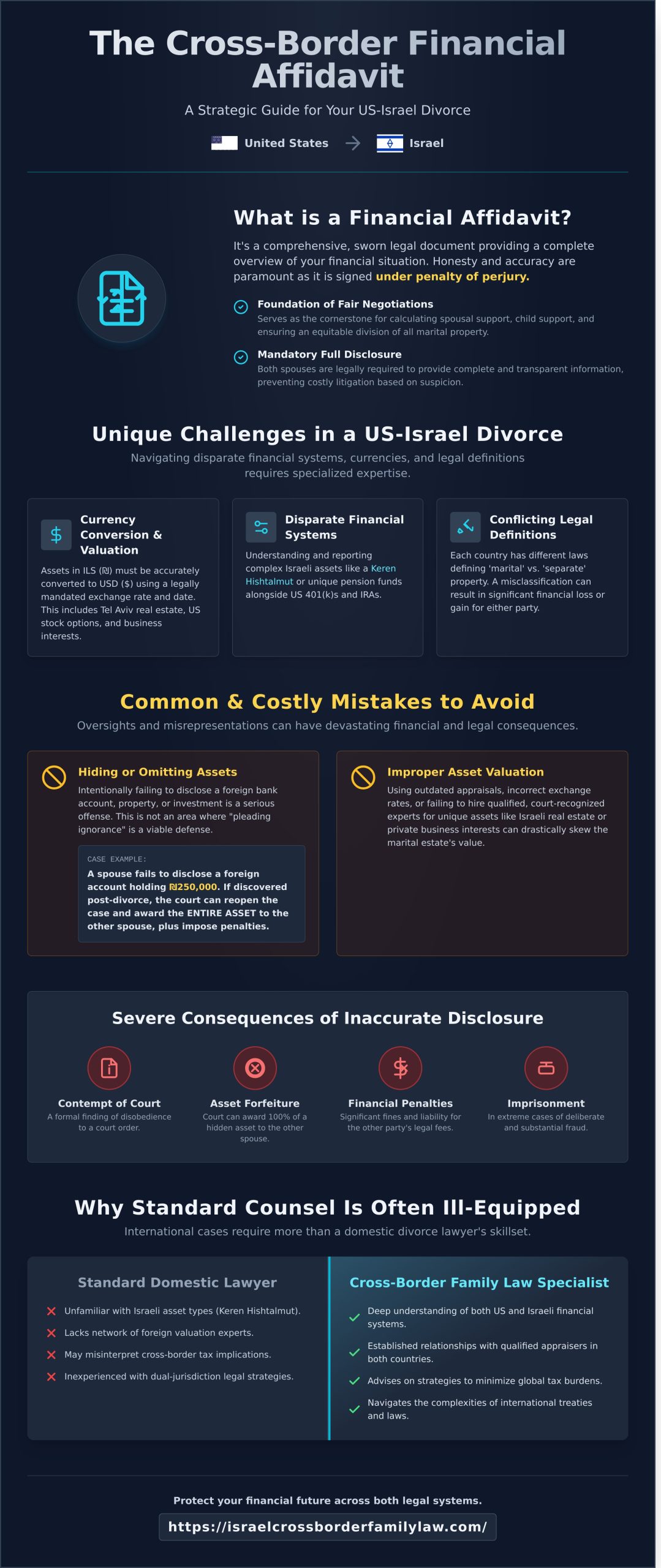
Intentionally omitting or misrepresenting information on a financial affidavit can lead to severe legal repercussions. A court may find a party in ‘contempt of court’-a formal finding of disobedience to a court order-which can result in significant fines, payment of the other party’s legal fees, or even, in extreme cases, imprisonment. For instance, imagine a spouse fails to disclose a foreign bank account holding ₪250,000. If this asset is discovered after the divorce is finalized, the court can reopen the case, award the entire asset to the other spouse, and impose additional financial penalties. While the principles of disclosure are central to systems like U.S. divorce law, Israeli courts also hold this obligation as sacred. Pleading ignorance or claiming an oversight is rarely a successful defense.
Unique Challenges of Financial Affidavits in a US-Israel Divorce
Preparing a financial affidavit for an international divorce involving the United States and Israel presents a set of sophisticated, multi-jurisdictional challenges not found in domestic cases. The process of accurately completing a Financial Affidavit is foundational to a fair settlement, but the cross-border nature of a US-Israel marriage introduces layers of complexity. Parties must meticulously navigate disparate financial systems, currency fluctuations, and conflicting legal definitions of property, transforming a standard procedure into a complex undertaking that demands specialized legal and financial expertise.
Key complexities include the proper declaration of assets and income in both US Dollars ($) and Israeli Shekels (₪), addressing divergent tax implications, and understanding how each country’s legal framework defines ‘marital’ versus ‘separate’ property. Failure to properly address these issues can lead to significant financial consequences.
Valuing Assets Across Different Markets and Currencies
A primary hurdle is the valuation of assets held in two distinct economic environments. This requires converting all Israeli assets, such as a Tel Aviv apartment valued in Shekels, into US Dollars using an official exchange rate for a specific, legally mandated date. Securing qualified, court-recognized appraisers for Israeli real estate or valuing private business interests rooted in Israel’s “start-up nation” ecosystem adds further complexity, demanding a team with a deep understanding of both markets.
Understanding Disparate Retirement and Pension Accounts
The financial instruments for retirement savings differ significantly between the two countries. A comprehensive financial affidavit must correctly list and value US accounts like a 401(k) or IRA alongside Israeli equivalents such as a Keren Hishtalmut, Bituach Menahalim, or Pension Fund. Each of these accounts is governed by unique rules regarding vesting, distribution, and taxation, making the division of these assets across jurisdictions a highly technical legal challenge that requires careful analysis.
Discovery and Information Gathering Across Borders
When one spouse resides in Israel and the other in the US, the process of financial discovery-formally requesting and obtaining documents-becomes significantly more intricate. While international treaties like the Hague Convention on the Taking of Evidence Abroad can facilitate this process, it is invariably slower and more complex than domestic discovery. Guiding clients through this cross-border information gathering is critical to ensuring a complete and accurate financial affidavit for international divorce proceedings.
A Cross-Border Checklist: Gathering Your US and Israeli Financial Data
Preparing a comprehensive financial affidavit for international divorce requires meticulous documentation of your entire financial landscape, spanning both the United States and Israel. This process is not merely administrative; it forms the bedrock of equitable asset division and support calculations. A thorough and transparent disclosure is legally mandated and protects your interests. Use this checklist as a foundational guide to collate the necessary information and supporting paperwork.
Documenting Your Global Income
The court requires a complete picture of all income streams, not just your primary salary. Gather documentation for every source of revenue, including recent pay stubs, employment contracts, and at least three years of tax returns from both countries.
- Employment Income: This includes salaries, wages, commissions, and bonuses. For US income, locate your W-2 and 1099 forms. For Israeli income, you will need your Tlush Maskoret (pay slip).
- Business and Self-Employment Income: Compile profit and loss statements, balance sheets, and corporate tax filings for any business interests.
- Investment and Passive Income: Document earnings from stock dividends, bond interest, rental properties, and any other investments.
Listing All US and Israeli Assets
Full disclosure of all marital assets, regardless of where they are held or whose name they are in, is non-negotiable. The complexity of cross-border holdings often necessitates a forensic approach, as courts have sophisticated methods for uncovering assets hidden from spouses. Be prepared to provide deeds, statements, and recent valuations.
- Real Estate: List all properties, including primary residences, vacation homes, and investment properties in both the US and Israel. Gather deeds, mortgage statements, and property tax assessments.
- Bank and Financial Accounts: Include all checking accounts, savings accounts, and certificates of deposit (CDs). Provide statements for the last 12-36 months.
- Investments: Detail all stocks, bonds, mutual funds, retirement accounts (e.g., 401(k), IRA), and Israeli pension funds like kupot gemel and keren hishtalmut.
- Valuable Personal Property: Itemize significant assets such as vehicles, art collections, jewelry, and valuable furnishings.
Accounting for International Debts and Liabilities
Your financial obligations are as important as your assets. Create a detailed list of all outstanding debts, specifying the creditor, outstanding balance, and monthly payment amount for each.
- Mortgages and Real Estate Loans: Include all loans secured by your properties in any country.
- Credit Card Debt: List balances for all US and Israeli credit cards.
- Other Loans: Account for personal loans, vehicle loans, student loans, and any business-related debts.
Navigating the intricate requirements of a financial affidavit for international divorce is a formidable task. Our firm provides the strategic guidance necessary to ensure your financial disclosure is accurate, complete, and effectively presented. We assist clients in methodically gathering and organizing this multi-jurisdictional data. To learn more about our structured approach, see how our process works.
Common (and Costly) Mistakes to Avoid on Your International Affidavit
Navigating a multi-jurisdictional marital estate requires meticulous accuracy. The financial affidavit for international divorce is not merely a formality; it is a sworn legal document upon which courts in Israel and abroad will base life-altering decisions. Errors, whether accidental or intentional, can lead to severe financial penalties, protracted litigation, and a loss of credibility before the court. Understanding the most common pitfalls is the first step in protecting your interests.
The Danger of ‘Guesstimates’ and Informal Valuations
Courts require defensible, formal valuations for significant assets, not informal estimates. Relying on a “guesstimate” for a property in London or a private business interest in New York is a critical error. Currency fluctuations between the ILS, USD, and EUR can dramatically alter values, and your spouse’s legal team will vigorously challenge any valuation not supported by a qualified, professional appraiser. This single mistake can force costly re-valuations and undermine your entire financial disclosure.
Failing to Disclose Complex and Future Assets
In a global economy, and particularly within Israel’s dynamic tech sector, assets are often complex and forward-looking. It is a frequent and serious mistake to omit items like unvested stock options or RSUs, interests in offshore trusts, or anticipated inheritances. The legal obligation is to provide a complete picture of the marital estate, which includes these contingent assets. For high-net-worth individuals and tech employees, failure to disclose these sophisticated assets can be viewed as concealment by the court.
The Futility of Hiding Offshore Assets
In today’s interconnected financial world, intentionally hiding assets is a futile and high-risk strategy. Legal teams now routinely employ sophisticated tools to uncover non-disclosure:
- Forensic Accountants: Experts who can trace complex international money transfers and identify discrepancies.
- International Discovery: Formal legal processes compelling foreign banks and institutions to produce financial records.
- Global Information Sharing: Agreements like the Common Reporting Standard (CRS) mean that over 100 countries automatically exchange financial account information, making offshore bank secrecy largely a thing of the past.
The penalties for fraudulent disclosure are severe and can include significant fines (often exceeding the value of the hidden asset), an unfavorable division of property, and even criminal charges for perjury. Full transparency is not just an ethical obligation-it is a strategic necessity. Guiding clients through these complex disclosure requirements is a core part of our practice. For assistance with your financial affidavit for international divorce, contact our experienced legal team.
Why a Standard Divorce Lawyer Is Not Equipped for Your Case
When marital assets and family members span continents, particularly between the United States and Israel, the complexity of a divorce proceeding escalates exponentially. A standard domestic relations attorney, while proficient in local state law, is fundamentally unequipped to navigate the sophisticated challenges of a cross-border case. Relying on such counsel introduces significant financial risks, from inaccurate asset valuation to unenforceable judgments that can cost you hundreds of thousands of shekels.
A domestic lawyer’s knowledge gap typically includes a critical lack of understanding in several key areas:
- Israeli Financial Instruments: They will likely be unfamiliar with unique Israeli assets such as a Keren Hishtalmut (study fund), provident funds, or specific pension schemes, leading to their mischaracterization or omission from the financial affidavit.
- International Evidence Gathering: They lack the procedural knowledge to obtain evidence from abroad, such as deposing a witness in Tel Aviv for a U.S. case, which is governed by complex international agreements like the Hague Convention.
- US-Israel Tax Treaty: Crucially, they cannot provide strategic advice on the profound implications of the US-Israel tax treaty on alimony, child support, and asset division, which is essential for accurately preparing a financial affidavit for international divorce.
Navigating Jurisdictional Complexities
The decision of where to file for divorce-be it a U.S. state or Israel-is a strategic one with profound financial consequences. Each jurisdiction has different laws governing property division and spousal support. A cross-border specialist can analyze your unique situation to advise on the most advantageous venue. The complexities of divorce for international families demand this level of strategic foresight to protect your assets and secure a favorable outcome.
The Value of a Coordinated Legal Strategy
An effective international divorce requires a legal team that operates seamlessly across both countries. A specialist firm collaborates with a network of forensic accountants versed in both U.S. and Israeli financial systems and works directly with foreign legal counsel. This coordinated approach ensures that every detail is meticulously managed and, most importantly, that the final divorce decree is structured to be fully enforceable in both the United States and Israel-a critical step that inexperienced attorneys often overlook.
Engaging a firm with a deep, proven understanding of both legal and financial landscapes is not merely an option; it is a necessity for protecting your financial future in a high-stakes international divorce. Our team is positioned to provide that expert guidance.
Securing Your Financial Future in a Complex Cross-Border Divorce
Navigating a divorce between the United States and Israel introduces a layer of financial complexity that cannot be overstated. The critical takeaway is that your financial affidavit is not merely a procedural form; it is the cornerstone of your financial settlement, requiring meticulous documentation of assets and liabilities across two distinct legal and economic systems. Errors or omissions on this multi-jurisdictional document can result in significant, long-term financial penalties and jeopardize the equitable division of your marital estate.
Successfully completing the financial affidavit for international divorce demands a level of niche expertise that standard practitioners do not possess. Our firm is built on providing this specialized counsel. With proven experience in complex international asset valuation and division, and a dedicated team adept at navigating the legal frameworks of both the U.S. and Israel, we are positioned to safeguard your financial interests with precision and authority.
Protect your assets and ensure a fair outcome. We invite you to Request a Confidential Case Review to discuss your cross-border financial situation. Taking this decisive step is paramount to achieving financial clarity and security for your future.
Frequently Asked Questions
What happens if my spouse refuses to disclose their foreign assets?
Non-disclosure of foreign assets is a serious violation of court orders. Our firm can initiate robust legal actions, including filing motions to compel disclosure and seeking sanctions against the non-compliant party. For assets held in Israel or the US, we can employ sophisticated discovery tools like letters rogatory or engage forensic accountants to trace and identify concealed wealth. Courts possess significant authority to penalize such conduct, which can severely impact the final division of assets in your disfavor.
Do I have to disclose assets I acquired before my marriage in a US-Israel divorce?
Yes, full disclosure of all assets, including those acquired pre-maritally, is mandatory. However, whether these assets are divisible depends on their classification as ‘separate’ or ‘marital’ property. Under both Israeli and US law, pre-marital assets are typically considered separate property, but they can become subject to division if they were commingled with marital funds or appreciated in value due to marital efforts. Proper characterization is a complex, fact-specific inquiry requiring expert cross-border legal analysis.
How are complex business assets valued and divided in an international divorce?
Valuing and dividing sophisticated business interests, such as a stake in an Israeli tech start-up or a US-based company, requires a multi-jurisdictional approach. We engage a network of premier forensic accountants and business valuation experts who are adept at assessing complex corporate structures, intellectual property, and goodwill across borders. The process involves a detailed analysis of financial records and market conditions to establish a fair valuation, ensuring an equitable division in accordance with the governing law.
Which country’s financial affidavit form do we use if we have connections to both the US and Israel?
The specific form required is determined by the jurisdiction in which the divorce proceedings are filed. If you file in a US state, you must use that state’s prescribed financial affidavit. If the case is litigated in Israel, you will use the Israeli equivalent. In complex cases involving parallel proceedings, it may be necessary to complete a financial affidavit for international divorce in both jurisdictions. Our bicultural attorneys are proficient in navigating the procedural requirements of both legal systems to ensure full compliance.
What is the difference between ‘marital property’ and ‘separate property’ under Israeli vs. US law?
While both systems distinguish between marital and separate property, the application differs. In Israel, under the Spouses’ Property Relations Law, all assets accumulated during the marriage (excluding certain exceptions like pensions and inheritances) are subject to a “balancing of resources” upon divorce. In the US, the distinction depends on whether the state follows “community property” or “equitable distribution” principles. Navigating these differing legal frameworks is critical for protecting your separate assets in a cross-border divorce.
Can my spouse’s Israeli pension be divided in a US divorce proceeding?
Yes, an Israeli pension can be treated as a marital asset and divided by a US court. Effectuating this division requires a specific court order, similar to a Qualified Domestic Relations Order (QDRO), that is enforceable in Israel. Crafting such an order demands a sophisticated understanding of both US family law and Israeli pension regulations. Our firm possesses the cross-border expertise to draft and implement the necessary legal instruments to secure your rightful share of such international retirement assets.

Article by
Gabriel Lior
A Personal Journey That Became a Mission
The advisory was founded by an American father Gabriel Lior, LLB, MBA , global entrepreneur, and cross-border advisor who spent more than a decade navigating the Israeli family court system firsthand and now lives in Singapore with his son.
As a divorced parent in a cross-border family, Gabriel faced nearly every legal challenge a foreign parent can encounter in Israel — including child custody disputes, child support proceedings, property matters in Israel and abroad, false accusations, and complex immigration and relocation proceedings.
Over the years, he learned the hard way how difficult it is for non-Israeli parents to understand the system, identify the right legal strategy, and choose the right legal representation — especially when language, culture, and jurisdictional differences are involved. He also witnessed how foreign parents and new immigrants are often disadvantaged or taken advantage of by service providers and institutions simply because they lack local knowledge or fluency.
From Client to Advisor
To truly understand — and survive — the system, Gabriel pursued formal legal education in Israel, completing two Israeli law degrees, alongside a BA and MBA earned in the United States. This was never about becoming a practicing attorney, but about gaining a deep, structural understanding of how the system works — and where it breaks down for foreign parents.
This rare combination of:
Firsthand client experience
Israeli legal and US business education
International business and negotiation training
Decades of commercial execution
created a unique perspective – one that understands both sides of the table.
After years of litigation, persistence, and at times self-representation, he ultimately succeeded in securing custody of his son and relocating abroad through a rare legal victory in the Israeli Supreme Court — becoming one of the first fathers in Israel to do so under these circumstances.
Disclaimer
Important Disclaimer:
The information provided on this website and in its content is for general informational and educational purposes only and does not constitute legal advice, legal opinion, or legal representation.
Gabriel Lior is not licensed to practice law in Israel (nor is he interested in doing so) and does not provide legal services, despite having completed 2 Law Degrees. The services offered are advisory in nature and are intended to provide general guidance, strategic insight, and information regarding cross-border family law considerations.
No attorney-client relationship is formed by accessing this website, reading its content, or communicating with us.
Any decisions made based on this information are at your own discretion and risk. For legal advice specific to your situation, you should consult a licensed attorney in the relevant jurisdiction.
Where appropriate, we may refer clients to independent, licensed attorneys or professionals. Such referrals do not constitute legal representation and no liability is assumed for services provided by third parties.