This article is published on an independent advisory platform and is not a law firm. The content provided is for informational and advisory purposes only and does not constitute legal representation or an attorney-client relationship.
The legal boundary between a planned family relocation and a serious international violation is often thinner than most parents realize. You might assume that having custodial rights in one country automatically allows you to travel to another, but a simple misunderstanding of “habitual residence” can lead to life-altering consequences. Understanding What Is International Parental Child Abduction? is a critical first step for any family with ties to both the United States and Israel. It’s a complex area of law where a single decision can trigger the multi-jurisdictional power of the Hague Convention.
We understand the deep anxiety that comes with navigating two different legal systems and the fear of how these complexities might affect your child’s long-term well-being. This guide promises to clarify the legal definitions, risks, and the international frameworks that govern cross-border custody. You’ll gain a strategic overview of the return process, learn how to recognize potential risks before they escalate, and understand the specific protocols used to manage these sensitive transnational matters between the US and IL.
Key Takeaways
- Understand the distinction between wrongful removal and wrongful retention to see how What Is International Parental Child Abduction? applies even when a parent has valid custody rights.
- Learn how the Hague Convention functions as the primary civil remedy for returning a child to their habitual residence between the United States and Israel.
- Gain clarity on how Israeli Family Courts and Rabbinical Courts interpret cross-border residency differently for expats and dual citizens.
- Discover proactive steps to protect your family, including the use of enforceable travel consent forms and the US Children’s Passport Issuance Alert Program.
- Recognize the critical importance of the one-year filing rule and why avoiding “self-help” measures is vital for a successful return process.
Defining International Parental Child Abduction (IPCA)
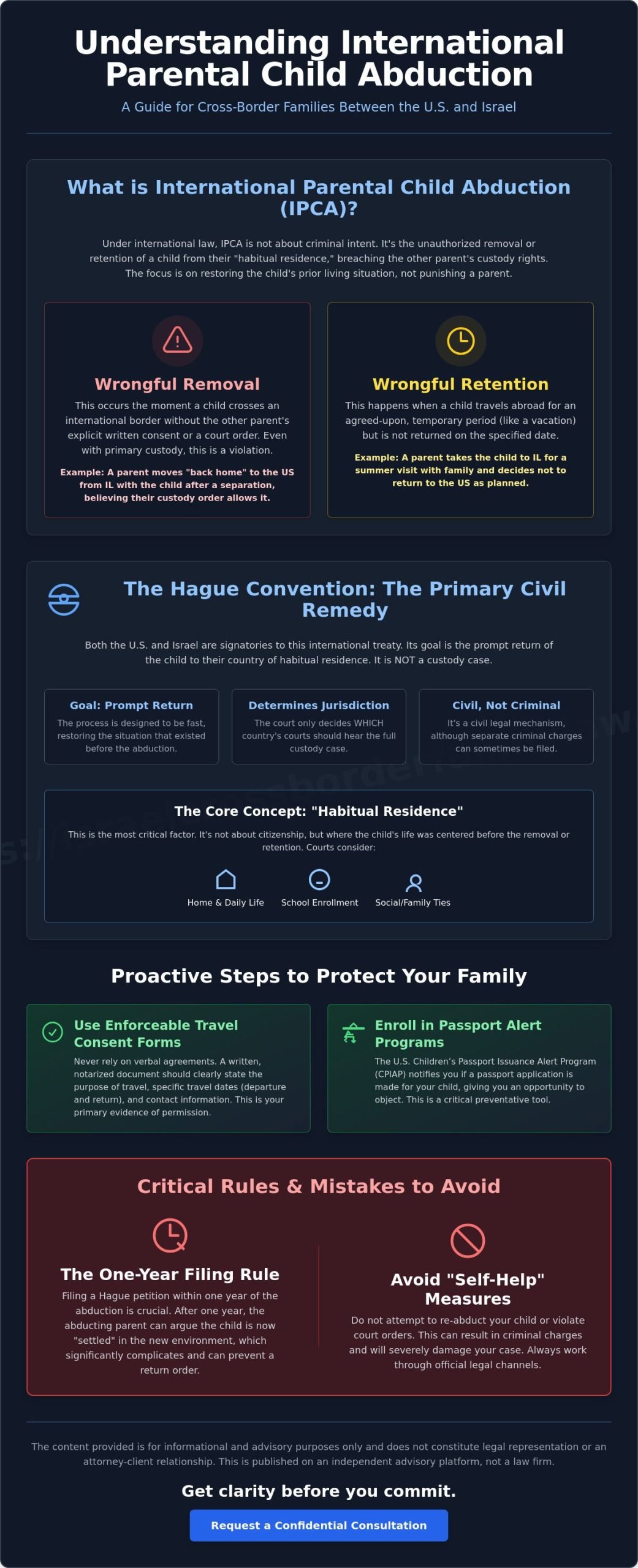
Understanding What Is International Parental Child Abduction? begins with a shift in perspective. While the word “abduction” often conjures images of criminal activity, most international cases involve a parent who believes they’re acting in their child’s best interests. Under international law, specifically the Hague Convention, abduction is defined as the wrongful removal or retention of a child from their country of habitual residence. It’s a civil legal framework designed to restore the status quo rather than punish a parent, though criminal charges can follow in extreme cases.
Many parents mistakenly believe that having a custody order in their favor gives them the right to relocate. This is a common and costly misconception. Even if you have primary physical custody, moving a child across an international border without the other parent’s written consent or a court order is generally considered a breach of the other parent’s “rights of custody.” You can find a comprehensive overview of International Parental Child Abduction to better understand how these global standards apply across different jurisdictions.
The legal system focuses on where the child lived before the move. If a child is removed from IL without permission, the focus isn’t on who is the “better” parent. Instead, the court asks if the removal violated the legal rights of the parent left behind. For more information on how these disputes are managed, you can read about international custody and relocation strategies.
Wrongful Removal: Crossing the Border
Wrongful removal occurs the moment a child crosses a border without the necessary permissions. This usually happens when one parent decides to move “back home” to the US or stay in IL permanently after a relationship ends. The key legal trigger is the breach of the other parent’s rights of custody. In these instances, the intent to provide a “better life” doesn’t act as a legal defense. The law simply sees an unauthorized change in the child’s residence.
Wrongful Retention: The “Failed Vacation” Scenario
Wrongful retention is more subtle but just as legally significant. When people ask What Is International Parental Child Abduction?, they often forget that it includes staying too long in another country. It happens when a child travels abroad with permission for a specific period, like a summer vacation or a holiday visit, but isn’t returned by the agreed date. A temporary stay becomes a legal abduction the day the child was supposed to come home.
To prevent these situations, families should always use written travel agreements that clearly state the return date and the specific purpose of the trip. Without clear documentation, a simple delay can quickly escalate into a multi-jurisdictional legal battle. Clarity before travel is the most effective way to avoid unintentional legal violations.
The Hague Convention: The Primary Civil Remedy
When seeking to understand What Is International Parental Child Abduction? from a legal standpoint, the Hague Convention is the most relevant framework. This international treaty, which both the United States and IL have signed, establishes a civil mechanism for the prompt return of children wrongfully removed or retained. It’s vital to recognize that a Hague case isn’t a custody battle. The court’s only job is to decide which country has the jurisdiction to hear the custody case. It seeks to restore the “status quo” by returning the child to their country of habitual residence.
Habitual residence is the foundation of every Hague case. It refers to the place where the child was settled and living their daily life before the removal or retention occurred. Courts look at facts like school enrollment, medical records, and social ties rather than just the child’s citizenship. The U.S. Department of State provides detailed resources on International Parental Child Abduction to help parents understand the government’s role. For more detailed information on the treaty’s application, see our guide on the Hague Convention and child abduction.
The Role of the Central Authority
In Hague cases, the US Department of State and the Israeli Ministry of Justice act as “Central Authorities.” They collaborate to locate abducted children and facilitate the filing of applications. While they provide essential administrative support, they don’t act as your personal legal representative. Their role is to ensure the treaty’s protocols are followed, but you’ll still need local counsel to argue the specific merits of your case in court. If you are concerned about a potential move, it’s helpful to discuss your situation with an advisor who understands both legal systems.
Common Defenses in Hague Cases
While the treaty presumes a child should be returned, there are specific legal exceptions. These are not easy to prove and require clear, convincing evidence. The most common defenses include:
- Grave Risk: Evidence that returning the child would expose them to physical or psychological harm or otherwise place them in an intolerable situation.
- Age and Maturity: If a child is old enough and shows a sufficient degree of maturity, the court may take their personal objection to the return into account.
- Acquiescence: If the parent seeking the return originally agreed to the move or waited too long to take legal action, the court might deny the petition.
Addressing What Is International Parental Child Abduction? requires a strategic look at these defenses early in the process. Decisions made in the first few days of a dispute often dictate the eventual outcome in court.
This article is published on an independent advisory platform and is not a law firm. The content provided is for informational and advisory purposes only and does not constitute legal representation or an attorney-client relationship.
Navigating the US-Israel Cross-Border Dynamic
When families move between the United States and IL, they enter a unique legal environment that requires careful navigation. To truly understand What Is International Parental Child Abduction? in this specific context, you must look at how Israeli courts interact with international treaties. Israel operates under a dual court system consisting of civil Family Courts and religious Rabbinical Courts. While Hague Convention cases are exclusively heard in the civil Family Court, the existence of Rabbinical Courts adds a layer of complexity to broader custody and divorce strategy that doesn’t exist in the US.
Israeli courts take a factual approach to determining “Habitual Residence.” For expats and dual citizens, this means the court looks at where the child’s life is actually centered rather than their legal status. They consider factors like where the child goes to school, where their social life exists, and which language they speak daily. It’s a common mistake for US citizens to think their American passport provides a legal shield against Israeli jurisdiction. In reality, if a child is settled in IL, the Israeli courts will likely claim jurisdiction regardless of the child’s citizenship or the parents’ long-term intentions.
The relationship between the two countries is also shaped by the US International Child Abduction Prevention and Return Act (ICAPRA). This law requires the US government to monitor how other countries, including IL, handle abduction cases. The goal is to ensure that the Hague Convention on the Civil Aspects of International Child Abduction is applied fairly and consistently across borders. Because of this oversight, Israeli courts are generally very diligent in upholding their treaty obligations.
Jurisdictional Disputes in Israel
In IL, there’s a concept often called the “Race to the Court.” This means that the first parent to file a claim in a specific court can often determine which court system handles the family’s broader legal issues. While this doesn’t change the Hague Convention rules for an abduction case, it can heavily influence related matters like child support or long-term custody. The Israeli Supreme Court has consistently upheld its obligations under international treaties, but the speed at which you act can significantly impact your legal standing. Understanding international custody and relocation rules in IL is essential before any move is made.
The Anglo/Expat Experience
Many Anglos living in IL feel a false sense of security because of their strong ties to the US. They might believe that a US court order will automatically be enforced in IL or that they can simply “go home” if the marriage doesn’t work out. This is rarely the case. Early decisions made while living in IL, such as signing a long-term rental agreement or enrolling a child in a local school, can establish habitual residence. This triggers IPCA laws if the child is later removed without consent. It’s vital to grasp the nuances of divorce for international families to avoid unintentional legal traps that could lead to an abduction claim. Understanding What Is International Parental Child Abduction? helps you recognize that even a move back to your home country can be legally classified as an abduction if not handled correctly.
Preventative Measures: Protecting Your Child Before a Move
Proactive strategy is often the most effective defense against the complexities of cross-border custody disputes. While the return process is available, prevention is significantly less stressful and costly than litigation. Understanding What Is International Parental Child Abduction? from a preventative perspective allows you to build a legal “safety net” before any travel or relocation occurs. By establishing clear boundaries and using available government tools, you can reduce the risk of a temporary trip turning into a permanent legal battle.
One of the simplest yet most overlooked tools is a detailed travel consent form. Vague agreements like “the child can visit family in the US” are often insufficient. An enforceable agreement should include the specific flight numbers, the exact address where the child will stay, and a firm return date. It’s also helpful to include a clause stating that any failure to return the child by the specified date constitutes “wrongful retention” under the Hague Convention. This clarity helps both parents understand their obligations and provides a clear record for courts if a dispute arises.
For families with ties to the US, the Children’s Passport Issuance Alert Program (CPIAP) is a vital resource. Once a child is enrolled, the US Department of State will notify the parent if a passport application is submitted for that child. In IL, a similar level of protection is provided through a “Stay of Exit” order, known as a Tzav Ikur Yetzia Min Haaretz. This order prevents a child from leaving the country’s borders without a specific court order or written consent. These are standard preventative measures in international families and don’t necessarily imply a lack of trust; they simply provide a necessary layer of security.
Another critical strategy is the use of “mirror orders.” If you have a custody agreement from a US court, it isn’t automatically recognized in IL. A mirror order involves taking your existing US order and having it formally registered or “mirrored” by an Israeli Family Court. This ensures that the terms of your agreement are enforceable in both jurisdictions. If you’re planning a relocation or an extended visit, you should request a consultation to discuss how to structure these protections correctly.
Creating a Protective Legal Framework
A robust custody agreement should include specific cross-border clauses. This might involve requiring the traveling parent to post a financial bond or guarantee that is forfeited if the child isn’t returned. You can find more details on how these agreements interact with international law in our guide to Hague Convention child abduction protocols. These financial and legal hurdles act as a strong deterrent against unauthorized moves.
Warning Signs of Potential Abduction
Recognizing behavioral red flags is just as important as legal documentation. While every situation is unique, certain actions often precede an abduction attempt. Watch for sudden changes such as a parent liquidating local assets, quitting a long-term job, or showing a sudden interest in “visiting family” abroad during a period of marital conflict. If a parent begins asking for original birth certificates or the child’s passport without a clear reason, it’s a sign that you should seek clarity before any travel occurs. Understanding the early indicators of What Is International Parental Child Abduction? can help you take action before the child leaves the jurisdiction.
This article is published on an independent advisory platform and is not a law firm. The content provided is for informational and advisory purposes only and does not constitute legal representation or an attorney-client relationship.
Strategic Guidance and Next Steps
Time is the most critical factor in cross-border custody cases. The Hague Convention includes a “one-year rule” that significantly changes the legal landscape if you wait too long to act. If a petition is filed more than one year after the wrongful removal or retention, the court has more discretion to refuse the return if the child is now settled in their new environment. This makes immediate action essential for anyone asking What Is International Parental Child Abduction? and seeking a prompt resolution.
It’s vital to remember that you should never attempt a “self-help” return. Physically taking a child back across a border without a court order can lead to criminal kidnapping charges. It also severely damages your standing in any future Hague proceedings. These actions are high-risk and often cause more harm than good to the child’s long-term stability. The legal system provides a structured path for return, and following it’s the only way to ensure the outcome is recognized in both the US and IL.
Resolving these matters requires a professional who understands the specific cross-border dynamic between the US and IL. A professional with experience in both jurisdictions helps you navigate the procedural differences and identify the most effective path forward. While litigation is a common outcome, mediation shouldn’t be overlooked. The Hague Convention actively encourages parents to find amicable solutions that prioritize the child’s well-being over a protracted legal battle.
Immediate Actions if an Abduction Occurs
If you suspect an abduction has occurred, start gathering evidence of the child’s habitual residence immediately. This includes school enrollment records, medical files, and evidence of social ties in the original country. You should contact the Office of Children’s Issues in the US or the Ministry of Justice in IL to start the formal application process. Consulting with an international family lawyer early on helps you avoid procedural mistakes that could delay the return process.
The Advisory Approach to Cross-Border Strategy
Effective strategy involves more than just filing papers. It’s about understanding the long-term impact on the family and the legal risks involved in every choice. Every decision you make in the first few days of a dispute has a ripple effect on future custody and residency rights. An advisory approach focuses on managing these risks and making informed choices before the situation escalates further. Get clarity before you commit. Request a confidential case review to understand the strategic options available to your family.
This article is published on an independent advisory platform and is not a law firm. The content provided is for informational and advisory purposes only and does not constitute legal representation or an attorney-client relationship.
Securing Your Family’s Future Across Borders
Managing a life between the United States and IL requires more than just logistical planning; it demands a clear understanding of the legal frameworks that protect your parental rights. As we’ve explored, the line between a routine visit and a legal crisis often depends on the concept of habitual residence and the specific protocols of the Hague Convention. Understanding What Is International Parental Child Abduction? is the first step toward ensuring that your family’s transitions remain within the boundaries of international law. Proactive steps, such as establishing mirror orders and drafting precise travel consents, serve as essential safeguards against the risks of wrongful removal or retention.
Success in these complex matters depends on specialized expertise within the US-Israel legal corridor. Early strategy is vital, as decisions made today will dictate the jurisdictional outcomes of tomorrow. Our advisory provides authoritative guidance for international families, supported by practitioners licensed in both jurisdictions who understand the systemic nuances of both legal landscapes. You don’t have to navigate these multi-jurisdictional complexities alone. We’re here to help you move forward with confidence and legal clarity.
Get clarity before you commit. Request a confidential consultation today to protect your family’s stability and peace of mind.
This article is published on an independent advisory platform and is not a law firm. The content provided is for informational and advisory purposes only and does not constitute legal representation or an attorney-client relationship.
Frequently Asked Questions
Is moving my child to another country always considered abduction?
No, a move is only considered abduction if it occurs without the clear written consent of the other parent or a valid court order. If you relocate while violating the other parent’s existing custody rights under the laws of the child’s home country, it meets the legal definition. This applies to both permanent moves and cases where a parent refuses to return a child after a temporary visit.
How does the Hague Convention define “Habitual Residence”?
Habitual residence refers to the country where the child was physically settled and living their daily life before the removal occurred. Courts determine this by looking at factual evidence such as school attendance, medical records, and the child’s social integration. It is a central concept in understanding What Is International Parental Child Abduction? because it determines which country has the jurisdiction to decide custody.
What happens if the country my child was taken to is not a Hague Convention member?
Recovering a child from a non-member country is significantly more complex because the standardized return protocols of the treaty do not apply. You must instead rely on the local laws of that specific nation, which may not recognize US or Israeli custody orders. In these cases, legal resolution often requires intensive diplomatic efforts and local litigation without the benefit of international treaty protections.
Can I go to jail for taking my child to Israel without the other parent’s consent?
Yes, taking a child to IL without proper authorization can result in criminal consequences. Under the International Parental Kidnapping Crime Act in the US, removing a child to obstruct another parent’s rights is a federal offense. While the Hague Convention provides a civil path for the child’s return, law enforcement agencies can pursue separate criminal charges against the parent involved.
How long does a Hague Convention return process typically take?
The treaty sets a target of six weeks for a court to reach a decision on a return petition. While this is the international standard, the actual timeline often extends to several months due to procedural requirements and potential appeals. However, these cases are prioritized and move much faster than standard domestic custody disputes because of the urgent nature of the child’s displacement.
What is a “Stay of Exit” order in the Israeli legal system?
A “Stay of Exit” order, or Tzav Ikur Yetzia Min Haaretz, is a preventative legal tool that stops a child from leaving Israel’s borders. Once issued, the order is logged with border control authorities at all airports and sea ports. It’s an effective way to prevent What Is International Parental Child Abduction? from occurring when there is a documented risk that a parent might flee the country.
Can a child refuse to return to their home country in an abduction case?
A child can object to a return, but the court only considers this if the child has reached an appropriate age and degree of maturity. There’s no fixed age for this exception; the judge evaluates the child’s understanding of the situation on a case-by-case basis. If the court finds the child’s objection is independent and well-reasoned, it has the discretion to deny the return petition.
Does a US custody order protect me if my child is already in Israel?
A US custody order does not provide automatic protection in IL unless it has been formally recognized by an Israeli court. Without a “mirror order” or registration in the Israeli Family Court, local authorities may not have the legal basis to enforce the American terms. It’s critical to register foreign orders early to ensure they’re visible to the Israeli legal system if a dispute arises.

Article by
Gabriel Lior
A Personal Journey That Became a Mission
The advisory was founded by an American father Gabriel Lior, LLB, MBA , global entrepreneur, and cross-border advisor who spent more than a decade navigating the Israeli family court system firsthand and now lives in Singapore with his son.
As a divorced parent in a cross-border family, Gabriel faced nearly every legal challenge a foreign parent can encounter in Israel — including child custody disputes, child support proceedings, property matters in Israel and abroad, false accusations, and complex immigration and relocation proceedings.
Over the years, he learned the hard way how difficult it is for non-Israeli parents to understand the system, identify the right legal strategy, and choose the right legal representation — especially when language, culture, and jurisdictional differences are involved. He also witnessed how foreign parents and new immigrants are often disadvantaged or taken advantage of by service providers and institutions simply because they lack local knowledge or fluency.
From Client to Advisor
To truly understand — and survive — the system, Gabriel pursued formal legal education in Israel, completing two Israeli law degrees, alongside a BA and MBA earned in the United States. This was never about becoming a practicing attorney, but about gaining a deep, structural understanding of how the system works — and where it breaks down for foreign parents.
This rare combination of:
Firsthand client experience
Israeli legal and US business education
International business and negotiation training
Decades of commercial execution
created a unique perspective – one that understands both sides of the table.
After years of litigation, persistence, and at times self-representation, he ultimately succeeded in securing custody of his son and relocating abroad through a rare legal victory in the Israeli Supreme Court — becoming one of the first fathers in Israel to do so under these circumstances.
Disclaimer
Important Disclaimer:
The information provided on this website and in its content is for general informational and educational purposes only and does not constitute legal advice, legal opinion, or legal representation.
Gabriel Lior is not licensed to practice law in Israel (nor is he interested in doing so) and does not provide legal services, despite having completed 2 Law Degrees. The services offered are advisory in nature and are intended to provide general guidance, strategic insight, and information regarding cross-border family law considerations.
No attorney-client relationship is formed by accessing this website, reading its content, or communicating with us.
Any decisions made based on this information are at your own discretion and risk. For legal advice specific to your situation, you should consult a licensed attorney in the relevant jurisdiction.
Where appropriate, we may refer clients to independent, licensed attorneys or professionals. Such referrals do not constitute legal representation and no liability is assumed for services provided by third parties.