This article is published on an independent advisory platform and does not constitute legal representation or legal advice. An attorney-client relationship is only formed through a separate engagement with a licensed attorney.
Your American durable power of attorney for health care internationally will likely fail to protect you the moment you land at Ben Gurion Airport. While you’ve likely spent years planning your estate in the United States, Israeli hospitals and courts do not recognize foreign medical proxies. Most international families believe their existing directives are portable; however, this misconception often leads to legal paralysis during a medical crisis. It’s a stressful situation that can leave family members abroad unable to make critical decisions for their loved ones in Israel.
By reading this guide, you’ll gain a clear understanding of the Israeli Enduring Power of Attorney (EPA) and how it differs from US documents. We’ll explore the specific requirements of the Israeli Ministry of Justice and provide a strategy to harmonize your medical directives across borders. This information is designed to help you achieve peace of mind, knowing your wishes are enforceable in both jurisdictions. For more insights on protecting your family’s interests, you can view our resources at https://www.youtube.com/@IsraelFamilyLaw. Get clarity before you commit. Request a confidential consultation.
Key Takeaways
- Learn why a US-based durable power of attorney for health care internationally is often insufficient for ensuring your medical wishes are honored within the Israeli healthcare system.
- Understand the specific functions of the Israeli Enduring Power of Attorney (EPA) and how it provides a local legal framework for your care.
- Identify the risks of medical-legal gridlock when foreign documents are not properly harmonized with Israeli law.
- Discover strategic steps to align your international directives, allowing your family to navigate the complexity of two different legal cultures.
- Gain a clear roadmap for appointing agents who can effectively manage your medical affairs across borders.
This article is published on an independent advisory platform and does not constitute legal representation or legal advice. An attorney-client relationship is only formed through a separate engagement with a licensed attorney.
What is a Durable Power of Attorney for Health Care in an International Context?
A healthcare DPOA is a legal instrument that empowers a trusted individual to make medical decisions on your behalf if you become incapacitated. Establishing a durable power of attorney for health care internationally is the first step for any expat living in Israel. Understanding the foundational role of What is a Power of Attorney is essential for cross-border planning. The “durable” designation is vital. It ensures the document remains valid after you lose mental capacity. Without this specific status, your agent’s legal authority could disappear exactly when you need it most.
Planning for a durable power of attorney for health care internationally requires a strategy that addresses multi-jurisdictional complexity. Many international families believe their US-based documents are universally accepted. This is a common misconception. Israeli medical institutions operate under local regulations that often do not recognize foreign legal structures. If you are an expat in IL, relying solely on a US document can lead to medical-legal gridlock during a crisis. To learn more about managing these risks, you can view our resources at https://www.youtube.com/@IsraelFamilyLaw.
To better understand this concept, watch this helpful video:
The Role of the Healthcare Proxy Across Borders
Your healthcare proxy acts as your representative within a foreign medical system. This person must bridge the gap between your personal wishes and the requirements of Israeli hospitals. Clear, plain English directives are vital for international clarity. They help doctors understand your intent without getting lost in translation. Establishing this role early is the best way to prevent a court-appointed guardianship, known as an Apotropus. In Israel, a court-appointed guardian is a state-regulated official who may not know your values or preferences. A private directive keeps the decision-making power within your family and ensures that your chosen agent can advocate for the care you desire.
Key Terminology: DPOA vs. Medical Proxy vs. EPA
Legal terms are not always interchangeable across borders. In the US, the term “Durable Power of Attorney for Health Care” is standard. However, Israel utilizes the “Enduring Power of Attorney” or Yipui Koach Mitmashech. This system was significantly updated following a 2016 amendment to the Legal Capacity and Guardianship Law. The Israeli EPA is a specific tool that must be filed with the Administrator General to be valid. While the goals of these documents are similar, the execution is different. Understanding these nuances helps you maintain autonomy and avoid the inherent complexity of cross-border medical law. Get clarity before you commit. Request a confidential consultation.
This article is published on an independent advisory platform and does not constitute legal representation or legal advice. An attorney-client relationship is only formed through a separate engagement with a licensed attorney.
Understanding the Israeli Enduring Power of Attorney (EPA)
Israeli law underwent a significant transformation following a 2016 amendment to the Legal Capacity and Guardianship Law. This change, which became fully operational in 2017, shifted the focus from court-appointed guardianship to individual autonomy. For those managing a durable power of attorney for health care internationally, this means your US documents must be supplemented by a local instrument known as the Enduring Power of Attorney (EPA), or Yipuy Koach Mitmashech. The EPA allows you to designate a decision-maker while you are still of sound mind, ensuring your future medical care is handled by someone you trust rather than a state-appointed stranger.
A critical distinction in the Israeli system is the requirement for professional certification. An EPA cannot be drafted by just any practitioner. It must be prepared and executed by an Israeli lawyer who has undergone specialized training and received certification from the Administrator General. This lawyer ensures the document meets strict digital filing standards. Once signed, the EPA is submitted to the Ministry of Justice’s online portal. This centralized database allows hospitals to verify your directives quickly during an emergency. If you are an expat, coordinating these requirements with your existing estate plan is a vital step in your cross-border strategy.
Why the EPA is Unique to the Israeli System
The Israeli EPA functions differently than “springing” powers often found in the US. It remains dormant until a specific activation event occurs, typically supported by a medical opinion. A unique feature of the Israeli model is the role of “informed persons.” You can name specific individuals who must be notified when the EPA is activated. This creates a layer of transparency and oversight that protects your interests. It prevents the agent from acting in isolation and ensures that family members, even those living abroad, are kept in the loop regarding your status.
Medical Directives within the Israeli EPA
The EPA provides a framework for detailed medical instructions, including palliative care and life-prolonging treatments. These directives often intersect with the Dying Patient Law of 2005, which governs end-of-life care in IL. The Ministry of Health respects these advance directives, but they must be clearly articulated to avoid conflict with local medical ethics. In Israel, medical autonomy often exists alongside traditional or religious values. A well-drafted EPA helps navigate these cultural nuances, ensuring your personal beliefs are respected by the medical establishment. To ensure your plan accounts for these local complexities, you may wish to seek professional guidance on your specific situation.
This article is published on an independent advisory platform and does not constitute legal representation or legal advice. An attorney-client relationship is only formed through a separate engagement with a licensed attorney.
Portability and Validity: Will Your US DPOA Work in Israel?
Many clients arrive in Israel believing their estate plan is complete because their US attorney assured them that their documents are valid globally. While a durable power of attorney for health care internationally is a vital component of a US estate plan, its practical application in an Israeli hospital is often limited. The legal principle of comity suggests that one jurisdiction may recognize the legal acts of another; however, in the fast-paced environment of a medical emergency, comity is rarely a priority for hospital administrators. They require documents that are immediately verifiable and compliant with local Ministry of Health standards.
Relying on a foreign document without local adaptation creates a high risk of legal paralysis. If a hospital refuses to honor a US directive, family members may find themselves unable to access medical records or consent to surgeries. This often forces the family into the very court-appointed guardianship (Apotropus) they were trying to avoid. Understanding these risks is part of a sound cross-border strategy for anyone living between two systems. The common objection, “my US lawyer said this covers everything,” fails to account for the reality of Israeli medical bureaucracy.
The Apostille and Translation Hurdle
A US document is not automatically recognized in IL. It must first receive an Apostille, which is an international certification that authenticates the notary’s signature on the document. Even with an Apostille, most Israeli medical staff will not act on a document written in English. A notarized Hebrew translation is almost always a practical necessity for doctors who need to understand your directives instantly. It’s important to understand that legal validity in a courtroom does not always equal practical acceptance in an emergency room.
US vs. Israel: A Comparison of Healthcare Directives
While US Living Wills typically focus on personal preferences and broad end-of-life scenarios, Israeli “Dying Patient” requests must align with the specific 2005 law governing terminal care. Witness requirements also differ significantly. US states often allow two lay witnesses to sign the document, whereas the Israeli EPA requires a certified attorney to oversee the execution and file it digitally. To ensure your US agent has authority in IL, your strategy must include a local EPA that mirrors your American wishes while satisfying Israeli regulatory oversight. Get clarity before you commit. Request a confidential consultation.
This article is published on an independent advisory platform and does not constitute legal representation or legal advice. An attorney-client relationship is only formed through a separate engagement with a licensed attorney.
Strategic Steps for International Healthcare Planning
Moving from legal theory to practical readiness requires a proactive strategy. The first step involves conducting a multi-jurisdictional audit of your existing estate plan. You must verify that your durable power of attorney for health care internationally aligns with the reality of your current residency. This audit should evaluate whether your chosen agents can realistically perform their duties across time zones and language barriers. If your primary decision-maker resides in the United States, they may struggle to communicate with Israeli medical staff or navigate local hospital protocols during a midnight emergency in Jerusalem.
Adopting a “Dual-Track” approach is the most effective way to ensure continuity of care. This involves maintaining a valid US healthcare proxy for your American interests while simultaneously executing an Israeli Enduring Power of Attorney (EPA) for your life in IL. Relying on a single document to cover both jurisdictions often leaves gaps that hospital administrators are quick to exploit. Once these documents are in place, you must communicate the plan clearly to your family and medical providers. A durable power of attorney for health care internationally is only effective if the people who need it know it exists and can access it immediately.
Coordinating with Cross-Border Legal Counsel
Your legal strategy must be cohesive. It’s vital that your US and Israeli attorneys collaborate to avoid contradictory instructions in your separate documents. For example; an instruction regarding life-prolonging treatment in a US Living Will must not conflict with the specific directives filed in your Israeli EPA. Integrating these healthcare proxies with your broader international estate planning ensures that your medical, financial, and personal wishes all pull in the same direction. This coordination prevents the confusion that often leads to family disputes or state intervention.
Practical Preparation for Expats in Israel
Israeli hospital bureaucracy can be challenging for those unfamiliar with the system. Practical preparation involves more than just filing paperwork; it requires “boots on the ground” readiness. You should store a physical copy of your EPA confirmation from the Administrator General in an accessible location. Additionally, local resources such as the “Hofesh” (Freedom) organization can provide valuable support for individuals seeking to maintain medical autonomy within the Israeli system. Because laws in both countries evolve, you should review your directives every few years to ensure they remain compliant with current regulations. To ensure your plan is robust enough for your specific needs, you may want to discuss your cross-border strategy with a professional. Get clarity before you commit. Request a confidential consultation.
This article is published on an independent advisory platform and does not constitute legal representation or legal advice. An attorney-client relationship is only formed through a separate engagement with a licensed attorney.
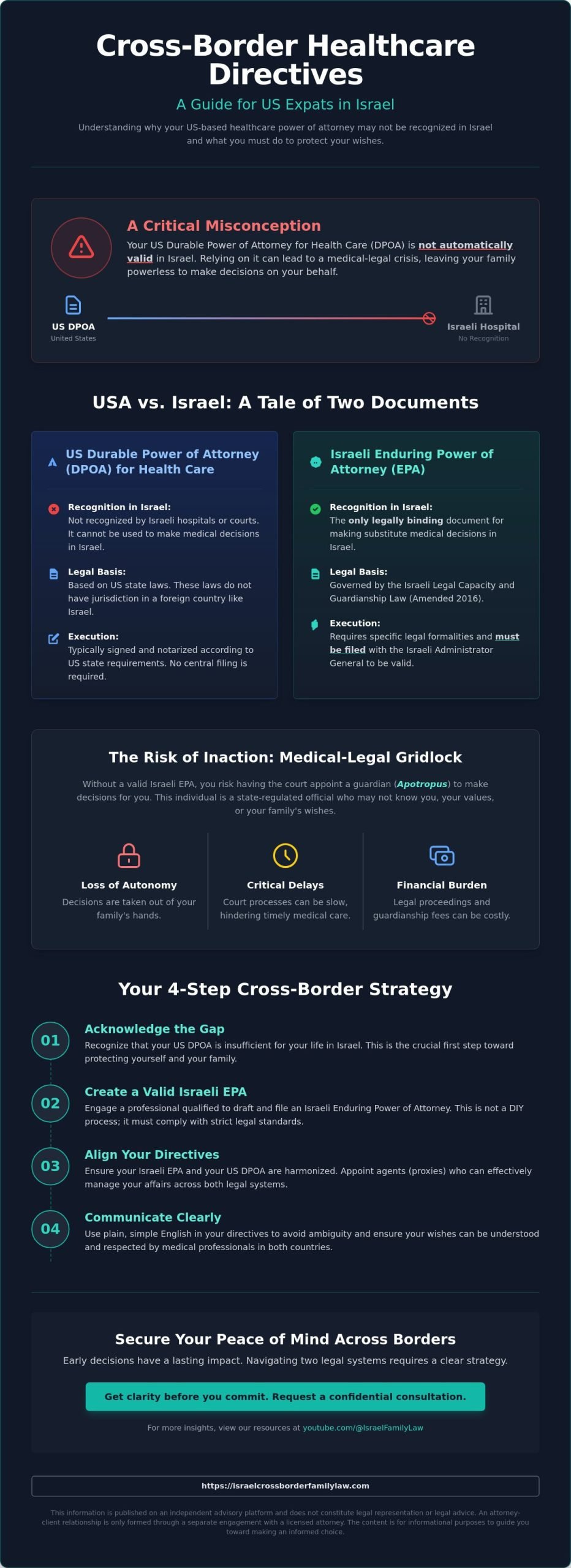
Navigating the Complexity of Cross-Border Medical Law
The Importance of Strategy Over Forms
A “template” approach often fails in cross-border situations because it ignores the specific friction between different legal frameworks. For international families, risk-based decision-making is essential. You must evaluate how your directives will be interpreted by an Israeli doctor who may be unfamiliar with US-style medical proxies. This level of planning is particularly critical for expats and foreign nationals who maintain ties to multiple countries and legal systems. By focusing on strategy rather than just filling out forms, you can avoid the legal gridlock that often occurs when documents from different jurisdictions collide. A strategy-first mindset helps you identify which jurisdiction’s rules will take precedence in specific medical scenarios, allowing you to prepare your agents for the unique challenges they’ll face in an Israeli hospital setting, where local laws like the Dying Patient Law of 2005 dictate the boundaries of care.
Next Steps: Securing Your Future in Both Jurisdictions
Securing your future requires a proactive rather than a reactive legal stance. A confidential case review can provide the specific insights needed for complex multi-jurisdictional situations. It allows you to address potential conflicts before they become emergencies. This strategic foresight ensures that your durable power of attorney for health care internationally remains effective and that your medical care remains in the hands of your chosen agents, regardless of which country you are in. By taking these steps now, you protect your autonomy and provide your family with the tools they need to advocate for you effectively. This preparation is the most reliable way to maintain your dignity and ensure your voice is heard when you can no longer speak for yourself. Get clarity before you commit. Request a confidential consultation.
This article is published on an independent advisory platform and does not constitute legal representation or legal advice. An attorney-client relationship is only formed through a separate engagement with a licensed attorney.
Securing Medical Autonomy Across Borders
Protecting your future medical care requires a proactive approach that recognizes the limitations of a single-jurisdiction document. While a durable power of attorney for health care internationally serves as a vital foundation, its effectiveness in IL depends on its alignment with the Israeli Enduring Power of Attorney system. Coordinating these directives ensures that your agents possess the practical authority to navigate hospital bureaucracy without the risk of legal paralysis or state intervention. Strategic planning today prevents the confusion that often occurs when families are forced to act during a medical crisis.
Our advisory platform draws on decades of experience in US-Israel family law to help international families bridge these complex legal gaps. We work with practitioners who are qualified in multiple jurisdictions and maintain a specialized focus on the unique needs of the Anglo expat community. Our goal is to provide you with the strategy needed to ensure your medical wishes are universally respected. Get clarity before you commit. Request a confidential consultation. Taking these steps now provides the peace of mind that your autonomy is protected wherever life takes you.
This article is published on an independent advisory platform and does not constitute legal representation or legal advice. An attorney-client relationship is only formed through a separate engagement with a licensed attorney.
Frequently Asked Questions
Is my US healthcare power of attorney valid in Israel?
Generally, no. Israeli medical institutions and courts do not recognize foreign healthcare proxies because they lack the specific digital filing and certification required by the Ministry of Justice. While the document might be valid in the US, an Israeli hospital will likely require a local instrument that complies with the Legal Capacity and Guardianship Law to grant an agent decision-making authority.
What is the Israeli Enduring Power of Attorney (EPA)?
The EPA, known in Hebrew as Yipuy Koach Mitmashech, is a legal tool introduced in 2017 that allows you to choose who will make decisions for you if you lose capacity. It covers medical, personal, and financial matters. Unlike a standard proxy, it must be drafted and filed online by a certified Israeli lawyer who has undergone specialized training from the Administrator General.
Can I appoint a person living in the US as my medical proxy in Israel?
You can legally appoint a person living abroad, but it presents significant practical challenges. Medical emergencies often require immediate, face-to-face communication with doctors and hospital administrators. If your primary agent is in the US, you should consider appointing a local co-proxy in IL who can act quickly while your American agent provides long-term direction from abroad.
How do I get an Apostille for my medical documents?
An Apostille is obtained from the Secretary of State in the US jurisdiction where your document was notarized. This certification authenticates the notary’s signature for international use under the Hague Convention. It’s a necessary step for any US document used in Israel, but remember that an Apostille doesn’t replace the need for a notarized Hebrew translation or a local EPA.
What happens if I become incapacitated in Israel without an EPA?
The Israeli court system will likely initiate a guardianship (Apotropus) process to appoint a decision-maker. This is often a slow, bureaucratic procedure that may result in a state-regulated guardian making your medical choices. Having a durable power of attorney for health care internationally that includes an Israeli EPA prevents this state intervention and keeps control within your family.
Do I need a separate will for my assets in Israel and the US?
It’s often a strategic choice to maintain separate wills for assets in different jurisdictions to simplify the probate process. A local Israeli will for your assets in IL avoids the need for complex legal opinions on foreign law and expensive translations. This ensures your estate is handled efficiently according to the specific regulations of each country’s legal system.
How often should I update my cross-border healthcare directives?
You should review your directives every three to five years or after any major life event, such as a move or a change in health status. Legal frameworks in both the US and Israel evolve over time. Regular updates ensure your durable power of attorney for health care internationally remains compliant with current Ministry of Health standards and reflects your most recent medical wishes.
Can an Israeli hospital override my US-based medical directives?
Yes, if the directives conflict with Israeli law or the Dying Patient Law of 2005. Israeli doctors are bound by local medical ethics and state regulations, which may differ from American standards regarding end-of-life care. To ensure your wishes are respected, your directives must be harmonized with the Israeli legal framework through a properly executed and filed Enduring Power of Attorney.

Article by
Gabriel Lior
A Personal Journey That Became a Mission
The advisory was founded by an American father Gabriel Lior, LLB, MBA , global entrepreneur, and cross-border advisor who spent more than a decade navigating the Israeli family court system firsthand and now lives in Singapore with his son.
As a divorced parent in a cross-border family, Gabriel faced nearly every legal challenge a foreign parent can encounter in Israel — including child custody disputes, child support proceedings, property matters in Israel and abroad, false accusations, and complex immigration and relocation proceedings.
Over the years, he learned the hard way how difficult it is for non-Israeli parents to understand the system, identify the right legal strategy, and choose the right legal representation — especially when language, culture, and jurisdictional differences are involved. He also witnessed how foreign parents and new immigrants are often disadvantaged or taken advantage of by service providers and institutions simply because they lack local knowledge or fluency.
From Client to Advisor
To truly understand — and survive — the system, Gabriel pursued formal legal education in Israel, completing two Israeli law degrees, alongside a BA and MBA earned in the United States. This was never about becoming a practicing attorney, but about gaining a deep, structural understanding of how the system works — and where it breaks down for foreign parents.
This rare combination of:
Firsthand client experience
Israeli legal and US business education
International business and negotiation training
Decades of commercial execution
created a unique perspective – one that understands both sides of the table.
After years of litigation, persistence, and at times self-representation, he ultimately succeeded in securing custody of his son and relocating abroad through a rare legal victory in the Israeli Supreme Court — becoming one of the first fathers in Israel to do so under these circumstances.
Disclaimer
Important Disclaimer:
The information provided on this website and in its content is for general informational and educational purposes only and does not constitute legal advice, legal opinion, or legal representation.
Gabriel Lior is not licensed to practice law in Israel (nor is he interested in doing so) and does not provide legal services, despite having completed 2 Law Degrees. The services offered are advisory in nature and are intended to provide general guidance, strategic insight, and information regarding cross-border family law considerations.
No attorney-client relationship is formed by accessing this website, reading its content, or communicating with us.
Any decisions made based on this information are at your own discretion and risk. For legal advice specific to your situation, you should consult a licensed attorney in the relevant jurisdiction.
Where appropriate, we may refer clients to independent, licensed attorneys or professionals. Such referrals do not constitute legal representation and no liability is assumed for services provided by third parties.