This article is published on an independent advisory platform and does not constitute legal representation or an attorney-client relationship. Legal services are only provided by licensed attorneys under a separate engagement.
Imagine receiving a court order in New York that directly contradicts a ruling from a judge in Tel Aviv because your legal team failed to sync the two proceedings. This isn’t just a minor oversight; it’s a sign that the bridge between your US and Israeli legal interests has collapsed. Understanding when to switch lawyers in a cross-border case is often the most important strategic decision you’ll make to protect your family or your assets.
It’s natural to feel anxious when legal fees mount without clear progress or when your advisor seems confused by the systemic differences in Israel. You deserve a strategy that works in both jurisdictions simultaneously. This article identifies the critical warning signs that your current representation is failing and provides a safe framework to transition to a more competent advisor. We’ll walk through a strategic checklist to help you decide if it’s time for a change and how to move forward without losing your momentum.
Key Takeaways
- Learn to recognize the “Local Vacuum” trap where your legal team ignores the US implications of your Israeli proceedings.
- Identify the risks of poor coordination; these include conflicting court orders or unexpected double taxation on settlements.
- Use our strategic framework to determine when to switch lawyers in a cross-border case without losing ground on your progress.
- Learn the safe steps for transitioning counsel, including how to secure your case files and time the move around major deadlines.
- Understand how an independent advisor helps bridge the gap between your US and Israeli legal teams for a more cohesive strategy.
This article is published on an independent advisory platform and does not constitute legal representation or an attorney-client relationship. Legal services are only provided by licensed attorneys under a separate engagement.
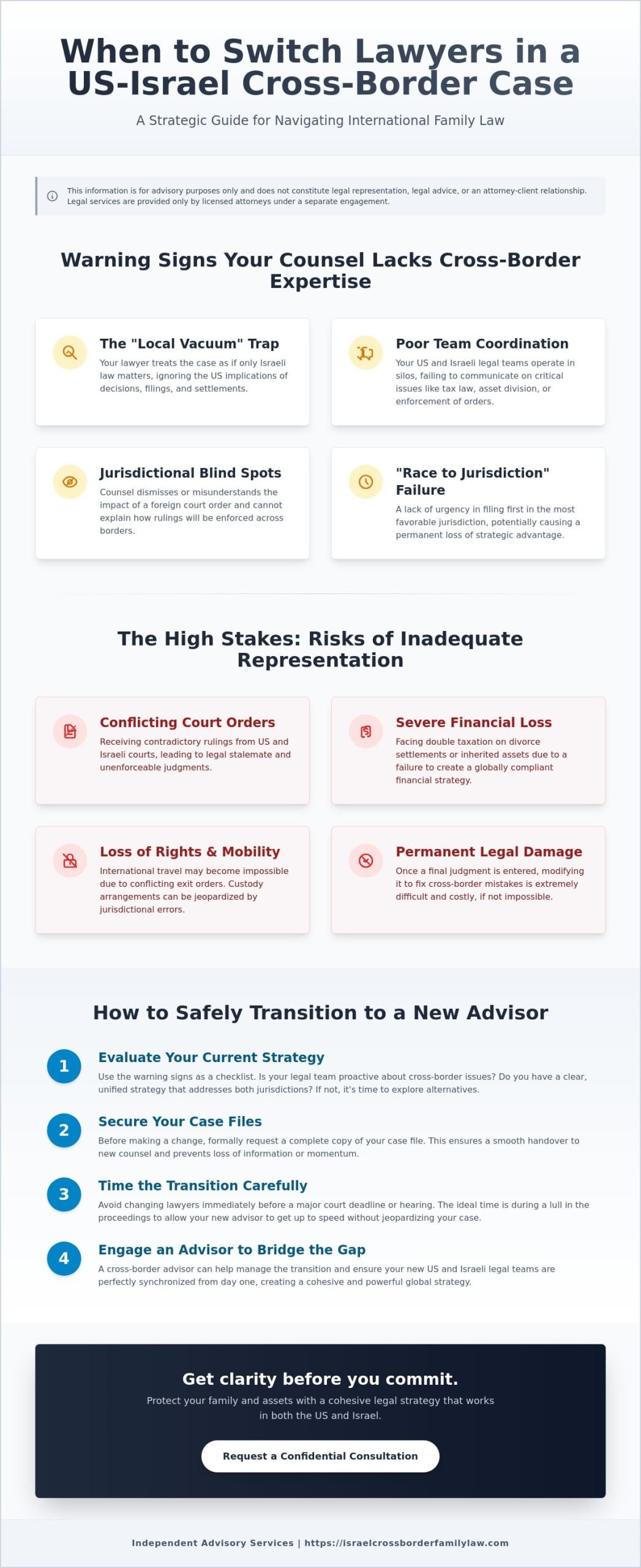
Warning Signs Your Current Counsel Lacks Cross-Border Expertise
Many practitioners in Israel are highly skilled in domestic matters but struggle when a case crosses international lines. You might be caught in the “Local Vacuum” trap if your lawyer treats your situation as if only Israeli law matters. This narrow focus ignores the fundamental cross-border legal principles that dictate how different jurisdictions interact. Determining when to switch lawyers in a cross-border case often begins when you realize your attorney is only looking at half of the map.
To better understand your rights regarding changing your legal representation, watch this helpful video:
Poor coordination with your US-based counsel is another critical warning sign. In a US-Israel case, your legal teams shouldn’t operate in isolation. If your Israeli lawyer fails to account for US tax implications in a settlement or ignores how an Israeli ruling affects your assets in the States, you’re at risk of double taxation or conflicting obligations. Additionally, the Israeli Rabbinical system is complex. If your counsel can’t clearly explain these religious court dynamics to US stakeholders or your American attorney, your international strategy will likely fracture.
Communication Gaps and Jurisdictional Blind Spots
Pay close attention to how your lawyer reacts to US court orders. If they dismiss the impact of a foreign ruling or can’t explain how an Israeli decision will be enforced in the US, there’s a significant gap in their expertise. A common red flag is a high frequency of “I don’t know” responses regarding the bridge between the two systems. You need an advisor who understands the mechanics of both sides to avoid being caught between two different sets of rules.
The ‘Race to Jurisdiction’ Failure
Timing is everything in international law. In a US-Israel context, the “Race to the Courthouse” is the strategic effort to file your case first in the jurisdiction that provides the most favorable legal environment for your specific needs. Missing these windows can permanently damage your position. This is especially true in Hague Convention cases or custody matters where a lack of urgency can lead to losing jurisdictional standing. If your lawyer isn’t treating these deadlines with the necessary speed, your strategy is already failing.
This article is published on an independent advisory platform and does not constitute legal representation or an attorney-client relationship. Legal services are only provided by licensed attorneys under a separate engagement.
The Risks of Staying with Inadequate Cross-Border Representation
Choosing to remain with counsel who lacks a global perspective isn’t just a matter of inconvenience. It creates tangible risks that can derail your future and your finances. One of the most severe consequences is the issuance of conflicting court orders. If your Israeli lawyer secures a ruling that a US judge refuses to recognize, you may find yourself in a legal stalemate where international travel becomes impossible due to contradictory exit orders or custody requirements. Knowing when to switch lawyers in a cross-border case is often about identifying this strategic stagnation before it results in a permanent loss of rights.
Financial loss is another reality when your legal team operates in a silo. Without a strategy that accounts for both Israeli and US tax codes, you might face double taxation on inherited assets or divorce settlements. These mistakes are frequently permanent. Once a final judgment is entered in Israel, modifying it to satisfy US requirements is significantly more expensive than getting it right the first time. If you’re experiencing these issues, understanding how to switch lawyers is a vital step toward protecting your interests.
Financial and Emotional Toll of Mismanaged Strategy
The cost of re-doing legal work in two different countries can double or triple your initial budget. Beyond the financial impact, the emotional exhaustion of serving as the “translator” between two disconnected legal teams takes a heavy toll. You shouldn’t be the one explaining US legal concepts to your Israeli lawyer. If your current strategy feels disconnected, you might benefit from a confidential strategy review to identify these risks before they become permanent.
The Impact on Child Custody and Relocation
In the context of International Custody and Relocation, poor legal strategy can lead to “accidental” child abduction claims. Vague visitation clauses that work in a local Israeli context often fail when applied to US-Israel travel. These gaps can trigger the Hague Convention, leading to traumatic legal battles that could have been avoided with a cohesive cross-border plan. Unwitting concessions made in one jurisdiction can lead to a complete loss of rights in the other, making it nearly impossible to resolve the case without starting over with new counsel.
This article is published on an independent advisory platform and does not constitute legal representation or an attorney-client relationship. Legal services are only provided by licensed attorneys under a separate engagement.
Checklist: Evaluating Your Current US-Israel Legal Strategy
Deciding when to switch lawyers in a cross-border case requires an objective audit of your current representation. Many clients realize too late that their legal team is operating without a cohesive plan that spans both jurisdictions. An effective international strategy requires more than just local expertise; it demands a “general contractor” who coordinates the efforts of both US and Israeli professionals. If your lawyers aren’t communicating with each other regularly, you are likely paying for redundant work and conflicting advice.
Use the following criteria to evaluate if your current counsel is equipped for the complexity of your case:
- Designated Leadership: Is there a clear lead professional responsible for the global strategy, or are you the one relaying information between two different offices?
- Tax Treaty Proficiency: Does your lawyer understand how the US-Israel Tax Treaty affects your specific assets, such as US-based 401(k)s or Israeli pension funds?
- Collaborative Openness: Is your lawyer comfortable working with an independent advisory platform to refine the strategy, or do they view outside expertise as a threat?
- Jurisdictional Foresight: Can your lawyer explain how an action taken in an Israeli court today will impact your legal standing in the US six months from now?
Technical Competence Check
Technical errors in cross-border cases often involve “Service of Process” and international protocols. If your lawyer isn’t familiar with the specific requirements of the Hague Service Convention, your case could be dismissed on a technicality years into the process. Similarly, asset valuation requires a nuanced understanding of both systems. For instance, the way Israeli courts value “reputation assets” or business interests often differs significantly from US standards. If your attorney treats a shekel-based asset exactly like a dollar-based one without considering currency fluctuations or divergent accounting rules, your financial future is at risk.
Strategic Alignment Check
Your legal strategy must reflect your long-term life goals. If you intend to move back to the US after your case concludes, every decision made in the Israeli courts must support that objective. It’s common for lawyers to focus on “winning” a local battle in a way that creates a permanent barrier to your international goals. This is particularly critical in Divorce for International Families, where a short-term victory regarding child support or property division in Israel might trigger negative consequences in a US court. Ensure your lawyer is fighting the right war, not just the nearest battle.
This article is published on an independent advisory platform and does not constitute legal representation or an attorney-client relationship. Legal services are only provided by licensed attorneys under a separate engagement.
How to Switch Lawyers Without Sabotaging Your Case
Executing a change in legal representation during an active international dispute requires surgical precision. Once you’ve determined when to switch lawyers in a cross-border case, your next priority is ensuring the transition doesn’t result in lost data or missed deadlines. In Israel, the process involves specific administrative steps that differ between the Family Court and the Rabbinical Court. Managing these steps carefully prevents the court from perceiving your move as a delay tactic or a lack of commitment to the process.
Before you notify your current counsel, you must secure your complete case file. This includes all court protocols, digital filings, and correspondence with the opposing side. While Israeli law generally entitles you to your file, fee disputes can lead to a lawyer attempting to withhold documents until accounts are settled. Having these records in hand before the relationship ends allows your new team to hit the ground running without waiting for a hostile handover. If you’re concerned about how your current strategy is being handled, you can request a confidential strategy review to map out your next steps safely.
The Quiet Transition: Planning Your Move
Success in a cross-border case depends on cohesion, not just local aggression. You should interview potential new advisors while your current case is still active. This allows you to identify what success actually looks like for your next representative. Is it better communication? A clearer understanding of US tax implications? Or perhaps better coordination with your American legal team? A confidential review of your current status can highlight gaps your current lawyer might be missing, giving you a clear roadmap for the new firm to follow from day one.
Communicating the Change to the Court
Once you’ve selected new counsel, the transition must be formalized with the court. In Israeli courts, a new attorney must file a formal Notice of Change of Representation to officially replace previous counsel on the record. This is a standard procedure, but timing is critical. Filing this notice immediately before a major hearing or a filing deadline can irritate a judge and may be viewed as an attempt to stall the proceedings. Ensure your new team has enough time to review the files so they can represent you effectively from their very first appearance. Managing the financial transition also requires clarity; review your initial fee agreement to understand your obligations regarding outstanding balances and the return of any unearned retainers.
This article is published on an independent advisory platform and does not constitute legal representation or an attorney-client relationship. Legal services are only provided by licensed attorneys under a separate engagement.
Bridging the Gap: The Advisory Advantage in Cross-Border Law
Determining when to switch lawyers in a cross-border case is only the first step toward resolving a complex international dispute. The most common mistake clients make is jumping immediately from one traditional law firm to another without first addressing the underlying strategic flaws. A “Strategy First” approach ensures that you don’t repeat the same mistakes with new counsel. By prioritizing high-level planning over immediate litigation, you can identify where the bridge between the US and Israeli systems originally failed.
An independent advisor serves as a critical coordinator between your US and Israeli legal teams. This role is designed to reduce the friction caused by divergent legal cultures, languages, and procedural expectations. While a local lawyer focuses on the specific rules of their jurisdiction, an advisor looks at the global picture to ensure that a victory in Tel Aviv doesn’t create a liability in New York. This layer of oversight provides the clarity you need before you commit to another long-term legal engagement.
Moving from Representation to Strategy
It’s helpful to understand how an advisory platform differs from a traditional law firm. While law firms are built to provide specific legal services and representation in court, an advisory platform focuses on the overarching architecture of your case. You can see a detailed breakdown of this model by reviewing how it works. Having a neutral expert audit your cross-border strategy allows for an objective assessment of your current risks. This audit can reveal if your lawyers are truly collaborating or if they are inadvertently working at cross-purposes, saving you from mounting fees and strategic stagnation.
Next Steps for Your US-Israel Case
Your immediate priority should be identifying the single most critical risk facing your case right now. Whether it’s a looming deadline in a US court or a pending hearing in an Israeli Rabbinical court, you need a clear plan of action. Preparing for a confidential case review is an effective way to gather your facts and receive an honest assessment of your situation. This process helps you move from a state of anxiety to a state of informed decision-making.
Fixing a flawed strategy is possible at any stage of the proceedings. Even if early decisions have complicated your standing, a well-coordinated transition to a more strategic approach can often mitigate the damage. Get clarity before you commit. Reach out for a soft advisory call or send a message via WhatsApp to discuss your options safely and confidentially.
This article is published on an independent advisory platform and does not constitute legal representation or an attorney-client relationship. Legal services are only provided by licensed attorneys under a separate engagement.
Moving Forward with a Cohesive US-Israel Plan
Navigating the complexities of two different legal systems requires more than just local representation; it demands a unified strategy that accounts for every jurisdictional nuance. Deciding when to switch lawyers in a cross-border case is a significant step toward reclaiming control over your future. By identifying communication gaps early and prioritizing a strategy-first approach, you can avoid the financial and emotional toll of conflicting court orders or unexpected tax penalties.
Our advisory platform offers a specialized focus on US-Israel family and corporate law, providing the cross-cultural expertise needed to bridge the gap between divergent systems. With practitioners licensed in multiple jurisdictions, we prioritize a calm, advisory-first approach that focuses on your long-term goals. It’s never too late to refine your strategy and ensure your legal teams are working in harmony. You deserve a plan that protects your interests in both countries simultaneously.
Get clarity before you commit. Request a confidential consultation to discuss your case and discover a more strategic path forward.
This article is published on an independent advisory platform and does not constitute legal representation or an attorney-client relationship. Legal services are only provided by licensed attorneys under a separate engagement.
Frequently Asked Questions
Is it more expensive to switch lawyers in the middle of a cross-border divorce?
Switching typically requires a new retainer and time for the new attorney to study your case files. While this feels more expensive upfront, staying with inadequate counsel is often much costlier in the long run. Inadequate representation can lead to missed assets, double taxation, or strategic errors that are expensive to fix. Knowing when to switch lawyers in a cross-border case can save you from these mounting financial risks.
Will switching my lawyer in Israel affect my ongoing case in the United States?
Yes, your Israeli proceedings directly impact your US legal standing. A new Israeli lawyer who understands the “bridge” between the two systems can ensure that filings in Israel don’t accidentally waive your rights in the US. If your current lawyer is making decisions in Israel without considering the American consequences, switching to a more globally aware team is usually a protective move for your US case.
How do I fire my current Israeli lawyer without making my case look bad to the judge?
Professionalism and timing are the keys to a smooth transition. You should have your new counsel file a formal “Notice of Change” with the court. If the transition is handled quickly and doesn’t cause a request for a long postponement of a major hearing, judges generally view it as a standard exercise of your right to counsel rather than a delay tactic.
Can I hire a US-based lawyer to handle my case in Israel?
No, a lawyer who is only licensed in the US cannot represent you in an Israeli court. Israeli law requires practitioners to be members of the Israel Bar Association to appear before judges. However, a US lawyer can work in an advisory capacity alongside your Israeli counsel to ensure that the international strategy remains cohesive across both jurisdictions.
What should I do if my current lawyer refuses to hand over my case file?
You are legally entitled to your case file under Israeli law. If a lawyer refuses to release it due to a fee dispute, you can request assistance from the Israel Bar Association or seek a court order. To avoid this friction, it’s often better to secure a complete digital copy of your file before you officially notify your current lawyer that you are ending the relationship.
How do I know if the new lawyer I’m considering actually understands cross-border law?
Ask specific questions about their experience with international protocols. A qualified lawyer should be able to explain how the Hague Convention applies to your custody situation or how the US-Israel Tax Treaty affects your assets. If their answers focus only on local Israeli law and they seem dismissive of the US side of the case, they likely lack the necessary cross-border expertise.
Can an independent advisor work alongside my existing local lawyer?
Yes, an independent advisor often acts as a “general contractor” to coordinate between you and your local legal team. This approach provides a neutral audit of your strategy without requiring you to fire your local lawyer immediately. It helps ensure that the local legal work in Israel aligns with your broader international goals and protects your interests in the United States.
What is the biggest mistake people make when changing lawyers in a US-Israel case?
The biggest mistake is switching to another “local-only” lawyer without fixing the underlying strategy. Many people find a new lawyer who is aggressive in Israeli courts but still fails to understand the US implications of the case. Without a cohesive cross-border plan, the same communication gaps and jurisdictional risks will likely happen again with the new firm.

Article by
Gabriel Lior
A Personal Journey That Became a Mission
The advisory was founded by an American father Gabriel Lior, LLB, MBA , global entrepreneur, and cross-border advisor who spent more than a decade navigating the Israeli family court system firsthand and now lives in Singapore with his son.
As a divorced parent in a cross-border family, Gabriel faced nearly every legal challenge a foreign parent can encounter in Israel — including child custody disputes, child support proceedings, property matters in Israel and abroad, false accusations, and complex immigration and relocation proceedings.
Over the years, he learned the hard way how difficult it is for non-Israeli parents to understand the system, identify the right legal strategy, and choose the right legal representation — especially when language, culture, and jurisdictional differences are involved. He also witnessed how foreign parents and new immigrants are often disadvantaged or taken advantage of by service providers and institutions simply because they lack local knowledge or fluency.
From Client to Advisor
To truly understand — and survive — the system, Gabriel pursued formal legal education in Israel, completing two Israeli law degrees, alongside a BA and MBA earned in the United States. This was never about becoming a practicing attorney, but about gaining a deep, structural understanding of how the system works — and where it breaks down for foreign parents.
This rare combination of:
Firsthand client experience
Israeli legal and US business education
International business and negotiation training
Decades of commercial execution
created a unique perspective – one that understands both sides of the table.
After years of litigation, persistence, and at times self-representation, he ultimately succeeded in securing custody of his son and relocating abroad through a rare legal victory in the Israeli Supreme Court — becoming one of the first fathers in Israel to do so under these circumstances.
Disclaimer
Important Disclaimer:
The information provided on this website and in its content is for general informational and educational purposes only and does not constitute legal advice, legal opinion, or legal representation.
Gabriel Lior is not licensed to practice law in Israel (nor is he interested in doing so) and does not provide legal services, despite having completed 2 Law Degrees. The services offered are advisory in nature and are intended to provide general guidance, strategic insight, and information regarding cross-border family law considerations.
No attorney-client relationship is formed by accessing this website, reading its content, or communicating with us.
Any decisions made based on this information are at your own discretion and risk. For legal advice specific to your situation, you should consult a licensed attorney in the relevant jurisdiction.
Where appropriate, we may refer clients to independent, licensed attorneys or professionals. Such referrals do not constitute legal representation and no liability is assumed for services provided by third parties.