This article is published on an independent advisory platform (not a law firm) and is for informational and advisory purposes only. It does not constitute legal representation, legal advice, or an attorney-client relationship; legal services are only provided by licensed attorneys under a separate engagement.
Did you know that nearly 47% of millennials in Israel now use financial contracts to protect their future, yet many expats mistakenly assume their foreign documents will automatically be honored by local courts? It’s natural to feel uneasy when facing a dual legal system that splits authority between civil and religious bodies, especially when your assets span multiple countries. You deserve to know that your property is protected by a strategy that satisfies both local and international standards. This guide will clarify how to structure a prenuptial agreement israel for foreigners so you can move forward with your marriage feeling secure and informed.
We will examine the essential validation steps for 2026, the impact of the Spouses’ Property Relations Law on your assets, and the specific roadmap required to ensure your agreement remains enforceable across different jurisdictions.
Key Takeaways
- Understand why Israel’s default property laws may lead to an unintended 50/50 asset split and how a Financial Agreement (Heskem Mamon) provides a necessary opt-out.
- Identify the specific risks of “commingling” separate assets and learn the procedural steps to ensure pre-marital property remains protected.
- Navigate the mandatory validation process to ensure a prenuptial agreement israel for foreigners is recognized by both civil and religious authorities.
- Secure your global interests by establishing clear jurisdictional boundaries and choice of law clauses for assets located outside of Israel.
- Develop a strategic approach to matrimonial planning that focuses on transparent communication and risk assessment before formal legal representation begins.
Understanding the Financial Agreement (Heskem Mamon) in Israel
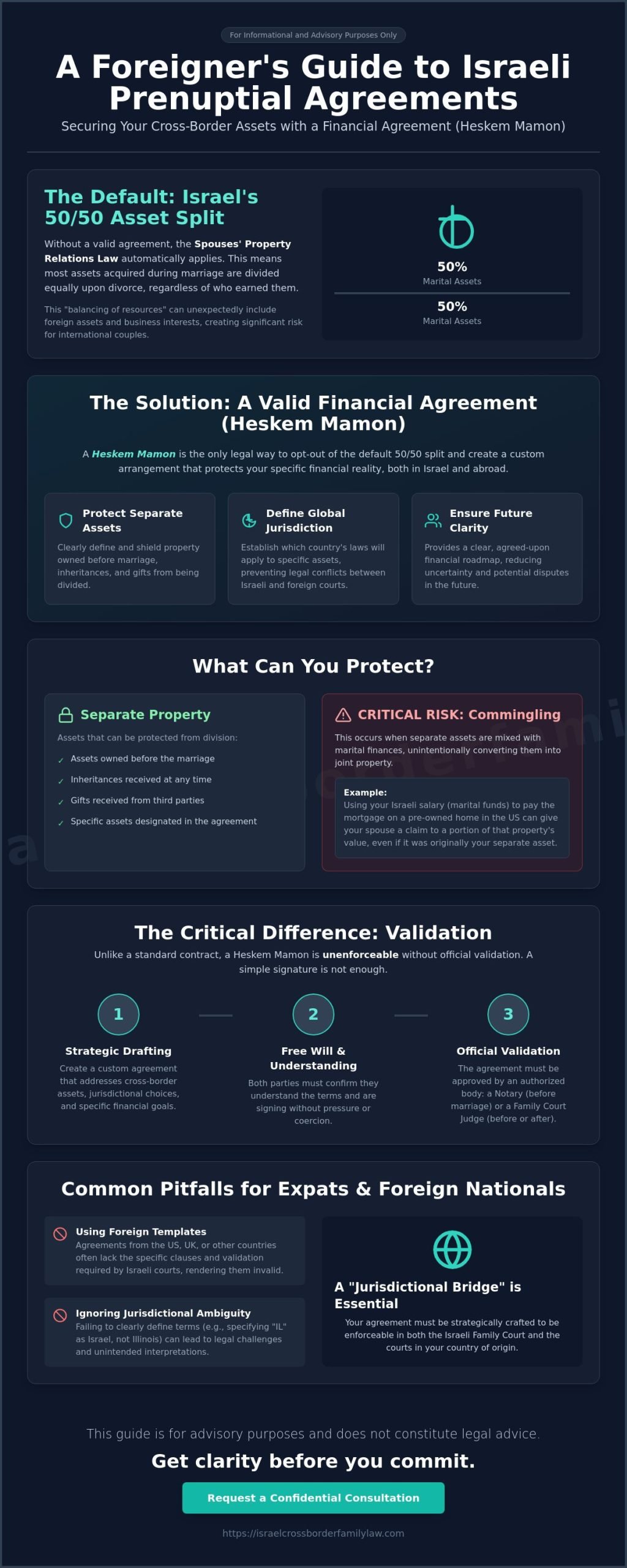
In Israel, the legal framework for marital assets is distinct from many Western jurisdictions. If you don’t have a valid agreement, the law applies a default rule called “balancing of resources.” This means that upon divorce or death, most assets acquired during the marriage are split equally. For an expat or international couple, this default setting can lead to unexpected consequences for assets held abroad.
A standard contract only requires signatures to be valid between parties. However, a Heskem Mamon is only legally binding once it has been validated by a qualified authority, such as a notary or a judge. This validation ensures that both parties understand the terms and have entered the agreement of their own free will. Understanding the Financial Agreement (Heskem Mamon) requires a deep appreciation of both civil law and the religious context that often influences family law in the region.
To better understand the strategic importance of these agreements, watch this helpful video:
The Role of the Matrimonial Relations Law
The Spouses Matrimonial Relations Law, 5733-1973 is the primary governing framework for marital property in Israel. This law assumes that marriage is a partnership of equals where all efforts contribute to a shared pool of wealth. Without a prenuptial agreement israel for foreigners, even assets like pensions, business interests, or savings accounts started after the wedding date are subject to a 50/50 division. A court-approved agreement is the only way to legally opt out of this presumption and establish a custom arrangement that reflects your specific financial reality.
Why Foreigners Need a Specific Approach
Foreign nationals often enter an Israeli marriage with significant pre-existing assets, such as real estate in the US or investment portfolios in Europe. Many expats don’t realize that the “balancing of resources” can sometimes reach back into assets they thought were separate. If you use marital funds to pay a mortgage on a pre-owned home in another country, an Israeli court might decide that a portion of that home has become joint property. This is a common concern for those moving to Israel as foreign nationals.
Relying on a template from your home country is a common pitfall; these documents often lack the specific clauses required to satisfy an Israeli judge. For example, your agreement must clearly state that “IL” refers to Israel to avoid any ambiguity with other jurisdictions like Illinois. Your residency status and visa type can also influence how property rights are viewed over time. A strategic prenuptial agreement israel for foreigners must account for these cross-border complexities, ensuring that your global footprint is protected. It’s about creating a jurisdictional bridge that works in both the local Family Court and your country of origin.
This article is published on an independent advisory platform (not a law firm) and is for informational and advisory purposes only. It does not constitute legal representation, legal advice, or an attorney-client relationship; legal services are only provided by licensed attorneys under a separate engagement.
Matrimonial Property vs. Separate Assets: What Can You Protect?
Under the Spouses’ Property Relations Law, assets accumulated during the marriage are generally divided equally. However, certain assets are considered “separate property” by default. These include items owned before the wedding, gifts, and inheritances received during the union. For those seeking a prenuptial agreement israel for foreigners, the challenge isn’t just defining these assets, but preventing them from “commingling” with the joint marital estate.
Commingling occurs when separate assets are mixed with joint finances, often through small, daily decisions. For instance, if you use your Israeli salary to pay the property taxes on a home you owned in London before the marriage, a court might view that home as a shared resource. This risk extends to business interests, intellectual property, and even future earnings from pre-marital ventures. Without clear documentation, your partner could claim a share of the growth in value of your pre-marital company. Strategic Planning: Strategy Before Legal Representation is essential to identify these crossover points where separate wealth accidentally becomes matrimonial property.
Defining Joint vs. Separate Property
Foreigners often hold complex portfolios including 401ks, stock options, or foreign real estate. To protect these, you must establish a clear “starting point” through a comprehensive disclosure of assets. In the absence of a written agreement, Israeli courts may look for “implied intent” to share. If you lived in a pre-owned apartment together and shared renovation costs, the court may assume you intended to share the asset regardless of whose name is on the deed. It’s vital to document that maintaining separate accounts isn’t just a preference, but a formal legal boundary.
Cohabitation Agreements for Foreigners
Israel recognizes a status known as “Reputed Spouses” (Yeduim BeTzibur). This status grants couples who live together many of the same rights as married spouses, including property claims. Many expats don’t realize they can trigger these legal obligations simply by cohabitating without a ceremony. A cohabitation agreement acts as a vital precursor to a prenuptial agreement israel for foreigners, defining financial boundaries for couples who are not yet ready for marriage or who are ineligible for civil marriage in IL. This is especially relevant for expats who aren’t yet citizens, as it provides legal certainty before their status changes.
Managing these risks requires a proactive approach to your financial structure. If you’re unsure how your current living situation impacts your global assets, you may want to reach out for a strategic advisory session. Addressing these details early prevents the systemic differences of the Israeli landscape from complicating your international financial standing.
This article is published on an independent advisory platform (not a law firm) and is for informational and advisory purposes only. It does not constitute legal representation, legal advice, or an attorney-client relationship; legal services are only provided by licensed attorneys under a separate engagement.
The Validation Process: Making Your Agreement Legally Binding
A prenuptial agreement israel for foreigners is not legally binding simply because both parties have signed it. Unlike standard commercial contracts, a financial agreement between spouses requires formal authorization by a recognized legal authority to be valid. The process begins with drafting the document in a language both spouses speak fluently. For many expats, this means drafting in English. However, you must also provide a certified Hebrew translation for the Israeli authorities to review and archive. This ensures there is no ambiguity regarding the terms when the document is presented for approval.
The core of the validation process is the “Understanding and Consent” hearing. During this session, a judge or a notary will speak with both parties to verify that they entered the agreement of their own free will. They must be certain that you understand the legal consequences of the document and the specific ways it alters your rights under Israel’s Spouses (Property Relations) Law. Once the authority is satisfied, they will apply a formal “Judgment” or “Approval” stamp. This stamp is the final step that transforms your private agreement into a court-ordered mandate that is enforceable in IL.
Validation Before Marriage: The Notary Option
Validation After Marriage: The Family Court Path
Once you have said your vows, the notary option is no longer available. Any financial agreement signed after the wedding date must be approved by the Family Court or a relevant religious court. The atmosphere in a Family Court hearing is professional and focused on the fairness of the process. The judge’s role isn’t to take sides but to ensure that the agreement doesn’t violate public policy and that both spouses are fully aware of what they are signing. For those navigating these requirements as part of an international move, you can learn more about our advisory for international families to understand how timing affects your legal standing. The court requires a filing fee for this process, and once approved, the agreement carries the full weight of a legal judgment.
This article is published on an independent advisory platform (not a law firm) and is for informational and advisory purposes only. It does not constitute legal representation, legal advice, or an attorney-client relationship; legal services are only provided by licensed attorneys under a separate engagement.
Cross-Border Complexity: US-Israel Jurisdictional Issues
Expats often operate under the assumption that the laws of their home country will naturally govern their marital assets. In reality, residing in IL introduces a phenomenon known as the “race to the court.” This occurs when one spouse attempts to gain a tactical advantage by filing for divorce in the Rabbinical Court before the other can file in the civil Family Court. The first court to receive the filing often secures jurisdiction over the division of property. For those with a prenuptial agreement israel for foreigners, this risk is significantly mitigated by pre-defining which legal system should handle future disputes.
Enforceability between the US and IL is not automatic. An agreement drafted in New York or London must still meet Israeli validation standards to be recognized by local judges. Similarly, an Israeli agreement must satisfy US requirements for full financial disclosure and the presence of independent counsel to be upheld in American courts. These jurisdictional overlaps create a layer of complexity that requires a clear, strategic roadmap to navigate effectively. Without this alignment, you may find that an agreement intended to provide security is set aside during a cross-border dispute.
The “Choice of Law” and “Choice of Forum” Clauses
Specifying that a particular state’s law, such as California or New York, should govern specific assets is a common strategy for international couples. A choice of law clause acts as a roadmap for which legal system applies to specific assets. This allows you to protect retirement accounts or real estate located abroad using the rules of that specific jurisdiction. You should be aware that Israeli courts may occasionally override these clauses if they believe the terms violate local public policy, making it essential to align your foreign interests with local procedural rules. This ensures that your choice of forum is respected by both jurisdictions.
The Religious Factor for Foreigners
Even for secular foreigners, the Rabbinical Court maintains exclusive authority over the religious divorce itself, known as the “Get.” Without a clear agreement, the religious court can also gain authority over financial matters if they are “bundled” with the divorce claim. You can use your prenup to “carve out” these financial issues, ensuring they remain under the jurisdiction of the civil Family Court. This prevents religious tribunals from making decisions about your corporate holdings or international investments. To better prepare for these scenarios, you can read more about understanding divorce and separation for international families.
If you have assets in multiple countries and are unsure which laws would apply to your marriage, you may want to contact us for a jurisdictional strategy review to gain clarity before moving forward.
This article is published on an independent advisory platform (not a law firm) and is for informational and advisory purposes only. It does not constitute legal representation, legal advice, or an attorney-client relationship; legal services are only provided by licensed attorneys under a separate engagement.
Strategic Planning: Strategy Before Legal Representation
The most effective prenuptial agreement israel for foreigners begins long before a single legal clause is drafted. Jumping straight into the drafting process with an attorney can often lead to defensive positioning or unnecessary friction between partners. A strategic advisory phase allows you to identify your goals and potential risks in a neutral environment. This approach is about building a clear financial roadmap for your life in IL, ensuring that both parties feel respected and secure. By focusing on strategy first, you can address the complexities of cross-border wealth without the pressure of formal litigation or adversarial negotiations.
Approaching your partner about a financial agreement requires a calm and reassuring tone. It’s helpful to frame the conversation as a mutual project for financial transparency rather than a lack of trust. You might highlight how an agreement protects both spouses from the unpredictable “race to the court” or the rigid default rules of the Israeli legal system. Identifying “red flags” early is a key part of this process. These may include foreign trusts, complex stock options, or properties that are already being maintained with marital income. Addressing these points before you sit down with a lawyer ensures that the final document is comprehensive and durable.
The Advisory Approach vs. Traditional Litigation
Traditional legal representation often focuses on advocacy, which can inadvertently create a “winner and loser” dynamic in a marriage. An advisory approach prioritizes risk assessment and clarity. You can explore how different scenarios might play out in both US and Israeli courts without the immediate cost of high-stakes drafting. This transparency minimizes future friction because it removes the element of surprise. You can discover more about how how our cross-border advisory works to help you navigate these initial stages. This method ensures that when you do engage a drafting attorney, you are providing them with a clear, pre-negotiated strategy rather than a list of unresolved disputes.
Next Steps for Foreigners in Israel
Your next practical step involves gathering documentation for all assets in both jurisdictions. This includes bank statements, property deeds, and pension details from your home country. It’s also beneficial to consult with practitioners who understand the nuances of being licensed in both Israel and the US. These professionals can help you ensure that your prenuptial agreement israel for foreigners won’t be easily challenged in a foreign court years down the line. Early decisions in international family law have a profound impact on your long-term security. Taking the time to plan your strategy in 2026 will provide you with the legal certainty needed to start your marriage with confidence.
Get clarity before you commit. We invite you to reach out for a confidential advisory call or message us via WhatsApp to discuss your cross-border strategy.
Securing Your Cross-Border Future
Establishing a prenuptial agreement israel for foreigners is a critical step in bridging the gap between two distinct legal systems. By prioritizing a strategic advisory phase, you can address the risks of asset commingling and jurisdictional uncertainty before they become points of contention. It’s vital to remember that a valid agreement in IL requires formal approval by a notary or the Family Court; a simple signature isn’t enough to protect your global interests. This proactive approach ensures your assets in both countries remain governed by your choices rather than default legal presumptions.
Our team specializes in US-Israel cross-border family law, providing a dedicated advisory focus for Anglos and expats. With licensed expertise in multiple jurisdictions, we help you navigate the cultural and systemic differences of the Israeli landscape with confidence. You’ve worked hard to build your international life, and you deserve a roadmap that reflects that complexity. Get clarity before you commit. We invite you to request a confidential consultation to discuss your unique financial profile and strategic goals.
This article is published on an independent advisory platform (not a law firm) and is for informational and advisory purposes only. It does not constitute legal representation, legal advice, or an attorney-client relationship; legal services are only provided by licensed attorneys under a separate engagement.
Frequently Asked Questions
Is a US prenuptial agreement valid in Israel?
A US prenuptial agreement is not automatically enforceable in Israel. To be legally binding in IL, it must be ratified by an Israeli Family Court or an authorized notary. Without this formal ratification, the document may be treated as a standard contract rather than a matrimonial financial agreement, which leaves it vulnerable to challenges under local property laws.
Can a foreigner sign a prenuptial agreement in English in Israel?
You can sign an agreement in English, but the Israeli legal system requires a certified Hebrew translation for the validation process. The court or notary must ensure that the version filed with the state is accessible to local authorities. Drafting in both languages is a common practice for an international couple to ensure absolute clarity for both spouses and the court.
How much does it cost to validate a prenuptial agreement in the Israeli Family Court?
As of 2026, the court filing fee for approving a financial agreement in the Family Court is ₪563. If you choose to validate your agreement before a notary prior to your marriage, the regulated fee is 197 NIS for the first signatory and 77 NIS for each additional signatory. These rates are updated annually by the Ministry of Justice based on the Consumer Price Index.
What happens if we get married in Israel without a prenuptial agreement?
If you marry without an agreement, your assets will be governed by the Spouses’ Property Relations Law, 5733-1973. This law assumes a default of equal division for all assets accumulated during the marriage, regardless of whose name is on the title. A prenuptial agreement israel for foreigners is the only way to opt out of this “balancing of resources” and protect pre-marital or inherited wealth.
Do I need an Israeli lawyer if my prenup was drafted by a US attorney?
You should consult with a practitioner familiar with the Israeli system to ensure your US-drafted document meets local procedural standards. Israeli courts require specific language and validation steps that foreign templates often lack. Aligning the document with the requirements of both jurisdictions is the only way to ensure it remains durable if a dispute arises in either country.
Can a prenuptial agreement prevent the Rabbinical Court from deciding on my property?
A properly drafted agreement can include a “choice of forum” clause that directs property disputes exclusively to the civil Family Court. This is a vital tool for foreigners who wish to keep their financial matters separate from the religious divorce process. Without this clause, the Rabbinical Court could gain jurisdiction over your assets if one spouse files there first.
What is the difference between a prenuptial and a postnuptial agreement in Israel?
The primary difference is the timing and the authority required for validation. A prenuptial agreement is signed before the wedding and can be authorized by a notary or the court. A postnuptial agreement is signed after the marriage has taken place and can only be validated by a judge in the Family Court or a relevant religious tribunal.
How long does the validation process take for an international couple?
The timeline varies based on the chosen validation path. A notary validation can often be completed in a single meeting before the wedding date. If you must go through the Family Court, the process typically takes several weeks or months. This depends on the court’s current schedule and the time required to set a formal hearing for the “Understanding and Consent” review.

Article by
Gabriel Lior
A Personal Journey That Became a Mission
The advisory was founded by an American father Gabriel Lior, LLB, MBA , global entrepreneur, and cross-border advisor who spent more than a decade navigating the Israeli family court system firsthand and now lives in Singapore with his son.
As a divorced parent in a cross-border family, Gabriel faced nearly every legal challenge a foreign parent can encounter in Israel — including child custody disputes, child support proceedings, property matters in Israel and abroad, false accusations, and complex immigration and relocation proceedings.
Over the years, he learned the hard way how difficult it is for non-Israeli parents to understand the system, identify the right legal strategy, and choose the right legal representation — especially when language, culture, and jurisdictional differences are involved. He also witnessed how foreign parents and new immigrants are often disadvantaged or taken advantage of by service providers and institutions simply because they lack local knowledge or fluency.
From Client to Advisor
To truly understand — and survive — the system, Gabriel pursued formal legal education in Israel, completing two Israeli law degrees, alongside a BA and MBA earned in the United States. This was never about becoming a practicing attorney, but about gaining a deep, structural understanding of how the system works — and where it breaks down for foreign parents.
This rare combination of:
Firsthand client experience
Israeli legal and US business education
International business and negotiation training
Decades of commercial execution
created a unique perspective – one that understands both sides of the table.
After years of litigation, persistence, and at times self-representation, he ultimately succeeded in securing custody of his son and relocating abroad through a rare legal victory in the Israeli Supreme Court — becoming one of the first fathers in Israel to do so under these circumstances.
Disclaimer
Important Disclaimer:
The information provided on this website and in its content is for general informational and educational purposes only and does not constitute legal advice, legal opinion, or legal representation.
Gabriel Lior is not licensed to practice law in Israel (nor is he interested in doing so) and does not provide legal services, despite having completed 2 Law Degrees. The services offered are advisory in nature and are intended to provide general guidance, strategic insight, and information regarding cross-border family law considerations.
No attorney-client relationship is formed by accessing this website, reading its content, or communicating with us.
Any decisions made based on this information are at your own discretion and risk. For legal advice specific to your situation, you should consult a licensed attorney in the relevant jurisdiction.
Where appropriate, we may refer clients to independent, licensed attorneys or professionals. Such referrals do not constitute legal representation and no liability is assumed for services provided by third parties.