When a former partner resides in another country, the enforcement of court-ordered child support can present a formidable legal challenge. Whether you are a custodial parent seeking to secure payments from an ex-partner who has relocated to Israel or the United States, or an individual facing a foreign garnishment order, the complexities of the international legal system can be profoundly intimidating. The process of pursuing wage garnishment for child support internationally often appears to be an insurmountable maze of multi-jurisdictional regulations, leaving individuals uncertain of their rights and the proper course of action.
This authoritative guide is designed to provide clarity and strategic direction through this intricate legal landscape. We will navigate the sophisticated framework of treaties and reciprocal agreements that govern the enforcement of family support obligations between the U.S. and Israel. By reading, you will gain a clear understanding of the step-by-step process for both initiating and responding to a cross-border claim, empowering you with the critical knowledge needed to protect your interests and achieve a successful resolution in these complex international matters.
Key Takeaways
- International treaties and bilateral agreements between the U.S. and Israel provide a robust legal framework, ensuring that geographic borders no longer shield obligors from their child support responsibilities.
- Learn the critical first steps for initiating a cross-border enforcement action from within your home jurisdiction, whether in Israel or the United States, to ensure procedural compliance.
- For paying parents (obligors), understanding your specific rights under both U.S. and Israeli law is paramount to distinguishing between a valid enforcement order and potential procedural errors.
- Successfully navigating wage garnishment for child support internationally often requires a strategic approach that moves beyond contentious litigation toward more sustainable, long-term solutions.
The Legal Framework: How International Wage Garnishment is Possible
In an increasingly globalized world, the notion that international borders can serve as a shield against familial financial obligations is obsolete. The enforcement of child support duties is no longer confined by geography, thanks to a sophisticated, multi-jurisdictional legal framework. This system is built upon the foundational principle of reciprocity, where cooperating nations agree to recognize and enforce each other’s judicial decisions. Consequently, a child support order issued by a court in the United States can be domesticated and enforced against an obligor’s assets and income in Israel with the full authority of local law.
To provide a foundational understanding of this enforcement mechanism, the following video offers a clear explanation:
The Hague Child Support Convention
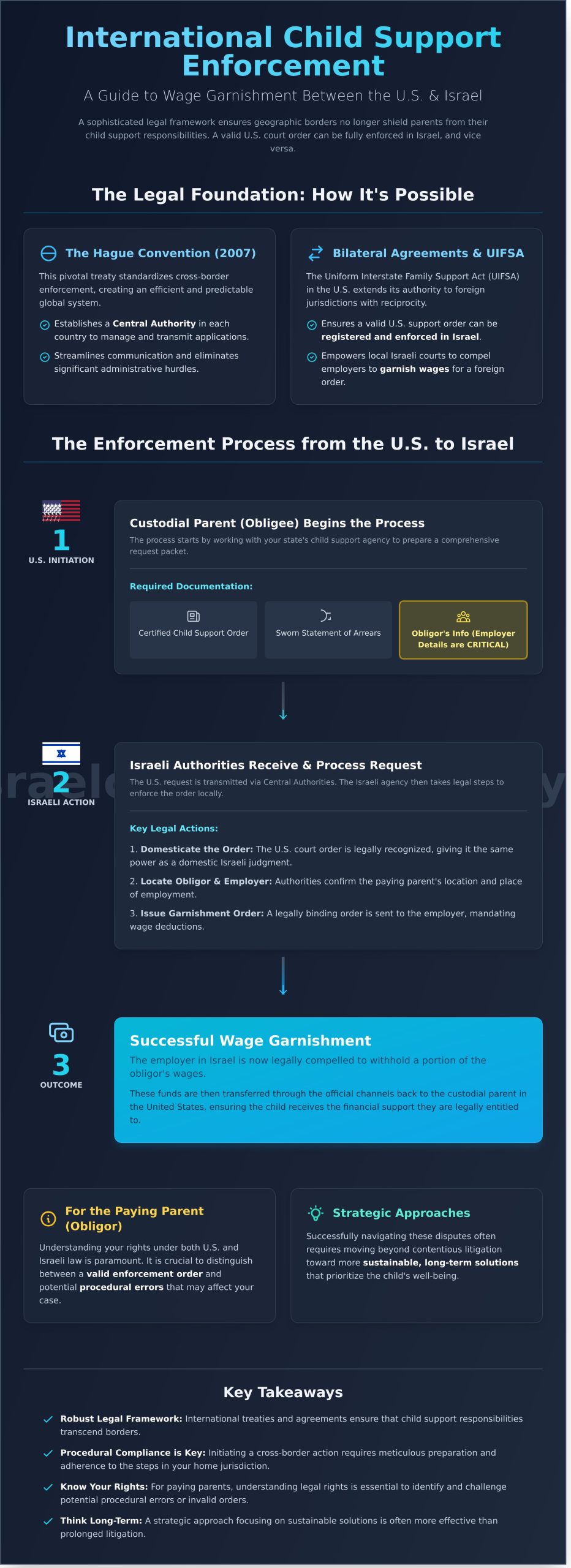
At the forefront of this international cooperation is the 2007 Hague Convention on the International Recovery of Child Support and Other Forms of Family Maintenance. This pivotal treaty standardizes the procedures for cross-border enforcement, creating a more efficient and predictable system for parents. For instance, The Hague Convention on Child Support mandates that signatory countries, including both the United States and Israel, designate a Central Authority. This government body acts as the primary intermediary, managing and transmitting applications for support enforcement, thereby streamlining communication and eliminating significant administrative hurdles for individuals seeking to collect owed support.
Bilateral Agreements and Uniform Laws
Complementing the broad framework of the Hague Convention are specific bilateral agreements and powerful domestic laws that facilitate wage garnishment for child support internationally. Within the United States, the Uniform Interstate Family Support Act (UIFSA) is the primary legal instrument governing the enforcement of support orders across state lines. Crucially, UIFSA’s authority extends to foreign jurisdictions that have established reciprocity with the U.S. or individual states. The robust cooperative relationship between American and Israeli authorities ensures that a valid U.S. child support order can be registered and enforced in Israel, empowering local courts to compel employers to garnish wages just as they would for a domestic order.
Step-by-Step: The Process of Enforcing Child Support Across Borders
Securing wage garnishment for child support internationally is not an administrative whim but a structured, multi-jurisdictional process governed by treaties and bilateral agreements. The journey of a U.S. child support order to an Israeli payroll department follows a clear, albeit complex, pathway. Navigating this requires a meticulous understanding of both U.S. federal procedures and the Israeli legal enforcement system. The process is designed to ensure that a legal obligation established in one country is recognized and acted upon in another, transforming a foreign court order into a local, enforceable judgment.
Phase 1: Initiating the Enforcement Request in the U.S.
The enforcement process begins with the custodial parent (the obligee) in the United States. This initial phase is centered on meticulous preparation and collaboration with your state’s child support enforcement agency. The agency requires a comprehensive packet of information to formally request assistance from Israeli authorities. Key documents include:
- A certified copy of the U.S. child support order.
- A sworn statement of arrears, detailing the unpaid support.
- All available information on the non-custodial parent (the obligor), including their last known address and, most critically, their current employer in Israel.
Providing precise employer details is paramount, as it directly enables the final step of wage garnishment. Once compiled, the U.S. agency transmits this official request to their counterpart in Israel.
Phase 2: The Role of Israeli Authorities
Upon arrival in Israel, the request is received and reviewed by the designated Israeli Central Authority within the Ministry of Justice. This authority acts as the official liaison, ensuring the U.S. request complies with the legal framework established between the two nations. The entire protocol is detailed in the official US-Israel child support enforcement process guide for caseworkers. The U.S. order is then submitted to an Israeli family court for registration and recognition, a legal process known as domestication. Once the court recognizes the order, it gains the full legal force and authority of a domestic Israeli judgment, making it ripe for enforcement.
Phase 3: Execution of Wage Garnishment in Israel
With the U.S. order now legally equivalent to an Israeli judgment, the case is transferred to the Israeli Collection and Enforcement Agency (Hotza’a LaPoal). This powerful government body is responsible for executing all civil judgments, including the complex matter of wage garnishment for child support internationally. The agency issues a formal garnishment order directly to the obligor’s Israeli employer, compelling them to withhold a specified portion of the employee’s salary. Our firm has specific expertise in navigating this final, critical stage of cross-border child support enforcement. The withheld funds, calculated in Israeli Shekels (₪), are then transferred through official channels back to the U.S. child support agency for distribution to the custodial parent.
For the Paying Parent: Understanding Your Rights and Obligations
Receiving a notice of wage garnishment can be a deeply concerning event, particularly when it originates from a foreign jurisdiction. While the immediate impulse may be to panic or ignore the correspondence, the most strategic course of action is to understand your legal standing and act decisively. Ignoring an official court or administrative order will not resolve the issue; it will only lead to more severe enforcement measures. For expatriates and foreign nationals residing in Israel, navigating this process requires a sophisticated understanding of both international treaties and Israeli domestic law.
Grounds for Contesting a Garnishment Order
It is critical to distinguish between contesting the enforcement action (the garnishment itself) and re-litigating the original child support order. The Israeli legal system, when enforcing a foreign order, will not re-examine the merits of the original case. Your ability to challenge the garnishment is limited to very specific procedural defenses, including:
- Mistake of Identity: Proving you are not the individual named in the order.
- Debt Already Paid: Providing clear documentation that the support arrears have been satisfied.
- Lack of Proper Notice: Arguing that you were not properly served or notified of the original legal proceedings, which may constitute a due process violation.
Upon receiving a notice, time is of the essence. Swift consultation with legal counsel is imperative to determine if any valid defenses apply to your specific situation.
Israeli Law and Protections
While Israel robustly enforces international child support obligations, its laws also provide certain protections for the paying parent. Israeli law limits the percentage of your net salary that can be garnished, ensuring that a protected amount remains for your basic living expenses. This protected sum is often calculated based on the national minimum wage and your family status (e.g., whether you are single or supporting a family in Israel). Your employer has a legal obligation to comply with a valid garnishment order from the Hotza’a Lapoal (Execution Office). We provide specialized guidance for expats and foreign nationals navigating these complex cross-border legal challenges.
Consequences of Non-Compliance
Failing to address an order for wage garnishment for child support internationally can trigger a cascade of increasingly severe enforcement actions. Garnishment is merely one tool available to authorities. Non-compliance can lead to:
- Seizure of funds directly from your Israeli bank accounts.
- Placement of liens on personal property, including real estate.
- Imposition of a travel ban (Ikuv Yetzia Min Ha’aretz), preventing you from leaving Israel.
- Negative impacts on your credit and financial standing.
Proactive compliance and strategic legal negotiation are paramount to mitigating these significant risks. If you are facing an international enforcement action, securing expert legal representation is the most critical step you can take. You can contact us for a consultation.
Strategic Approaches to International Child Support Disputes
While facing enforcement is an immediate and pressing concern, the ultimate objective in any cross-border family law matter should be to establish a sustainable, long-term resolution. Protracted international litigation is not only emotionally taxing but can also be financially debilitating, with legal costs frequently escalating into tens of thousands of shekels. A strategic, proactive approach is therefore essential for moving beyond a cycle of conflict. Exploring alternatives to contentious proceedings, such as cross-border mediation or negotiated payment agreements, is often a more effective and less costly path than defending against aggressive enforcement actions.
Modifying a Child Support Order vs. Evading It
A material change in financial circumstances, such as a loss of employment or a significant reduction in income, does not automatically alter your legal support obligation. The only correct and legally sound recourse is to formally petition the court that issued the original order for a modification. Attempting to evade payments will only compound the issue, leading to the rapid accumulation of arrears, interest, and severe penalties under Israeli law, including potential exit bans or bank account freezes. This failure to act is a primary trigger for initiating actions like wage garnishment for child support internationally.
The Role of Specialized Legal Counsel
Navigating these sophisticated cases requires more than a standard family lawyer; it demands a legal team with proven expertise in the multi-jurisdictional legal frameworks at play. An expert in this field acts as a crucial bridge between two distinct legal systems, possessing a deep understanding of international treaties, the domestic laws of both countries, and the procedural nuances of cross-border enforcement. Effectively responding to a threat of wage garnishment for child support internationally demands this level of specialized representation. An expert is critical for negotiating viable settlements, ensuring all legal procedures are correctly followed, and vigorously protecting your rights. Our firm is uniquely positioned to guide clients through these challenging matters. We invite you to request a confidential case review to receive a professional assessment of your situation and explore strategic solutions.
Strategic Counsel for Your International Child Support Case
Enforcing child support obligations between the United States and Israel is a complex, multi-jurisdictional process, yet it is entirely feasible through established international treaties and domestic laws. Whether you are the recipient seeking enforcement or the paying parent navigating your obligations, understanding the precise legal steps and your inherent rights is paramount to achieving a fair and lawful resolution. Successfully managing a case of wage garnishment for child support internationally demands more than a basic understanding of family law; it requires sophisticated, dual-jurisdictional expertise.
Our firm provides this specialized strategic guidance, leveraging a proven track record in complex international enforcement cases and deep expertise in both U.S. and Israeli family law to protect the interests of expats and foreign nationals. If you are facing the challenges of a cross-border child support dispute, we invite you to schedule a confidential consultation to discuss your case. With the right legal partner, you can navigate this intricate landscape with clarity and confidence, securing a stable future for your family.
Frequently Asked Questions
How much of my salary can be garnished for child support in Israel?
In Israel, the amount of salary subject to garnishment is governed by the Execution Office (Hotza’a Lapoal) and is designed to leave the paying parent with a protected minimum living wage. This protected amount varies based on marital status and number of dependents, and is calculated relative to the national minimum wage. For instance, a single individual has a higher portion of their salary protected than a parent with a new family, ensuring basic living expenses, which could be around ₪5,000-₪8,000, are covered.
How long does the international wage garnishment process typically take?
The timeline for executing an international wage garnishment is highly variable, often spanning several months to over a year. The duration depends on complex factors, including the existence of a reciprocal enforcement treaty, such as the Hague Convention, between the two countries. Delays can arise from procedural requirements in each jurisdiction, the translation of legal documents, and the administrative efficiency of the foreign court and the employer, making it a sophisticated and lengthy cross-border legal undertaking.
What happens if the paying parent changes jobs to avoid garnishment?
Attempting to evade a child support order by changing employment is a temporary and ill-advised strategy. Enforcement agencies possess sophisticated tools for locating new employers through national databases and tax authorities. Such evasive actions can escalate the matter, potentially leading to more severe enforcement measures. These may include the seizure of other assets, bank account levies, or the imposition of travel restrictions, demonstrating the comprehensive reach of modern child support enforcement mechanisms.
Can my US passport be revoked for unpaid child support while living abroad?
Yes, unequivocally. The U.S. federal government’s Passport Denial Program authorizes the State Department to deny, revoke, or restrict a passport for child support arrears exceeding $2,500. This powerful enforcement tool applies to U.S. citizens regardless of their country of residence. It serves as a significant consequence for non-compliance with U.S. court-ordered child support obligations and underscores the serious, multi-jurisdictional implications of falling into significant arrears while living internationally.
What if there is no child support agreement between the two countries involved?
The absence of a bilateral or multilateral treaty complicates but does not foreclose the possibility of enforcement. In such cases, the process of wage garnishment for child support internationally requires domesticating the foreign support order. This involves petitioning a court in the country of residence-for example, Israel-to recognize and convert the foreign judgment into a locally enforceable order. This is a more intricate and resource-intensive legal process that demands experienced cross-border legal counsel to navigate effectively.
Can a bank account be garnished internationally for child support?
Yes, international enforcement is not limited to wages. Bank accounts and other financial assets are also subject to seizure to satisfy child support arrears. Executing a garnishment on a foreign bank account is a complex legal action that typically requires obtaining a court order in the jurisdiction where the account is held. This demonstrates that enforcement bodies have a wide array of tools to pursue assets across borders, ensuring that financial obligations are met irrespective of the obligor’s location.
Does it matter if my employer is a multinational corporation?
The multinational status of an employer can be a significant factor. A corporation with a legal presence in both the country that issued the support order and the country where the parent resides may streamline the process, as they are obligated to comply with local laws in each jurisdiction. However, navigating the complex corporate structure to serve the garnishment order on the correct legal and payroll entity requires precise legal guidance to ensure compliance and effective execution of the order.

Article by
Gabriel Lior
A Personal Journey That Became a Mission
The advisory was founded by an American father Gabriel Lior, LLB, MBA , global entrepreneur, and cross-border advisor who spent more than a decade navigating the Israeli family court system firsthand and now lives in Singapore with his son.
As a divorced parent in a cross-border family, Gabriel faced nearly every legal challenge a foreign parent can encounter in Israel — including child custody disputes, child support proceedings, property matters in Israel and abroad, false accusations, and complex immigration and relocation proceedings.
Over the years, he learned the hard way how difficult it is for non-Israeli parents to understand the system, identify the right legal strategy, and choose the right legal representation — especially when language, culture, and jurisdictional differences are involved. He also witnessed how foreign parents and new immigrants are often disadvantaged or taken advantage of by service providers and institutions simply because they lack local knowledge or fluency.
From Client to Advisor
To truly understand — and survive — the system, Gabriel pursued formal legal education in Israel, completing two Israeli law degrees, alongside a BA and MBA earned in the United States. This was never about becoming a practicing attorney, but about gaining a deep, structural understanding of how the system works — and where it breaks down for foreign parents.
This rare combination of:
Firsthand client experience
Israeli legal and US business education
International business and negotiation training
Decades of commercial execution
created a unique perspective – one that understands both sides of the table.
After years of litigation, persistence, and at times self-representation, he ultimately succeeded in securing custody of his son and relocating abroad through a rare legal victory in the Israeli Supreme Court — becoming one of the first fathers in Israel to do so under these circumstances.
Disclaimer
Important Disclaimer:
The information provided on this website and in its content is for general informational and educational purposes only and does not constitute legal advice, legal opinion, or legal representation.
Gabriel Lior is not licensed to practice law in Israel (nor is he interested in doing so) and does not provide legal services, despite having completed 2 Law Degrees. The services offered are advisory in nature and are intended to provide general guidance, strategic insight, and information regarding cross-border family law considerations.
No attorney-client relationship is formed by accessing this website, reading its content, or communicating with us.
Any decisions made based on this information are at your own discretion and risk. For legal advice specific to your situation, you should consult a licensed attorney in the relevant jurisdiction.
Where appropriate, we may refer clients to independent, licensed attorneys or professionals. Such referrals do not constitute legal representation and no liability is assumed for services provided by third parties.