This article is published on an independent advisory platform and is for informational and advisory purposes only. It does not constitute legal representation or legal advice. Legal services are only provided by licensed attorneys under a separate engagement, and this content does not imply an attorney-client relationship.
In the complex world of cross-border law, a second opinion isn’t a sign of distrust; it’s a mandatory due diligence step for high-stakes jurisdictional conflicts. You may feel caught between conflicting advice from your US and Israeli counsel, or perhaps you’re worried that a single procedural error could jeopardize your assets or family custody. It’s difficult to maintain confidence when costs mount without a clear sense of progress. Understanding the nuances of getting a second opinion on an international case can provide the reassurance you need to move forward effectively.
This guide explains how to seek professional clarity to ensure your legal strategy is sound. You’ll learn to identify overlooked risks in the gap between the US and IL legal systems and gain a structured roadmap for your next steps. By prioritizing strategy and risk assessment, you can make informed choices before committing to a final path. We’ll explore the specific indicators that suggest your case needs a fresh set of eyes and how to bridge the cultural and systemic differences inherent in international matters.
Key Takeaways
- Recognize the specific warning signs that suggest your current counsel may be struggling with the complex intersection of US and Israeli law.
- Understand how getting a second opinion on an international case serves as a strategic advisory tool to refine your approach without necessarily changing your legal team.
- Learn why the systemic friction between Israeli Rabbinical courts and US Civil courts makes an independent strategy review essential for protecting your assets and family.
- Discover the step-by-step process of a legal audit, from reviewing filed documents to identifying overlooked jurisdictional advantages.
- Gain the clarity needed to lead more productive conversations with your current lawyers and establish a viable backup plan if your current trajectory is unsustainable.
This article is published on an independent advisory platform and is for informational and advisory purposes only. It does not constitute legal representation or legal advice. Legal services are only provided by licensed attorneys under a separate engagement, and this content does not imply an attorney-client relationship.
Why Seek a Second Opinion on an International Legal Case?
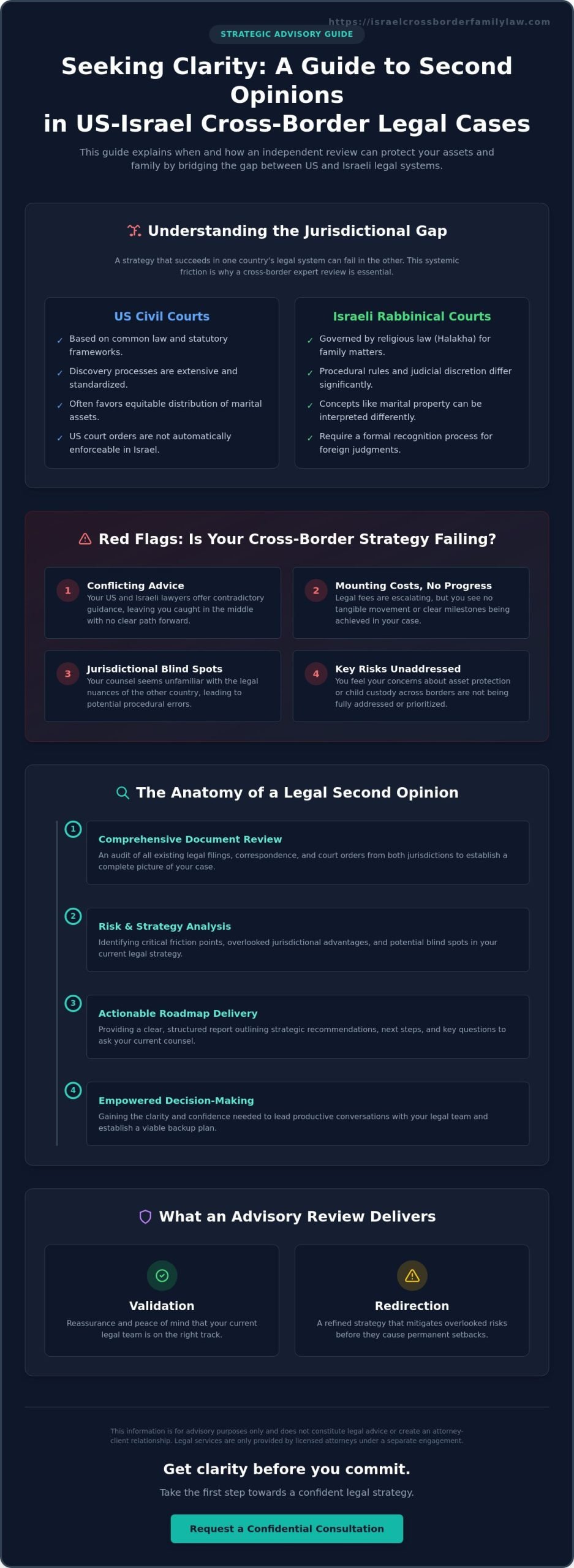
International litigation is fundamentally different from domestic disputes. When your case spans the United States and Israel, you’re managing two distinct sets of laws, procedural rules, and judicial cultures. Often, a strategy that works perfectly in a US civil court can lead to disastrous results in an Israeli Rabbinical court. Getting a second opinion on an international case is a strategic step to ensure your current path hasn’t overlooked these critical jurisdictional frictions. It’s about verifying that your counsel’s expertise in one region isn’t creating a blind spot in the other.
To better understand the value of an independent review, watch this helpful video:
Many clients fall into the “Sunk Cost Fallacy,” believing they’ve already spent too much time and money to change course now. However, staying with a failing strategy is far more expensive than a targeted review. A second opinion doesn’t always mean you need to fire your current team. In many instances, it provides validation, confirming your lawyer is on the right track. In other cases, it offers a redirection, identifying risks before they become permanent legal setbacks.
The Complexity of Multi-Jurisdictional Law
Local lawyers are experts in their own territory, but they may lack the specific cross-border training required for transnational family or estate matters. Early procedural choices, such as where you first file for divorce or how you draft a will, have long-term consequences that are difficult to reverse. An independent foreign legal opinion can illuminate how Israeli law treats US court orders. As of June 2026, US court orders are not automatically enforceable in Israel; they must undergo a formal recognition process under the Foreign Judgments Enforcement Law. A second opinion identifies these “blind spots” before you commit to a costly litigation cycle.
Peace of Mind in High-Stakes Litigation
The anxiety of “not knowing” if your assets or family rights are protected is often the heaviest burden of an international case. A neutral advisory review reduces this stress by providing an objective assessment of your counsel’s specialization. It ensures that your strategy accounts for both US and IL legal realities. This process empowers you to make informed choices based on strategy and risk rather than fear. You can learn more about how this process works on our about the advisory page, which focuses on providing clarity for international families.
This article is published on an independent advisory platform and is for informational and advisory purposes only. It does not constitute legal representation or legal advice. Legal services are only provided by licensed attorneys under a separate engagement, and this content does not imply an attorney-client relationship.
Red Flags: When Your Current Cross-Border Strategy May Be Failing
Many clients hesitate to seek a review because they’ve already invested heavily in their current legal team. This is known as the “Sunk Cost Fallacy.” You might feel that changing course now would waste the money already spent. However, in international law, continuing a flawed strategy is often more expensive than the cost of getting a second opinion on an international case. If your counsel cannot clearly explain how a decision in New York affects your standing in an Israeli court, you may be facing a significant strategy gap. Professional clarity is essential to ensure your resources are being used effectively.
Effective representation requires more than local expertise. It demands a holistic understanding of How International Disputes are Settled across different legal systems. If your lawyer seems dismissive of the “other” jurisdiction, it’s a major red flag. This often leads to conflicting orders that are impossible to enforce, leaving you in a legal stalemate. A strategy that ignores the cultural nuances of either the Israeli or US court systems is unlikely to succeed in the long term.
The Danger of ‘Local-Only’ Thinking
A common mistake is treating a cross-border matter like a standard domestic case. You might notice your lawyer is not coordinating with counsel in the reciprocal jurisdiction. If they ignore international treaties like the Hague Convention, your parental rights or assets could be at risk. A strategy that works in a US civil court might be completely ignored by an Israeli Rabbinical court if the proper procedural steps aren’t followed from the start. True cross-border strategy requires a bridge between both legal worlds.
Financial and Timeline Warning Signs
Watch for unexpected costs that lack a clear explanation. With law firm rates increasing by an average of 7.4% in 2025, and elite firms seeing even higher jumps, the financial stakes of a stalled case are higher than ever. Missing critical deadlines in IL while focusing on the US is another sign of poor coordination. Procedural delays are common, but they should follow a logical timeline. If your case has stalled for months without a clear explanation of the next steps, it may indicate that your counsel is unfamiliar with local court rhythms. Without a clear roadmap for the enforcement of orders abroad, you are essentially litigating in a vacuum. If you feel your case is drifting, you might benefit from a confidential case review to regain your footing.
Communication is the ultimate litmus test for any legal strategy. Your lawyer should be able to translate complex cross-border impacts into plain English. If you receive vague answers or if your counsel seems unfamiliar with the specific procedural rules of the Israeli system, your strategy may be failing. Seeking a second opinion allows you to validate your concerns before small errors turn into permanent losses. If you’re unsure about your current direction, you can always reach out for a brief discussion about your options.
This article is published on an independent advisory platform and is for informational and advisory purposes only. It does not constitute legal representation or legal advice. Legal services are only provided by licensed attorneys under a separate engagement, and this content does not imply an attorney-client relationship.
The Anatomy of a Legal Second Opinion: What to Expect
A legal second opinion is a structured diagnostic process. It’s not a commitment to fire your current lawyer or a move that automatically triggers a change in representation. Instead, it’s a specialized advisory service designed to provide a high-level view of your current trajectory. The process is entirely confidential, ensuring your privacy is maintained while an independent expert scrutinizes the details of your case. By getting a second opinion on an international case, you gain an objective audit of your strategy without disrupting your existing legal team.
This review acts as a safety net. It identifies where your current plan might be vulnerable to the differences between US and Israeli law. The goal is to provide you with the transparency needed to make informed choices. You aren’t just getting another lawyer’s take; you’re receiving a comprehensive strategic analysis focused on cross-border success.
Step 1: Document and Strategy Audit
The process begins with a deep dive into your existing legal records. This includes all filed documents, motions, and correspondence between parties. The goal is to understand the “Theory of the Case” your current team is pursuing. By analyzing jurisdictional filings in both US and Israeli courts, an advisor can spot inconsistencies. This step often uncovers gaps in evidence or legal arguments that may have been missed during the initial rush of litigation. You can learn more about how this evaluation is structured on our how it works page.
Step 2: Risk and Opportunity Assessment
Once the audit is complete, the focus shifts to evaluating the likelihood of success. This isn’t about generalities. It’s a specific look at how your strategy holds up against both Israeli family law and US civil standards. For example, an advisor might identify “hidden” jurisdictional advantages, such as forum shopping opportunities that could favor your position. Understanding these cross-border dynamics is vital for protecting assets and family rights. This assessment helps clarify how an Israeli ruling might be viewed by a US judge and vice versa.
Step 3: The Advisory Report
The final outcome is a comprehensive strategy report. This document is written in plain English, avoiding the dense jargon often found in court filings. It provides a neutral summary of findings, highlighting both risks and untapped opportunities. You’ll receive actionable recommendations that you can take back to your current counsel. This report gives you the data needed to decide whether to stay the course or pivot to a new approach. If you’re ready for this level of clarity, a confidential case review can provide the roadmap you’ve been missing.
This article is published on an independent advisory platform and is for informational and advisory purposes only. It does not constitute legal representation or legal advice. Legal services are only provided by licensed attorneys under a separate engagement, and this content does not imply an attorney-client relationship.
Navigating the US-Israel Jurisdictional Gap
The legal distance between the United States and Israel is often wider than the physical one. While US law is built on a secular civil tradition, the Israeli system involves a complex intersection of civil and religious jurisdictions. This dual system creates significant friction, particularly when a case involves the Rabbinical courts in IL. Getting a second opinion on an international case is often the only way to verify if your current strategy accounts for these jurisdictional clashes. Without a bridge between these two worlds, you risk obtaining a US court order that is unenforceable in Israel, or vice versa.
Cultural differences also play a major role in how cases proceed. US litigation often emphasizes extensive discovery and mediation, while the Israeli approach can be more direct and fast-paced. If your counsel isn’t prepared for the “tachles” (direct) nature of Israeli proceedings, they may miss critical windows for filing. A cross-border advisor serves as a translator for these systemic nuances, ensuring that your strategy remains effective in both Tel Aviv and New York.
Family Law Friction Points
Child custody relocation is a primary area where the US-Israel gap becomes apparent. While US courts generally apply a “best interests of the child” standard, Israeli courts may interpret this through a different cultural and social lens. This can lead to conflicting rulings if both jurisdictions claim authority. Additionally, for US citizens living in Israel, navigating the “Get” (religious divorce) alongside civil components requires specialized coordination. You can find more detailed guidance on these complexities in our guide on divorce for international families.
Corporate and Estate Challenges
Estate planning and probate for assets held in both countries present unique hurdles. Local lawyers in one jurisdiction often miss the implications of the US-Israel tax treaty, which can lead to double taxation or missed exemptions. Probate for assets in New York may not follow the same procedural requirements as assets in Tel Aviv. It’s vital to ensure that your will or trust is recognized under the specific rules of both legal systems. To understand these requirements better, you can learn about inheritance law for foreigners in the Israeli system.
Understanding these gaps is the first step toward securing your global interests. If you’re concerned that your current legal path doesn’t fully address the friction between US and Israeli law, you may want to discuss your situation with an advisor to gain a clearer perspective on your options.
This article is published on an independent advisory platform and is for informational and advisory purposes only. It does not constitute legal representation or legal advice. Legal services are only provided by licensed attorneys under a separate engagement, and this content does not imply an attorney-client relationship.
Moving Forward: How an Advisory Review Provides Clarity
An advisory review is designed to transform confusion into a structured plan of action. When you are managing assets or family matters across the US and Israel, the emotional weight can often cloud strategic judgment. Getting a second opinion on an international case provides the objective distance necessary to evaluate your position without the fog of litigation stress. This process empowers you to lead more effective, data-driven conversations with your current legal team. It ensures that you aren’t just reacting to court dates but are actively steering toward your desired outcome.
Beyond immediate validation, this review serves as a critical “Plan B.” If your current trajectory is unsustainable or if your counsel lacks a clear roadmap for enforcement in IL, you need to know this before a final ruling is issued. An independent perspective identifies if your resources are being allocated to the most high-impact jurisdictional advantages. This clarity allows you to pivot your strategy while you still have the procedural window to do so.
Collaborating with Your Current Counsel
Presenting second-opinion findings to your lawyer should be a constructive, professional exercise. It’s helpful to frame the report as a tool for refining your strategy rather than a reason to replace personnel. In complex international matters, a “team” approach often yields the best results. By bringing specialized cross-border insights to your current counsel, you’re adding a layer of expertise that can strengthen your overall position. Most experienced attorneys welcome a well-researched foreign legal opinion that helps them navigate unfamiliar procedural hurdles in the reciprocal jurisdiction.
Getting Clarity Before You Commit
In international law, strategy must always take priority over speed. Decisions made in the early phases of a case often dictate the enforcement options available years later. Taking the time to request a review does not have to disrupt your current case. Instead, it provides the peace of mind that your path is sound. You can explore the specifics of this process on our how it works page, which outlines how we provide clarity for international families. For further educational resources on cross-border strategy, you can also visit our YouTube channel at https://www.youtube.com/@IsraelFamilyLaw.
Get clarity before you commit. Request a confidential consultation via an advisory call or WhatsApp.
This article is published on an independent advisory platform and is for informational and advisory purposes only. It does not constitute legal representation or legal advice. Legal services are only provided by licensed attorneys under a separate engagement, and this content does not imply an attorney-client relationship.
Securing Your Strategy Across Borders
Achieving legal clarity in a cross-border matter requires a proactive approach to risk management. As we’ve explored, the systemic gaps between the United States and the Israeli legal landscape can lead to significant procedural errors if left unaddressed. By getting a second opinion on an international case, you ensure that your strategy is built on specialized expertise rather than assumptions. This independent review provides the plain English guidance you need to navigate complex jurisdictional conflicts with confidence.
Whether you’re validating your current path or identifying a necessary pivot, an objective audit offers a clear roadmap for the future. It allows you to protect your global interests while maintaining a collaborative relationship with your current counsel. You don’t have to navigate these multi-jurisdictional challenges without a sound plan. Get clarity before you commit. Request a confidential case review to gain the perspective needed for an informed decision.
Moving forward with a verified strategy is the most effective way to safeguard your family and assets in an international environment.
This article is published on an independent advisory platform and is for informational and advisory purposes only. It does not constitute legal representation or legal advice. Legal services are only provided by licensed attorneys under a separate engagement, and this content does not imply an attorney-client relationship.
Frequently Asked Questions
Will getting a second opinion offend my current lawyer?
Professional attorneys generally view second opinions as a standard part of high-stakes due diligence. It’s similar to seeking a specialist’s view in a medical context. You don’t have to present it as a lack of trust. Instead, frame it as a necessary step to ensure all cross-border angles between the US and IL are fully covered.
Can a second opinion be done remotely for an international case?
Yes, remote reviews are the standard for international matters. Since the focus is on document analysis and strategic alignment between jurisdictions, digital communication is highly effective. You don’t need to travel to gain clarity on your case strategy. This makes getting a second opinion on an international case accessible regardless of your current location.
What documents do I need to provide for a legal strategy review?
You should provide all filed court documents, motions, and relevant correspondence between counsel. It’s also vital to include any existing court orders from both the US and Israeli courts. This allows for a complete audit of the current “Theory of the Case” and identifies any jurisdictional gaps.
How much does a second opinion on a cross-border case typically cost?
Costs vary based on the volume of documents and the complexity of the jurisdictional conflict. While elite international lawyers often charge significant hourly rates, an advisory review is typically a focused engagement. It’s designed to provide a high-level strategic audit rather than open-ended litigation expenses.
Is a legal second opinion the same as hiring a new lawyer?
No, it’s an advisory service rather than a change in representation. Getting a second opinion on an international case allows you to gain an independent perspective without firing your current team. You remain in control of your representation while gaining the data needed to make informed choices.
Can a second opinion help with Hague Convention child abduction cases?
Yes, these cases are governed by strict international treaties and rigid timelines. A review can identify if your current counsel is meeting the specific procedural requirements of the Hague Convention. This is critical for protecting parental rights and ensuring the case is handled correctly in both jurisdictions.
What happens if the second opinion contradicts my current lawyer?
Contradictions highlight areas of risk that require your attention. You can use these findings to have a constructive conversation with your current counsel. It provides the objective evidence needed to decide if a pivot in strategy is necessary to protect your assets or family rights.
Is the information I share during a second opinion review confidential?
Yes, confidentiality is a cornerstone of the advisory process. Your documents and situation details are protected to ensure you can speak freely about your concerns. This allows for an honest, neutral assessment of the risks and opportunities in your US-Israel legal matter.

Article by
Gabriel Lior
A Personal Journey That Became a Mission
The advisory was founded by an American father Gabriel Lior, LLB, MBA , global entrepreneur, and cross-border advisor who spent more than a decade navigating the Israeli family court system firsthand and now lives in Singapore with his son.
As a divorced parent in a cross-border family, Gabriel faced nearly every legal challenge a foreign parent can encounter in Israel — including child custody disputes, child support proceedings, property matters in Israel and abroad, false accusations, and complex immigration and relocation proceedings.
Over the years, he learned the hard way how difficult it is for non-Israeli parents to understand the system, identify the right legal strategy, and choose the right legal representation — especially when language, culture, and jurisdictional differences are involved. He also witnessed how foreign parents and new immigrants are often disadvantaged or taken advantage of by service providers and institutions simply because they lack local knowledge or fluency.
From Client to Advisor
To truly understand — and survive — the system, Gabriel pursued formal legal education in Israel, completing two Israeli law degrees, alongside a BA and MBA earned in the United States. This was never about becoming a practicing attorney, but about gaining a deep, structural understanding of how the system works — and where it breaks down for foreign parents.
This rare combination of:
Firsthand client experience
Israeli legal and US business education
International business and negotiation training
Decades of commercial execution
created a unique perspective – one that understands both sides of the table.
After years of litigation, persistence, and at times self-representation, he ultimately succeeded in securing custody of his son and relocating abroad through a rare legal victory in the Israeli Supreme Court — becoming one of the first fathers in Israel to do so under these circumstances.
Disclaimer
Important Disclaimer:
The information provided on this website and in its content is for general informational and educational purposes only and does not constitute legal advice, legal opinion, or legal representation.
Gabriel Lior is not licensed to practice law in Israel (nor is he interested in doing so) and does not provide legal services, despite having completed 2 Law Degrees. The services offered are advisory in nature and are intended to provide general guidance, strategic insight, and information regarding cross-border family law considerations.
No attorney-client relationship is formed by accessing this website, reading its content, or communicating with us.
Any decisions made based on this information are at your own discretion and risk. For legal advice specific to your situation, you should consult a licensed attorney in the relevant jurisdiction.
Where appropriate, we may refer clients to independent, licensed attorneys or professionals. Such referrals do not constitute legal representation and no liability is assumed for services provided by third parties.