This article is published on an independent advisory platform and does not constitute legal representation or legal advice. Legal services are only provided by licensed attorneys under a separate engagement.
What if the most effective way to protect your international interests in an Israeli divorce isn’t a high-stakes courtroom battle, but a private, structured conversation? For many expats and international families, the prospect of entering the Israeli legal system feels overwhelming, especially when faced with the dual jurisdiction of civil and religious courts. Engaging a skilled family mediator Israel can transform this process from a source of anxiety into a strategic path forward. You likely want to avoid the “race to file” and the unpredictability of the Rabbinic courts while ensuring your children’s stability remains the priority.
We understand that the mandatory mediation laws in Israel often cause confusion, particularly regarding how they impact international relocation or Hague Convention risks. This guide explains how to navigate these complexities to achieve a legally binding agreement recognized in both Israel and the US. You’ll learn about the mandatory “time out” period, the specific costs involved in private mediation, and how to minimize trauma for your children through a clear, cross-border resolution strategy.
Key Takeaways
- Learn how to bypass high-conflict court battles and the “race for jurisdiction” between civil and religious courts through a strategic mediation approach.
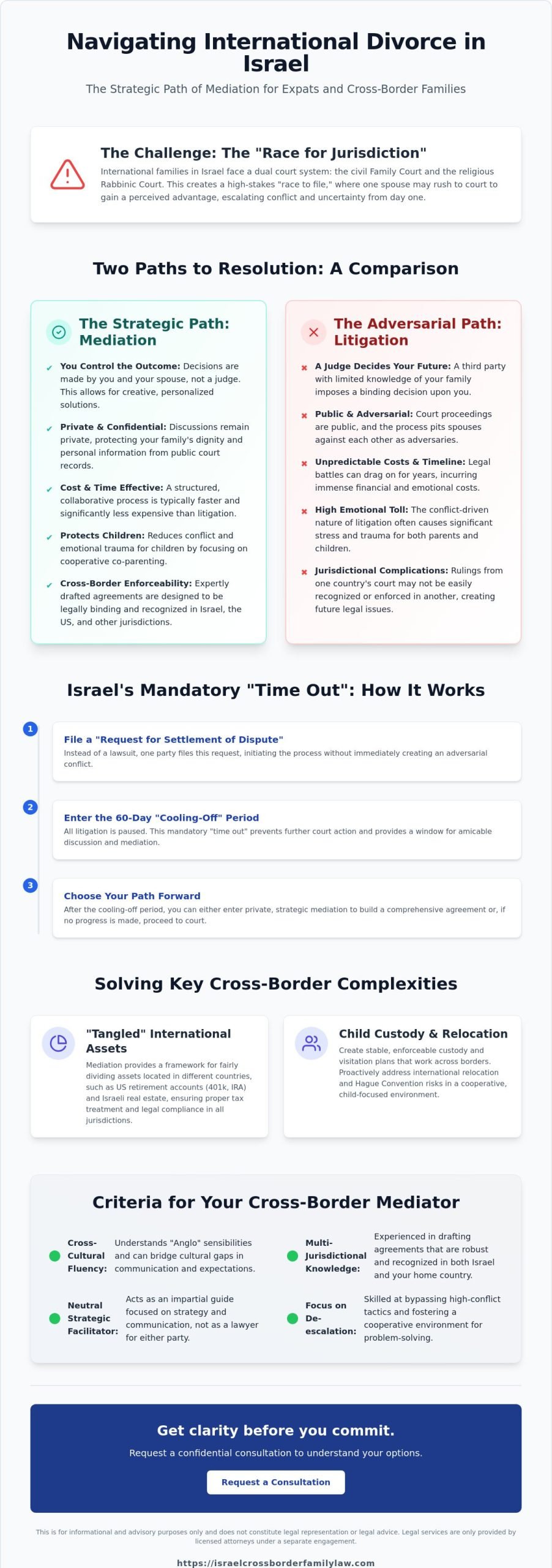
- Understand the mandatory Israeli “Request for Settlement of Dispute” and the 60-day cooling-off period that pauses litigation to allow for amicable discussion.
- Discover methods for managing “tangled” international assets, such as US retirement accounts and Israeli real estate, within a single binding agreement.
- Identify the essential criteria for selecting a family mediator Israel who possesses the cross-cultural expertise to draft agreements recognized in multiple jurisdictions.
- Gain clarity on establishing fair child support and custody arrangements that remain enforceable across borders to protect your family’s stability.
Understanding Family Mediation in the Israeli Cross-Border Context
This article is published on an independent advisory platform and does not constitute an attorney-client relationship. Legal services are only provided by licensed attorneys under a separate engagement. Mediation is a voluntary and confidential process where a neutral third party helps couples reach a binding agreement. Unlike a court trial, you can choose to exit the process at any time if it doesn’t meet your needs. This flexibility allows for creative solutions that a judge simply cannot provide. Gaining a foundational Understanding Family Mediation is essential for anyone starting this journey in a foreign country.
Standard Israeli mediation often overlooks the specific requirements of foreign jurisdictions. For example, an agreement drafted solely for the Israeli Family Court might not include the necessary language to divide a US-based 401k or IRA properly. The goal is a seamless resolution that protects your future. A family mediator Israel with cross-border expertise ensures that the final document stands up to scrutiny in both Tel Aviv and New York. This prevents future legal disputes that could arise if one country refuses to recognize the other’s rulings or tax treatments.
To better understand the differences between these two paths, watch this helpful video:
The Role of the Family Mediator in Israel
The mediator facilitates dialogue between parties who often bring different cultural expectations to the table. It’s a common misconception that a mediator acts as a lawyer for the couple. In reality, they remain neutral and don’t provide legal advice. Their focus is on strategy and communication. For English-speakers, finding a professional who understands “Anglo” sensibilities is a significant advantage. This cultural alignment helps in navigating the Israeli legal landscape without feeling like a stranger to the process. A family mediator Israel acts as a bridge, ensuring that your voice is heard and your international interests are prioritized.
When is Mediation Appropriate for International Couples?
Mediation is an ideal choice for families facing international relocation or complex custody issues. These situations often involve Hague Convention risks that require sensitive handling. It’s also beneficial for international families with high-net-worth assets located in multiple countries. By opting for this path, you can bypass the aggressive “Race for Jurisdiction.” This is the tactical maneuver where one spouse files in the Rabbinic court to gain a perceived advantage over the civil Family Court. Mediation removes this threat, allowing for a calmer and more predictable outcome.
This article is published on an independent advisory platform and does not constitute an attorney-client relationship. Legal services are only provided by licensed attorneys under a separate engagement.
Why Mediation is the Strategic Choice for International Divorces
For international families, choosing a family mediator Israel is often a tactical decision to bypass the high-conflict “Race for Jurisdiction.” In the Israeli legal system, the court that first receives a filing, whether it is the civil Family Court or the Rabbinic Court, typically gains authority over the case. This creates a high-pressure environment where spouses feel forced to make a pre-emptive strike to secure a perceived legal advantage. Mediation effectively de-escalates this tension. It provides a structured environment where both parties agree to halt litigation efforts, ensuring that neither side is blindsided by a sudden court summons while negotiations are ongoing.
The cost-effectiveness of this approach is substantial. While a contested divorce involving multi-jurisdictional assets can result in legal fees exceeding 200,000 NIS per person, mediation typically costs a fraction of that amount. Beyond the financial savings, mediation offers a level of privacy that the public court system cannot guarantee. For expats and high-net-worth individuals, keeping sensitive financial disclosures and personal history out of public records is often a top priority. This process allows you to maintain control over the timeline and the final outcome rather than leaving life-altering decisions to a judge who may not understand your specific cultural background.
Protecting the Children: A Cross-Border Priority
Reducing conflict through mediation is the most effective way to prevent parental alienation and long-term psychological distress for children. For international families, the stakes are even higher due to the complexities of international custody and relocation. By addressing relocation clauses early in a neutral setting, parents can create stable, enforceable schedules that respect both Israeli law and the requirements of their home country. This proactive planning significantly reduces the risk of future Hague Convention disputes, which are often the result of poorly defined or high-conflict custody arrangements. You can explore your options further by requesting a confidential case review to discuss your family’s specific needs.
Preserving Assets and Reputation
The “scorched earth” litigation style often seen in Israeli courts can be devastating to a family’s global reputation and financial health. Mediation allows for customized financial solutions that recognize the reality of a life lived in two countries. For example, mediation protects US retirement accounts from incorrect Israeli court valuation by ensuring that the final agreement accounts for specific US tax regulations and distribution rules that an Israeli judge might overlook. This level of precision ensures that assets like 401ks, IRAs, and foreign real estate are divided fairly and in a way that is recognized by tax authorities in both jurisdictions.
This article is published on an independent advisory platform and does not constitute an attorney-client relationship. Legal services are only provided by licensed attorneys under a separate engagement.
The Mandatory Mediation Process in Israel: A Step-by-Step Guide
Since the introduction of the Regulating Litigation in Family Conflicts Regulations in 2016, most family disputes in Israel must begin with a structured dispute resolution process. This isn’t a suggestion; it’s a legal requirement designed to reduce the burden on the court system. For international families, understanding the timeline is critical for strategic planning. The process begins with filing a “Request for Settlement of Dispute” (Bakasha L’Yishuv Sichsoch). This filing effectively freezes the ability of either party to submit contested claims in court for a set period.
Once the request is filed, a mandatory 60-day “stay of proceedings” begins. During this cooling-off period, neither spouse can file for divorce, child support, or asset division, except in specific emergency situations. This window is intended to lower the temperature and allow for dialogue. You’ll be invited to meet with the court’s Assistance Unit for “Mahut” meetings. After these initial sessions, many families choose to engage a private family mediator Israel. A private professional can dedicate the time necessary to handle complex cross-border drafting that the court’s social services aren’t equipped to manage. The final step is submitting your signed “Settlement Agreement” to the court to be validated as a legally binding judgment.
What Happens During the Mandatory ‘Mahut’ Meetings?
The Mahut meetings are often misunderstood as the actual mediation. In reality, they’re an intake and information-gathering process. You’ll meet with a court-appointed social worker and sometimes a lawyer from the Assistance Unit. Their role is to explain your options and assess if your case is suitable for an amicable settlement. They don’t represent you, and they don’t provide legal strategy. It’s wise to consult with your own advisory before attending these meetings. Knowing your rights regarding international assets or relocation before you walk into the room prevents you from making uninformed concessions during this high-pressure intake phase.
Validating the Agreement in Court
A signed mediation agreement is a private contract until it’s validated by a judge. To make it enforceable, it must be submitted to the Israeli Family Court or the Rabbinic Court. The judge will review the document to ensure it’s fair and that both parties understand the terms. For divorce and separation for international families, dual validation is sometimes necessary. If you’re a Jewish couple, you may need the agreement approved by both the Family Court and the Rabbinic Court to ensure the civil and religious aspects of the divorce are fully resolved. This step turns your private settlement into a “Judgment,” which carries the same weight as a ruling issued after a full trial.
Get clarity before you commit. Request a confidential consultation.
This article is published on an independent advisory platform and does not constitute an attorney-client relationship. Legal services are only provided by licensed attorneys under a separate engagement.
Addressing Cross-Border Complexity: Assets, Custody, and Support
Divergent legal systems often create friction when dividing global assets. A family mediator Israel provides the necessary bridge between Israeli property laws and US financial regulations. For instance, while an Israeli court might view a US retirement account as a simple cash asset, US law requires specific procedures for a tax-free transfer. Mediation allows you to draft these requirements directly into your settlement. This prevents the Israeli court from assigning an incorrect valuation to your 401k or IRA, which could lead to significant financial loss. You must also consider the tax implications of alimony and child support under US filing requirements to avoid penalties from the IRS.
Drafting detailed holiday schedules is another critical component of a successful cross-border agreement. Standard Israeli templates rarely account for the logistical realities of international flights or the need for extended summer visits in the US. A strategic mediation process ensures these schedules are practical and enforceable. This level of detail provides clarity for both parents and reduces the likelihood of future disputes over travel dates or flight costs. If you need assistance with these complex arrangements, contact us for a strategy session.
Enforcing Support Orders Across Borders
Ensuring that child support, known as Mezonot, is fair and enforceable is a primary concern for international parents. An agreement must be drafted so that US state agencies can recognize the payments if one parent moves. You can learn more about child support cross-border enforcement to understand how these orders are managed. Additionally, the agreement should explicitly address “stay of exit” (Ikuv Yetzia) orders. These orders are common in IL and can prevent a parent or child from leaving the country. A clear mediation agreement provides the conditions under which these orders are lifted for travel or relocation.
Custody and the Hague Convention
Custody arrangements for international families must be robust enough to withstand jurisdictional challenges. Including “Safe Return” clauses helps mitigate fears of child abduction by providing clear legal consequences for a failure to return a child after a visit. It’s also vital to define the child’s “Habitual Residence” clearly. This definition is a cornerstone of the Hague Convention and determines which country’s courts have jurisdiction over the child. By settling these points in mediation, you create a strategic shield against future litigation. For a broader context on these issues, review our guide for expats and foreign nationals.
This article is published on an independent advisory platform and does not constitute an attorney-client relationship. Legal services are only provided by licensed attorneys under a separate engagement.
Choosing the Right Mediator for Your International Case
Selecting a family mediator Israel requires more than just a local certification. For international families, the professional must possess a deep understanding of the transnational complexities discussed in previous sections, specifically how Israeli rulings interface with foreign legal systems. A mediator who is unfamiliar with the nuances of US-Israel legal differences may inadvertently draft an agreement that is unenforceable or tax-inefficient abroad. You need a professional who can anticipate how a US court or tax authority will view the terms you reach in Tel Aviv or Jerusalem.
Language proficiency is a non-negotiable requirement for English-speaking expats. While many Israeli professionals speak conversational English, a mediator for an international case must be able to review and draft complex clauses in both Hebrew and English with technical precision. This ensures that the nuances of terms like “habitual residence” or “qualified domestic relations orders” are accurately reflected in the final document. Additionally, a qualified mediator must navigate the “Dual System” of Israeli law. They must understand how to satisfy the requirements of both the civil Family Court and the Rabbinic Court to ensure full legal finality for Jewish couples. Failing to address religious divorce requirements can leave you civilly divorced but still “chained” under religious law.
We strongly recommend an “Advisory First” approach. This means seeking clarity on your strategic goals and risks before you enter the first mediation session. Walking into a room without a clear understanding of your rights regarding international assets or relocation can lead to emotional concessions that are difficult to reverse. Early decisions often have a permanent impact on your future financial stability and your relationship with your children. Understanding the specific risks related to your situation allows you to approach the table with a clear strategy rather than reacting to pressure.
Questions to Ask a Potential Mediator
- How many cross-border cases have you handled involving US-based assets like 401ks or IRAs?
- Are you familiar with the specific requirements for the enforcement of Israeli support agreements in the US?
- What is your process for handling high-conflict international custody issues and Hague Convention risks?
- Do you have experience drafting agreements that satisfy both the civil Family Court and the Rabbinic Court?
The Transition from Mediation to Finality
Mediation doesn’t happen in a vacuum. It’s often beneficial to integrate your own independent legal counsel into the process to review drafts and ensure your specific interests are protected. This collaborative approach helps future-proof the final document against changes in international law or shifts in jurisdictional standards. A well-drafted agreement should be robust enough to remain valid even if your family moves to a different country in the future. For more insights on this process, you can watch our guide on strategy and decision making.
Get clarity before you commit. Request a confidential consultation.
This article is published on an independent advisory platform and does not constitute legal representation or legal advice. Legal services are only provided by licensed attorneys under a separate engagement.
Securing a Stable Future Through Strategic Resolution
Navigating an international divorce requires a shift from reactive litigation to proactive strategy. By choosing mediation, you effectively de-escalate the “race for jurisdiction” and ensure that complex assets, such as US retirement accounts and Israeli property, are divided with technical precision. This path allows you to maintain control over your family’s timeline while avoiding the unpredictability of the court system. Engaging an experienced family mediator Israel provides the cross-cultural bridge necessary to draft agreements that are recognized and enforceable in both jurisdictions.
Our advisory focuses exclusively on the needs of US-Israel cross-border families. We offer a calm, educational approach that prioritizes multi-jurisdictional asset protection and the long-term well-being of your children. You don’t have to face the complexities of the Israeli legal landscape alone or without a clear plan. Informed choices made today will define your family’s stability for years to come.
Get clarity before you commit. Request a confidential consultation.
This article is published on an independent advisory platform and does not constitute legal representation or legal advice. Legal services are only provided by licensed attorneys under a separate engagement.
Frequently Asked Questions
Is mediation mandatory in Israel before I can file for divorce?
Yes, the 2016 regulations require parties to participate in a preliminary dispute resolution procedure before filing most family law claims. You must first file a “Request for Settlement of Dispute” with the court. This initiates a mandatory 60-day stay of proceedings where neither spouse can file contested claims. This period allows families to meet with the court’s Assistance Unit to explore an amicable resolution before entering high-conflict litigation.
Can a US citizen living in Israel use mediation for a divorce?
Yes, US citizens and other expats living in IL frequently utilize a family mediator Israel to resolve their marital affairs. This approach is particularly effective for international families who need to manage assets in multiple countries. A specialized mediator ensures that the final agreement addresses both Israeli legal requirements and the specific needs of US jurisdictions, such as the division of 401k accounts or IRS tax reporting.
What happens if we reach an agreement in mediation but my spouse changes their mind?
Mediation remains a voluntary process until the final agreement is signed and validated by the court. If your spouse changes their mind before the judge grants the agreement the status of a court ruling, the contract isn’t yet enforceable. However, once the document is validated, it carries the same weight as a formal judgment. It becomes legally binding and can be enforced through the Execution Office if one party fails to comply.
How long does the mediation process typically take in Israel?
The timeline begins with a mandatory 60-day cooling-off period after filing the initial request. Once you move into private sessions, the process typically requires between three and eight meetings to finalize all terms. The actual duration depends on the complexity of your international assets and the level of cooperation between parties. Choosing mediation is generally much faster than litigation, which can often drag on for several years in the Israeli court system.
Will a mediation agreement signed in Israel be recognized by US courts?
Yes, an Israeli mediation agreement is generally recognized by US courts through the legal principle of comity. To ensure seamless recognition, the agreement must be drafted with specific cross-border language that accounts for US state laws and federal regulations. This includes clear provisions for child support enforcement and the division of foreign assets. Without these specific details, you may face difficulties when attempting to enforce or modify the agreement in a US jurisdiction.
Can we mediate child custody if one parent wants to move back to the US?
Yes, mediation is often the preferred method for resolving sensitive international relocation and custody issues. It allows parents to create detailed holiday schedules and travel protocols that a judge might not have the time to craft. You can include “Safe Return” clauses and clearly define the child’s habitual residence within the agreement. This proactive planning helps mitigate Hague Convention risks and provides a stable framework for the children’s future across two countries.
How much does family mediation cost in Israel compared to going to court?
Mediation is substantially more cost-effective than a contested court battle. A litigated divorce in the Israeli courts can cost each party between 50,000 and 200,000 NIS in legal fees alone, depending on the complexity of the case. In contrast, mediation costs are typically a small fraction of those figures. Because the parties usually split the mediator’s fees, it represents a strategic way to preserve family wealth rather than exhausting it on multi-year litigation.
Do I still need a lawyer if we are using a family mediator?
Yes, it’s highly recommended that each party has independent legal or advisory counsel to review the mediation agreement. While the mediator is a neutral facilitator who doesn’t represent either side, your own counsel ensures your specific interests are fully protected. They can provide a strategic review of the final draft before it’s submitted for court validation. This collaborative approach ensures the agreement is “future-proof” and addresses all multi-jurisdictional complexities before you commit.

Article by
Gabriel Lior
A Personal Journey That Became a Mission
The advisory was founded by an American father Gabriel Lior, LLB, MBA , global entrepreneur, and cross-border advisor who spent more than a decade navigating the Israeli family court system firsthand and now lives in Singapore with his son.
As a divorced parent in a cross-border family, Gabriel faced nearly every legal challenge a foreign parent can encounter in Israel — including child custody disputes, child support proceedings, property matters in Israel and abroad, false accusations, and complex immigration and relocation proceedings.
Over the years, he learned the hard way how difficult it is for non-Israeli parents to understand the system, identify the right legal strategy, and choose the right legal representation — especially when language, culture, and jurisdictional differences are involved. He also witnessed how foreign parents and new immigrants are often disadvantaged or taken advantage of by service providers and institutions simply because they lack local knowledge or fluency.
From Client to Advisor
To truly understand — and survive — the system, Gabriel pursued formal legal education in Israel, completing two Israeli law degrees, alongside a BA and MBA earned in the United States. This was never about becoming a practicing attorney, but about gaining a deep, structural understanding of how the system works — and where it breaks down for foreign parents.
This rare combination of:
Firsthand client experience
Israeli legal and US business education
International business and negotiation training
Decades of commercial execution
created a unique perspective – one that understands both sides of the table.
After years of litigation, persistence, and at times self-representation, he ultimately succeeded in securing custody of his son and relocating abroad through a rare legal victory in the Israeli Supreme Court — becoming one of the first fathers in Israel to do so under these circumstances.
Disclaimer
Important Disclaimer:
The information provided on this website and in its content is for general informational and educational purposes only and does not constitute legal advice, legal opinion, or legal representation.
Gabriel Lior is not licensed to practice law in Israel (nor is he interested in doing so) and does not provide legal services, despite having completed 2 Law Degrees. The services offered are advisory in nature and are intended to provide general guidance, strategic insight, and information regarding cross-border family law considerations.
No attorney-client relationship is formed by accessing this website, reading its content, or communicating with us.
Any decisions made based on this information are at your own discretion and risk. For legal advice specific to your situation, you should consult a licensed attorney in the relevant jurisdiction.
Where appropriate, we may refer clients to independent, licensed attorneys or professionals. Such referrals do not constitute legal representation and no liability is assumed for services provided by third parties.