What if the decision of where you file for divorce today determines whether you keep your pre-marital assets or see them divided under 2026 Israeli Supreme Court precedents? For expats in Central Israel, the intersection of US civil law and the local religious and civil systems creates a high-stakes environment where traditional assumptions often fail. Seeking an international family law consultation Petah Tikva is a strategic step toward understanding these jurisdictional risks before they impact your family’s future.
It’s common to feel anxious about the interplay between Rabbinical courts and civil authorities, particularly regarding child custody and asset protection across two countries. You’ll need a reliable roadmap to navigate these complexities without the fear of making a costly jurisdictional mistake. This guide provides a structured framework for managing US-Israel cross-border matters, ensuring you have the clarity to make informed choices. We will explore how to mitigate financial risks, the realities of international relocation rules, and the importance of early strategic planning in achieving a stable outcome for your family.
Key Takeaways
- Identify why standard local legal advice often fails to address the specific jurisdictional risks faced by the growing Anglo community in Central Israel.
- Use an international family law consultation Petah Tikva to map out potential “red flags” regarding cross-border child custody and complex asset protection.
- Evaluate the importance of working with practitioners who hold multi-jurisdictional qualifications across both the Israeli and US legal systems.
- Learn how to gather essential documentation and define clear objectives to ensure your family interests are protected before committing to a path.
- Understand the benefits of a strategic advisory model that prioritizes informed decision-making and risk mitigation over immediate litigation.
Navigating International Family Law Challenges in Petah Tikva
Petah Tikva has evolved into a significant hub for international professionals, particularly within the technology and medical sectors of Central Israel. This growth has brought a rise in multi-jurisdictional families who face unique pressures when domestic issues arise. Standard legal advice often overlooks the specific risks inherent in cross-border lives, such as how US tax obligations or foreign property holdings interact with the Israeli legal system. Scheduling an international family law consultation Petah Tikva is often the first step in identifying these hidden vulnerabilities before they escalate into high-stakes litigation.
The Unique Expat Landscape in Central Israel
International families in Petah Tikva often manage assets across continents while raising dual-nationality children. These families must bridge the gap between American expectations of civil law and the reality of Israel’s dual court system. Relocation is a frequent trigger for conflict. If one parent wishes to move back to the US, they must navigate the Hague Convention on the Civil Aspects of International Child Abduction. This treaty is a cornerstone of international custody and relocation strategy, ensuring that children aren’t removed from their habitual residence without proper authorization. Cultural nuances also play a role, as the approach to mediation and settlement in Israel can differ significantly from US norms.
Why Jurisdiction is Your Most Critical Decision
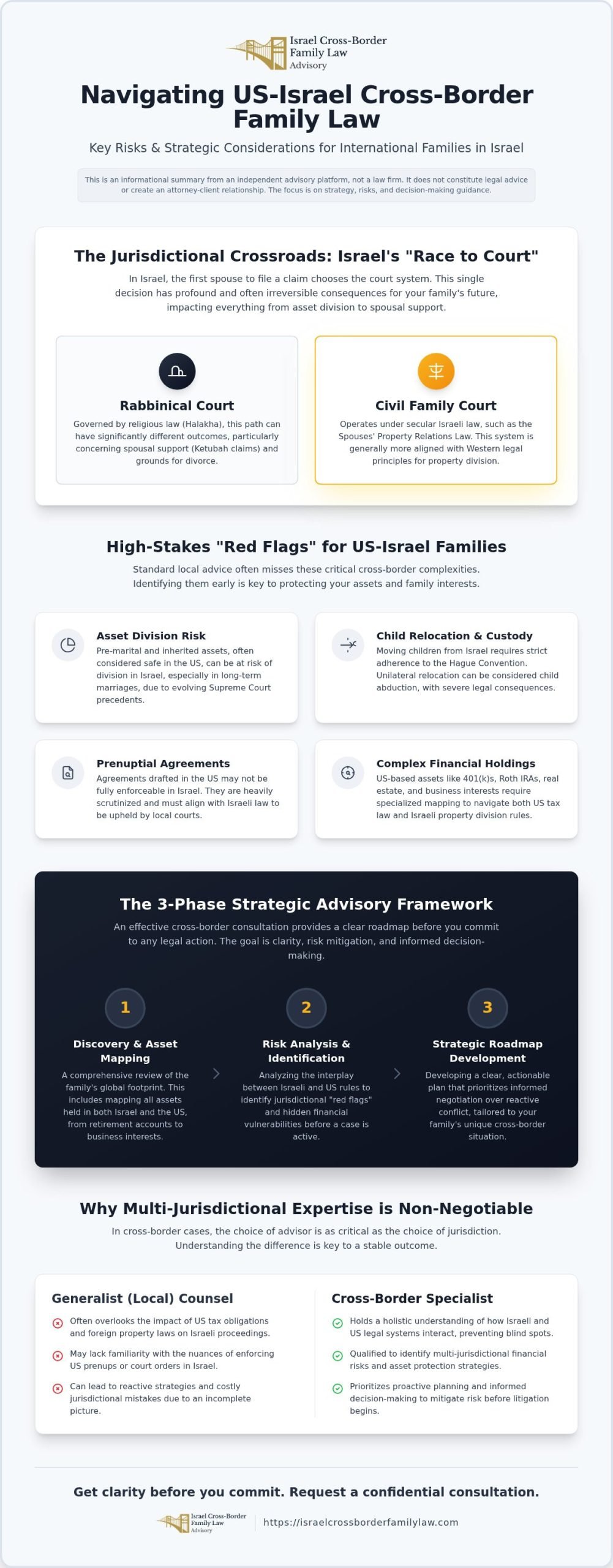
In Israel, the “Race to Court” (Meroz Samchuyot) is a defining feature of divorce proceedings. The first spouse to file a claim can effectively choose between the civil Family Court and the Rabbinical Court. This choice has profound consequences for property division and support. For example, recent 2026 Israeli Supreme Court decisions show a trend toward including pre-marital assets in the division of property for long-term marriages. Filing in the wrong jurisdiction without a strategic plan can lead to “forum shopping” risks that jeopardize financial security. Local courts in Petah Tikva also scrutinize international prenuptial agreements to ensure they align with the Spouses’ Property Relations Law. Early strategic decisions are paramount for those managing lives in both Israel and the US. Understanding these systemic differences is essential before taking any formal steps.
What to Expect During an International Family Law Consultation
A session focused on cross-border strategy differs fundamentally from seeking specific legal representation. The primary objective of an international family law consultation Petah Tikva is to provide a high-level assessment of risks before you engage in formal litigation. This period of discovery allows families to identify jurisdictional “red flags” that might otherwise remain hidden until a case is active. By analyzing the interplay between Israeli and US rules, you can develop a roadmap that prioritizes informed negotiation over reactive conflict. An international family law consultation Petah Tikva provides the necessary framework to evaluate these variables early in the process.
Phase 1: Fact-Finding and Asset Mapping
The process begins with a comprehensive review of the family’s global footprint. This includes mapping assets held in both Israel and the US, such as retirement accounts, real estate, and business interests. It’s essential to identify how the US-Israel Tax Treaty might impact the division of these assets. For example, transferring certain funds between countries during a divorce can trigger unforeseen tax liabilities. Additionally, the consultation assesses current child custody status and any relocation intentions. Identifying these factors early helps prevent the complications associated with the Hague Convention, which governs international child abduction matters.
Phase 2: Jurisdictional Risk Analysis
Choosing the right venue is a critical strategic decision that dictates the trajectory of your case. The Israeli Family Courts handle civil matters like support and property, but the Rabbinical courts also play a role in the “race to court” dynamic. A cross-border consultation must identify which country’s laws will govern child support and alimony to avoid future enforcement crises. This includes determining if a US court would recognize an Israeli judgment, a process that varies significantly depending on the specific state and the nature of the ruling.
Strategic guidance ensures you aren’t caught off guard by systemic differences. For instance, while a law passed in March 2026 allows Rabbinical courts to arbitrate some civil disputes with consent, this authority does not apply to married or formerly married couples in the context of their family law disputes. Understanding these boundaries is vital for asset protection. You might consider scheduling a strategy session to clarify your specific risks and jurisdictional options.
Evaluating Specialist vs. Generalist Counsel in Petah Tikva
Many families in the Petah Tikva area assume that a local divorce lawyer with a strong reputation in the Central District is sufficient for their needs. While local expertise is valuable for navigating the Petah Tikva Family Court, it often lacks the multi-jurisdictional depth required for families with US ties. An international family law consultation Petah Tikva focuses on the strategy needed to bridge two distinct legal cultures. This involves coordinating with practitioners who understand the specific requirements of both Israeli and US systems. You need a partner who views your case through a global lens rather than a purely regional one.
The Generalist Pitfall in Cross-Border Cases
Generalist lawyers may excel at domestic matters but often overlook the transnational complexities that define expat lives. A significant risk involves the concept of “habitual residence,” a term central to custody disputes under international treaties. If a strategy fails to correctly identify how this affects your case, it can lead to catastrophic outcomes in relocation proceedings. Managing international assets also requires more than just local court familiarity. For instance, the 2026 Israeli Supreme Court decision indicating a trend toward including pre-marital assets in property division can have massive implications for US-based holdings. Missing a US tax filing requirement or a Hague Convention detail during the initial planning phase can create irreversible financial and personal damage.
Key Questions to Ask Your Advisor
When evaluating potential advisors, look for multi-qualified practitioners licensed in both Israel and the US. This dual qualification ensures a nuanced understanding of divergent business and legal cultures. You can learn more about about the advisory and its focus on cross-cultural proficiency. Consider asking the following questions during your strategy session:
- How many US-Israel cases have you managed in the current year?
- What is your specific framework for coordinating with legal teams in US time zones?
- How do you ensure that an Israeli order is structured for successful enforcement in the United States?
Effective communication and cultural fluency are not just conveniences; they’re strategic assets in high-stakes negotiations. An advisory platform should act as a bridge, ensuring that your objectives in one country don’t inadvertently trigger a crisis in another. This collaborative approach allows you to work seamlessly with existing professional teams while maintaining a global perspective on your family’s future.
Strategic Preparation for Your Cross-Border Consultation
Preparation turns a generic meeting into a high-stakes strategic session. For those seeking an international family law consultation Petah Tikva, the quality of information provided directly impacts the accuracy of the jurisdictional risk analysis. You should approach this session as a fact-finding mission to secure your family’s future across two legal systems. Strategic preparation ensures that the discussion remains focused on risk mitigation rather than reactive problem-solving.
The Essential Document Checklist
Organizing your documentation is the first step in mapping out a cross-border strategy. You’ll need records from both jurisdictions to identify potential conflicts between Israeli and US laws. Key items include marriage certificates, existing prenuptial agreements, and any previous court orders issued in either country. Financial transparency is equally critical. You should compile records for US-based 401(k) accounts alongside Israeli assets like a Keren Hishtalmut or local property deeds. Review our pricing guide to understand the investment in strategic clarity required for these complex matters. Having these documents ready allows for a more nuanced international family law consultation Petah Tikva.
Defining Your Strategic Goals
A successful outcome begins with a clear definition of what a “win” looks like for your specific situation. For some, the priority is maintaining child stability and preventing disruptive international moves. For others, the focus may be on maximizing the protection of assets spread across multiple borders. You must decide whether to pursue “Early Neutral Evaluation” to find a middle ground or opt for a more aggressive filing strategy to secure a preferred jurisdiction. Learn more about our approach for expats and foreign nationals to see how these objectives are prioritized in a cross-border context.
The logistical burden of international proceedings often involves managing multiple time zones and different legal calendars. Preparing for this emotional and logistical toll is as important as the legal strategy itself. Clear objectives help you stay focused when the process becomes complex. Strategic guidance helps you navigate these stresses by providing a structured decision-making framework before you commit to any specific path.
The Advisory Framework: Clarity for US-Israel Families
The Israel Cross Border advisory model is designed to address the specific anxieties of Petah Tikva families who find themselves caught between two legal worlds. Instead of jumping straight into a courtroom, this framework prioritizes strategic risk mitigation. By leveraging deep expertise in the US-Israel legal corridor, families can identify the jurisdictional traps that often lead to financial or custodial loss. This approach empowers you to make decisions based on education and foresight rather than impulse. An international family law consultation Petah Tikva serves as the foundation for this proactive planning.
A Bridge Between Two Systems
The Israeli legal system, with its unique split between civil Family Courts and religious authorities, can be overwhelming for Anglos accustomed to a unified civil system. We simplify these complexities by translating procedural risks into plain English. This involves a collaborative process where we work alongside your existing US-based professionals to ensure a cohesive global strategy. You can watch: Understanding International Family Law for further insights into how these systems interact. This bridge ensures that your actions in Central Israel don’t negatively impact your legal standing in the United States.
Next Steps: Securing Your Future
In the context of the “race to court” discussed earlier, timing is often the most significant variable. Taking action to secure a strategic roadmap before the other party files can fundamentally change the trajectory of your case. A single international family law consultation Petah Tikva provides the clarity needed to avoid reactive mistakes. It’s about choosing the right forum and the right timing to protect your long-term interests. You can see how it works to start your strategic journey today. Informed choice is the only way to navigate the multi-jurisdictional complexity of an expat life in Israel.
Securing Your Family’s Global Future
Managing the intersection of US and Israeli legal systems requires a proactive stance rather than a reactive one. The “race to court” and the complexities of international asset division mean that early strategic decisions are your most effective tool for protection. By prioritizing clarity and choosing a specialized path, you ensure that your family’s objectives remain the central focus of any proceeding.
Scheduling an international family law consultation Petah Tikva allows you to leverage decades of cross-border experience from practitioners licensed in multiple jurisdictions. This specialized focus on US-Israel expat needs provides the reassurance that your strategy accounts for the nuances of both cultures. You have the power to mitigate risks before they become crises.
Frequently Asked Questions
What is the primary difference between a domestic and international family law consultation?
The primary difference lies in the jurisdictional risk analysis that accounts for the legal systems of two countries. While a domestic session focuses on local procedures, an international family law consultation Petah Tikva evaluates how Israeli court decisions might impact US tax obligations or foreign property rights. It identifies transnational “red flags,” such as Hague Convention triggers, that standard local advice often overlooks. This strategic approach ensures your global interests are protected across borders.
Can I have an international family law consultation remotely if I am currently outside Petah Tikva?
Remote consultations are standard for international families who aren’t currently residing in Petah Tikva or Central Israel. These digital sessions allow for a comprehensive review of cross-border assets and custody concerns without the need for physical travel. High-stakes strategy is effectively managed through secure video platforms, ensuring that families can access specialized expertise from any time zone. This flexibility is essential for coordinating with US-based professionals and managing the logistical complexities of a multi-jurisdictional life.
How much does a cross-border family law consultation typically cost in Israel?
In the Israeli market, the cost of a cross-border strategy session reflects the high level of specialized expertise required for transnational matters. Fees for these sessions vary based on the practitioner’s experience and the complexity of the multi-jurisdictional assets involved. Rather than a standard domestic fee, you should expect pricing that accounts for a detailed risk analysis and coordination across two legal systems. It’s best to request a transparent quote before the session to understand the investment in strategic clarity.
Will an Israeli family law consultation be recognized by US courts?
A strategy consultation isn’t a legal judgment, so it doesn’t require formal recognition by US courts. However, the roadmap developed during the session is designed to ensure that any eventual Israeli orders are structured for successful enforcement in the United States. US courts look for specific jurisdictional markers and adherence to due process when evaluating foreign judgments. A cross-border advisory model focuses on aligning Israeli proceedings with these American legal expectations to prevent future enforcement crises.
What documents should I bring to a consultation involving US-Israel assets?
You should prepare a comprehensive portfolio of documents that spans both jurisdictions. This includes marriage certificates, existing prenuptial agreements, and previous court orders from either country. Financial transparency is vital, so bring records for US 401(k) accounts, Israeli pension funds like a Keren Hishtalmut, and deeds for property located in either nation. Having these items ready allows the advisor to conduct a nuanced risk analysis and identify potential tax implications under the US-Israel Tax Treaty.
Is Petah Tikva a separate jurisdiction for family law filings in Israel?
Petah Tikva isn’t a separate legal jurisdiction but falls under the Central District Family Court system in Israel. While the local court handles the proceedings, the legal framework applied is national. However, the specific court location can influence logistical aspects of your case. An international family law consultation Petah Tikva accounts for these local court boundaries while maintaining a global perspective on how these filings interact with US civil courts and international treaties like the Hague Convention.
How long does a typical international family law strategy session last?
A typical international strategy session usually lasts between sixty and ninety minutes. This duration allows for a deep dive into fact-finding, asset mapping, and jurisdictional risk analysis. The goal is to move beyond surface-level summaries and provide a structured decision-making framework. By the end of the session, you should have a clear roadmap for negotiation or litigation that addresses the multi-jurisdictional complexity of your family’s specific situation and identifies immediate next steps.
Can an advisory platform help if I already have a local lawyer in Petah Tikva?
Advisory platforms frequently work in collaboration with a client’s existing local professional teams. If you already have a lawyer in Petah Tikva, an international advisor acts as a bridge to manage the cross-border and multi-jurisdictional aspects that a generalist might miss. This partnership ensures that your local litigation strategy doesn’t inadvertently trigger negative consequences in the US. This collaborative model provides an elite level of oversight, grounding your local case in established global expertise and strategic direction.

Article by
Gabriel Lior
A Personal Journey That Became a Mission
The advisory was founded by an American father Gabriel Lior, LLB, MBA , global entrepreneur, and cross-border advisor who spent more than a decade navigating the Israeli family court system firsthand and now lives in Singapore with his son.
As a divorced parent in a cross-border family, Gabriel faced nearly every legal challenge a foreign parent can encounter in Israel — including child custody disputes, child support proceedings, property matters in Israel and abroad, false accusations, and complex immigration and relocation proceedings.
Over the years, he learned the hard way how difficult it is for non-Israeli parents to understand the system, identify the right legal strategy, and choose the right legal representation — especially when language, culture, and jurisdictional differences are involved. He also witnessed how foreign parents and new immigrants are often disadvantaged or taken advantage of by service providers and institutions simply because they lack local knowledge or fluency.
From Client to Advisor
To truly understand — and survive — the system, Gabriel pursued formal legal education in Israel, completing two Israeli law degrees, alongside a BA and MBA earned in the United States. This was never about becoming a practicing attorney, but about gaining a deep, structural understanding of how the system works — and where it breaks down for foreign parents.
This rare combination of:
Firsthand client experience
Israeli legal and US business education
International business and negotiation training
Decades of commercial execution
created a unique perspective – one that understands both sides of the table.
After years of litigation, persistence, and at times self-representation, he ultimately succeeded in securing custody of his son and relocating abroad through a rare legal victory in the Israeli Supreme Court — becoming one of the first fathers in Israel to do so under these circumstances.
Disclaimer
Important Disclaimer:
The information provided on this website and in its content is for general informational and educational purposes only and does not constitute legal advice, legal opinion, or legal representation.
Gabriel Lior is not licensed to practice law in Israel (nor is he interested in doing so) and does not provide legal services, despite having completed 2 Law Degrees. The services offered are advisory in nature and are intended to provide general guidance, strategic insight, and information regarding cross-border family law considerations.
No attorney-client relationship is formed by accessing this website, reading its content, or communicating with us.
Any decisions made based on this information are at your own discretion and risk. For legal advice specific to your situation, you should consult a licensed attorney in the relevant jurisdiction.
Where appropriate, we may refer clients to independent, licensed attorneys or professionals. Such referrals do not constitute legal representation and no liability is assumed for services provided by third parties.