What if the most effective way to protect your family’s future in Israel isn’t through an aggressive courtroom battle, but through a strategy that prioritizes long term emotional and financial stability? For many expats and international families, the Israeli legal system often feels like a confusing maze of unfamiliar Hebrew terms and high stakes decisions. It’s understandable to feel overwhelmed by the fear that hostile litigation is the only path forward, particularly when language barriers make every step feel uncertain. This advisory overview, published on an independent platform, explores how Arthur Shani Lawyer and his firm approach these complexities using a holistic model specifically tailored for cross border cases.
You’ll gain clarity on the methodology behind this practice and learn why the weight of early decisions is so significant in the Israeli jurisdiction. We will examine the critical differences between mediation and litigation options, helping you understand the risks and strategic advantages of each path. By the end of this guide, you will have a better grasp of how to approach your family law matter with the confidence of an informed decision maker. For a deeper look at these topics, you can also view expert discussions on the @IsraelFamilyLaw YouTube channel. Please note that this content is for informational purposes and does not constitute formal legal representation.
Key Takeaways
- Learn how a specialized practitioner in Tel Aviv can help you bridge the gap between foreign expectations and the realities of the Israeli legal system.
- Understand the benefits of a holistic legal model that integrates financial and emotional perspectives to help preserve your family’s long term stability.
- Discover the strategic differences between private mediation and court mandated sessions when resolving sensitive or high conflict family disputes.
- Gain insights into managing complex cross border challenges, including international asset division and custody matters involving the Hague Convention.
- Evaluate whether the resolution focused methodology used by Arthur Shani Lawyer is the most effective path for your specific family law needs.
Who is Adv. Arthur Shani? An Overview of His Legal Standing
Arthur Shani is a recognized figure in the Tel Aviv legal community, known for his focus on the intersection of high-stakes litigation and alternative dispute resolution. As the founder of Arthur Shani & Co., he’s built a practice that addresses the specific needs of families navigating the complexities of the Israeli legal environment. His standing is reflected in his consistent inclusion in the Duns 100 rankings, an elite directory that identifies top-tier legal practitioners in Israel. For an expat or a foreign national, these rankings provide a benchmark of professional reliability in a legal market that can often feel opaque or difficult to navigate from the outside.
He functions as a strategic bridge within the Israeli court system, which is unique for its dual-track jurisdiction of civil family courts and religious tribunals. Arthur Shani Lawyer provides a steady hand in these environments, helping clients understand how to manage the procedural differences between these two systems. His reputation is built on his ability to handle sensitive matrimonial disputes where traditional litigation might otherwise lead to a complete breakdown in communication.
Foundational Philosophy: Family Law for Every Family
The firm operates under the guiding principle of “Family Law for Every Family.” This inclusive approach is particularly relevant for those who don’t fit into traditional categories, such as same-sex couples, secular households, or international families with no religious affiliation in Israel. You can find more details on how these dynamics affect non-citizens at the advisory for expats and foreign nationals. The philosophy emphasizes humane treatment during legal transitions. It recognizes that while the legal process is technical, the impact on the individuals involved is deeply personal. The goal is to facilitate a transition that preserves dignity and reduces the long-term friction often caused by aggressive courtroom tactics.
The Professional Trajectory of Arthur Shani
Over the last decade, Arthur Shani has become a prominent name in complex matrimonial and estate disputes. His experience as both an arbitrator and a mediator allows him to offer perspectives that go beyond simple advocacy. He’s frequently cited in cases where standard litigation has failed to produce a sustainable resolution for the parties involved. This trajectory has shaped his role as a neutral arbitrator in high-conflict scenarios, where he’s tasked with finding equitable solutions in property and custody matters. His name is often associated with cases involving multi-jurisdictional assets, where a deep understanding of both local Israeli law and international legal standards is required to reach a fair outcome.
The Holistic Legal Service Model Explained
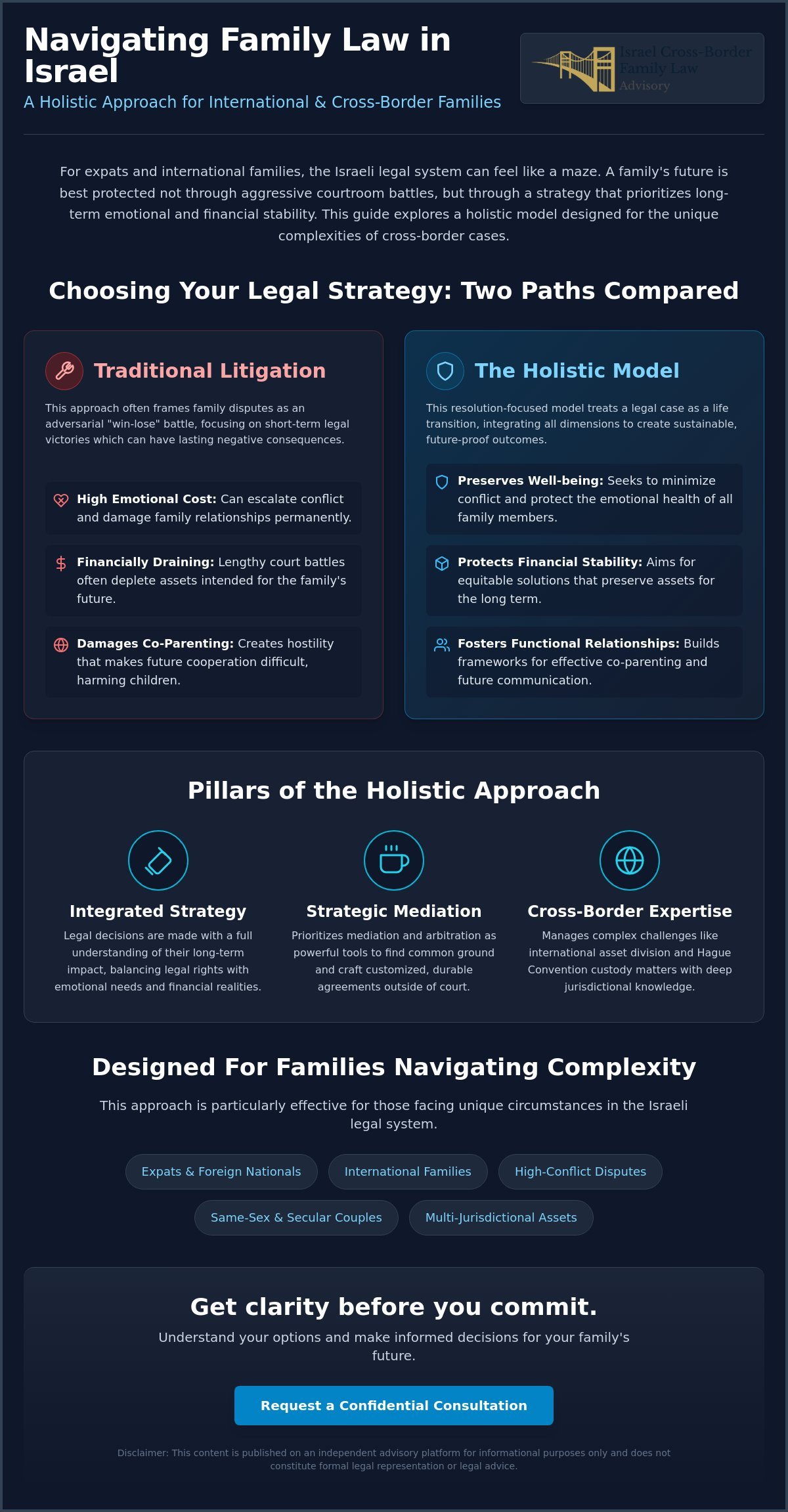
Traditional family law often centers on a “win-lose” mentality. This aggressive approach can leave families emotionally and financially depleted, even if a legal victory is achieved in court. The holistic model championed by Arthur Shani Lawyer shifts this focus toward a more integrated resolution. It treats the legal case not as an isolated event, but as a life transition that involves emotional, financial, and relational dimensions. By moving away from the purely adversarial nature of standard divorce law, this method seeks to create sustainable outcomes that protect the family’s future.
Integration is the core of this approach. It involves a strategy where legal decisions are made with a full understanding of their long-term impact. For example, a custody arrangement isn’t just a schedule; it’s a framework for how parents will interact for years to come. Arthur Shani Lawyer utilizes interdisciplinary collaboration to ensure that every angle of a case is considered. This might include working with financial experts to evaluate the tax implications of asset division or consulting with specialists to address the emotional needs of children during the transition. The goal is to preserve functional relationships, which is particularly vital for parents who must continue to co-parent long after the legal process ends.
Practice Areas Under the Holistic Umbrella
The holistic framework applies to a wide variety of legal needs, ensuring that all aspects of a client’s domestic and financial life are protected. These areas include:
- Divorce proceedings and comprehensive common-law spouse arrangements that prioritize clarity over conflict.
- Intergenerational wealth transfer and strategic capital management for families with multi-jurisdictional interests.
- The drafting of wills, management of inheritances, and navigating complex guardianship matters to ensure long-term security.
Why Expats Benefit from a Holistic Approach
Expats and international families often face a steep learning curve when they enter the Israeli legal system. There is a significant cultural gap between Western expectations of fairness and the procedural realities of local law. A holistic approach helps bridge this divide by providing advisory guidance on how local decisions impact global interests. It reduces the friction of cross-border asset division by accounting for different tax years, currency fluctuations, and varying property laws between countries.
Addressing these complexities early helps international families avoid the instability that often follows a poorly planned legal separation. If you are beginning to navigate these challenges, it’s helpful to discuss your specific situation with a professional who understands the nuances of both systems. This proactive strategy ensures that the weight of early decisions doesn’t lead to unintended consequences in the future.
Mediation and Arbitration: Shani’s Strategic Core
In the Israeli legal landscape, the path to resolution often begins with a mandatory “Dispute Settlement” process. While these court-mandated sessions provide a basic introduction to consensus, they are frequently limited by time and procedural constraints. Private mediation through Arthur Shani Lawyer offers a significantly more detailed and personalized alternative. This approach allows families to address the nuances of their specific situation in a setting that prioritizes confidentiality and mutual respect. For many international families, the privacy afforded by this route is a critical factor in protecting their reputation and business interests.
The strategic core of this practice lies in the belief that a negotiated agreement is almost always superior to a court-imposed one. When parties reach a consensus, they are more likely to adhere to the terms of the agreement over the long term. This reduces the risk of future litigation and provides a sense of closure that the adversarial system rarely achieves. You can explore more about how these strategies are implemented on the page detailing how the advisory process works. Transparency serves as a cornerstone here, ensuring that both parties have access to the same information before making binding commitments.
The Process of Private Mediation
A typical mediation session is structured to facilitate open communication while managing high emotional stakes. It begins with identifying shared goals, such as the well-being of children or the preservation of family assets. Arthur Shani Lawyer uses specific techniques to de-escalate matrimonial disputes, focusing on neutral language and objective data. This often involves separate “caucuses” where each party can speak freely with the mediator before returning to a joint discussion. The goal is to move beyond past grievances and toward a “win-win” settlement. By resolving issues without court intervention, families save time and avoid the public nature of the Israeli family court system.
When Arbitration Becomes Necessary
There are instances where mediation may not reach a full resolution, particularly in complex financial disputes or cases with significant power imbalances. In these cases, arbitration serves as a powerful tool. Under Israeli law, arbitration is a binding process where a neutral third party makes a final decision based on the evidence presented. It’s often faster than traditional litigation because it bypasses the significant backlogs in the court system. Arbitration offers a level of discretion that public courts cannot match. It’s especially useful for families with sensitive business holdings who require a decisive but private conclusion to their legal matters. This method ensures that decisions are made by an expert who understands the complexities of cross-border wealth and family dynamics.
Considerations for International and Cross-Border Families
Families who maintain lives across multiple jurisdictions face a specific set of challenges that local practitioners may not fully appreciate. When assets are distributed across different countries, the legal strategy must account for diverse tax codes, property laws, and financial regulations. Arthur Shani Lawyer specializes in managing these multi-jurisdictional complexities, ensuring that capital management remains a priority during family transitions. This often requires a deep understanding of how Israeli law interacts with foreign financial structures, such as US-based 401(k) plans or European real estate holdings. Decisions made in a Tel Aviv courtroom can have significant tax or inheritance implications in New York or London.
Managing these cases successfully often depends on the ability to coordinate with a client’s existing professional circle. The firm frequently collaborates with US-based legal teams to create a seamless representation strategy. This prevents conflicting court orders and ensures that the legal narrative remains consistent across all active jurisdictions. Whether the case involves the Hague Convention or complex financial oversight, the focus is on maintaining a clear line of communication between all parties. This integrated approach is essential for families who require a practitioner who understands the global scale of their interests.
Navigating the US-Israel Legal Bridge
One of the most significant hurdles for international families is the structural difference between the Israeli Rabbinical courts and US Civil courts. In Israel, religious tribunals hold specific authority over marriage and divorce, which can lead to unexpected outcomes for those accustomed to a purely secular system. Understanding how to manage this dual-track environment is essential for enforcing foreign judgments or navigating international custody and relocation matters. Without a practitioner who understands both systems, families risk making procedural errors that can haunt them for years. Clarity on these jurisdictional boundaries is the first step toward a stable resolution.
Risk Management in Cross-Border Cases
Expats often fall into common traps within the Israeli legal system, such as failing to understand the implications of where a case is first filed. The weight of early procedural decisions in an international divorce cannot be overstated. A single filing in the wrong forum can shift the entire jurisdictional balance of a case. It affects everything from asset division to child support. Seeking clarity before making a formal commitment is the most effective way to manage these risks. If you are dealing with assets or family members in multiple countries, it’s vital to consult with a cross-border specialist to understand your rights before taking action. These early steps often determine the long-term success of the entire legal process.
Is an Arthur Shani Approach Right for Your Case?
Choosing the right legal partner is a decision that carries significant weight, especially when your family’s future and global assets are at stake. You must evaluate whether your specific situation requires a litigation-heavy approach or a resolution-focused strategy. While some cases inevitably require a judge’s intervention, many international families find that a “scorched-earth” policy in court leads to unnecessary financial and emotional depletion. Arthur Shani Lawyer is often the preferred choice for those who value a holistic model that prioritizes building a sustainable future over winning a temporary battle.
Trust and personal chemistry are non-negotiable in family law. You’re sharing the most private details of your life; you need to feel certain that your representative understands your cultural background as well as the Israeli legal framework. Top-tier representation involves a specific cost-value dynamic. While the initial fees for a prestigious Tel Aviv firm may reflect their standing in the market, the cost of a poorly drafted cross-border agreement can be exponentially more expensive in the long run. Mistakes in international asset division or custody arrangements can lead to years of corrective litigation in multiple countries.
Decision-Making Framework for Expats
When you’re interviewing a high-profile Israeli practitioner, you should come prepared with specific questions to test their cross-border proficiency. Consider asking the following:
- How much experience do you have coordinating with legal teams in my home country?
- Do you have a dedicated network of financial experts who understand both Israeli and foreign tax implications?
- In what percentage of your cases do you successfully reach a settlement through private mediation?
Determining if your case requires a “holistic” or “aggressive” stance depends on your ultimate goals. If your priority is maintaining a functional co-parenting relationship or protecting a family business, a resolution-focused approach is usually more effective. You can learn more about how our advisory works to help you determine which strategy fits your needs before you commit to a specific firm.
Taking the Next Step with Confidence
This content is published on an independent advisory platform and is intended for informational purposes only. It doesn’t constitute legal advice, formal legal representation, or an attorney-client relationship. Legal services in Israel are only provided by licensed attorneys under a separate, formal engagement. Seeking an independent advisory review before engaging a specific firm provides an extra layer of security. It allows you to vet strategies and understand risks without the pressure of an immediate retainer. The weight of early decisions in the Israeli system is significant; taking the time to seek clarity ensures you don’t make commitments you’ll later regret. Get clarity before you commit. Request a confidential consultation.
Securing Your Family’s Global Interests
Managing a family law matter in Israel requires more than just legal representation; it demands a strategic vision that accounts for global assets and long-term relationships. By prioritizing a holistic model, Arthur Shani Lawyer addresses the unique needs of international families who wish to avoid the exhaustion of traditional litigation. You’ve seen how private mediation and arbitration can provide a discreet, efficient path toward resolution, bypassing the significant backlogs of the civil court system. These methods are particularly effective when dealing with the complexities of US-Israel jurisdictional conflicts and multi-country asset division.
As an independent advisory platform focused on supporting Anglo expats, we provide the clarity you need to navigate these high-stakes decisions. Understanding the weight of your initial procedural choices is the best way to protect your interests and your children’s future. Our guidance is designed to offer a neutral perspective on top-tier Israeli practitioners and the risks inherent in cross-border cases. Get clarity before you commit. Request a confidential case review to explore your options with confidence. Taking an informed first step is the most reliable way to ensure a stable outcome for everyone involved.
Frequently Asked Questions
What is Adv. Arthur Shani known for in Israeli law?
Adv. Arthur Shani is primarily recognized for his expertise as a mediator and arbitrator who manages complex matrimonial and estate disputes. He’s known for pioneering a holistic model in the Israeli legal market, moving away from aggressive litigation toward integrated resolutions. His practice often addresses the unique needs of international families, helping them navigate the specific procedural requirements of the Israeli jurisdiction while protecting their global financial interests.
Does Arthur Shani represent clients in the Rabbinical courts?
Yes, his firm provides representation within both the civil Family Court and the Rabbinical courts. Navigating the dual-track system is a fundamental part of practicing family law in Israel. Arthur Shani Lawyer assists clients in understanding how the rules of joinder or binding work, ensuring that strategic decisions are made early to determine which court system will handle specific matters like property division or child custody.
What does a “holistic” legal model mean for my divorce?
A holistic legal model means your divorce is treated as a life transition rather than just a technical legal dispute. This approach integrates your financial goals and emotional well-being into the legal strategy. Instead of focusing solely on a win in court, the objective is to create a sustainable agreement that preserves your family’s stability. It often involves collaboration with financial experts to ensure long-term capital management is protected during the separation.
Can Arthur Shani help with US-Israel cross-border inheritance?
Yes, the firm frequently manages inheritance and estate matters involving assets held in multiple countries. Cross-border inheritance requires a deep understanding of how Israeli succession laws interact with foreign tax codes and property regulations. This specialized guidance helps international families avoid the pitfalls of conflicting legal systems. It ensures that wills and wealth transfer strategies are enforceable and clear in both the Israeli and international contexts.
Is mediation always better than going to the Family Court in Israel?
While mediation isn’t the right choice for every case, it’s often the most effective way to resolve disputes privately and efficiently. In Israel, mediation is generally faster and less adversarial than the public Family Court system. It allows parties to maintain control over the final agreement rather than leaving the decision to a judge. For families with sensitive business interests or children, mediation provides a level of confidentiality that litigation cannot match.
How does Arthur Shani handle high-conflict custody disputes?
High-conflict custody disputes are handled with a focus on de-escalation and long-term joint parental responsibility. The firm utilizes structured mediation or neutral arbitration to move the conversation away from past grievances and toward the children’s future needs. By acting as a neutral bridge, Arthur Shani Lawyer helps parents create detailed parenting plans that address the complexities of international relocation or multi-cultural upbringing, reducing the friction often caused by traditional litigation.
What is the role of an arbitrator in Israeli family law?
An arbitrator acts as a private judge who makes a binding decision on your legal matter outside the public court system. In Israeli family law, arbitration offers a discreet alternative to the Family Court, providing a faster resolution for complex financial or property disputes. This role is especially vital for high-profile families or business owners who require a decisive conclusion to their legal issues without the delays or public exposure of the standard judiciary.
How do I know if I need a cross-border specialist or a local Israeli lawyer?
You likely need a cross-border specialist if your case involves assets in multiple countries, foreign citizenship, or an international move. A local Israeli lawyer might understand domestic law but could overlook the tax or jurisdictional implications of your decisions in another country. A specialist understands how to coordinate with foreign legal teams and navigate the Hague Convention. This ensures that your Israeli legal strategy doesn’t inadvertently trigger negative consequences in your home jurisdiction.

Article by
Gabriel Lior
A Personal Journey That Became a Mission
The advisory was founded by an American father Gabriel Lior, LLB, MBA , global entrepreneur, and cross-border advisor who spent more than a decade navigating the Israeli family court system firsthand and now lives in Singapore with his son.
As a divorced parent in a cross-border family, Gabriel faced nearly every legal challenge a foreign parent can encounter in Israel — including child custody disputes, child support proceedings, property matters in Israel and abroad, false accusations, and complex immigration and relocation proceedings.
Over the years, he learned the hard way how difficult it is for non-Israeli parents to understand the system, identify the right legal strategy, and choose the right legal representation — especially when language, culture, and jurisdictional differences are involved. He also witnessed how foreign parents and new immigrants are often disadvantaged or taken advantage of by service providers and institutions simply because they lack local knowledge or fluency.
From Client to Advisor
To truly understand — and survive — the system, Gabriel pursued formal legal education in Israel, completing two Israeli law degrees, alongside a BA and MBA earned in the United States. This was never about becoming a practicing attorney, but about gaining a deep, structural understanding of how the system works — and where it breaks down for foreign parents.
This rare combination of:
Firsthand client experience
Israeli legal and US business education
International business and negotiation training
Decades of commercial execution
created a unique perspective – one that understands both sides of the table.
After years of litigation, persistence, and at times self-representation, he ultimately succeeded in securing custody of his son and relocating abroad through a rare legal victory in the Israeli Supreme Court — becoming one of the first fathers in Israel to do so under these circumstances.
Disclaimer
Important Disclaimer:
The information provided on this website and in its content is for general informational and educational purposes only and does not constitute legal advice, legal opinion, or legal representation.
Gabriel Lior is not licensed to practice law in Israel (nor is he interested in doing so) and does not provide legal services, despite having completed 2 Law Degrees. The services offered are advisory in nature and are intended to provide general guidance, strategic insight, and information regarding cross-border family law considerations.
No attorney-client relationship is formed by accessing this website, reading its content, or communicating with us.
Any decisions made based on this information are at your own discretion and risk. For legal advice specific to your situation, you should consult a licensed attorney in the relevant jurisdiction.
Where appropriate, we may refer clients to independent, licensed attorneys or professionals. Such referrals do not constitute legal representation and no liability is assumed for services provided by third parties.