What if the most critical factor in your divorce isn’t the reason for the split, but rather which court receives your paperwork first? For expats and international families, the realization that Israeli and US legal systems often conflict is both overwhelming and stressful. You might feel uncertain about how assets are divided across borders or fear that a foreign jurisdiction won’t protect your parental rights. It’s natural to feel protective of your future when the rules of the game seem to change depending on the country.
In this guide, you’ll discover how to find strategic clarity through the expertise of Shai Simchauve Attorney. We’ll provide a roadmap for managing complex cross-border custody and estate matters while explaining the specific risks inherent in the Israeli system. This article is published on an independent advisory platform, not a law firm, and is intended for informational purposes only. It’s designed to help you understand the weight of early decisions, such as the 2025 laws regarding Rabbinical court jurisdiction over child support. We’ll preview the shift toward joint parental responsibility and the evolving “tender years” presumption to ensure you have a clear view of the current legal landscape.
Key Takeaways
- Understand the strategic importance of the “Race to the Court” and how choosing between Family and Rabbinical courts affects your financial future.
- Learn how the Hague Convention applies to international relocation and the legal risks of moving children across borders without prior consent.
- Discover how Shai Simchauve Attorney provides a multi-qualified perspective to manage complex assets and estate matters located in both the US and Israel.
- Gain clarity on the cross-border enforcement of child support and how recent 2025 legislative changes impact your jurisdictional standing.
- Explore how an independent advisory platform helps you build a strategic roadmap before you commit to formal legal representation or litigation.
Who is Shai Simchauve? Bridging the US-Israel Legal Gap
Managing family law across two continents isn’t just about filing papers; it’s about understanding how two distinct legal cultures interact. Shai Simchauve Attorney serves as a founding partner and cross-border strategist for families caught between the United States and Israel. This dual perspective is essential because decisions made in one jurisdiction often have unintended consequences in the other. Expats and foreign nationals frequently face a steep learning curve when they encounter the Israeli legal system. It operates with different procedural rhythms and cultural expectations than those in the West.
For English speakers, the barrier isn’t just language; it’s the logic behind the law. A specialist who understands both the US and Israeli frameworks can act as a bridge, ensuring that nothing is lost in translation. This clarity is vital when assets are spread across borders or when children hold dual citizenship. Without a guide who speaks both the legal and cultural languages, international families risk making choices that could jeopardize their long-term security.
To better understand the emotional and strategic challenges of these complex situations, watch this helpful video:
Professional Philosophy and Cross-Border Focus
Shai’s approach emphasizes calm, strategic planning over the aggressive, reactive litigation often found in family law. The goal is to provide authoritative expertise that reassures families during high-stakes transitions. It’s important to understand that the content provided here is for educational purposes and is published on an independent advisory platform rather than a law firm. You can learn more about the advisory and how it supports strategic decision-making. By focusing on the long-term commercial and personal goals of the client, Shai Simchauve Attorney helps families move from confusion to a structured roadmap.
Navigating the Israeli Court Culture for Anglos
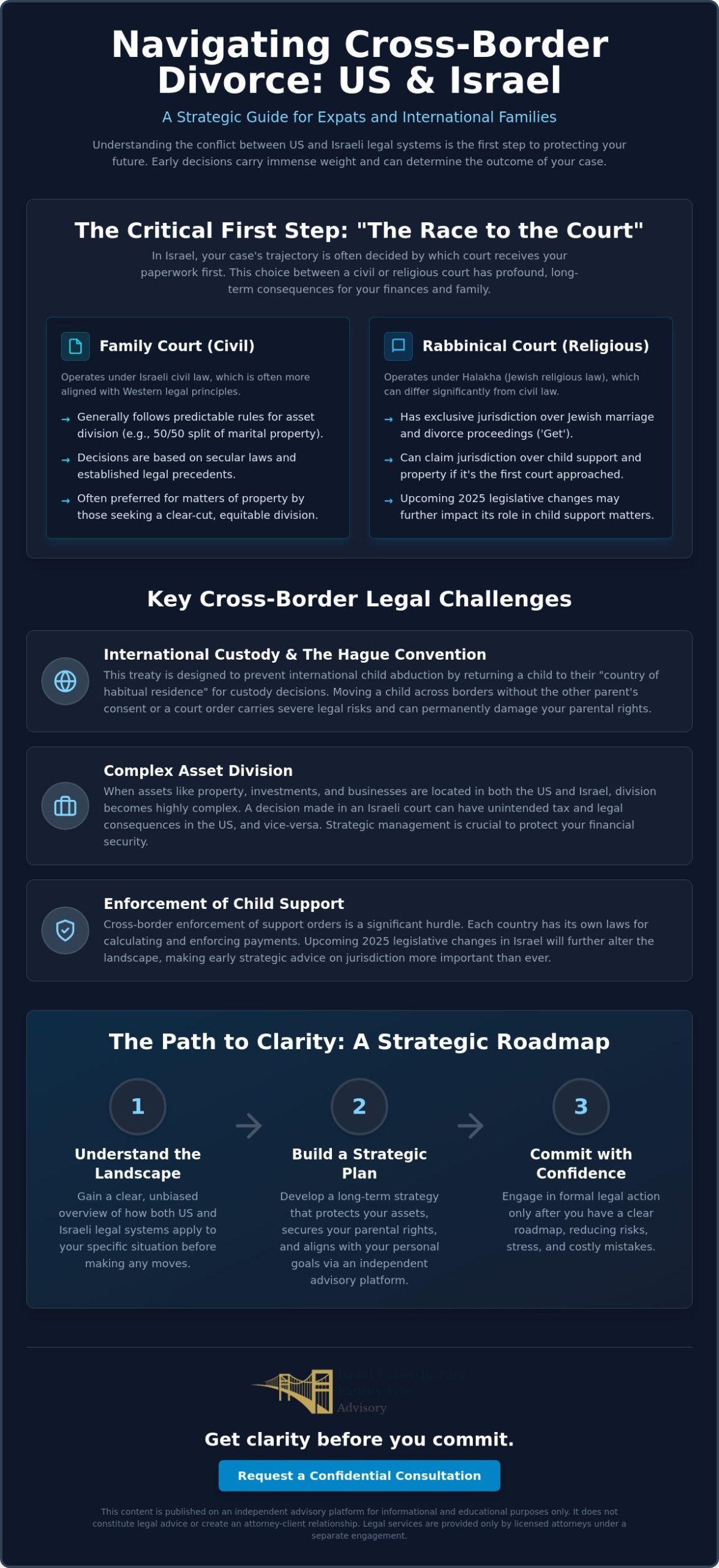
The Israeli family law landscape is significantly different from what most Anglos expect. One of the most striking differences is the existence of dual jurisdictions: the civil Family Court and the religious Rabbinical Court. Early decisions carry immense weight here, particularly regarding where a case is first filed. This “race to the court” can determine everything from how your property is divided to the specifics of child support. For those dealing with potential relocation, understanding the Hague Convention on the Civil Aspects of International Child Abduction is critical to avoiding legal pitfalls. Seeking clarity before making any formal commitments is the only way to protect your standing. For more tailored information, explore our resources for expats and foreign nationals.
Expertise in the Hague Convention and International Custody
International custody disputes represent some of the most complex challenges in family law, particularly when parents are divided between the US and Israel. Shai Simchauve Attorney approaches these cases by prioritizing the child’s stability while navigating the rigid requirements of international treaties. In these high-stakes scenarios, emotions can lead to “self-help” measures, such as moving a child without the other parent’s consent. These actions often trigger severe legal consequences that can permanently damage a parent’s standing in both countries. Understanding the mechanics of international law is the only way to protect your parental rights and your child’s future.
Parental Abduction and the Hague Convention
The primary framework for resolving these disputes is the Hague Convention on the Civil Aspects of International Child Abduction. This treaty is designed to return children to their country of “habitual residence” for custody determinations. Determining habitual residence is a fact-specific process that considers the child’s school, social ties, and the parents’ shared intent. According to the U.S. State Department on International Child Abduction, immediate action is required if a child is removed without consent. If you find yourself in this situation, there are several critical steps to take:
- Secure all travel documents and passports for the child to prevent further unauthorized travel.
- Document any written or verbal communication regarding travel intent or temporary stays.
- Consult with a specialist to determine if a Hague application is the appropriate strategic move.
Delaying a filing can be interpreted as acquiescence, making it much harder to secure a return order later. You can find more detail on these procedures through our guide on International Custody & Relocation.
Relocation Strategy and Risk Management
Relocating with a child from Israel requires either written consent from the other parent or a specific court order. Under Israeli law, as of 2026, courts are increasingly moving toward joint parental responsibility, which makes unilateral moves even more legally precarious. The legal principle that children under six should stay with the mother is also being applied with less frequency, now treated as a rebuttable presumption rather than a rule. Informal or “handshake” agreements are rarely enforceable in cross-border contexts. If you intend to move, you need a relocation agreement that is recognized by both the Israeli Family Court and a US court to ensure long-term compliance.
Shai Simchauve Attorney focuses on drafting multi-jurisdictional parenting plans that address travel schedules, holiday rotations, and communication protocols across time zones. These plans help prevent future litigation by providing clear, enforceable rules that both legal systems respect. The goal is to create a roadmap that minimizes the risk of a Hague Convention claim while allowing for a smooth transition. If you’re considering a move or facing a custody dispute, it’s helpful to discuss your strategy before any formal steps are taken.
Strategy in the ‘Race to the Court’ and Dual Jurisdictions
In the Israeli legal landscape, the “Race to the Court” is a pivotal strategic element that often dictates the trajectory of a divorce. This phenomenon occurs because two separate court systems, the civil Family Court and the religious Rabbinical Court, share concurrent jurisdiction over many family matters. The court where a claim is first filed generally gains the authority to rule on the entire case. For US citizens and expats, this creates a time-sensitive environment where a delay of even a few hours can shift the legal ground beneath them. Decisions made in these early moments often carry more weight than months of subsequent litigation.
In 2025, data showed that 11,093 couples divorced in Israel. Many of these cases involved complex jurisdictional battles where the choice of venue directly impacted the outcome. A significant development occurred in November 2025, when a temporary law granted Rabbinical courts the authority to rule on child support matters as part of divorce proceedings. This change adds another layer of complexity for international families who might be more familiar with a strictly secular court model. Shai Simchauve Attorney specializes in evaluating these nuances to determine which venue offers the most equitable path for a specific family’s needs while managing the risks of the Israeli system.
The Dual Court System: Family vs. Rabbinical
The Rabbinical Court operates according to Jewish law and has exclusive jurisdiction over the marriage and divorce itself. However, it can also handle “bundled” issues like property division and alimony if they’re filed there first. Conversely, the Family Court is a civil institution that applies secular law to matters of assets and parental responsibility. Each system has its own procedural rules and cultural leanings. While one spouse might find the Rabbinical court’s approach to alimony more favorable, the other might prefer the Family Court’s stance on asset division. A neutral analysis of these pros and cons is essential before any papers are signed. It’s vital to remember that this content is published on an independent advisory platform and is intended for informational purposes only.
Strategic Filing and Jurisdictional Tactics
Choosing the right starting point requires a deep understanding of how each court views multi-jurisdictional assets, such as US-based retirement accounts or Israeli real estate. Shai Simchauve Attorney focuses on the strategic alignment of these choices with the client’s long-term commercial goals. Because foreign orders aren’t automatically enforceable in Israel, the initial filing sets the stage for all future enforcement actions. You can see a detailed breakdown of how it works to understand the progression from strategy to litigation. Timing isn’t just about speed; it’s about making an informed decision before the other party acts.
Protecting Assets and Enforcing Support Across Borders
Navigating the financial separation of an international marriage requires more than just a list of accounts. It demands a strategy that accounts for different valuation methods and tax obligations in two countries. Shai Simchauve Attorney works with families to create a comprehensive view of their global estate. This includes evaluating how the US-Israel Tax Treaty affects the transfer of funds or the sale of property during a settlement. High-net-worth individuals, particularly those with interests in Israeli startups or US equity markets, must be cautious about how these assets are disclosed and divided. Financial decisions made without this cross-border context can lead to significant tax penalties or the loss of separate property rights.
Cross-Border Support Enforcement
Many expats believe that a US child support order is automatically valid in Israel. This is a common misconception. To be enforceable, a foreign order must undergo a process called domestication in the Israeli Family Court. This requires proving the order is final and doesn’t contradict Israeli public policy. Strategic navigation is necessary because the Israeli system’s calculation of “needs” may differ from US state guidelines. Common obstacles include:
- Disputes over whether the original US court had proper personal jurisdiction.
- Differences in how “spousal maintenance” is categorized versus “child support.”
- Challenges in verifying income when one party is self-employed or has offshore interests.
By addressing these issues strategically at the outset, you can avoid years of gridlock in the enforcement process. You can learn more about Child Support & Cross-Border Enforcement to understand the procedural hurdles involved. It’s vital to remember that this content is published on an independent advisory platform and is intended for informational purposes only.
Asset Division and Property Rights
Israeli law generally follows a “balancing of resources” principle for assets acquired during the marriage. However, disputes often arise over what constitutes “separate” property, especially with inheritances or pre-marital assets held in the US. Early asset mapping is the most effective way to prevent these conflicts. This involves identifying the legal status of every account, property, and business interest before the first legal claim is filed. Addressing the complexities of US-based retirement accounts alongside Israeli real estate requires a specialist who understands the tax and legal implications in both countries.
Israeli courts may look at the “commingling” of funds differently than a court in New York or California. If you owned a home in the US before moving to Israel, protecting that interest is paramount. Comprehensive asset mapping ensures that your legal standing is clear before you enter the “Race to the Court” described earlier in this guide. This proactive approach is the best way to secure your financial interests across borders. If you are managing assets in multiple jurisdictions, it’s helpful to request a confidential strategy session to review your standing.
Navigating Your Case via an Independent Advisory Platform
Most individuals rush to hire a litigation attorney the moment a family crisis erupts. In a cross-border context, this reactive approach can be a costly mistake. International family law requires a sequence of strategic decisions that must happen before any legal papers are served. An independent advisory platform provides the necessary space to evaluate your standing without the immediate pressure of court deadlines. Shai Simchauve Attorney focuses on this high-level strategy to help you understand the long-term impact of your choices. It’s essential to remember that this content is published on an independent advisory platform and is intended for informational purposes only. Legal services are only provided by licensed attorneys under a separate engagement.
The Advisory Process: Clarity Before Commitment
The initial strategy session is designed to provide a comprehensive risk assessment of your specific situation. During a confidential case review, a cross-border specialist identifies the pitfalls that a standard local lawyer might miss. For instance, a lawyer in Israel may understand the local Family Court but might not grasp how a specific ruling could impact your US tax obligations or your ability to enforce child support in a US state court. The advisory process bridges this gap by looking at the entire multi-jurisdictional picture. You can learn more about the advisory and how it helps you build a roadmap before you commit to a specific path of litigation.
This process typically involves three key stages:
- Jurisdictional Analysis: Evaluating whether the Family Court or Rabbinical Court offers the most strategic advantage for your specific assets and custody goals.
- Conflict Identification: Spotting potential contradictions between US and Israeli law regarding property division or parental rights.
- Roadmap Development: Creating a clear plan of action that your local litigation counsel can follow to ensure your international interests are protected.
Making Informed Choices for Your Family’s Future
Cultural nuance is often the most overlooked factor in US-Israel legal negotiations. The way cases are settled in Israel differs significantly from the US. By working with Shai Simchauve Attorney through this advisory model, you gain the knowledge required to lead your own legal team with confidence. You aren’t just a participant in your case; you become an informed decision-maker who understands the weight of every signature. This strategy-first approach ensures that your legal team operates with a clear objective, rather than reacting to the other party’s moves. Navigating a complex system requires a steady, authoritative guide who understands the significant differences between legal cultures. Get clarity before you commit. Request a confidential consultation.
Securing Your Strategy in a Global Legal Landscape
Navigating the intersection of US and Israeli family law requires a shift from reactive litigation to proactive strategy. We’ve explored the weight of early decisions, from the competitive “Race to the Court” to the rigid requirements of the Hague Convention. Understanding these risks before you file is the most effective way to protect your parental rights and long-term financial stability. Decisions made in haste often lead to complications that are difficult to reverse in foreign jurisdictions. It’s vital to seek clarity on your legal standing before you make any formal commitments.
Shai Simchauve Attorney provides the authoritative expertise needed to bridge the gap between these divergent legal systems. By utilizing an independent advisory platform for international families, you can access strategic guidance for US-Israel cross-border matters with a focus on risk assessment rather than immediate litigation. This strategy-first approach empowers you to lead your legal team with a clear roadmap for managing complex Hague Convention cases and multi-jurisdictional assets. You don’t have to face these challenges without a steady guide who understands both cultures. Get clarity before you commit. Request a confidential consultation.
Frequently Asked Questions
Is Shai Simchauve a US or Israeli lawyer?
Shai Simchauve is a licensed Israeli attorney who specializes in cross-border family law disputes involving US and Israeli jurisdictions. As a specialist, Shai Simchauve Attorney focuses on the unique needs of expats and international families who require a nuanced understanding of how these two legal systems interact. This content is published on an independent advisory platform and is intended for informational purposes; legal representation is provided only under a separate engagement.
What exactly is the ‘Race to the Court’ in Israeli family law?
The ‘Race to the Court’ is a strategic phenomenon where the first party to file a claim determines which court system will hear the case. In Israel, both the civil Family Court and the religious Rabbinical Court have jurisdiction over divorce matters. Filing first in the venue that best aligns with your goals is essential, as the chosen court will often rule on property division and alimony for the entire case.
Can a US child support order be enforced in Israel?
A US child support order can be enforced in Israel through a formal domestication process in the Israeli Family Court. The court will verify that the original order is final and that the respondent had a fair opportunity to be heard. It’s important to note that Israeli courts may adjust enforcement based on local standards, making strategic planning vital for both parties to ensure the order is recognized correctly.
How does the Hague Convention protect my child in a cross-border dispute?
The Hague Convention provides a mechanism to return a child to their country of habitual residence if they have been moved across borders without consent. It prevents parents from seeking a more favorable custody ruling in a new country. By focusing on jurisdictional authority rather than the merits of the custody case, the treaty ensures that the child’s home court makes the final decision regarding their welfare and future.
What is the difference between an advisory platform and a traditional law firm?
An advisory platform focuses on high-level strategy and risk assessment rather than immediate court litigation. While a traditional law firm handles procedural filings, the advisory model used by Shai Simchauve Attorney helps clients understand the global impact of their legal choices. This strategy-first approach ensures that international families have a clear roadmap before they commit to a specific path of litigation, identifying risks that local lawyers might overlook.
Do I need a separate lawyer for my assets in the US and Israel?
While you may need local counsel for specific filings in each country, having one cross-border specialist manage the overall strategy is highly recommended. Conflicting legal positions in the US and Israel can lead to the loss of property rights or tax penalties. A unified approach ensures that your US-based retirement accounts and Israeli real estate are handled with a single, coherent legal objective that respects both jurisdictions.
How long does a typical cross-border divorce between the US and Israel take?
The timeline for a cross-border divorce varies significantly based on the complexity of the assets and the level of conflict between the parties. Cases involving dual jurisdictions and the domestication of foreign orders typically take longer than local divorces. You should expect the process to take between 12 and 24 months if the case proceeds to litigation, though strategic mediation can sometimes shorten this window significantly.
Is my US prenuptial agreement enforceable in the Israeli courts?
US prenuptial agreements are typically respected by Israeli courts, provided they meet specific requirements for fairness and full disclosure. The agreement must be validated by the Israeli Family Court to be fully enforceable within the country. It’s essential to review these documents with a specialist to ensure they address Israeli legal principles, particularly regarding the division of local assets or future child support obligations that may arise.

Article by
Gabriel Lior
A Personal Journey That Became a Mission
The advisory was founded by an American father Gabriel Lior, LLB, MBA , global entrepreneur, and cross-border advisor who spent more than a decade navigating the Israeli family court system firsthand and now lives in Singapore with his son.
As a divorced parent in a cross-border family, Gabriel faced nearly every legal challenge a foreign parent can encounter in Israel — including child custody disputes, child support proceedings, property matters in Israel and abroad, false accusations, and complex immigration and relocation proceedings.
Over the years, he learned the hard way how difficult it is for non-Israeli parents to understand the system, identify the right legal strategy, and choose the right legal representation — especially when language, culture, and jurisdictional differences are involved. He also witnessed how foreign parents and new immigrants are often disadvantaged or taken advantage of by service providers and institutions simply because they lack local knowledge or fluency.
From Client to Advisor
To truly understand — and survive — the system, Gabriel pursued formal legal education in Israel, completing two Israeli law degrees, alongside a BA and MBA earned in the United States. This was never about becoming a practicing attorney, but about gaining a deep, structural understanding of how the system works — and where it breaks down for foreign parents.
This rare combination of:
Firsthand client experience
Israeli legal and US business education
International business and negotiation training
Decades of commercial execution
created a unique perspective – one that understands both sides of the table.
After years of litigation, persistence, and at times self-representation, he ultimately succeeded in securing custody of his son and relocating abroad through a rare legal victory in the Israeli Supreme Court — becoming one of the first fathers in Israel to do so under these circumstances.
Disclaimer
Important Disclaimer:
The information provided on this website and in its content is for general informational and educational purposes only and does not constitute legal advice, legal opinion, or legal representation.
Gabriel Lior is not licensed to practice law in Israel (nor is he interested in doing so) and does not provide legal services, despite having completed 2 Law Degrees. The services offered are advisory in nature and are intended to provide general guidance, strategic insight, and information regarding cross-border family law considerations.
No attorney-client relationship is formed by accessing this website, reading its content, or communicating with us.
Any decisions made based on this information are at your own discretion and risk. For legal advice specific to your situation, you should consult a licensed attorney in the relevant jurisdiction.
Where appropriate, we may refer clients to independent, licensed attorneys or professionals. Such referrals do not constitute legal representation and no liability is assumed for services provided by third parties.