Receiving an inheritance from Israel while residing overseas presents a unique and often daunting set of legal and logistical hurdles. The process can quickly become overwhelming, complicated by language barriers with Israeli financial institutions, confusion over the critical ‘habitual residence’ rule, and the considerable expense of international travel, often for minor administrative tasks. These factors represent the core challenges of managing an estate from abroad, transforming a period of remembrance into one of significant stress and uncertainty, compounded by the fear of assets being frozen by the Administrator General due to procedural delays.
This comprehensive 2026 guide is engineered to provide clarity and strategic direction through this complex, multi-jurisdictional process. We will deliver a definitive roadmap of the Israeli succession system, outlining sophisticated strategies to manage the estate efficiently from your home country and demystifying the substantial risks of delay. Our objective is to empower you to navigate these proceedings with confidence, securing your inheritance and honoring your loved one’s legacy with minimal disruption and maximal peace of mind.
Key Takeaways
Learn why an Israeli Succession Order is only the first step in a complex process required to access bank accounts and transfer property titles at the Land Registry (Tabu).
Grasp the critical legal distinctions between the U.S. probate system and Israel’s succession process, including the standard absence of an ‘Executor’ role.
Discover strategic tools, such as a targeted Power of Attorney (PoA), to effectively navigate the logistical challenges of managing an estate from abroad without requiring frequent international travel.
Assess the significant risks and legal consequences of inaction, including the potential intervention of the Israeli Administrator General, and understand the necessity of proactive planning.
Table of Contents
The Reality of Managing an Israeli Estate from Overseas
When an individual with assets in Israel passes away while their heirs or executors reside abroad, or vice-versa, a complex cross-border estate is created. The primary challenges of managing an estate from abroad stem not from mere physical distance, but from navigating the profound systemic, legal, and bureaucratic differences between jurisdictions. Understanding these multi-jurisdictional complexities is the first step toward a successful resolution. The process in Israel is overseen by the Registrar of Inheritance Affairs, a body with specific procedures that often differ significantly from those in common law countries like the United States or the United Kingdom.
To better understand the practicalities of handling property from a distance, the following video offers valuable insights:
Understanding the Law of the Deceased’s Domicile
A foundational principle in Israeli law is the concept of ‘habitual residence’ or domicile. Section 135 of Israel’s Succession Law (1965) dictates that the law of the deceased’s domicile at the time of death governs the inheritance. For example, if a U.S. citizen who was habitually resident in Tel Aviv passes away, Israeli law will generally apply to their estate. Conversely, if an Israeli citizen dies while domiciled in New York, New York law would apply. This crucial distinction determines which country’s inheritance laws dictate the distribution of assets, a factor that profoundly impacts the validity of foreign wills and the entire probate or succession process.
Why ‘IL’ (Israel) Estates Require a Different Mindset
Successfully navigating the challenges of managing an estate from abroad requires a strategic shift in thinking, moving from the familiar logic of U.S. ‘Probate’ to Israel’s ‘Succession’ framework. The Israeli system is registrar-based rather than court-centric, involving distinct documentation and procedural requirements. A critical early step is the comprehensive identification of all Israeli assets, which can include real estate holdings (apartments or land), funds in Israeli bank accounts, pension plans, and interests in local businesses. For those beginning this complex journey, the guidance For Expats and Foreign Nationals provides an essential initial orientation for understanding the unique landscape of Israeli succession.
Navigating the Bureaucratic Hurdles of Israeli Institutions
One of the most significant challenges of managing an estate from abroad involves navigating the sophisticated and often opaque administrative frameworks of Israeli governmental and financial bodies. For non-resident heirs, what appears to be a straightforward inheritance process can quickly become mired in complex regulatory requirements, language barriers, and procedural delays. Successfully managing these hurdles demands a strategic approach, deep institutional knowledge, and proactive engagement with each entity.
The Struggle with Israeli Banking Bureaucracy
Accessing a deceased’s Israeli bank account is far more complex than simply presenting a will. Israeli banks enforce stringent anti-money laundering (AML) and know-your-customer (KYC) protocols, creating a veritable ‘Bank Wall’ for overseas beneficiaries. An official Israeli Inheritance Order (Tzav Yerusha) is the mandatory first step, but banks will subsequently demand extensive documentation to verify the identity and tax residency of each heir before permitting the transfer of funds. Furthermore, managing ongoing account maintenance, including monthly fees that can range from ₪50 to ₪200, requires diligent oversight to prevent erosion of the asset’s value.
Real Estate and the Land Registry (Tabu)
For estates containing Israeli real estate, the Land Registry (Tabu) presents its own unique set of challenges. The transfer of property rights from the deceased to the heirs must be officially registered, a process requiring precise legal submissions. If the intention is to sell the property, a specific certificate (Ishur Yerusha) is often necessary to proceed. Heirs based overseas frequently encounter significant delays, particularly if the original title has unresolved issues or if the documentation does not perfectly align with the Tabu’s exacting standards.
Beyond banking and property, heirs must also be aware of the risk of assets being deemed unclaimed. Without proper and timely administration, assets can be transferred to the custody of the Guardian General and Director of Inheritance Affairs, the government body responsible for managing such property. Compounding these issues is the fundamental challenge of communication; official correspondence is predominantly in Hebrew, and securing clear, ‘plain English’ guidance from administrative staff is rarely possible, underscoring the critical need for experienced, bilingual legal counsel on the ground.
Systemic Gaps: US Probate vs. Israeli Succession Law
A fundamental error in cross-border estate administration is assuming that American legal concepts and documents are directly applicable within the Israeli judicial system. This assumption creates significant delays and procedural complexities, amplifying the inherent challenges of managing an estate from abroad. The Israeli framework for inheritance, governed by the Succession Law of 1965, operates on principles distinct from the common law probate process familiar to US citizens.
Most critically, Israel does not have "probate." Instead of a court validating a will and appointing an executor in a single process, Israeli law requires heirs to petition the Inheritance Registrar for either a Succession Order (Tzav Yerusha) if there is no will, or a Will Probate Order (Tzav Kiyum Tzava’a) if a will exists. Furthermore, the concept of intestacy is handled according to a strict statutory hierarchy in Israel, which may not align with the decedent’s state laws or intentions. Believing a US Will automatically "works" without undergoing a rigorous validation process is a costly misconception.
The Missing Executor: Who Manages the Assets?
In a standard Israeli succession, there is no automatic equivalent to the US "Executor." The Will Probate Order simply validates the will and identifies the heirs, who are then expected to collaborate to manage and distribute assets. For complex or contentious estates, or where beneficiaries are overseas, it is often necessary to petition the court to appoint an Estate Manager (Manhel Izavon). This individual is granted legal authority to act on behalf of the estate, a crucial step for effective administration from a distance.
Validating a Foreign Will in the Israeli System
For an Israeli court to recognize a will executed in the United States, it must undergo a specific and formal validation process. This is not a mere formality but a substantive legal requirement. The submission must include:
The original will, certified with an Apostille seal.
A notarized, professional Hebrew translation of the entire will.
A formal legal opinion, known as an "Opinion on Foreign Law," drafted by an expert on the law of the jurisdiction where the will was signed (e.g., New York law). This opinion confirms the will’s validity under that specific jurisdiction’s statutes.
Successfully navigating these multi-jurisdictional requirements demands specialized expertise. Our firm provides comprehensive guidance on these procedural steps, ensuring all documentation meets the stringent standards of the Israeli Inheritance Registrar. Discover How the Advisory Works to streamline this complex process.
Practical Strategies to Manage the Estate Remotely
Navigating the complexities of an Israeli inheritance from overseas requires a proactive and structured approach. The primary challenges of managing an estate from abroad are logistical and procedural, but they can be effectively overcome with strategic legal instruments and expert local representation. By implementing a robust framework, beneficiaries can avoid costly and time-consuming travel to Israel, ensuring the probate process moves forward efficiently.
The Strategic Power of Attorney
A Power of Attorney (PoA) is the cornerstone of remote estate management. However, not just any PoA will suffice. Israeli institutions, including banks and the Israel Land Authority (Tabu), have stringent requirements. A general PoA is often rejected; what is required is a specific, limited inheritance PoA drafted by Israeli counsel that explicitly details the powers granted for the probate process. While signing at an Israeli Consulate is an option, it is frequently more efficient to have the document notarized and apostilled in your country of residence, bypassing potential consular delays.
Managing Communication and Expectations
Effective management hinges on clear communication and realistic timelines. Our firm provides clients with direct access to progress tracking through the Israeli Registrar of Inheritance Affairs’ online portal, offering a layer of transparency. We also serve as the critical "team on the ground," bridging the cultural and professional gap that can otherwise lead to frustration. Understanding the nuances of local business practices is key to maintaining momentum. For a detailed assessment of your unique situation, we invite you to request a Confidential Case Review to develop a personalized strategy.
A crucial element in managing expectations is understanding the timeline. The Israeli probate or succession order process typically takes between 6 and 12 months, contingent on the complexity of the estate and the court’s docket. Furthermore, while Israel does not have an inheritance tax, beneficiaries in the United States must navigate their own federal and state tax obligations. Coordinating these multi-jurisdictional financial matters is a sophisticated task that requires integrated legal and tax counsel to prevent compliance issues and financial penalties. Proper planning transforms the theoretical challenges of managing an estate from abroad into a manageable, step-by-step process.
Conclusion: Clarity Before Commitment
The process of settling an Israeli estate from a different country is far more than a procedural checklist; it is a complex, multi-jurisdictional challenge demanding a sophisticated strategic framework. As we have detailed, the challenges of managing an estate from abroad—from navigating Israeli inheritance law and tax obligations to dealing with local financial institutions and real estate—require foresight and meticulous planning. Early engagement is not merely advisable; it is the cornerstone of effective risk management, preserving asset value and ensuring the decedent’s wishes are honored efficiently and respectfully.
The alternative, succumbing to inaction or administrative paralysis, carries significant consequences. An unmanaged Israeli estate can ultimately fall under the purview of the Administrator General of Israel (Ha’apotropos Ha’klali). This governmental intervention, while designed to protect assets, introduces a layer of bureaucracy, cost, and delay that can diminish the estate’s value and frustrate beneficiaries. This outcome underscores a critical truth: managing a cross-border estate is an active process of strategic decision-making, not a passive administrative task.
Confronting these responsibilities from afar can be emotionally and logistically taxing. The key to avoiding burnout is to adopt a calm, methodical approach. By breaking down the process into manageable phases—assessment, strategy, and execution—you can maintain control and make informed decisions without feeling overwhelmed.
Moving Forward with Confidence
While the legal and financial terrain is complex, these obstacles are entirely surmountable with the right professional bridge connecting your home jurisdiction to the Israeli system. The primary challenges of managing an estate from abroad are best met with an objective, high-level perspective. An independent advisory can provide this crucial oversight, helping you understand the complete landscape before you commit to specific legal or financial paths. To learn more about this strategic function, we invite you to review the principles behind our Advisory services.
Ultimately, your success hinges on a single principle: Get clarity before you commit. By investing in a comprehensive strategy at the outset, you empower yourself to navigate this intricate process with confidence and precision. For guidance on developing a tailored strategy for your unique situation, contact our cross-border advisory team.
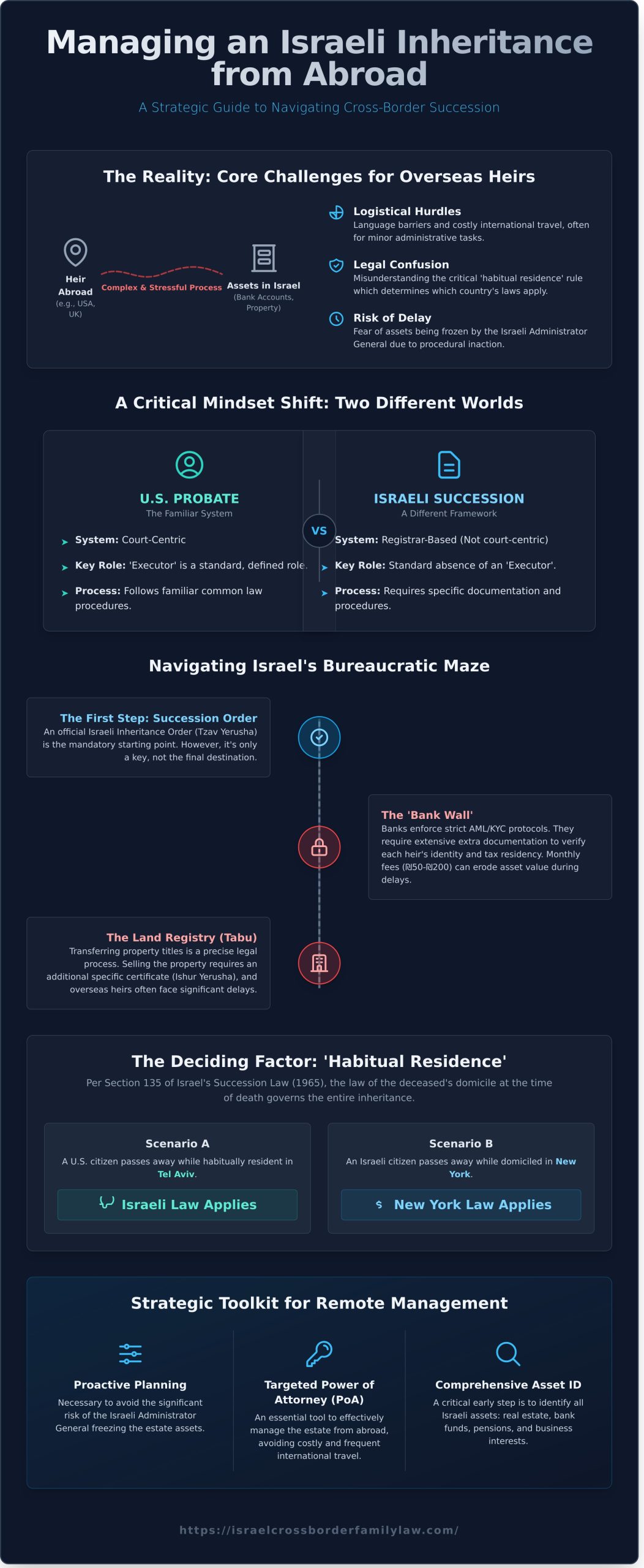
Clarity Before Commitment: Strategically Navigating Your Israeli Estate
Managing an Israeli estate from overseas is a multi-faceted undertaking, defined by unique bureaucratic complexities and significant divergences between Israeli succession law and foreign probate systems. As we have detailed, the challenges of managing an estate from abroad demand more than just logistical coordination; they require a sophisticated, forward-thinking strategy to protect assets and honor the decedent’s intentions without costly delays. Successfully navigating this landscape hinges on a deep, practical understanding of both legal frameworks and the ability to implement remote management protocols effectively.
Before you commit to a course of action, gaining absolute clarity on your position and obligations is paramount. As an independent advisory platform specializing in the intricate details of US-Israel cross-border complexities, we provide Plain English guidance to help international families make informed, strategic decisions. Get clarity before you commit. Request a confidential strategy review here.
With the right strategic partner, you can confidently secure your family’s legacy and navigate the complexities of Israeli estate management with precision and peace of mind.
Frequently Asked Questions
Do I need to travel to Israel to claim my inheritance?
No, it is not mandatory for beneficiaries to travel to Israel to manage or claim their inheritance. By granting a limited power of attorney to a qualified Israeli law firm, all necessary legal and administrative actions can be handled on your behalf. This includes filing for the probate order, communicating with Israeli authorities, and managing the transfer of assets. This approach provides a seamless and efficient solution for international heirs navigating this complex process from their home country.
Can an American Will be used for assets located in Israel?
While an American Will can be recognized, it significantly complicates the Israeli probate process. The Israeli courts will require the Will to be validated through a specific legal procedure, which necessitates an ‘Opinion on Foreign Law’ to confirm its validity under U.S. statutes. To streamline the administration and mitigate potential cross-border legal conflicts, we strongly advise clients to execute a separate, Israeli-compliant Will that specifically governs their assets located within Israel, ensuring a more predictable and efficient outcome.
How long does the Israeli probate process typically take for foreigners?
The timeline for obtaining a probate or succession order in Israel for foreign beneficiaries generally ranges from six to twelve months, assuming an uncontested and straightforward estate. However, this period can be extended by complexities such as multi-jurisdictional assets, challenges to the will’s validity, or intricate real estate matters. Engaging experienced cross-border legal counsel is critical to effectively navigate the Israeli Registrar of Inheritance Affairs and proactively mitigate potential delays in the proceedings.
What is an ‘Opinion on Foreign Law’ and why is it required in Israel?
An ‘Opinion on Foreign Law’ is a formal legal assessment prepared by an expert qualified in the relevant foreign jurisdiction’s legal system (e.g., New York state law). This document is submitted to the Israeli court to certify that a foreign-drafted will is valid according to the laws of the place where it was made. It is a mandatory procedural requirement when probating a non-Israeli will, providing the court with the necessary legal foundation to execute the will’s provisions in Israel.
Are there inheritance taxes in Israel for US beneficiaries?
Israel does not currently impose an inheritance or estate tax on assets passed to beneficiaries, including those residing in the United States. However, beneficiaries should be aware of other potential tax liabilities. For instance, the sale of inherited Israeli real estate is subject to a Capital Gains Tax (Mas Shevach). Furthermore, U.S. citizens are reminded of their obligation to report the inheritance as part of their worldwide estate for U.S. federal and state tax purposes.
What happens if I don’t claim an Israeli property for several years?
Failing to claim an Israeli property or other assets in a timely manner can lead to significant complications. After a number of years, unclaimed assets may be transferred to the custody of the Administrator General of Israel (Apoptropos HaKlali). While recovery is possible, the process of reclaiming assets from this government body is considerably more arduous and protracted. Proactive administration is essential to prevent assets from being deemed ‘abandoned’ and to maintain control over their disposition.
Can I sell an inherited Israeli apartment while living in the US?
Yes, it is entirely feasible to conduct the sale of an inherited Israeli property while residing in the United States. This is one of the common challenges of managing an estate from abroad, but it can be handled seamlessly through a power of attorney granted to your Israeli legal counsel. Your representatives can manage the entire transaction remotely, from negotiating the sale agreement and handling tax authority reporting to executing the final title transfer (Tabu) on your behalf.
Once the legal framework is in place, the next step is often deciding on the best financial strategy for the property. Whether you’re considering selling, renting, or reinvesting the proceeds, understanding the real estate market is key. For those new to property investment who want to make the most of their inheritance, you can explore Personal Mentorship Program to gain the necessary skills and confidence.
How do I move money from an Israeli bank account to my US account?
Transferring inherited funds requires strict compliance with both Israeli and U.S. banking regulations, including anti-money laundering (AML) protocols. Upon securing the official probate order, your Israeli legal counsel will present it to the bank to access the account. They will then facilitate the international wire transfer by providing all necessary documentation to the Israeli financial institution, proving the legal origins of the funds and ensuring a compliant, secure transfer to your designated U.S. account.

Article by
Gabriel Lior
A Personal Journey That Became a Mission
The advisory was founded by an American father Gabriel Lior, LLB, MBA , global entrepreneur, and cross-border advisor who spent more than a decade navigating the Israeli family court system firsthand and now lives in Singapore with his son.
As a divorced parent in a cross-border family, Gabriel faced nearly every legal challenge a foreign parent can encounter in Israel — including child custody disputes, child support proceedings, property matters in Israel and abroad, false accusations, and complex immigration and relocation proceedings.
Over the years, he learned the hard way how difficult it is for non-Israeli parents to understand the system, identify the right legal strategy, and choose the right legal representation — especially when language, culture, and jurisdictional differences are involved. He also witnessed how foreign parents and new immigrants are often disadvantaged or taken advantage of by service providers and institutions simply because they lack local knowledge or fluency.
From Client to Advisor
To truly understand — and survive — the system, Gabriel pursued formal legal education in Israel, completing two Israeli law degrees, alongside a BA and MBA earned in the United States. This was never about becoming a practicing attorney, but about gaining a deep, structural understanding of how the system works — and where it breaks down for foreign parents.
This rare combination of:
Firsthand client experience
Israeli legal and US business education
International business and negotiation training
Decades of commercial execution
created a unique perspective – one that understands both sides of the table.
After years of litigation, persistence, and at times self-representation, he ultimately succeeded in securing custody of his son and relocating abroad through a rare legal victory in the Israeli Supreme Court — becoming one of the first fathers in Israel to do so under these circumstances.
Disclaimer
Important Disclaimer:
The information provided on this website and in its content is for general informational and educational purposes only and does not constitute legal advice, legal opinion, or legal representation.
Gabriel Lior is not licensed to practice law in Israel (nor is he interested in doing so) and does not provide legal services, despite having completed 2 Law Degrees. The services offered are advisory in nature and are intended to provide general guidance, strategic insight, and information regarding cross-border family law considerations.
No attorney-client relationship is formed by accessing this website, reading its content, or communicating with us.
Any decisions made based on this information are at your own discretion and risk. For legal advice specific to your situation, you should consult a licensed attorney in the relevant jurisdiction.
Where appropriate, we may refer clients to independent, licensed attorneys or professionals. Such referrals do not constitute legal representation and no liability is assumed for services provided by third parties.