Choosing a high-profile name like Ruth Dayan Wolfner for your legal representation is only half the battle; the real success of an international divorce lies in the cross-border strategy you build before ever stepping into a courtroom. For many expats and international families, the name Ruth Dayan is synonymous with Israeli history, but in the halls of the family court, it represents a specific, high-stakes approach to litigation. It’s natural to feel anxious about the “race for jurisdiction” or the complex interplay between secular and religious courts in Israel. Seeking a Ruth Dayan Lawyer often stems from a need for strength and experience when your assets or children are caught between two different legal systems.
You deserve a clear perspective on the legal landscape surrounding one of the region’s most prominent family law practitioners and how it affects your specific case. This guide will clarify the distinction between the historical activist and the modern legal practice, helping you navigate the nuances of the Israeli system with confidence. We’ll preview the strategic decisions required for cross-border success and provide a framework for managing legal risks honestly. Please note that this content is published on an independent advisory platform and is intended for informational purposes rather than formal legal advice. By the end, you’ll have a strategy for handling the unique challenges of the Israeli courts while protecting your family’s future.
Key Takeaways
- Distinguish between the historical figure and the professional role of a Ruth Dayan Lawyer to understand the firm’s specific influence on contemporary Israeli family law.
- Understand the strategic weight of initial court filings in Israel and how the “race for jurisdiction” can fundamentally alter your divorce or custody case.
- Identify the specific complexities of cross-border inheritance and asset division when your legal interests span both Israel and the United States.
- Learn how to evaluate if your international family case requires a high-profile specialist or a broader strategic approach to navigate the Israeli legal system.
Who is Ruth Dayan the Lawyer? Identity and Professional Background
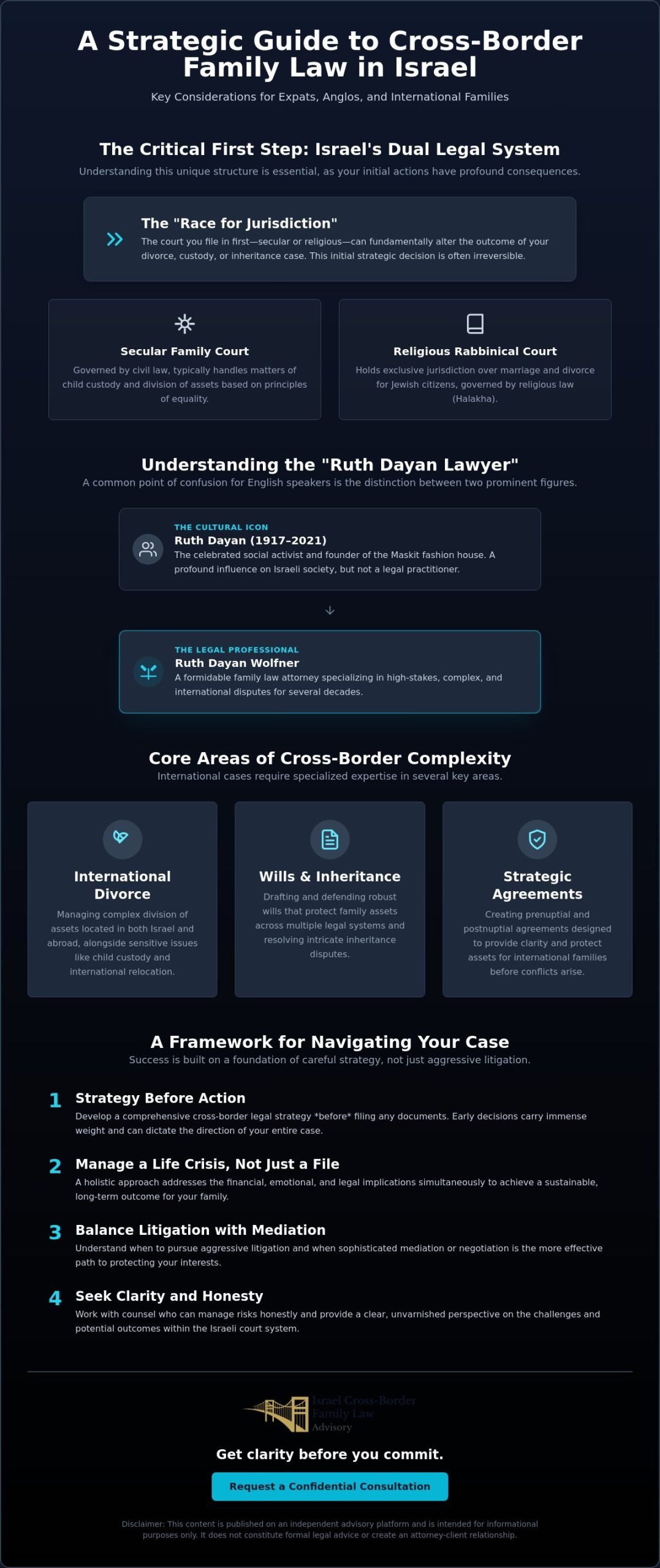
Many English speakers searching for a Ruth Dayan Lawyer often encounter the legacy of the late Ruth Dayan, the celebrated social activist and founder of Maskit. While her historical influence on Israeli society is profound, she was not a legal practitioner. The legal professional currently leading one of Israel’s most high-profile family law firms is Ruth Dayan Wolfner. She has established herself as a formidable force in the Israeli legal market over several decades, specializing in the intricate layers of matrimonial law and complex asset division. This information is published on an independent advisory platform and does not constitute a formal attorney-client relationship.
Ruth Dayan Wolfner founded her firm with a specific focus on high-stakes disputes, particularly those involving high-net-worth individuals and international elements. Understanding the legal framework is vital for anyone entering this system, as Marriage and divorce laws in Israel are governed by a dual system of civil and religious courts. This complexity often requires a practitioner who can navigate both the Family Court and the Rabbinical Court with equal proficiency. For those unfamiliar with the system, understanding how it works is the first step toward gaining clarity.
To better understand the professional journey and the challenges of building a top-tier practice in this field, watch this helpful video:
The Distinction Between the Activist and the Attorney
It’s easy to see why the name Dayan carries such weight. The late Ruth Dayan (1917–2021) was a pioneer of Israeli culture and social welfare. However, when seeking legal representation for a divorce or inheritance matter, you’re looking for the expertise of Ruth Dayan Wolfner. Her career is defined by a deep focus on the evolving landscape of Israeli family law. The firm’s presence in the Dun’s 100 rankings serves as a benchmark for English-speaking clients who may be unfamiliar with the local legal market. These rankings are based on rigorous criteria, including the complexity of the cases handled and the firm’s reputation among peers. For an expat or foreign national, this provides a level of reassurance that they’re engaging with a Ruth Dayan Lawyer recognized at the highest levels of the Israeli legal hierarchy.
Professional Vision and Approach
The firm’s philosophy centers on the idea of managing a life crisis, not just a legal file. This involves a strategic balance between aggressive litigation and sophisticated mediation. Her firm approaches multi-layered disputes by looking at the financial, emotional, and legal implications simultaneously. They don’t just file papers; they build a comprehensive strategy. This is especially important when dealing with the “race for jurisdiction,” where the court you choose first can dictate the outcome of your entire case. Whether it’s a dispute over a family business or a disagreement about child relocation, the focus remains on achieving a sustainable outcome for the family unit. Managing these risks honestly is essential for any international family facing the Israeli court system.
Core Fields of Expertise: Divorce, Wills, and Inheritance
The professional scope of a Ruth Dayan Lawyer extends across the most sensitive areas of personal and financial life in Israel. This practice typically encompasses the comprehensive management of divorce proceedings, the drafting of robust wills, and the resolution of complex inheritance disputes. For international families, these services often include the creation of prenuptial and postnuptial agreements designed to protect assets across multiple jurisdictions. Mediation also serves as a critical tool for those hoping to resolve conflicts without the financial and emotional exhaustion of a public trial. Understanding these core fields is essential for expats and foreign nationals who may be unfamiliar with the local legal landscape.
Matrimonial Law and the Race for Jurisdiction
Israel operates under a unique dual-court system where family matters can be heard in either the secular Israel’s Family Courts or the religious Rabbinical Courts. While both systems apply the same laws regarding property division, their procedural approaches and judicial philosophies can differ significantly. A lawyer’s role is to evaluate which system offers the most equitable environment for a client’s specific circumstances. The “Race for Jurisdiction” is the strategic rush to file a case in one court system before the other spouse files in the competing system, effectively locking in the venue that will decide the divorce outcome.
Succession and Inheritance in Israel
Succession becomes increasingly complex when a family holds assets in both Israel and abroad. While Israel does not currently levy an inheritance or estate tax, the process of probate requires careful navigation of the Inheritance Law of 1965. If a valid will exists, the court must grant a Succession Order; without one, assets are distributed according to statutory rules that might not align with the deceased’s wishes. Multi-generational disputes often arise when international properties or businesses are involved, making specialized counsel necessary to bridge the gap between different legal cultures. If you are facing a complex estate matter, it is often helpful to discuss your strategy with an advisor before taking formal legal steps.
Early decisions in these areas carry significant weight. Whether you are drafting a will to protect your children’s future or preparing for a divorce, the complexity of cross-border issues requires a calm and strategic approach. This content is provided for informational purposes by an independent advisory platform and does not constitute legal representation.
Managing Complex Legal Proceedings in the Israeli System
Managing complex legal proceedings in Israel requires more than just a basic understanding of the law; it demands a tactical awareness of how different courts interact within a dual system. For an expat or international family, complexity often stems from the intersection of local statutes and Family Laws and Regulations for foreign nationals. When you engage a Ruth Dayan Lawyer, the focus is typically on high-stakes litigation where financial transparency is a primary concern. These cases frequently require the involvement of financial investigators to uncover hidden assets or expert witnesses to provide valuations for international business interests. This content is published on an independent advisory platform and is not a law firm; our focus is on providing strategy and decision-making guidance to help you navigate these risks.
The emotional and financial toll of high-stakes litigation in Israel can be significant, especially when cases stretch across multiple years. High-profile disputes often involve intense scrutiny of a family’s private life and financial history. To manage these pressures, it’s essential to balance a strong litigation stance with the possibility of a negotiated settlement. A strategic advisor can help you determine when to push forward in court and when a settlement might offer a more secure and private resolution for your family. Gaining a confidential case review early in the process can provide the clarity needed to make these difficult choices.
The Weight of Early Decisions
The first 48 hours of a family law dispute in Israel can determine the trajectory of the next several years. Decisions made in haste, such as choosing where to file the initial petition, are often irreversible due to the rules of jurisdiction. Taking action without a comprehensive strategy puts your assets and parental rights at risk. You should seek clarity on your court choices before committing to a specific legal path. Understanding the inherent differences between the Family Court and the Rabbinical Court is the only way to ensure your interests are protected from the start.
Mediation as an Alternative
Mediation is often a superior choice for families who wish to avoid the public nature of a courtroom. In the Israeli context, a signed settlement agreement that has been ratified by a judge carries the same legal weight as a formal court judgment. High-profile attorneys often utilize mediation as a tool to protect client privacy and maintain a level of control over the final outcome that litigation cannot guarantee. This approach is particularly effective for international families who need to address complex, multi-jurisdictional issues without the exhaustion of a protracted trial.
The Cross-Border Reality for Anglos and Expats
For many English-speaking families, the decision to engage a Ruth Dayan Lawyer often arises from a need to manage assets and relationships that span multiple continents. The “Anglo” experience in the Israeli legal system is unique because it involves navigating not just a different language, but a fundamentally different legal philosophy. When assets are split between the United States and Israel, the complexity of a divorce or inheritance case increases exponentially. This content is published on an independent advisory platform, not a law firm, and focuses on helping you understand the strategic risks inherent in these international matters. For deeper context on these challenges, you can explore our international family law resources.
One of the most significant challenges for expats is the “split” family dynamic, where one parent resides in Israel while the other remains in the US. Israeli courts have historically prioritized different factors in custody than US courts. While Israeli law is increasingly shifting toward joint parental responsibility and phasing out traditional doctrines like the “Tender Years” rule, the cultural expectations of judges in Tel Aviv may still differ from those in New York or California. Understanding these nuances is critical before making any formal commitments in court.
US-Israel Jurisdictional Conflicts
Jurisdictional conflicts occur when legal proceedings are opened in both New York and Tel Aviv simultaneously. This creates a state of legal limbo where two different court systems may claim authority over the same children or assets. In cases of international child relocation or abduction, the Hague Convention plays a decisive role. This international treaty provides a framework for the prompt return of children wrongfully removed from their country of habitual residence. If you are concerned about these issues, it is helpful to review the firm’s guide on Hague Convention matters to understand the procedural requirements and risks involved.
Asset Protection Across Borders
A common misconception among expats is that a standard Israeli prenuptial agreement will automatically protect US-based real estate or business interests. This is rarely the case. US courts may not recognize an Israeli agreement if it doesn’t meet specific state-level requirements for disclosure and fairness. For tech founders and business owners, a cross-border strategy is not just an option; it’s a necessity. A local lawyer focused only on Israeli statutes may overlook the tax implications or enforcement hurdles in a foreign jurisdiction. An honest risk assessment often reveals that a high-profile litigator is most effective when supported by a broader strategy that accounts for both legal systems. If you need to evaluate your international standing, you should request a confidential strategy review before taking action.
Navigating Your Case: Strategy, Risks, and Next Steps
Deciding how to proceed with an international family law matter requires a clear distinction between hiring a litigator and engaging a cross-border advisor. A litigator is primarily focused on the mechanics of the courtroom and achieving a specific result within the Israeli legal system. In contrast, a cross-border advisor looks at the broader landscape, including how an Israeli ruling might impact your assets in the United States or your parental rights under international treaties. This content is published on an independent advisory platform and is not a law firm. Our role is to provide strategic guidance and risk assessment rather than formal legal representation. Understanding the pricing and structure of this international support is a vital step in protecting your financial interests.
Evaluating whether your case requires a high-profile specialist like a Ruth Dayan Lawyer depends on the complexity of your assets and the stakes involved. High-net-worth cases involving family businesses, tech startups, or multi-generational estates often benefit from the presence of a recognized litigator. However, the most effective approach usually involves a combination of top-tier litigation and a neutral strategy that accounts for the differences between legal systems. Seeking clarity before making commitments allows you to move forward with a plan that addresses both the immediate crisis and your long-term security.
How the Advisory Model Works
An independent advisory platform serves as a bridge between your local needs and the complexities of the Israeli court system. This model provides a neutral space to develop a strategy without the pressure of immediate litigation. You can use an advisory review to vet potential litigators in Israel, ensuring that the Ruth Dayan Lawyer you choose aligns with your specific goals. By analyzing your case from a cross-border perspective, you can identify risks that a purely local practitioner might overlook. You can learn more about this process on our how it works page.
Requesting a Confidential Case Review
When preparing for an initial consultation regarding a US-Israel dispute, it’s helpful to organize your financial documentation and any existing legal agreements from both countries. A second opinion is often invaluable in complex matrimonial or inheritance matters, as it provides a fresh perspective on potential outcomes. This initial review focuses on identifying the “race for jurisdiction” risks and evaluating the strength of your position in both the Family and Rabbinical courts. Early intervention is the most effective way to manage the inherent complexity of these cases. Get clarity before you commit. Request a confidential consultation.
Secure Your Cross-Border Future with Strategic Clarity
Navigating the Israeli legal system as an expat requires more than just local representation; it demands a strategy that accounts for your global footprint. You now have a clearer understanding of how a Ruth Dayan Lawyer operates within the high-stakes environment of the family and rabbinical courts. By distinguishing between the historical activist and the modern legal practitioner, you can better evaluate the type of specialist your case needs. It’s essential to remember that the “race for jurisdiction” and the nuances of cross-border asset protection make early, informed decisions critical to your success.
This platform serves as an independent advisory resource specifically designed for Anglos and international families who need to manage US-Israel legal risks. We provide the neutral strategy required to vet litigators and protect your interests across two different legal cultures. For more educational context, you can access our specialized videos on the Israel Family Law YouTube channel. Gaining clarity on these complex issues is the best way to ensure your family’s financial and emotional stability.
Get clarity before you commit. Request a confidential consultation.
Frequently Asked Questions
Is Ruth Dayan Wolfner the same as Moshe Dayan’s wife?
No, Ruth Dayan Wolfner is not the same person as the late Ruth Dayan who was married to Moshe Dayan. While the late Ruth Dayan was a prominent social activist and cultural figure who passed away in 2021, Ruth Dayan Wolfner is a contemporary legal professional. She is the founder of a leading Israeli law firm specializing in complex family law and matrimonial disputes. It is common for those searching for a Ruth Dayan Lawyer to encounter this distinction during their initial research.
What does an Israeli family lawyer typically handle for US citizens?
An Israeli family lawyer manages the intersection of local statutes and international legal requirements for US citizens living in or having assets in Israel. This includes navigating divorce proceedings, child custody disputes, and the enforcement of child support across borders. They also provide essential guidance on inheritance matters where a deceased relative held property in Israel. Their role is to ensure that legal actions taken in Israel are compatible with the client’s interests and potential legal standing in the United States.
How does the “Race for Jurisdiction” work in Israeli divorce law?
The “Race for Jurisdiction” refers to the strategic competition between spouses to file for divorce in either the secular Family Court or the religious Rabbinical Court. In Israel, the court that receives the valid filing first generally gains the authority to decide on related matters like property division and alimony. This early decision is critical because the two court systems may apply different judicial philosophies to the same facts. Seeking strategic clarity before filing is the only way to manage the risks inherent in this dual system.
Can an Israeli lawyer help with assets located in the United States?
Yes, an Israeli lawyer can assist with US-based assets by coordinating with local counsel in the relevant state jurisdiction. They ensure that Israeli court orders or settlement agreements are drafted with the specific terminology required for enforcement in US courts. This is particularly important for the division of retirement accounts, real estate, or business interests held abroad. A Ruth Dayan Lawyer often focuses on these high-stakes, multi-jurisdictional financial issues to protect a client’s global net worth during a divorce or estate dispute.
Are prenuptial agreements signed in the US valid in Israel?
Prenuptial agreements signed in the US are not automatically valid or enforceable in Israel. To be recognized under the Israeli Financial Relations between Spouses Law, such agreements must typically be ratified by an Israeli Family Court or a notary, depending on the timing of the marriage. Without this formal approval in Israel, the agreement may not protect assets as intended during a divorce. It’s vital to have a cross-border strategy to ensure your foreign agreement meets local Israeli legal standards.
What should I look for when choosing an international divorce lawyer in Israel?
When choosing a lawyer for an international case, you should prioritize English-language proficiency, experience with the Hague Convention, and a deep understanding of cross-border asset protection. You need a practitioner who recognizes the cultural and legal differences between the US and Israeli systems. It is also important to evaluate their track record in high-stakes litigation if your case involves significant financial complexity. Choosing a representative who can bridge the gap between these two legal cultures is essential for a successful outcome.
How much does it cost to hire a top-tier family lawyer in Israel?
The cost of hiring a top-tier family lawyer in Israel varies significantly based on the complexity of the case and the level of conflict involved. Amicable, uncontested divorces where both parties agree on terms are generally the most cost-effective. In contrast, high-stakes litigation involving international assets or contested child custody requires a much larger financial commitment. You should check the specific fee structure of any firm you consider, as rates are typically determined by the seniority of the practitioners and the expected duration of the proceedings.
Can I resolve an Israeli inheritance dispute without flying to Israel?
Yes, many Israeli inheritance disputes can be resolved remotely through the use of a power of attorney and digital communication. Most filings with the Inheritance Registrar or the Family Court can be handled by your local Israeli representative without requiring your physical presence. In some instances, judges may allow testimony or participation in hearings via video conferencing. This allows international families to manage their legal interests in Israel while remaining in their home country, though complex litigation may still occasionally require a physical appearance.

Article by
Gabriel Lior
A Personal Journey That Became a Mission
The advisory was founded by an American father Gabriel Lior, LLB, MBA , global entrepreneur, and cross-border advisor who spent more than a decade navigating the Israeli family court system firsthand and now lives in Singapore with his son.
As a divorced parent in a cross-border family, Gabriel faced nearly every legal challenge a foreign parent can encounter in Israel — including child custody disputes, child support proceedings, property matters in Israel and abroad, false accusations, and complex immigration and relocation proceedings.
Over the years, he learned the hard way how difficult it is for non-Israeli parents to understand the system, identify the right legal strategy, and choose the right legal representation — especially when language, culture, and jurisdictional differences are involved. He also witnessed how foreign parents and new immigrants are often disadvantaged or taken advantage of by service providers and institutions simply because they lack local knowledge or fluency.
From Client to Advisor
To truly understand — and survive — the system, Gabriel pursued formal legal education in Israel, completing two Israeli law degrees, alongside a BA and MBA earned in the United States. This was never about becoming a practicing attorney, but about gaining a deep, structural understanding of how the system works — and where it breaks down for foreign parents.
This rare combination of:
Firsthand client experience
Israeli legal and US business education
International business and negotiation training
Decades of commercial execution
created a unique perspective – one that understands both sides of the table.
After years of litigation, persistence, and at times self-representation, he ultimately succeeded in securing custody of his son and relocating abroad through a rare legal victory in the Israeli Supreme Court — becoming one of the first fathers in Israel to do so under these circumstances.
Disclaimer
Important Disclaimer:
The information provided on this website and in its content is for general informational and educational purposes only and does not constitute legal advice, legal opinion, or legal representation.
Gabriel Lior is not licensed to practice law in Israel (nor is he interested in doing so) and does not provide legal services, despite having completed 2 Law Degrees. The services offered are advisory in nature and are intended to provide general guidance, strategic insight, and information regarding cross-border family law considerations.
No attorney-client relationship is formed by accessing this website, reading its content, or communicating with us.
Any decisions made based on this information are at your own discretion and risk. For legal advice specific to your situation, you should consult a licensed attorney in the relevant jurisdiction.
Where appropriate, we may refer clients to independent, licensed attorneys or professionals. Such referrals do not constitute legal representation and no liability is assumed for services provided by third parties.