This article is published on an independent advisory platform and does not constitute a law firm or an attorney-client relationship. Legal services are only provided by licensed attorneys under a separate engagement.
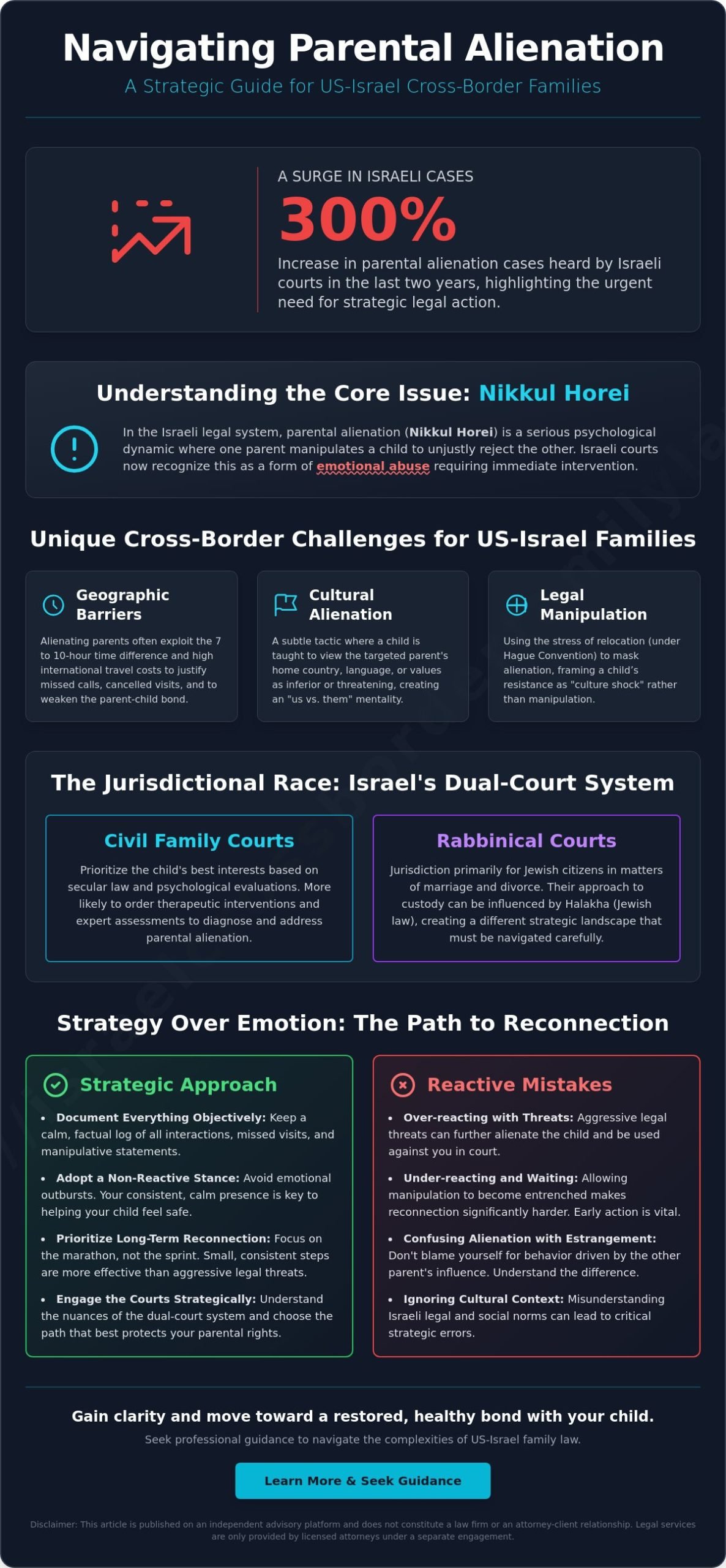
Did you know that parental alienation cases in Israel have surged by 300 percent in the last two years? For many international families, this statistic represents a painful daily reality rather than just a data point. You likely feel an intense sense of helplessness as you watch your bond with your child dissolve while you struggle to understand a legal system that feels foreign and complex. If you’re currently focused on restoring a relationship with an alienated child, you probably fear that the distance between the U.S. and Israel, combined with the jurisdictional “race” between Rabbinical and Civil courts, might mean losing that connection forever.
It’s a heavy burden to feel like a stranger to your own child, but there’s a path forward through structured strategy and psychological patience. This guide offers the clarity you need to navigate the Israeli landscape safely. You’ll learn the necessary stages of reconnection and how to strategically engage the Israeli courts to protect your parental rights. We’ll walk you through the procedural steps required to bridge the gap between two legal systems, helping you move toward a restored, healthy bond with your child.
Key Takeaways
- Identify how the Israeli legal framework defines parental alienation (Nikkul Horei) and the unique challenges faced by cross-border families.
- Navigate the complex dual-court system in Israel by understanding how Civil and Rabbinical courts approach high-conflict custody disputes differently.
- Learn the psychological stages of restoring a relationship with an alienated child, including techniques to help children move past “split thinking” patterns.
- Adopt a strategy-based approach by documenting interactions objectively and avoiding reactive behaviors that can damage your legal standing.
- Gain clarity on the importance of prioritizing long-term strategy over emotional impulses when dealing with the complexities of US-Israel family law.
Understanding Parental Alienation in US-Israel Cross-Border Families
This article is published on an independent advisory platform and does not constitute a law firm or an attorney-client relationship. In the Israeli legal system, parental alienation is referred to as Nikkul Horei. It describes a psychological dynamic where one parent manipulates a child to unjustly reject the other parent. For those seeking a foundational perspective, Understanding Parental Alienation requires recognizing that IL courts now view this behavior as a form of emotional abuse that demands immediate intervention.
In cross-border cases involving the U.S. and Israel, physical distance often becomes a sophisticated tool for the alienating parent. They may use the 7 to 10-hour time difference or the high cost of international travel to justify missed communication or cancelled visits. This environment frequently fosters “cultural alienation,” where the child is taught to view the targeted parent’s home country, language, or values as inferior or even threatening. Identifying these subtle shifts in the child’s attitude early is the first step toward restoring a relationship with an alienated child.
To better understand the nuances of this dynamic and how to begin the healing process, watch this helpful video:
The Impact of International Relocation
When a family transitions between the U.S. and Israel, the Hague Convention framework often influences the legal narrative. Some parents use the inherent stress of relocation to mask alienation tactics, framing the child’s resistance to contact as “culture shock” or difficulty adjusting to a new school in IL. The psychological toll on a child caught between two different legal cultures is immense. They often feel they must “choose” a side to survive the conflict, making early strategic decisions in these cases vital as they are often difficult to reverse once a court record is established.
Common Misconceptions for Expats in IL
Many international families mistakenly believe that IL courts will not intervene if the parents are not Israeli citizens. This is a significant error. Israeli family courts prioritize the child’s best interests and have become increasingly proactive, with a reported 300 percent increase in parental alienation cases being heard in recent years. It is also critical to distinguish between “estrangement,” which results from a parent’s own actions, and “alienation,” which is driven by the other parent’s influence. Expats often risk over-reacting with aggressive legal threats that can alienate the child further, or under-reacting and allowing the manipulation to become entrenched. Finding a balanced, strategy-based approach is the most effective way of restoring a relationship with an alienated child while navigating the complexities of a multi-jurisdictional family life.
This article is published on an independent advisory platform and does not constitute a law firm or an attorney-client relationship. Legal services are only provided by licensed attorneys under a separate engagement.
The Psychological Journey: Stages of Reconnecting with Your Child
Restoring a relationship with an alienated child is a marathon rather than a sprint. For many international families in Israel, the urge to “fix” the situation quickly through aggressive legal motions often backfires. Success requires a deep understanding of the psychological state of a child who has been conditioned to reject a parent. You must manage your expectations; the process is often non-linear and requires a steady, non-reactive presence that allows the child to feel safe while they process conflicting information. Reconnection typically moves through three distinct phases:
- Stage 1: Breaking the “Split Thinking”: Alienated children often view the world in binary terms, seeing the alienating parent as all-good and the targeted parent as all-bad. The first goal is to introduce nuance, helping the child eventually see that all people possess both positive and negative traits.
- Stage 2: Reality Testing: This stage involves the child observing the targeted parent’s actual behavior and comparing it to the negative narrative they’ve been fed. By remaining calm and consistent, you provide the child with data that contradicts the alienating parent’s claims.
- Stage 3: Integration: In the final phase, the child begins to accept their own independent thoughts and memories. They start to integrate their past experiences with their current reality, moving toward a more authentic relationship.
Helping the Child Reframe the Past
Discussion techniques should focus on affirming the child’s autonomy rather than debating the “truth” of the past. If a child repeats a false accusation, responding with anger only reinforces the alienating parent’s narrative. Instead, use firm but non-aggressive boundaries. You might say, “I remember that differently, but I’m interested in hearing how you feel right now.” This approach uses unconditional love as a strategic tool. It shows the child that your bond is not contingent on their compliance or their belief in a specific version of events.
The Role of Specialized Therapy in IL
Standard talk therapy frequently fails in cases of Nikkul Horei because it can inadvertently validate the child’s distorted perceptions. The Israeli system often utilizes “Parental Coordination,” known as Teum Horei. A Teum Horei professional acts as a bridge, managing conflict and ensuring that court-ordered visitations occur. For Anglos and expats, finding bicultural therapists is essential. These professionals understand the specific pressures of living in a cross-border dynamic and can help the child navigate the cultural complexities of having parents in different legal or social systems. If you are struggling to find the right path forward, you may want to request a confidential strategy session to discuss your specific circumstances.
This article is published on an independent advisory platform and does not constitute a law firm or an attorney-client relationship. Legal services are only provided by licensed attorneys under a separate engagement.
Navigating the Israeli Legal Landscape: Civil Courts vs. Rabbinical Courts
In Israel, the legal framework for family matters is defined by a unique dual-court system that significantly impacts the strategy for restoring a relationship with an alienated child. Families must navigate between the Civil Family Court and the Rabbinical Court. This creates what’s colloquially known as the “race for jurisdiction,” where the first party to file in a specific venue often determines which legal principles will govern the case. Understanding these nuances is especially critical during divorce and separation for international families, where bicultural factors and cross-border distance complicate the proceedings.
The Civil Family Court generally relies heavily on psychological experts and specialized social workers, known as Pkidat Saad. These social workers are court-appointed and serve as the primary investigators into the family dynamic. Their reports often carry more weight than almost any other evidence presented in court. While the Rabbinical Court historically focused on Jewish law, they’ve increasingly adopted modern psychological frameworks to address Nikkul Horei. However, their procedural style remains distinct, and the choice of venue can determine whether a reconnection plan is prioritized or delayed.
Costs for initiating these proceedings are standardized by the Israeli Judicial Authority. As of January 1, 2026, a claim concerning child custody requires a fee of 417 ₪, while an application for settling a dispute costs 119 ₪. Choosing the correct venue isn’t just about these administrative fees. It’s about identifying which court’s philosophical approach aligns with a strategy of reconnection and transparency.
The Role of Court-Appointed Experts
Judges rarely make final decisions on alienation without a forensic evaluation from a court-appointed psychologist. For expats, this presents a unique challenge because evaluations are often conducted in Hebrew. It’s vital to prepare for these assessments to ensure your narrative isn’t lost in translation. A court-ordered evaluation is viewed as objective. In contrast, an independent expert hired by one parent is often dismissed as biased, making the court-appointed professional the most influential figure in your case.
Legal Remedies for Alienation in IL
Israeli courts have several tools to enforce contact. They may impose financial sanctions on the alienating parent, effectively “fining” them for every missed visitation or communication. Reconnection therapy is another common remedy where the court mandates a specific professional to oversee the process. In the most severe cases, the court may consider a change in primary custody. This is an extreme measure and is only used when the court determines that the child’s psychological safety is at greater risk by staying with the alienating parent.
This article is published on an independent advisory platform and does not constitute a law firm or an attorney-client relationship. Legal services are only provided by licensed attorneys under a separate engagement.
Practical Steps to Restore the Bond: A Strategy-Based Approach
While the legal framework in IL provides the structure for contact, your personal conduct remains the most significant variable in restoring a relationship with an alienated child. Success requires shifting from a reactive mindset to a strategic one. This involves five foundational steps designed to protect your legal standing and your child’s emotional health:
- Step 1: Objective Documentation. Keep a precise log of every interaction, missed call, and denied visitation. This data is essential for the Pkidat Saad (social worker) when they prepare their recommendations for the court.
- Step 2: Avoid the Counter-Alienation Trap. It’s tempting to defend yourself by criticizing the other parent. Don’t do it. Bad-mouthing the alienating parent only validates their narrative that you are the “hostile” party.
- Step 3: Conduct a Jurisdictional Risk Assessment. Before filing new motions, understand how a specific court might view your cross-border status. This helps avoid unintended consequences in your custody arrangement.
- Step 4: Utilize Low-Conflict Tools. Use specialized communication apps or email for all logistics. This reduces friction and creates a transparent record that a judge can easily review.
- Step 5: Prioritize Psychological Safety. Your long-term strategy must prioritize the child’s comfort over your own desire for immediate results. Reconnection is built on trust, not just court orders.
Communication Strategies for Rejected Parents
Writing “no-pressure” messages is a critical skill. Instead of asking why they didn’t call, send a brief text about a neutral topic. Use the “Bridge Building” technique by referencing a positive shared memory from before the conflict began. This helps bypass the child’s current defensive filters. In cases of international custody and relocation, maintaining this consistent, gentle presence is your most powerful tool against the distance.
Managing Your Own Legal and Emotional Risks
Early decisions in the IL family court system have a significant ripple effect. For example, how you respond to an initial dispute settlement application (costing 119 ₪) can set the tone for the entire case. You must also be prepared for the risk of false allegations, which frequently surface in high-conflict alienation cases. Building a support network of other Anglo expats who have navigated the Israeli system can provide the emotional stability needed to stay the course. If you need to evaluate your current position, request a confidential strategy session to gain clarity on your next steps.
This article is published on an independent advisory platform and does not constitute a law firm or an attorney-client relationship. Legal services are only provided by licensed attorneys under a separate engagement.
Moving Toward Resolution: Seeking Clarity and Professional Guidance
The process of restoring a relationship with an alienated child is defined by strategic patience rather than impulsive legal maneuvers. In the high-conflict environment of US-Israel cross-border disputes, emotional reactions often lead to procedural errors that are difficult to correct within the Israeli family court system. Prioritizing a clear strategy allows you to navigate these complexities with a focus on your child’s long-term psychological safety. By treating the situation as a marathon, you avoid the common pitfalls that often lead to further estrangement.
Seeking clarity before making major legal commitments is the most important step any international parent can take. The differences between the Israeli and U.S. legal cultures are significant. Decisions made in the early stages of a case in IL can have a permanent impact on your parental rights. For additional visual guidance and expert insights on these dynamics, we encourage you to view the resources available on the Israel Family Law YouTube channel. Every cross-border family situation is unique, and this article is for informational and advisory purposes only. It does not constitute legal advice or a guarantee of any specific outcome.
The Advisory Process
Strategy-based decision-making differs fundamentally from standard litigation. While traditional legal representation focuses on winning individual motions, the advisory process prioritizes a global view of your family’s dynamic. By understanding how the advisory works, international families can identify potential jurisdictional traps before they become entrenched. This approach emphasizes risk assessment, ensuring that you don’t inadvertently trigger aggressive court responses that could damage your standing with the Pkidat Saad or the presiding judge.
Next Steps for Your Family
Identifying your immediate priorities is the first step toward a resolution. You must evaluate whether your current legal path is effectively addressing the alienation or simply increasing the conflict. Because the Israeli system moves quickly once a case is filed, having a prepared strategy is vital. Whether you are dealing with a recent relocation or a long-standing denial of contact, professional guidance helps you maintain the “steady presence” required for reconnection. Get clarity before you commit. Request a confidential consultation to assess the risks and opportunities in your specific case. A restored relationship is possible with the right strategy, consistent conduct, and professional patience.
Advancing Your Strategy for Family Reconnection
Restoring a relationship with an alienated child in a cross-border context is a high-stakes endeavor that leaves little room for error. You’ve seen how the strategic choice between Civil and Rabbinical courts, combined with the critical influence of the Pkidat Saad, determines the long-term trajectory of your case. Success depends on moving beyond emotional reactivity to a strategy-based, risk-mitigation approach that accounts for the specific nuances of the Israeli legal landscape. Early decisions are often irreversible, making it vital to understand the “race for jurisdiction” before filing any motions.
Our platform provides deep expertise in US-Israel cross-border family law and specialized knowledge of both court systems to help you navigate this complex environment. We serve as a bicultural bridge, offering the steady, authoritative guidance needed when your family is caught between two different legal cultures. It’s essential to have a team that understands the “start-up nation” marketplace and its unique judicial procedures. Get clarity before you commit. Request a confidential consultation. While the journey is a marathon, a restored bond is achievable through persistent, strategic action and professional patience.
This article is published on an independent advisory platform and does not constitute a law firm or an attorney-client relationship. Legal services are only provided by licensed attorneys under a separate engagement.
Frequently Asked Questions
Can I force my child to see me if they refuse visitation in Israel?
You cannot physically force a child to visit, but Israeli courts utilize enforcement mechanisms such as financial sanctions or mandatory reconnection therapy. As of January 2026, the court can impose significant fines on the alienating parent for every missed visit or communication. The judicial goal is to create a structured environment that encourages contact while protecting the child’s psychological safety.
How do Israeli courts view parental alienation compared to US courts?
Israeli courts are increasingly proactive, with a reported 300 percent rise in alienation cases over the last two years. Unlike the decentralized US system, the Israeli Family Court system is centralized and relies heavily on court-appointed social workers to investigate family dynamics. This specialized focus allows for more consistent intervention when restoring a relationship with an alienated child across international borders.
What happens if the alienating parent moves the child from the US to IL?
If a parent moves a child from the US to Israel without consent, the Hague Convention on the Civil Aspects of International Child Abduction typically governs the return process. This is a complex multi-jurisdictional issue that requires immediate strategy to prevent the move from becoming permanent. If the relocation was legally authorized, the Israeli courts will assume jurisdiction over all future custody and visitation matters.
Is it possible to change custody in Israel if alienation is proven?
Changing primary custody is an available remedy in Israel, though it remains an extreme measure reserved for severe cases. Courts will only order a change if a forensic psychologist determines the alienating parent’s influence is causing substantial emotional harm. The judicial priority remains the child’s best interests, focusing on long-term stability rather than punishing the offending parent.
How long does the reconnection process typically take?
The timeline for reconnection is non-linear and varies based on the severity of the alienation and the child’s age. Most families require between 12 and 24 months of consistent therapy and court-ordered contact to achieve meaningful integration. Success in restoring a relationship with an alienated child depends on the targeted parent’s ability to maintain a steady, non-reactive presence throughout the process.
Do I need a lawyer in both the US and Israel for an alienation case?
You generally need legal representation in the jurisdiction where the child is physically located and where the court orders are being enforced. For US-Israel families, having a bicultural advisor who understands both systems is critical for coordinating a global strategy. This ensures that actions taken in one country don’t inadvertently damage your legal standing or credibility in the other.
What is the role of the “Pkidat Saad” (social worker) in alienation cases?
The Pkidat Saad acts as the court’s primary investigator and expert witness throughout the duration of the case. They conduct home visits, interview the child, and provide written recommendations that judges follow in a high percentage of cases. Their reports are the most influential evidence used by the court to determine the presence and severity of parental manipulation.
Can I stop paying child support if I am being alienated from my child?
You should never stop paying child support as a response to alienation, as this will likely damage your legal position. In Israel, child support and visitation are treated as separate legal obligations under the law. Withholding support can lead to severe sanctions and will negatively impact the Pkidat Saad‘s assessment of your commitment to the child’s welfare.

Article by
Gabriel Lior
A Personal Journey That Became a Mission
The advisory was founded by an American father Gabriel Lior, LLB, MBA , global entrepreneur, and cross-border advisor who spent more than a decade navigating the Israeli family court system firsthand and now lives in Singapore with his son.
As a divorced parent in a cross-border family, Gabriel faced nearly every legal challenge a foreign parent can encounter in Israel — including child custody disputes, child support proceedings, property matters in Israel and abroad, false accusations, and complex immigration and relocation proceedings.
Over the years, he learned the hard way how difficult it is for non-Israeli parents to understand the system, identify the right legal strategy, and choose the right legal representation — especially when language, culture, and jurisdictional differences are involved. He also witnessed how foreign parents and new immigrants are often disadvantaged or taken advantage of by service providers and institutions simply because they lack local knowledge or fluency.
From Client to Advisor
To truly understand — and survive — the system, Gabriel pursued formal legal education in Israel, completing two Israeli law degrees, alongside a BA and MBA earned in the United States. This was never about becoming a practicing attorney, but about gaining a deep, structural understanding of how the system works — and where it breaks down for foreign parents.
This rare combination of:
Firsthand client experience
Israeli legal and US business education
International business and negotiation training
Decades of commercial execution
created a unique perspective – one that understands both sides of the table.
After years of litigation, persistence, and at times self-representation, he ultimately succeeded in securing custody of his son and relocating abroad through a rare legal victory in the Israeli Supreme Court — becoming one of the first fathers in Israel to do so under these circumstances.
Disclaimer
Important Disclaimer:
The information provided on this website and in its content is for general informational and educational purposes only and does not constitute legal advice, legal opinion, or legal representation.
Gabriel Lior is not licensed to practice law in Israel (nor is he interested in doing so) and does not provide legal services, despite having completed 2 Law Degrees. The services offered are advisory in nature and are intended to provide general guidance, strategic insight, and information regarding cross-border family law considerations.
No attorney-client relationship is formed by accessing this website, reading its content, or communicating with us.
Any decisions made based on this information are at your own discretion and risk. For legal advice specific to your situation, you should consult a licensed attorney in the relevant jurisdiction.
Where appropriate, we may refer clients to independent, licensed attorneys or professionals. Such referrals do not constitute legal representation and no liability is assumed for services provided by third parties.