What if the name on your child’s Israeli passport no longer reflects your family’s daily life, but your ex-partner refuses to sign the consent form? Many parents feel stuck when they ask, “can i change my child’s last name after divorce” and face an immediate objection from their former spouse. It’s a common source of stress for international families who must balance the Israeli Population Registry’s rules with the requirements of foreign passports and the nuances of cross-border travel.
We understand that you want a name that honors your child’s identity while ensuring legal consistency across different countries. This guide, published as an informational resource on an independent advisory platform, provides a clear roadmap for navigating the legal system under the Names Law of 1956. You’ll learn how the Family Court evaluates the “best interest of the child,” why the opinion of children over age ten carries significant weight, and how to manage the transition of official documents after a judge makes a ruling. This information is for educational purposes and does not constitute formal legal advice or an attorney-client relationship.
Key Takeaways
- Understand the distinction between restoring your own maiden name and the judicial requirements for altering a minor’s surname under the Names Law of 1956.
- Navigate the complexities of Joint Natural Guardianship to determine the legal path forward when asking “can i change my child’s last name after divorce” without mutual consent.
- Identify the risks of “split identity” across international documents and learn how the Israeli legal system interacts with foreign passport requirements.
- Gain clarity on the timeline and procedures of the Family Court, including the standard response periods and the criteria judges use to define the child’s best interest.
- Evaluate strategic compromises, such as hyphenation, to protect the child’s well-being while maintaining their connection to both parents and their international heritage.
The Legal Framework: The Names Law and the Population Registry in Israel
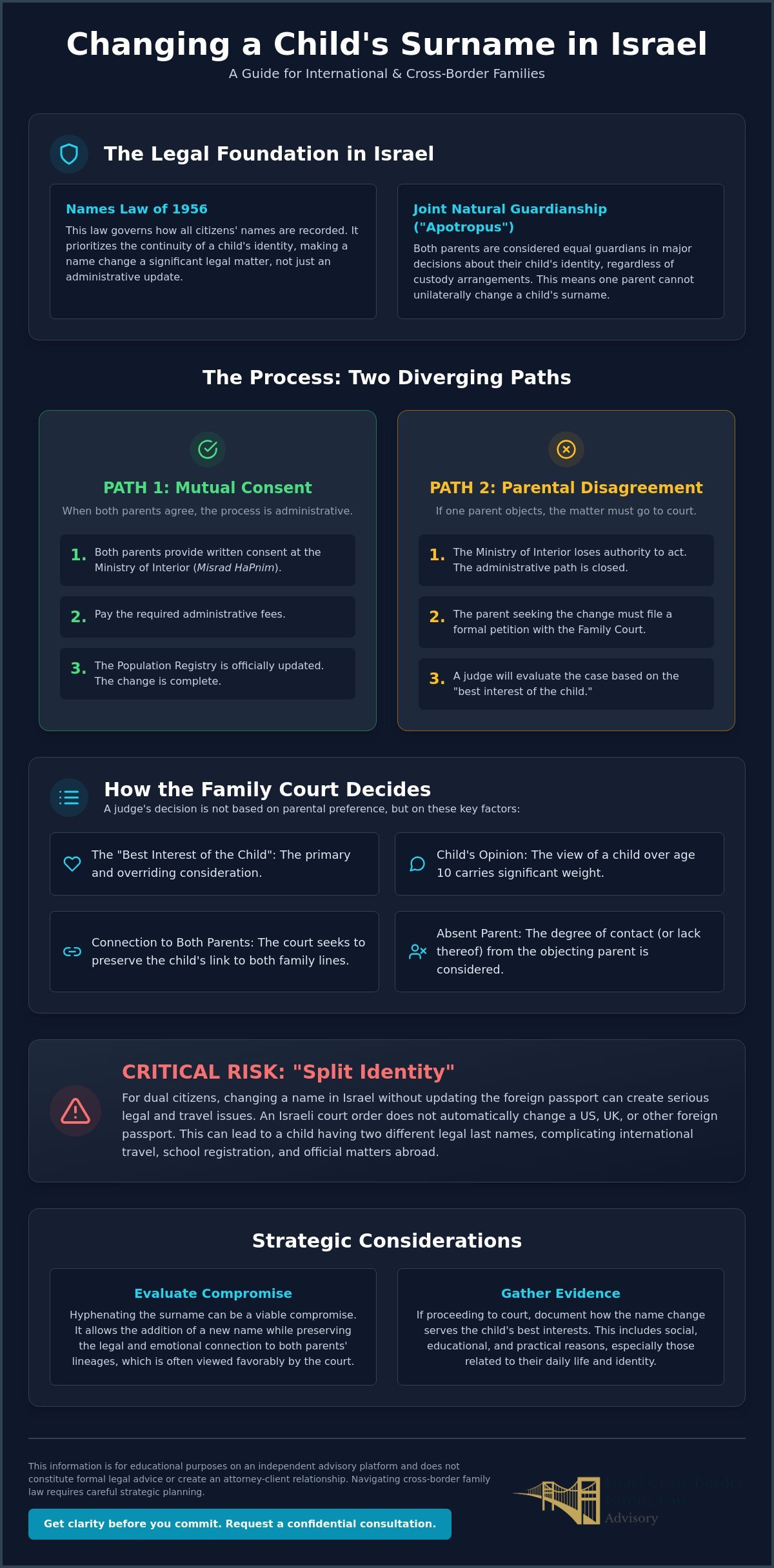
Expats often find themselves navigating a complex web of regulations when they ask “can i change my child’s last name after divorce” in a foreign legal system. In Israel, the foundational piece of legislation is Israel’s Naming Law of 1956. This statute provides the structure for how every citizen’s identity is recorded, from birth through various life changes. It’s important to recognize that the Israeli system prioritizes the continuity of a child’s identity, which often makes changing a surname more difficult than many parents anticipate. The registry isn’t just a list of names; it’s a legal declaration of a child’s lineage and status within the state.
A major distinction exists between a parent’s right to change their own name and the rights associated with a minor. Following a divorce, a parent can typically revert to a maiden name by filing a simple request with the Ministry of Interior. However, the child’s surname is not automatically linked to that parent’s change. Even if you have sole physical custody, you cannot unilaterally change your child’s name because the law views the surname as a shared component of the child’s heritage. This protection remains in place to ensure that both parents maintain a visible connection to the child’s official identity.
Many parents assume that a signed divorce decree is a “golden ticket” at the Ministry of Interior. In reality, unless that decree contains specific, explicit instructions regarding the child’s surname, the clerks at the Population Registry won’t process the change. This is a common hurdle for those who are used to different systems in the US or UK where a decree might be more flexible. For more context on how these local rules affect those from abroad, you can review our guidance for expats and foreign nationals.
Administrative vs. Judicial Changes
When both parents agree to the change, the process remains administrative. You provide mutual consent at the Ministry of Interior, pay the necessary fees, and the registry is updated. However, if there’s any disagreement, the Ministry loses its authority to act. The case must then move to the Family Court for a judicial determination. In these contested scenarios, the court may invite the Guardian General to provide an opinion, ensuring the state’s standards for child welfare are met. This transition from a simple office visit to a court proceeding is where most families face their greatest challenges.
Terminology for Expats: Surnames and Identity
Navigating Misrad HaPnim (the Ministry of Interior) requires an understanding of how they view your Teudat Zehut (identity card). In Israel, both parents are considered “Natural Guardians” (Apotropus), a status that isn’t easily waived or removed. This status gives both parents an equal say in major identity decisions regardless of the custody arrangement. The Names Law’s primary objective regarding minors is to ensure that any change to a child’s identity serves their long-term psychological and social well-being rather than the parents’ preferences.
The Requirement of Consent: When Parents Disagree
Israeli law operates on the fundamental presumption that both parents retain Joint Natural Guardianship, or Apotropus, regardless of which parent has primary physical custody. This legal status means that significant decisions affecting a child’s identity, including their surname, require mutual consent. When one parent asks, “can i change my child’s last name after divorce” and the other parent refuses, the situation shifts from a clerical update to a judicial dispute. The court does not view a parent’s refusal as an absolute veto. Instead, it serves as a starting point for a deeper investigation into what arrangement serves the child’s welfare.
In cases where a parent is entirely absent or has had no contact with the child for an extended period, the court may be more inclined to approve a name change petition. However, even in these instances, the petitioner must demonstrate that they made reasonable efforts to locate and inform the other parent. The Israeli legal system is wary of erasing a parent’s presence from a child’s official record without a compelling justification that aligns with the child’s long-term interests. Every decision must be rooted in the child’s stability rather than parental preference.
Defining the Best Interests of the Child in Israel
The Family Court uses the “best interests of the child” as its guiding principle. Judges evaluate several factors to determine if a name change is appropriate. These include the child’s age, the strength of their bond with each parent, and their established social identity in school and the community. There is often a significant psychological impact when a child carries a different surname than their primary caregiver, especially in a tight-knit community or school environment. For children aged ten and older, the court places considerable weight on their own wishes. Judges will often speak with the child directly or through a professional to gauge their maturity and the reasons behind their preference.
Overcoming an Objection
If a parent objects to the name change out of spite or as a bargaining chip in other legal battles, the court may identify this as a “bad faith” objection. To bypass a parent’s refusal, the petitioner must present a strong case showing that the current name causes the child actual harm or confusion. This process is often intertwined with other high-conflict issues. You can find more context on managing these broader disputes in our guide on divorce and separation for international families.
Navigating these emotional hurdles requires a strategic approach that prioritizes the child’s stability. If you are facing a deadlock over your child’s identity, you might want to seek guidance on your specific situation before filing a formal petition. This information is published on an independent advisory platform and is intended for educational purposes only.
Cross-Border Complications: Passports and Dual Citizenship
For international families living in Israel, the question of “can i change my child’s last name after divorce” carries weight far beyond the local Population Registry. When a child holds dual citizenship, such as Israeli and American, a name change in one country does not automatically trigger a change in the other. This creates a state of split identity where a child’s Israeli passport and US passport display different surnames. Border control officers and airline personnel often flag this discrepancy as a security risk or a potential case of identity fraud. It leads to significant delays during international travel, especially if the parent traveling with the child does not share the surname listed on one of the documents.
The US State Department generally recognizes Israeli court orders for name changes provided they meet specific evidentiary standards. To update a US passport or a Consular Report of Birth Abroad (CRBA), you must present a certified copy of the Israeli court order. This document must be final and not subject to further appeal. Without this synchronization, your child may face issues when applying for US visas, Social Security benefits, or even school enrollment in the United States. It’s a complex process that requires careful timing to ensure all records are updated in a logical sequence. This information is published on an independent advisory platform and focuses on strategic risks rather than formal legal representation.
Synchronizing Israeli and US Documents
Once you obtain a favorable ruling from an Israeli Family Court, the next step involves the US Embassy in Jerusalem or the Branch Office in Tel Aviv. You will need an Apostille stamp on the Israeli court order to verify its authenticity for international use. This stamp, issued by the Israeli Ministry of Foreign Affairs, is the essential bridge that allows US authorities to accept a foreign judicial decision. Document consistency remains the single most important factor for ensuring smooth international travel and maintaining a clear legal identity for your child.
The Role of the Hague Convention
A unilateral attempt to change a child’s name in one jurisdiction while ignoring the other can have serious implications under international law. In high-conflict cases, changing a child’s surname might be interpreted as an attempt to rebrand the child’s identity to alienate them from the other parent or to facilitate a hidden relocation. Such actions can trigger red flags under the Hague Convention on Child Abduction. Border authorities are trained to look for inconsistent documentation as a sign of potential parental abduction. When evaluating the question, “can i change my child’s last name after divorce,” you must consider how these multi-jurisdictional complexities will be perceived by foreign courts and border agencies.
The Judicial Process: Filing a Petition in the Family Court
When mutual consent cannot be reached, the judicial route is the only remaining path to resolve the dispute. Drafting the petition is a formal process where the petitioner must clearly state the reasons why the modification serves the child’s welfare. It isn’t enough to cite parental preference; the document must outline the social, psychological, or practical benefits for the minor. As of January 2026, the court filing fee for a petition in the Family Court for this type of claim is 568 NIS. Once the petition is filed, the court grants the other parent a mandatory response period, which typically ranges from 15 to 30 days. This period allows the objecting parent to file their counter-arguments before the court schedules a hearing.
A distinct feature of the Israeli legal system is the mandatory involvement of a social worker, known as a Pashat, from the Ministry of Social Affairs. Unlike some foreign jurisdictions where a judge might decide based solely on parental testimony, Israeli judges rely heavily on the professional recommendation of the Pashat. This social worker will usually interview both parents and the child to assess the family dynamics. Their final report provides the court with an objective view of whether the change aligns with the child’s best interests. After reviewing this report and hearing arguments, the judge will hold a final hearing to issue the “Judgment for Name Change.” If you are wondering “can i change my child’s last name after divorce” while facing a contested battle, understanding this timeline is essential for setting realistic expectations.
Serving Notice to a Parent Abroad
International families often face the hurdle of serving legal papers to a former spouse who resides outside of Israel. If the other parent lives in the US, you must follow specific procedural requirements for “Service of Process” to ensure the Israeli court maintains jurisdiction. This process often involves international treaties, such as the Hague Service Convention, to ensure the papers are delivered in a way the court recognizes. If a parent in the US refuses to acknowledge the petition, the court may require proof of formal service through a process server or international courier before the case can proceed. Procedural accuracy at this stage prevents the other parent from later claiming they were never informed of the proceedings.
Updating the Population Registry
Once the judge issues a favorable judgment, the administrative phase begins. You must present the original, certified court order to the Ministry of Interior to update the child’s registry and the Teudat Zehut. There are separate fees for issuing a new passport and identity documents, and processing times can vary depending on the Ministry’s current workload. For those unfamiliar with the local bureaucracy, you can find more information in our guide for expats and foreign nationals.
If you need to initiate this process or require assistance with international service of process, you can request a confidential consultation to evaluate your legal strategy. This content is provided for informational purposes on an independent advisory platform and does not constitute an attorney-client relationship.
Strategic Considerations for Expats and International Families
Deciding to alter a child’s surname is a strategic decision that affects their connection to their heritage in both Israel and their country of origin. Parents often ask “can i change my child’s last name after divorce” while focusing on immediate emotional needs, but the long-term impact on the child’s identity is the court’s primary concern. If a child feels a strong connection to a parent’s culture through their name, removing that link can be viewed as detrimental to their sense of self. Timing is a critical factor in these cases. It’s often more efficient to address name changes during the initial divorce settlement negotiations rather than initiating a contested petition years later. Early decisions carry significant weight and can prevent the need for expensive litigation in the Family Court when a child’s social identity is already firmly established. Waiting too long can make the court hesitant to disrupt the status quo.
Alternative Solutions: Hyphenation and Middle Names
Israeli courts frequently view hyphenated surnames as a reasonable “middle ground” when parents cannot agree on a single name. This compromise allows the child to retain a visible legal link to both parents, which satisfies the principle of Joint Natural Guardianship. From a logistical perspective, keeping both names can simplify international travel and document recognition in both the US and Israel. While the US often treats middle names with more flexibility, the Israeli Population Registry is more rigid. A hyphenated surname is often a more stable choice for dual citizens who need their identity to remain consistent across multiple jurisdictions. This approach respects the cultural nuances of both societies while avoiding the “all or nothing” nature of a contested court battle.
Seeking Clarity Before You Commit
Initiating a legal battle over a surname involves inherent risks and costs that extend beyond the standard filing fees. A contested petition requires time, emotional energy, and the mandatory involvement of state social workers who will probe into your family dynamics. Before you commit to a specific path, an initial strategy session is vital to evaluate the likelihood of success and identify potential pitfalls in the cross-border context. Understanding the significant differences between legal systems and cultures is the first step toward a stable resolution. The inherent complexity of cross-border issues means that what works in a US court may not translate directly to the Israeli system. This content is published on an independent advisory platform and is intended for informational purposes. It does not establish an attorney-client relationship or constitute formal legal advice. Legal services are only provided by licensed attorneys under a separate engagement.
Get clarity before you commit. Request a confidential consultation.
Moving Forward with Your Child’s Legal Identity
Navigating the question of can i change my child’s last name after divorce requires a careful balance between Israeli administrative rules and international identity standards. You’ve seen that while the Names Law of 1956 provides the framework, the Family Court’s determination of a child’s best interests remains the ultimate deciding factor in contested cases. Protecting your child from the risks of a “split identity” across US and Israeli passports is essential for maintaining their long-term stability and security during international travel. Decisions made today regarding a minor’s surname will carry significant weight as they grow and establish their own social identity in both cultures.
Our advisory platform provides the Anglo and expat community in Israel with specialized expertise in US-Israel cross-border family law. We offer strategic guidance from practitioners licensed to navigate both the Israeli and international legal systems. Because every family situation is unique, seeking clarity before making formal legal commitments is the most effective way to manage risks and avoid unnecessary litigation. This content is published on an independent advisory platform and is intended for educational purposes only; legal services are only provided by licensed attorneys under a separate engagement.
Get clarity before you commit. Request a confidential consultation.
You can move forward with confidence when you have a clear understanding of the legal path ahead.
Frequently Asked Questions
Can I change my child’s last name without the father’s consent in Israel?
No, you generally cannot change a child’s surname without the other parent’s consent unless you obtain a specific court order from the Family Court. Under the principle of Joint Natural Guardianship, both parents have equal rights in identity decisions. If one parent objects, the petitioning parent must prove to a judge that the change is in the child’s best interests. This process is judicial rather than administrative when consent is withheld.
What are the legal grounds for a name change if the other parent is absent?
Legal grounds for a change typically involve demonstrating that the other parent has completely abandoned their relationship with the child or has been unreachable for a significant period. The court requires proof that reasonable efforts were made to locate and serve the absent parent with legal notice. In such cases, the judge may approve the change to ensure the child’s official identity matches their daily social reality and the name of their primary caregiver.
Will an Israeli court order be recognized by the US passport office?
Yes, the US State Department generally recognizes Israeli court orders for name changes if the document is properly authenticated with an Apostille stamp. You must present the original, certified Hebrew order along with a notarized English translation to the US Embassy in Jerusalem or the Branch Office in Tel Aviv. This step is vital to ensure your child’s US documents remain synchronized with their Israeli Population Registry records to avoid travel complications.
How long does the legal process take to change a minor’s name in Israel?
The timeline for a contested name change usually ranges from six months to over a year, depending on the court’s caseload and the complexity of the family dynamics. The process includes a mandatory response period for the other parent and time for a social worker to conduct interviews and file their professional recommendation. If both parents agree, the administrative update at the Ministry of Interior can be completed in a single appointment once the paperwork is processed.
Does a name change affect child support or custody rights?
No, changing a child’s surname has no legal impact on child support obligations or the custodial rights of either parent. A name change is considered a matter of personal identity and registry rather than a modification of parental responsibilities or financial duties. The other parent’s obligation to provide financial support and their right to maintain a relationship with the child remain unchanged even if the child’s last name is updated in the registry.
Can a child decide their own last name in an Israeli court?
While a child does not have the final legal authority to decide, the court places significant weight on the wishes of children aged ten and older. Judges often use professional reports from social workers or direct conversations in chambers to understand the child’s perspective. If a mature minor expresses a strong preference for a specific name, the court is highly likely to incorporate that preference into its final decision, as it reflects the child’s social identity.
What happens if my child has different names on their US and Israeli passports?
Having inconsistent names on dual passports can lead to “split identity” issues, resulting in significant delays and questioning by border control officers. Security personnel may flag the discrepancy as a concern, particularly in cases involving international travel. It’s important to resolve the question “can i change my child’s last name after divorce” across all jurisdictions to maintain a consistent legal identity. This information is published on an independent advisory platform and does not constitute formal legal representation.

Article by
Gabriel Lior
A Personal Journey That Became a Mission
The advisory was founded by an American father Gabriel Lior, LLB, MBA , global entrepreneur, and cross-border advisor who spent more than a decade navigating the Israeli family court system firsthand and now lives in Singapore with his son.
As a divorced parent in a cross-border family, Gabriel faced nearly every legal challenge a foreign parent can encounter in Israel — including child custody disputes, child support proceedings, property matters in Israel and abroad, false accusations, and complex immigration and relocation proceedings.
Over the years, he learned the hard way how difficult it is for non-Israeli parents to understand the system, identify the right legal strategy, and choose the right legal representation — especially when language, culture, and jurisdictional differences are involved. He also witnessed how foreign parents and new immigrants are often disadvantaged or taken advantage of by service providers and institutions simply because they lack local knowledge or fluency.
From Client to Advisor
To truly understand — and survive — the system, Gabriel pursued formal legal education in Israel, completing two Israeli law degrees, alongside a BA and MBA earned in the United States. This was never about becoming a practicing attorney, but about gaining a deep, structural understanding of how the system works — and where it breaks down for foreign parents.
This rare combination of:
Firsthand client experience
Israeli legal and US business education
International business and negotiation training
Decades of commercial execution
created a unique perspective – one that understands both sides of the table.
After years of litigation, persistence, and at times self-representation, he ultimately succeeded in securing custody of his son and relocating abroad through a rare legal victory in the Israeli Supreme Court — becoming one of the first fathers in Israel to do so under these circumstances.
Disclaimer
Important Disclaimer:
The information provided on this website and in its content is for general informational and educational purposes only and does not constitute legal advice, legal opinion, or legal representation.
Gabriel Lior is not licensed to practice law in Israel (nor is he interested in doing so) and does not provide legal services, despite having completed 2 Law Degrees. The services offered are advisory in nature and are intended to provide general guidance, strategic insight, and information regarding cross-border family law considerations.
No attorney-client relationship is formed by accessing this website, reading its content, or communicating with us.
Any decisions made based on this information are at your own discretion and risk. For legal advice specific to your situation, you should consult a licensed attorney in the relevant jurisdiction.
Where appropriate, we may refer clients to independent, licensed attorneys or professionals. Such referrals do not constitute legal representation and no liability is assumed for services provided by third parties.